
Published October 7, 2026
Two Accreditation Checks Before U.S. Seminary Distance Learning

Yes, accredited seminary distance learning is a legitimate path toward ministry preparation or theological study, provided you confirm two things first: that the school’s accreditor recognizes distance delivery, and that the program qualifies for Title IV and FAFSA funding. Formats vary widely (asynchronous, synchronous, hybrid, and competency-based), and formation support such as mentoring and cohort community differs by program, so these details deserve equal scrutiny before you commit.
TL;DR:
- Check that the recognized accreditor explicitly covers distance education, then verify the program’s Title IV eligibility before relying on FAFSA.
- Asynchronous study offers schedule flexibility, while synchronous classes require set login times; hybrid programs may require campus intensives for a week or two annually.
- Ask who teaches core courses, how often faculty meet students, and whether mentors, supervised placements, or cohorts support formation and reduce isolation.
- Chaplaincy roles usually require an accredited Master of Divinity and supervised clinical training; academic teaching generally requires a doctoral degree.
Table of Contents
- Benefits of Seminary Distance Learning
- Delivery Formats Explained: Asynchronous, Synchronous, Hybrid, and Competency-Based Models
- Accreditation, Title IV, and Quality Signals to Verify Before Enrolling
- How to Choose an Accredited Online Seminary: A Compact Checklist
- How Find Bible Schools Supports Discovery: What the Directory Offers and Example Next Steps
- Admission Requirements and the Application Process for Distance Seminary Programs
- Technology and Technical Skills Needed for Seminary Distance Learning
- Types of Degrees and Certificates Available Through Distance Seminary Programs
- Career Outcomes and Ministry Opportunities Following Distance Seminary Graduation
- Challenges Unique to Distance Learning in Seminary Education and Strategies to Overcome Them
- A Brief Editorial Perspective on Formation Concerns and How Good Programs Address Them
- Use Find Bible Schools to Compare Accredited Online Seminary Programs
- FAQ
- Sources
Benefits of Seminary Distance Learning
For adults balancing a pastorate, a full-time job, or family responsibilities, distance seminary study removes the obstacle that used to keep theological education out of reach: relocation. Coursework fits around existing commitments rather than the reverse, which matters most to students already serving in ministry roles while they study. A pastor working through an online Master of Divinity can apply what they learn in Tuesday’s class to Sunday’s sermon without stepping away from the congregation.
Distance programs also widen access to faculty and concentrations that may not exist within driving distance. A student interested in a niche area of biblical languages or a specific denominational tradition can study with specialists anywhere in the country rather than settling for whoever teaches locally.
- Flexible scheduling accommodates work, family, and existing ministry commitments.
- Coursework applies directly to current ministry context rather than waiting for graduation.
- Online delivery opens access to faculty and specializations outside your region.
- Avoiding relocation can lower total cost of attendance, since housing and moving expenses disappear from the equation.
Pro Tip: Ask a program directly how many of its core courses are taught by residential faculty versus adjuncts before assuming online access means the same instructors as the campus track.
Delivery Formats Explained: Asynchronous, Synchronous, Hybrid, and Competency-Based Models
Not all “online seminary” programs work the same way, and the format shapes how much flexibility you actually get.
- Asynchronous programs let you complete readings, lectures, and assignments on your own schedule within weekly or module deadlines, which suits students with unpredictable hours.
- Synchronous programs require you to log in for live class sessions at set times, functioning much like a campus classroom delivered over video, so you need a work schedule that can accommodate fixed meeting times.
- Hybrid programs blend online coursework with periodic on-campus intensives, often a week or two per year, giving you in-person community without a full relocation.
- Competency-based theological education (CBTE) replaces seat-time with demonstrated mastery of defined outcomes; the ATS Commission’s CBTE guidelines require schools to document clear competency definitions and faculty mentoring, and some CBTE variants require a special petition and approval process before a school can offer them.
Before enrolling, check a program’s sample syllabus or academic calendar. A course marketed as “online” can still carry synchronous meeting requirements, according to comparisons of synchronous and asynchronous formats, so the label alone will not tell you what your week will actually look like.
Accreditation, Title IV, and Quality Signals to Verify Before Enrolling
Accreditation is the single factor that determines whether your degree will be recognized by churches, denominations, and employers, and whether you can use federal aid to pay for it. The Association of Theological Schools (ATS) is the primary accreditor for graduate theological education in North America, and its Standards of Accreditation require distance programs to meet the same graduate-level workload expectations and learning outcomes as residential ones. A program that cannot show ATS or another recognized accreditor covering its distance offerings specifically is a program worth questioning.
Federal aid eligibility follows a similar logic. Federal Student Aid guidance treats eligible distance programs as Title IV-eligible on the same basis as traditional ones, but only when the accreditor’s recognition explicitly covers distance education and the program meets federal definitions of distance delivery. Skipping this check can mean discovering too late that FAFSA will not cover a program you assumed qualified.
Nationally, distance education is now a mainstream mode of study rather than a fringe option: NCES/IPEDS enrollment data show millions of U.S. postsecondary students enrolled in distance education courses as of the 2024-25 reporting period, which should reassure prospective seminarians that online study carries institutional infrastructure behind it, not improvisation.
Academic quality also hinges on what regulators call “regular and substantive interaction,” meaning real, scheduled engagement between faculty and students rather than self-guided modules with no instructor contact. Before applying, verify these points directly:
- Confirm the school’s accreditor and whether its scope explicitly names distance education.
- Check the program page for Title IV and FAFSA eligibility language.
- Search the Department of Education’s accreditation database to cross-check accreditor recognition.
- Ask admissions how faculty interaction is structured week to week.
How to Choose an Accredited Online Seminary: A Compact Checklist
With accreditation and aid eligibility confirmed, the remaining decision comes down to fit and formation support. Use this checklist to compare programs side by side.
- Verify both institutional and program-level accreditation, not just a general claim of being “accredited.”
- Confirm financial aid eligibility and request a net cost estimate rather than relying on sticker-price tuition.
- Look for built-in formation supports: assigned mentors, supervised ministry placements, or cohort-based course structures.
- Clarify scheduling obligations, including any synchronous sessions, required intensives, and how transfer credit is evaluated.
- Weigh denominational alignment, how accessible faculty actually are, and what graduates go on to do.
Pro Tip: Request a current student’s course schedule for one semester before enrolling. It reveals synchronous commitments, intensive dates, and workload far better than a marketing page does.
How Find Bible Schools Supports Discovery: What the Directory Offers and Example Next Steps
Comparing dozens of seminary websites one by one is slow, which is exactly the problem our directory at Find Bible Schools was built to solve. We connect students with accredited theological institutions across the country, with filters for program type, delivery mode, accreditation status, and FAFSA acceptance, so you can narrow the field in minutes instead of weeks.
Common ways people use the directory include:
- Searching for online MDiv, MTS, or DMin programs by denomination or concentration.
- Checking a school’s FAFSA acceptance before applying, using our financial aid pages for quick reference.
- Filtering specifically for hybrid or CBTE formats when a fully asynchronous schedule will not fit your week.
Admission Requirements and the Application Process for Distance Seminary Programs
Admission standards for distance seminary programs generally mirror their residential counterparts, since accreditors expect comparable rigor regardless of delivery mode. Expect to submit a bachelor’s degree transcript for master’s-level programs (or a master’s degree for doctoral programs), letters of recommendation, often from a pastor or ministry supervisor, and a personal statement describing your calling and ministry goals.
Many programs also require a pastoral or denominational endorsement, particularly for degrees tied to ordination tracks, since the school wants evidence of a sending community behind the student, not just academic readiness. Some ask for a short interview, conducted over video call for distance applicants, to assess ministry fit and discuss formation expectations.
Application timelines vary, but most programs process applications on a rolling or semester basis rather than a single annual deadline, which suits working adults who may need to plan enrollment around a ministry calendar. Before applying, confirm whether prior college coursework, military training, or denominational certificate programs can transfer in, since transfer policies differ sharply between schools and can shorten time to completion substantially.
Technology and Technical Skills Needed for Seminary Distance Learning
Distance seminary study does not demand advanced technical expertise, but it does require comfort with a handful of recurring tools. Most programs run on a learning management system such as Canvas or Moodle, where you will submit assignments, access readings, and participate in discussion boards. Reliable high-speed internet matters more than any single piece of software, especially for synchronous sessions or video-based coursework.
You will also want working familiarity with video conferencing platforms like Zoom for live classes or faculty meetings, word processing software for papers written in formats such as Turabian or SBL style, and basic file management skills for organizing coursework across multiple classes and semesters.
Programs with a language component, Greek or Hebrew in particular, sometimes use specialized software for parsing and vocabulary practice, so it is worth asking admissions what tools a given course requires before the semester starts. None of this demands a technical background, but a student who has never used a learning management system should expect a short adjustment period in the first few weeks.
Types of Degrees and Certificates Available Through Distance Seminary Programs
Distance seminary education spans the same range of credentials found on residential campuses, from short certificates to doctoral degrees. Undergraduate options include associate and bachelor’s degrees in biblical studies or ministry, often chosen by students exploring a call to ministry before committing to graduate study.
At the graduate level, the Master of Divinity (MDiv) remains the standard degree for ordination in most denominations and typically includes supervised ministry components even in online formats. The Master of Theological Studies (MTS) suits students pursuing academic or personal theological study without an ordination track, while the Doctor of Ministry (DMin) targets working clergy looking to deepen practical ministry skills through a doctoral-level program designed around their existing pastoral work.
For those pursuing scholarship or teaching, a PhD in Theology or Biblical Studies is also available through select distance-friendly programs, alongside graduate certificates that let students build targeted expertise, in counseling, missions, or a particular biblical language, without committing to a full degree.
Career Outcomes and Ministry Opportunities Following Distance Seminary Graduation
Graduates of accredited distance seminary programs pursue the same range of vocational paths as their residential counterparts: pastoral ministry, chaplaincy, missions work, denominational leadership, nonprofit administration, and academic teaching among them. Because many distance students are already serving in ministry roles while they study, graduation often marks an expansion of existing responsibilities rather than a first entry into the field, whether that means formal ordination, a new pastoral call, or a move into a denominational leadership position.
Chaplaincy, in hospitals, the military, or correctional settings, typically requires both an accredited MDiv and supervised clinical training, so distance students pursuing this path should confirm their program includes or coordinates a chaplaincy-specific practicum. Academic and seminary teaching positions generally require a doctoral degree, making the online PhD or DMin route relevant for graduates aiming at higher education rather than congregational ministry.
Employers and denominational credentialing bodies increasingly accept online seminary degrees at face value, provided the issuing school carries recognized accreditation, which is precisely why confirming that accreditation before enrollment protects a graduate’s career options years down the road.

Challenges Unique to Distance Learning in Seminary Education and Strategies to Overcome Them
The most frequently cited challenge in online theological education is isolation: seminary has historically depended on shared physical space, communal worship, and face-to-face mentoring to shape not just knowledge but character and pastoral identity. Peer-reviewed and practitioner literature on spiritual formation in distance theological education identifies this formation gap as the central concern educators raise about remote study.
Well-designed programs address it directly rather than ignoring it. Strategies include assigning formation mentors who meet regularly with students over video, requiring supervised ministry placements in the student’s own local church or ministry context, and building cohort structures so students progress through coursework together rather than in isolation. Hybrid programs add periodic in-person intensives specifically to restore some of the communal worship and face-to-face mentoring that purely asynchronous study can miss.
A second common challenge is self-discipline: without a fixed classroom schedule, some students struggle to keep pace, particularly in asynchronous formats with distant deadlines. Setting a weekly study block on the calendar, treating it with the same seriousness as a work shift, resolves this for most students within the first semester.

A Brief Editorial Perspective on Formation Concerns and How Good Programs Address Them
The formation debate in theological education is legitimate, not a straw man raised by skeptics of online learning. Seminary has always claimed to shape character alongside intellect, and that claim is harder to deliver through a screen. But the answer is not to dismiss distance seminary wholesale, it is to demand evidence that a program has designed formation intentionally rather than assuming a residential campus provides it automatically. ATS guidelines on competency-based education already require schools to document mentoring and supervised ministry components explicitly, which gives applicants something concrete to ask about. When you interview a program, ask who mentors students personally and how supervised ministry is structured. A program with good answers has done the work; one without them probably has not.
— Grant
Use Find Bible Schools to Compare Accredited Online Seminary Programs
Narrowing a seminary search to the schools that actually match your accreditation, aid, and formation requirements takes real time, and that is the gap our directory closes. We list accredited online Bible college and seminary programs with the filters that matter most: delivery mode, accreditation status, and FAFSA eligibility, so you can compare real options rather than marketing pages.
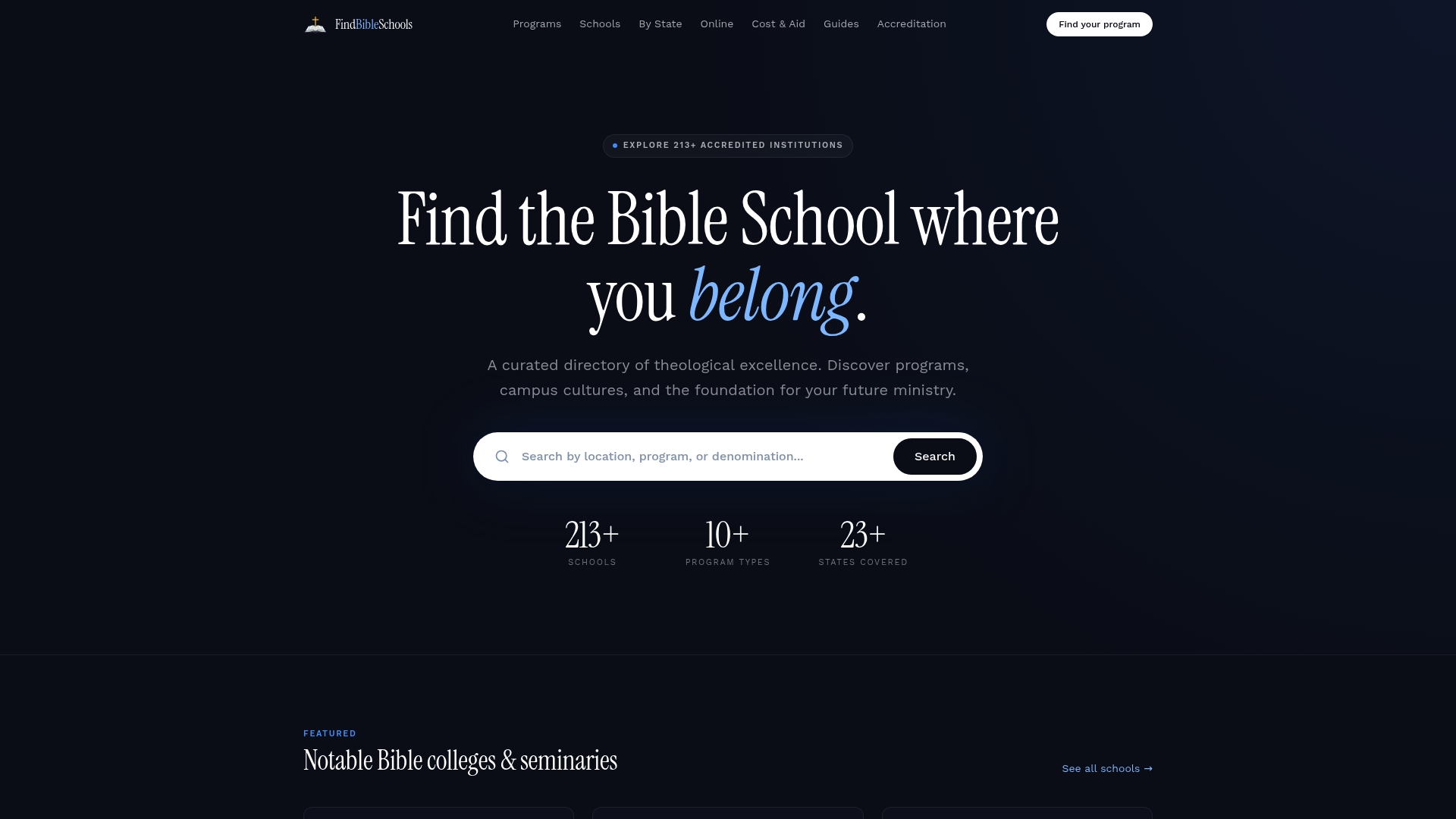
If cost is part of your decision, our guide to schools accepting FAFSA walks through eligibility before you apply. When you are ready to see accredited programs side by side, visit our seminary degree comparison page to start narrowing your options today.
FAQ
Can I do seminary school online?
Yes, many ATS-accredited seminaries offer full degree programs online, including the Master of Divinity, Master of Theological Studies, and Doctor of Ministry. Confirm the specific degree track is offered in distance format, since some specialized concentrations still require campus residency.
Does FAFSA pay for seminary?
FAFSA can cover seminary study when the program is accredited by an agency recognized for Title IV purposes and the school participates in federal aid programs, according to Federal Student Aid guidance. Religious institutions are eligible on the same terms as other accredited schools, so check each program’s financial aid page directly.
Can I get a free seminary degree online?
There is no standard path to a free seminary degree, but many students significantly reduce costs through denominational scholarships, employer tuition assistance from a sponsoring church, and federal or institutional grants layered on top of FAFSA eligibility. Comparing financial aid options across schools is the most reliable way to find the lowest net cost for your situation.
What is the cheapest online seminary school?
Cost varies widely by institution, degree level, and denominational affiliation, and the cheapest option depends heavily on your specific program and financial aid eligibility. Comparing net cost after aid, rather than sticker tuition, across multiple accredited online programs gives a more accurate picture than ranking schools by list price alone.
Sources
- Program Eligibility, Written Arrangements, and Distance Education | 2024-2025 Federal Student Aid Handbook
- IPEDS distance education enrollment tables
- Guidelines for Competency-Based Theological Education (CBTE) — ATS Commission