
Published September 1, 2026
4 Decisions to Pick Accredited Online Seminary Programs

You can earn an accredited seminary degree entirely or partially online, and the right one for you comes down to four decisions: accreditation, delivery mode, cost, and the strength of student support. Programs range from noncredit certificates to full Doctor of Ministry tracks, and Findbibleschools helps you compare accredited options side by side so you can match a program to your calling and your schedule.
TL;DR:
- Accreditation by ATS and regional bodies ensures your degree is recognized for ordination, transfer credits, and further education, so verify both before applying.
- Full-time online M.Div. programs typically take 72 to 90 credits over two to three years, with coursework usually requiring 8 to 12 hours weekly per course.
- Cost varies by school, with discounts for full-time enrollment and potential savings through scholarships, diocesan funds, employer sponsorship, or VA benefits.
- Delivery formats include asynchronous, synchronous, and hybrid models, each offering different levels of live interaction and on-campus intensives.
- Always confirm program details directly with admissions, especially residency requirements, practicum support, transfer policies, and accreditation standing.
Table of Contents
- What Types of Online Seminary Programs and Delivery Formats Exist
- How Accreditation and Academic Quality Actually Work
- Cost, Scholarships, and Lower-Cost Alternatives
- Typical Timeline and What a Normal Week Looks Like
- How to Choose the Right Online Seminary Program
- Why Accreditation Verification Is the Whole Game
- Find Programs That Match Your Calling and Your Schedule
- Sources
What Types of Online Seminary Programs and Delivery Formats Exist
Seminary education online isn’t a single product. It’s a spectrum of degrees, each built for a different vocational outcome, delivered through formats that vary widely in how much live interaction they require.
The Master of Divinity (M.Div.) remains the standard credential for ordination in most denominations and typically runs 72 to 90 credit hours. A Master of Arts (M.A.) or Master of Theological Studies (MTS) suits students headed toward teaching, writing, or counseling rather than pulpit ministry, and usually requires fewer credits. Certificate programs, meanwhile, offer a faster, lower-commitment entry point for lay leaders or those testing a call before committing to a full degree.
Delivery format matters just as much as degree type:
- Asynchronous courses let you complete coursework on your own schedule within a set weekly window, the most common model for working adults.
- Synchronous online classes meet at fixed times over video, preserving live discussion and cohort connection.
- Hybrid programs blend online coursework with short on-campus intensives, sometimes called gathering weeks.
Accredited seminaries design online courses to mirror their on-campus curriculum, with the same faculty teaching both formats. Language requirements and practicum hours are usually still required online, just scheduled through intensives or local placements arranged with your program advisor.
How Accreditation and Academic Quality Actually Work
Accreditation is the single filter that determines whether your degree will count for ordination, transfer credit, or further graduate study. Skip this step and you risk investing years into a credential that denominational ordination committees won’t recognize.
Two types matter for seminary study. ATS accreditation, granted by the Association of Theological Schools, is the specialized standard built specifically for graduate theological education. Regional accreditation (through bodies like the Higher Learning Commission) confirms the institution meets broader academic standards. Many strong seminaries, like United Theological Seminary, hold both, and that dual credential is a meaningful trust signal.
Here’s how to verify a program before applying:
- Check the school’s own accreditation page for specific accreditor names, not vague claims of “recognized accreditation.”
- Search the ATS member directory directly rather than trusting a school’s self-description.
- Confirm the regional accreditor’s site lists the institution in good standing, not on probation.
- Ask the registrar directly how credits transfer if you might switch schools later.
Beyond accreditation, look at faculty credentials, library and digital research access, practicum mentoring, and how responsive academic advising is for online students specifically. Findbibleschools’ guide to verifying accredited online Bible schools walks through this process school by school.
Pro Tip: Call the admissions office and ask them to name their institutional accreditor out loud. Hesitation or a vague answer is itself useful information.
Cost, Scholarships, and Lower-Cost Alternatives
Online seminary tuition typically runs on a per-credit model, though many schools offer discounted block rates for students enrolled full-time. Liberty University’s online M.Div., for example, combines per-credit pricing with block-rate discounts designed to reward full-time pace without requiring campus relocation.
Ways to lower your net cost include:
- Institutional scholarships tied to denomination, ministry role, or academic merit
- Denominational or diocesan education funds, often underused because students don’t ask
- Employer or sending-church tuition sponsorship
- VA education benefits for qualifying veterans and their dependents
Total cost isn’t just tuition. Factor in fees, books, and travel if your program requires periodic intensives on campus.
If you’re testing a calling before committing financially, free noncredit ministry training exists and can be genuinely useful for discernment. It’s worth being clear-eyed, though: noncredit training generally does not substitute for an accredited degree that most denominations require for ordination. Findbibleschools’ breakdown of online Bible college costs walks through the full math, tuition plus fees plus travel, so you can compare real totals rather than sticker prices.
Typical Timeline and What a Normal Week Looks Like
Many M.A. and MTS programs generally take around two years at full-time pace. M.Div. programs typically take longer, with duration varying depending on pace and transfer credits. Terms usually run 8 to 15 weeks, and most seminaries offer multiple start dates a year rather than a single fall intake, so you’re rarely stuck waiting months to begin.
Expect to budget:
- 8 to 12 hours weekly per course for reading, writing, and discussion posts
- Additional hours during intensive weeks if your program includes on-campus components
- Extra time in terms with language coursework or supervised practicum placements
Rolling admissions and flexible term structures mean your actual timeline often depends more on how many courses you carry per term than on any fixed institutional calendar.
How to Choose the Right Online Seminary Program
Once you’ve narrowed a few options, run each one through the same checklist rather than relying on impressions from a glossy homepage.
- Verify accreditation independently through the ATS directory or regional accreditor site, not just the school’s own claims.
- Match the degree to your actual goal. An M.Div. for ordination is a different commitment than an MTS for writing or teaching.
- Confirm the delivery mode and any residency requirements up front, including how many on-campus days per year, if any.
- Calculate total cost, including block-rate savings, fees, and travel for intensives.
- Ask about faculty accessibility and formation resources. Recorded lectures paired with live small-group discussion and mentoring tend to preserve community better than pure video-on-demand.
- Check transfer credit policies in writing if you’re bringing credits from another institution.
- Ask for current student or graduate references who can speak to practicum placement support specifically.
When you call admissions, ask directly: How many students are in a typical cohort? Who assigns and supervises practicum placements? What happens if I need to pause enrollment for a season?
Pro Tip: Ask to speak with a current student, not just an admissions counselor. Programs confident in their support systems will connect you without hesitation.
Red flags that should end your consideration immediately: vague or unverifiable accreditation claims, no clear practicum or fieldwork structure, and admissions staff who can’t explain how online students access advising or library resources.
Why Accreditation Verification Is the Whole Game
Most prospective seminary students obsess over tuition and timeline, and both matter. But the decision that actually protects your investment is the one people skip fastest: independently verifying accreditation before falling in love with a program’s marketing.
Here’s what gets overlooked. A school can accurately claim “accredited” while meaning something entirely different than what you assume. A regionally accredited but non-ATS seminary might satisfy a state licensing board while leaving you scrambling when a denominational ordination committee wants ATS-specific credentialing. That gap doesn’t show up in a glossy brochure. It shows up two years in, when you’re asking a credentialing body to recognize a degree they’ve never heard properly vetted.
Findbibleschools exists because this verification work is tedious and easy to get wrong on your own, curating accreditation, tuition, and program-format data across more than 213 accredited institutions so you’re comparing verified facts instead of marketing copy. Use the directory search to filter by online delivery and degree type, then go into admissions conversations already knowing which questions matter.
— Grant
Find Programs That Match Your Calling and Your Schedule
Findbibleschools works differently than searching seminary websites one by one and trying to compare tuition pages that all format things differently. Instead of hunting for accreditation disclosures buried in footer links, you filter directly by delivery mode, degree type, and denomination, and see tuition, accreditation status, and program structure laid out consistently across every listed school.
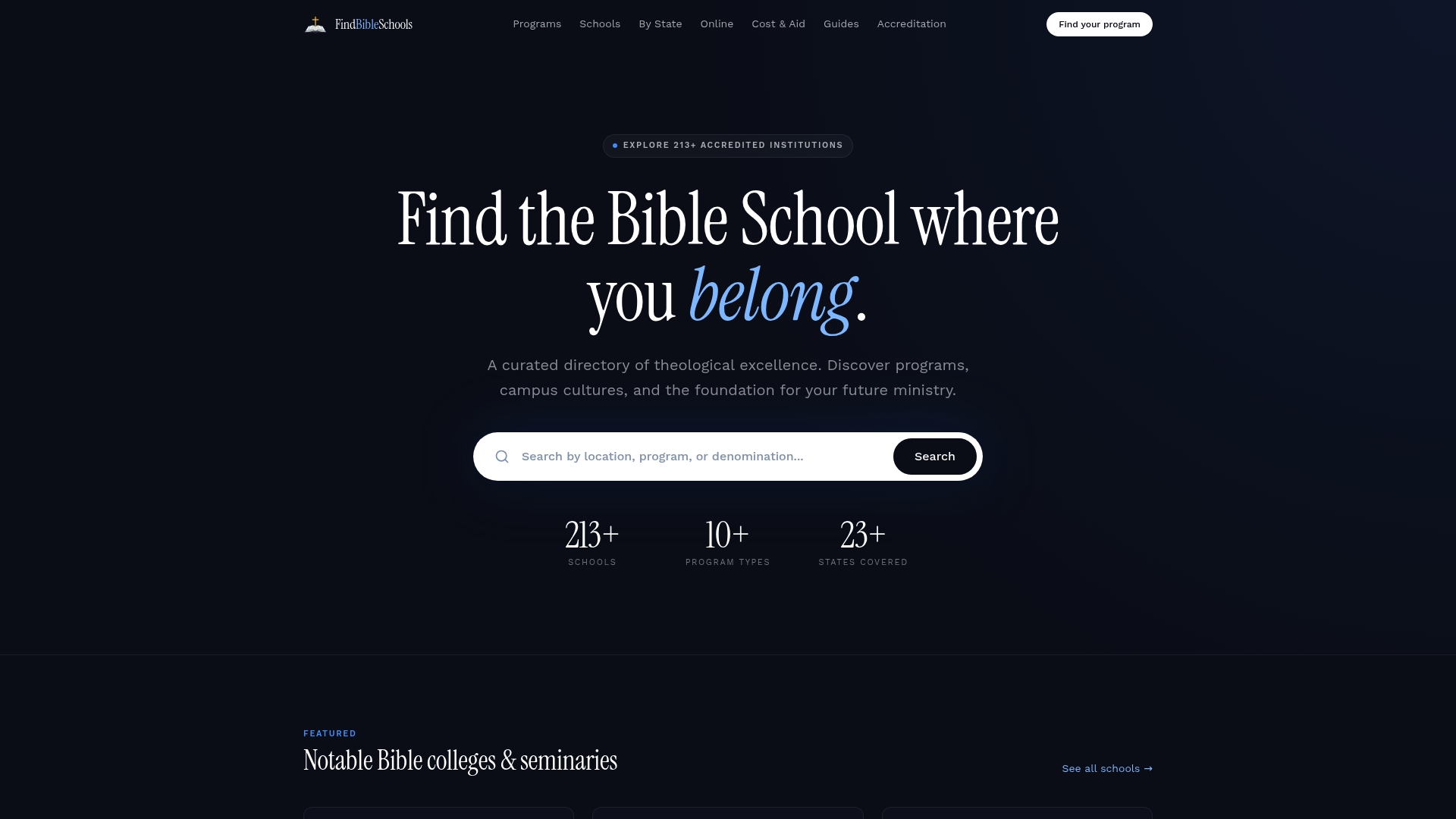
Start by browsing Theology Programs & Bible Degrees at every level to see how M.Div., M.A., and certificate tracks compare side by side. If you want to see how a specific well-known program presents its online offerings, Fuller Theological Seminary’s program page shows the level of detail, tuition, accreditation, delivery format, that Findbibleschools pulls together for every listed school. Once you’ve narrowed your list to two or three finalists, reach out to each admissions office directly to confirm current residency requirements and practicum placement details before you commit.
Sources
For accreditation verification, consult the ATS-accredited program details at United Theological Seminary and Talbot School of Theology’s online program structure. Browse Findbibleschools’ directory of accredited online programs for side-by-side comparisons.
- Online Seminary Programs: Talbot School of Theology - Biola University
- Online Seminary Degree Programs - United Theological Seminary
- General M.Div. Online | Master of Divinity | Liberty University
- Ashland University ATS library guide