
Published September 4, 2026
213+ Accredited U.S. Seminaries: An Accreditation First Shortlist
Accredited theological schools across the United States are cataloged through the Association of Theological Schools (ATS) and federal databases like NCES, but the fastest path to a trustworthy shortlist is verifying ATS membership and regional accreditation before you look at anything else. From there, curated directories, including Find Bible Schools, let you compare degree types, denominational fit, and cost. The rest of this guide covers program types, a representative school roster, and a practical selection framework.
TL;DR:
- Verifying ATS membership and regional accreditation is essential as it confirms theological standards and academic legitimacy, including degree transferability and federal aid eligibility.
- Seminary degrees vary, with an MDiv being standard for ordination and longer programs like PhDs suited for scholarly careers, while delivery formats range from residential to online, affecting community and mentorship.
- Smaller schools may offer closer faculty relationships, while larger institutions provide more specialization options; your choice depends on your academic and ministry goals.
- Accreditation clarity, transparency in tuition, faculty credentials, and field education opportunities are critical factors to evaluate before applying to ensure a good fit.
- Findbibleschools’s directory simplifies comparisons of tuition, accreditation, degree offerings, and location, helping applicants build a tailored shortlist based on program type, theology, and geography.
Table of Contents
- Seminary, Divinity School, or Bible College: What’s the Difference?
- Verifying Accreditation: ATS, NCES, and What the Numbers Mean
- Ten Notable U.S. Seminaries Worth Comparing
- How to Turn This List Into a Real Decision
- What Findbibleschools Adds to Your Search
- Life Beyond the Classroom
- Author Grant’s Short Take: What Applicants Should Prioritize
- Compare Programs and Request Information With Findbibleschools
- Sources
Seminary, Divinity School, or Bible College: What’s the Difference?
The terms get used interchangeably in casual conversation, but they point to different institutional models, and picking the wrong one can cost you a year of misdirected study. A seminary is a graduate-level institution focused on ministry preparation, typically granting a Master of Divinity (MDiv) as its flagship degree. A divinity school usually operates inside a larger university (think Duke Divinity School or Vanderbilt University Divinity School) and often blends ministry training with academic theology in a way that feels more university-integrated than a standalone seminary. A Bible college, by contrast, is generally undergraduate, awarding associate or bachelor’s degrees with a heavier emphasis on biblical literacy and lay ministry skills than on graduate-level scholarship.
Once you’re past the undergraduate stage, the degree landscape narrows to a handful of recognizable credentials, each built for a different vocational endpoint.
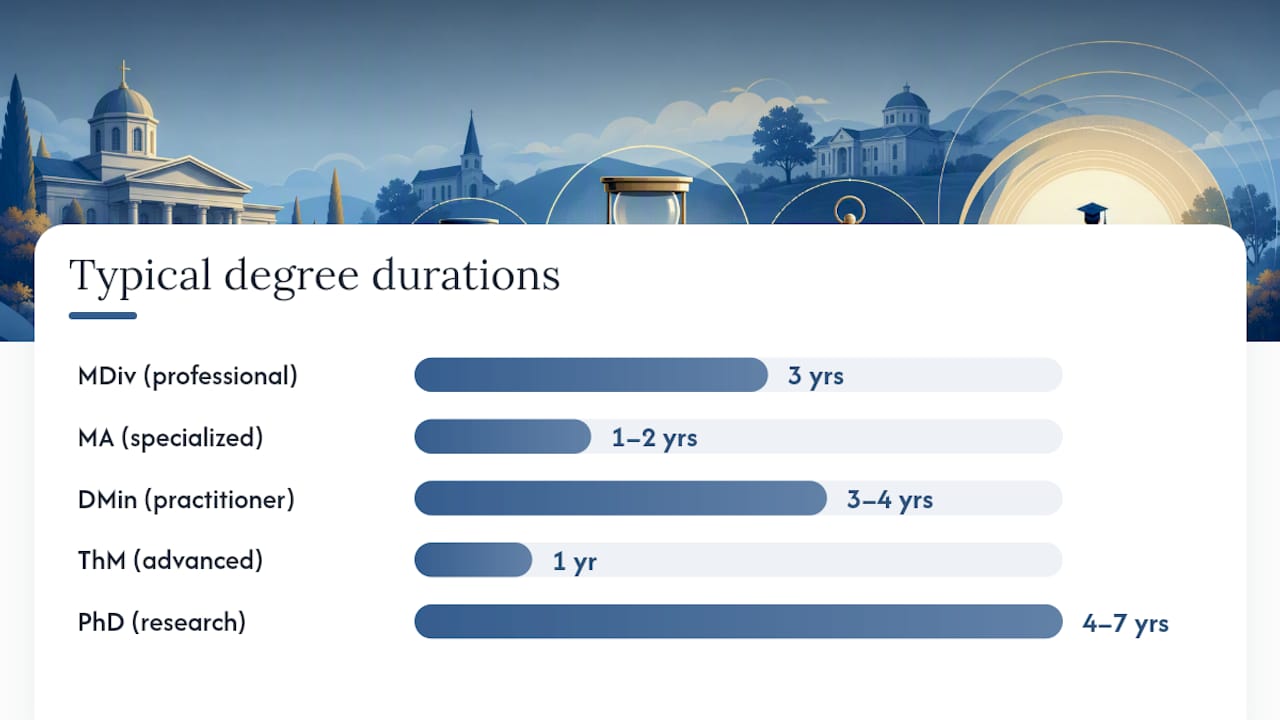
- Master of Divinity (MDiv): the standard three-year professional degree for pastoral ordination, chaplaincy, and most denominational credentialing tracks.
- Master of Arts (MA): a shorter (one to two year) degree, often specialized in counseling, biblical languages, or theological studies, for students who don’t need full ordination credentials.
- Doctor of Ministry (DMin): a practitioner-focused doctorate for working pastors, usually requiring an MDiv already in hand and completed part time over three to four years.
- Master of Theology (ThM): an advanced one-year research degree layered on top of an MDiv, often a bridge into a PhD.
- Doctor of Philosophy (PhD): the terminal academic research degree, aimed at seminary teaching or scholarly work, typically taking four to seven years.
Delivery format matters just as much as degree type, and it’s where a lot of applicants underestimate the tradeoffs. A fully residential program puts you on campus for spiritual formation, cohort relationships, and the kind of mentoring that happens in hallway conversations, not just classrooms. Extension centers, a model Dallas Theological Seminary has built out extensively, let you study at a satellite site closer to home while still connecting to the main institution’s faculty and resources. Fully online or hybrid programs, covered in detail in Findbibleschools’s guide to accredited online Bible colleges and seminaries, maximize flexibility for working students but can thin out the communal formation piece that many denominations expect before ordination.
Denominational orientation is the variable that trips up more applicants than any other. A seminary’s theological tradition, whether Reformed, Wesleyan, Baptist, or nondenominational evangelical, shapes its curriculum, its faculty hiring, and in many cases its accreditation with denominational ordination boards. Enrolling in a seminary outside your denomination’s approved list can mean extra coursework, a longer ordination path, or credits that simply don’t transfer where you need them to. Check with your denomination’s placement or credentialing office before you apply, not after.
Verifying Accreditation: ATS, NCES, and What the Numbers Mean
The single most important filter for any seminary search is accreditation, and there are two distinct layers to check. The Association of Theological Schools maintains a member school list that functions as the primary registry for verifying whether a theological institution meets recognized standards for faculty qualifications, library resources, and degree program design. Regional accreditation, granted by bodies overseen by the U.S. Department of Education, is a separate layer that confirms an institution’s general academic legitimacy, distinct from ATS’s theology-specific standards.
Both matter, but they answer different questions. ATS membership tells you the seminary meets theological education benchmarks recognized across denominations. Regional accreditation tells you the school’s credits will transfer to other academic institutions and that its degrees qualify for federal financial aid. A school lacking one or both isn’t automatically disqualified, but it should raise questions you take directly to admissions.
Pro Tip: Cross-check a seminary’s ATS status against its own website’s accreditation page. A mismatch, or a school that mentions accreditation only in vague marketing language without naming its accreditor, is worth a direct phone call before you apply.
Enrollment data adds useful context you won’t get from a school’s own marketing pages. The National Center for Education Statistics tracks institutional enrollment figures that reveal how seminary size varies enormously across the sector: some schools run small, ministry-focused cohorts of a few dozen students, while others operate multi-track professional and academic programs serving thousands. Neither scale is inherently better. A smaller school often means closer faculty relationships; a larger one usually means more specialization options and a bigger alumni network for placement.
Watch for these warning signs when you’re screening a school:
- No accreditation listed, or accreditation claimed without naming the accrediting body.
- Contact information that only routes through a general inquiry form, with no named faculty or staff you can verify independently.
- Tuition and fee structures that are vague, quoted only “per credit” with no total program estimate, or disclosed only after you submit personal contact information.
- Degree program pages that don’t specify accreditation status per program (some schools accredit certain degrees but not others).
Ten Notable U.S. Seminaries Worth Comparing
This roster isn’t a ranking. It’s a cross-section of well-established, ATS-recognized institutions spanning different traditions, sizes, and delivery models, meant to give you reference points as you build your own shortlist. Findbibleschools’s state-by-state directory covers well over 200 accredited theological institutions in total, so treat this list as a starting sample, not the full field.
- Fuller Theological Seminary. Based in Pasadena, California, Fuller is known for its interdisciplinary breadth, running schools of theology, psychology, and intercultural studies under one roof, with a student body drawn from dozens of denominations and countries. Its multi-campus and hybrid program structure makes it a useful reference point for applicants who want academic range without committing to a single narrow track.
- Dallas Theological Seminary. DTS built its reputation on dispensational, expository-preaching-focused theological education, and it has expanded access through a network of extension centers alongside its Dallas campus and a growing slate of online offerings. It’s a strong reference for applicants who want a well-defined theological identity paired with flexible geography.
- Asbury Theological Seminary. With campuses in Kentucky and Florida, Asbury sits in the Wesleyan-holiness tradition and has historically emphasized residential spiritual formation, even as it has added extension sites to reach students who can’t relocate. Its identity leans heavily on formation as inseparable from academics.
- The Southern Baptist Theological Seminary. As one of the largest Southern Baptist Convention seminaries, Southern offers a wide degree portfolio from undergraduate biblical studies through PhD-level work, anchored in a confessional Baptist identity that shapes both curriculum and faculty hiring.
- Vanderbilt University Divinity School. Housed inside Vanderbilt University in Nashville, this divinity school leans into interfaith and social-justice-oriented theological scholarship, drawing students who want graduate theological training integrated with a major research university’s broader academic resources.
- Gordon-Conwell Theological Seminary. With its main campus in Massachusetts and additional sites, Gordon-Conwell represents the multi-campus evangelical seminary model, offering regional accessibility without sacrificing a unified faculty and curriculum across locations.
- Westminster Theological Seminary. Located near Philadelphia, Westminster holds firmly to confessional Reformed theology, making it a reference point for applicants seeking rigorous systematic theology within a specific doctrinal tradition.
- Trinity Evangelical Divinity School. Part of Trinity International University in Illinois, TEDS blends broad evangelical scholarship with a substantial missions and intercultural studies emphasis, appealing to students eyeing cross-cultural or global ministry work.
- Covenant Theological Seminary. The denominational seminary of the Presbyterian Church in America, Covenant pairs Reformed theological training with a counseling program that has become one of its distinguishing features.
- Duke Divinity School. Part of Duke University in North Carolina, Duke Divinity publishes detailed faculty profiles and program specializations on its site, a useful model for the kind of transparency you should expect from any school’s admissions pages before you apply.
Notice how differently these ten schools handle scale, geography, and theological identity. That range is the point: your ideal fit depends far less on a school’s name recognition than on whether its tradition, format, and program lineup match what you’re actually trying to do next.
How to Turn This List Into a Real Decision
Once you’ve got a handful of schools that clear the accreditation bar, the harder work starts: figuring out which one actually fits your calling, your budget, and your life circumstances. Run every candidate through the same checklist.
- Degree goal: Does the school offer the specific credential your denomination or career path requires, not just a similar-sounding one?
- Theological fit: Does the seminary’s confessional stance align with where you actually stand, or where you’re willing to be challenged?
- Delivery format: Can you realistically sustain residential study, or does your job and family situation point you toward an extension site or online track?
- Faculty expertise: Do the professors in your intended specialization publish, teach, and mentor in that specific area, not just teach it as a side course?
- Field education and placement: Does the school have an established internship or field placement pipeline into the kind of ministry setting you want to enter?
Bring a short list of direct questions to admissions calls rather than relying on brochure language. Ask about class format (are core courses cohort-based or rolling enrollment?), how spiritual formation is structured for online or extension students, what internship placements looked like for the last graduating class, and exactly how transfer credit is evaluated if you’re coming from a Bible college or another seminary.
Cost is where a lot of promising shortlists fall apart, so get real numbers early. Seminary tuition varies widely, from moderate annual amounts at smaller denominational schools to higher rates at larger private institutions, before financial aid. Denominational subsidies can cut that substantially if you’re pursuing ordination within a sponsoring denomination, and many seminaries offer merit or need-based scholarships stacked on top of federal aid for regionally accredited programs. Build your timeline backward from your target enrollment term: most seminaries want applications finalized three to six months ahead, and that window has to include time to request transcripts, sit for any required language or aptitude exams, and secure pastoral or denominational recommendation letters.
Pro Tip: A seminary that posts sample syllabi, full faculty CVs, and a real degree-completion schedule on its public site is telling you something about its institutional transparency. If you can’t find that information without submitting a lead form, ask for it directly before you invest in an application fee.
What Findbibleschools Adds to Your Search
Findbibleschools exists because comparing dozens of seminary websites, each formatted differently and each emphasizing its own strengths, is genuinely inefficient when you’re trying to make an apples-to-apples decision. The platform’s directory currently lists more than 213 accredited theological institutions across the United States, with standardized data fields covering degree programs, tuition ranges, accreditation status, and notes on campus culture that don’t usually show up in a school’s own marketing copy.
The verification process behind that directory follows the same principle this guide has stressed throughout: accreditation status gets checked against ATS and regional accreditor records before a listing goes live, rather than relying on a school’s self-reported claims. Findbibleschools’s methodology page explains how listings are compiled and updated.
In practice, that means you can:
- Filter by degree type (MDiv, MA, DMin, and others) to skip schools that don’t offer what you need.
- Narrow by denomination to surface schools aligned with your ordination path.
- Compare tuition ranges side by side before you invest time in individual admissions conversations.
- Browse by state when geography, whether for residency, extension access, or family reasons, is a deciding factor.
Life Beyond the Classroom
Academic rigor gets most of the attention in seminary research, but the community you join matters just as much for whether you finish strong. Cohort-based programs, common at schools like Asbury and Covenant, build tight relational bonds through shared coursework schedules, chapel services, and field education placements that put small groups of students into the same ministry settings together. Larger seminaries with rolling enrollment, by contrast, often build community through specialized student organizations, mentoring cohorts within specific degree tracks, or affinity groups for students in similar life stages, married students, second-career pastors, or international students navigating a new academic culture.
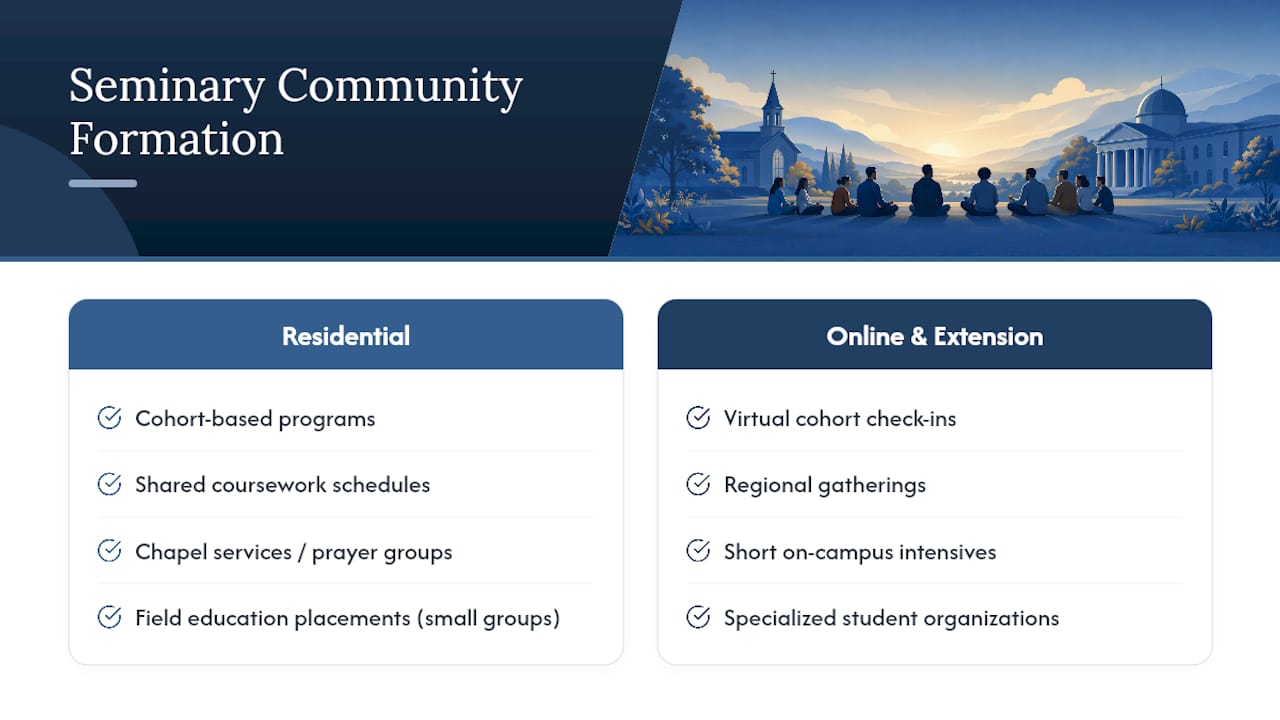
Campus chapel, prayer groups, and informal mentoring from faculty remain central to residential formation at most seminaries, regardless of denomination. Online and extension students shouldn’t assume they’re missing out entirely. Many schools now build virtual cohort check-ins, regional gatherings, and intensives, short on-campus residencies stacked into an otherwise remote program, specifically to preserve some of that relational formation for students who can’t relocate.
Author Grant’s Short Take: What Applicants Should Prioritize
Hybrid delivery has stopped being a compromise option and started becoming the default expectation for a lot of applicants, especially those balancing a current ministry job with graduate study. What’s shifted alongside that is a real uptick in counseling and mental-health-informed tracks within MDiv and MA programs, and a handful of shorter, vocationally focused MDiv variants aimed at students who don’t need (or want) the full academic-track version of the degree.
My honest read: don’t sacrifice formation depth purely for speed or convenience. A compressed program that skips field education or cohort relationships can leave you credentialed but underprepared for the actual pastoral work ahead. Weigh flexibility against what you’ll lose in mentoring and communal formation, not just against tuition and time.
— Grant
Compare Programs and Request Information With Findbibleschools
Findbibleschools provides a platform to compare standardized tuition, accreditation, and program data side by side, avoiding the need to visit individual seminary websites repeatedly.
If you already know the degree you want, start with the theology programs and Bible degrees landing page, which organizes options by level from associate through doctoral. If geography is your deciding factor, browsing a state page, like Bible colleges in Kentucky, shows which accredited options exist near you. Once you’ve narrowed to a few schools, request information directly through their listing pages to get tuition and admissions details.
Sources
- Member School List
- National Center for Education Statistics (NCES)
- Fuller Seminary
- Dallas Theological Seminary | Teach Truth. Love Well.