
Published August 28, 2026
Avoid Transfer Delays: Choose the Right U.S. Youth Ministry Degree

A youth ministry degree trains students in biblical studies, adolescent development, and ministry leadership so graduates can serve as youth pastors, student ministry directors, or campus ministry staff. Find Bible Schools catalogs accredited programs verified through agencies like ATS and ABHE, giving prospective students a reliable way to compare options before committing years and tuition dollars to a single school.
TL;DR:
- Most youth ministry jobs require internships with in-person supervision, making residency requirements a crucial factor when choosing a program.
- Accreditation by regional agencies and theological accrediting bodies ensures credit transferability, federal aid eligibility, and program credibility.
- Entry-level associate degrees allow quicker access to volunteer or part-time roles, while bachelor’s and graduate programs prepare students for full-time pastoral careers and ordination.
- Employers prioritize practical experience such as discipleship leadership, crisis care, and program planning over coursework transcripts alone.
- Internships and ongoing credentialing often require extra steps after graduation, including certification, continuing education, and denomination-specific licensing.
Table of Contents
- Choosing the Right Youth Ministry Degree Format
- The Coursework and Internships That Build Real Ministry Skills
- How to Choose a Program: Accreditation, Fit, and Cost
- What Employers Actually Look for in Youth Ministry Graduates
- Applying, Transferring Credits, and Locking Down Internships
- Real Program Snapshots From U.S. Catalogs
- Staying Credentialed After Graduation
- What Actually Matters Once You’re in the Program
- Compare Youth Ministry Programs Before You Commit
- Sources
Choosing the Right Youth Ministry Degree Format
Not every student needs the same credential. An associate degree typically requires about two years of study, allowing quicker entry into part-time or volunteer youth roles, while a bachelor’s degree remains the standard for full-time student ministry positions at most churches. A Master of Divinity (MDiv) or Bachelor of Divinity (BDiv) programs provide advanced pastoral counseling, theology, and often prepare for ordination, valuable for those pursuing senior pastoral roles rather than staying in youth work long term.
Program length and format vary considerably among institutions:
- Associate of Arts (AA): Roughly 60 credit hours, two years, good for a quick entry point or a transfer stepping stone.
- Bachelor of Arts or Science (BA/BS): The most common path, typically 120 to 130 credit hours over four years, combining general education with a youth ministry major.
- BDiv/MDiv: Graduate level, often three to four years, built for those who want ordination or senior pastoral credentials alongside youth ministry training.
- Certificates: Short, non-degree options for volunteers or staff who already hold a degree in another field.
Delivery formats include fully on-campus, hybrid (classroom plus online coursework), and fully online options. A youth ministry degree online works well for students already serving part-time at a church, though internship residency rules (covered below) often limit how much of the degree you can finish remotely.
The Coursework and Internships That Build Real Ministry Skills
Every accredited youth ministry program builds around four pillars: biblical and theological foundations, adolescent development, counseling basics, and ministry leadership. Columbia International University’s Bachelor of Science in Youth Ministry, Family, & Culture pairs biblical training with family systems coursework, reflecting a broader shift some call the “NextGen” approach, where programs train students to partner with parents rather than run adolescent programming in isolation, a model Summit Church describes as treating youth ministry as a church-family partnership rather than a separate track.
Typical required courses include:
- Old and New Testament survey
- Youth culture and adolescent psychology
- Counseling children, youth, and families
- Ministry program planning and administration
- Supervised practicum or internship credits
Pro Tip: Ask every program upfront how many internship credits require in-person supervision. Some schools mandate students complete practicums on campus under a specific mentor, which can conflict with a job or ministry commitment elsewhere.
North Greenville University’s Bachelor of Arts requires 128 total credit hours, including two dedicated internship courses, CHST-3210 and CHST-4210, both of which must be completed at NGU itself rather than transferred from another institution. That residency requirement is common enough that it deserves attention before you enroll anywhere, not after.
How to Choose a Program: Accreditation, Fit, and Cost
Accreditation determines whether your credits transfer, whether you qualify for federal financial aid, and whether ministries take your degree seriously. Regional accreditation covers the institution broadly; the Association of Theological Schools (ATS) and the Association for Biblical Higher Education (ABHE) accredit theological content specifically. A program lacking either raises real questions about how far your degree will travel.
Denominational fit matters just as much as accreditation. Two schools can teach youth ministry with very different theological assumptions about baptism, spiritual gifts, or church polity, and those differences shape what a hiring church expects from you. Ask directly whether faculty hold to a specific statement of faith and whether the program serves students outside that tradition comfortably.

Costs vary by institution, so comparing tuition per credit can help make informed decisions, and ask about denominational scholarships, which many church-affiliated schools offer to members of their sponsoring tradition. Federal aid eligibility depends on accreditation status, so confirm that before assuming you’ll qualify.
Before enrolling, get these answers in writing:
- Which accrediting bodies cover this specific program, not just the university overall?
- Must internship or practicum credits be completed on this campus, and can any transfer in from prior ministry experience?
- What is the minimum GPA required in major coursework to graduate? (North Greenville, for example, sets a 2.25 GPA minimum in major hours.)
- Does the program have placement relationships with local churches for internships?
- What percentage of graduates are working in ministry roles within a year of graduation?
What Employers Actually Look for in Youth Ministry Graduates
Job titles in this field range wider than most students expect going in: youth pastor, student pastor, campus ministry director, camp or retreat program leader, and parachurch roles with organizations focused on adolescent outreach. Each context weighs skills a little differently, but a few shows up on nearly every job description.
Search committees consistently prioritize:
- Discipleship and small-group leadership experience
- Basic pastoral care and crisis response skills
- Event and program planning, especially retreats and camps
- Volunteer team recruitment and management
- Working biblical literacy, not just academic theology
Internships carry more weight than transcripts in most hiring conversations, since they demonstrate you can actually run a program, not just describe one. Denominational endorsement, where your tradition formally certifies you for ministry, also opens doors that a degree alone doesn’t, and continuing education after graduation signals to hiring churches that you’re staying current rather than coasting on a four-year-old diploma.
Applying, Transferring Credits, and Locking Down Internships
Admissions requirements for most youth ministry programs look similar to any Christian college application: transcripts, two or three recommendation letters (often including one from a pastor), a personal statement or testimony essay, and sometimes an interview or a signed statement of faith.
A realistic 12 to 18 month timeline looks like this:
- Months 1 to 3: Research programs, request catalogs, and confirm accreditation status directly with ATS or ABHE.
- Months 3 to 6: Visit campuses or attend virtual info sessions, and ask about internship residency rules early.
- Months 6 to 9: Submit applications, recommendation letters, and financial aid forms (FAFSA opens each October).
- Months 9 to 12: Compare financial aid offers and confirm which internship credits, if any, transfer from prior ministry work.
- Months 12 to 18: Enroll, and start coordinating your practicum placement with the program’s ministry placement office before your first internship course begins.
Get transfer-credit policies confirmed in writing rather than relying on a verbal estimate from an admissions counselor, since internship residency rules in particular tend to surprise transfer students late in their program.
Real Program Snapshots From U.S. Catalogs
Catalog details reveal more about a program’s actual demands than any marketing brochure. North Greenville University’s BA in Youth Ministry requires 128 credit hours total, with both youth ministry internship courses completed on campus, no exceptions for transfer students.
Columbia International University’s BS in Youth Ministry, Family & Culture builds its identity around family systems, pairing biblical coursework with classes like counseling children, youth, and families, reflecting a deliberate move away from adolescent-only programming.
Anderson University’s BA in Christian Studies: Youth Ministry leans into administration and global ministry training through its Global Center for Youth Ministry, useful if you want exposure beyond a single local church context. Meanwhile, SEBTS offers a combined BA and MDiv track in student ministry, letting motivated students move straight into graduate-level pastoral training without a gap between degrees, a structure Judson College mirrors in its own combined program.
Staying Credentialed After Graduation
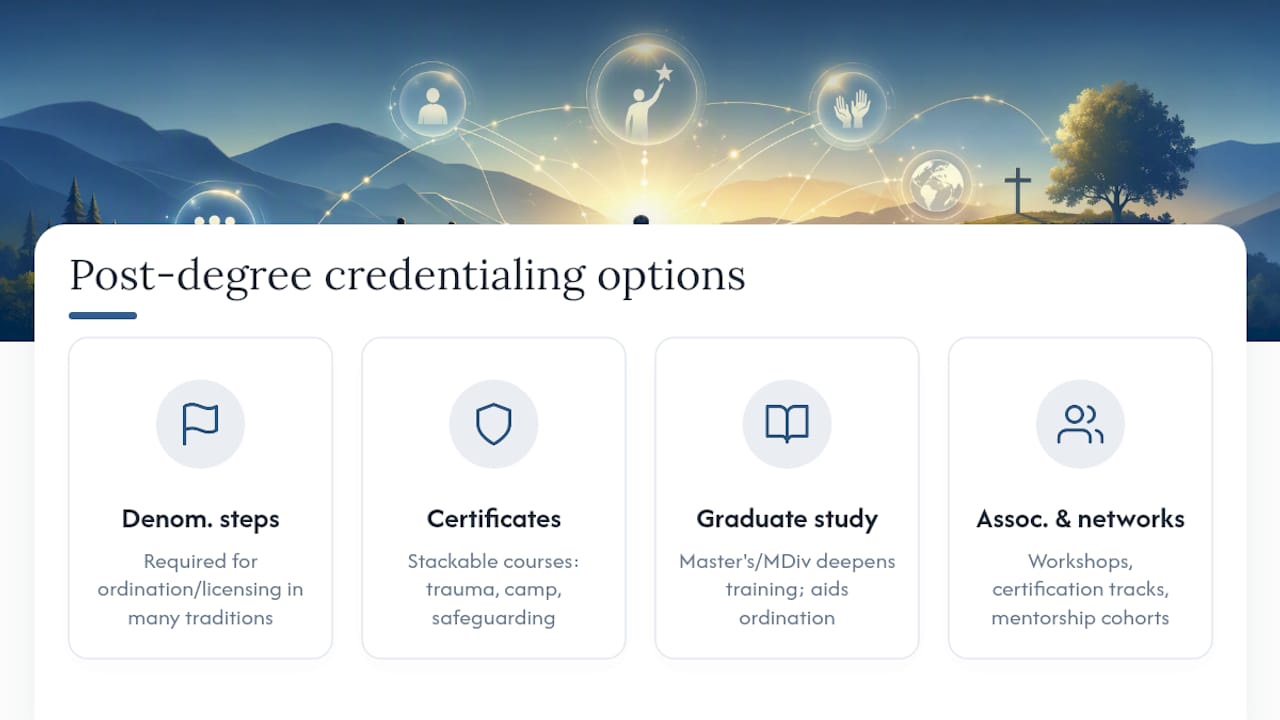
A youth ministry degree is the foundation, not the finish line. Most denominations require ongoing credentialing steps beyond a bachelor’s or master’s degree, particularly if you’re pursuing ordination or a formal ministerial license. These vary by tradition, so confirm your denomination’s specific process well before you need it for a job application.
Certificate programs in areas like trauma-informed youth counseling, camp administration, or safeguarding and child protection have become increasingly common continuing education options, and several accredited seminaries offer them as short, stackable courses alongside their degree programs. A youth pastor five years into ministry with a trauma-informed care certificate stands out from one without it, especially as churches face more scrutiny over safeguarding practices.
Graduate study remains the other major path forward. A master’s in youth ministry or a related MDiv concentration deepens theological training and often qualifies graduates for ordination tracks that a bachelor’s alone does not. Some schools structure this as a direct pipeline, letting undergraduate youth ministry majors roll straight into graduate coursework with minimal redundancy.
Professional associations and regional ministry networks also offer certification tracks, workshops, and mentorship cohorts that carry real weight in hiring conversations, particularly for candidates without extensive full-time ministry experience yet. None of these substitute for the degree itself, but stacked on top of one, they signal a candidate who treats ministry as a craft worth continuing to sharpen.
What Actually Matters Once You’re in the Program
Pick your internship supervisor as carefully as you picked your school. A distracted or overextended mentor will leave you running logistics instead of learning pastoral care, discipleship conversations, or how to handle a crisis with a student’s family. Ask around before you commit to a placement.
Build transferable skills deliberately while you’re still a student: volunteer to lead a small group, plan an event start to finish, or sit in on pastoral counseling sessions if your supervisor allows it. Classroom theology matters, but hiring committees remember what you’ve actually run.
Confirm nontransferable internship requirements before you enroll anywhere, not after your second semester. That single detail has derailed more transfer students’ timelines than any other part of the degree.
— Grant
Compare Youth Ministry Programs Before You Commit
Findbibleschools gives you what a stack of college brochures never can: side-by-side comparisons of accreditation status, tuition, and program focus across theological schools nationwide, without the sales pressure of a single admissions office pushing its own catalog.

You can filter by state to see what’s available close to home, whether that’s Bible colleges in Tennessee, Oregon, or Ohio, or browse by degree level on the theology programs and Bible degrees page to see how associate, bachelor’s, and graduate options stack up. Each school profile, including schools like Moody Bible Institute, lists accreditation status and cost details up front, so you can check internship residency requirements and curriculum focus before you ever fill out an application. If you’re also building ministry skills now, worship planning tools like Song7 can help you practice program leadership while you study. Start browsing programs on Findbibleschools today and narrow your list to schools that actually fit your calling and budget.
Sources
- Bachelor of Science in Youth Ministry, Family, & Culture - Columbia International University
- Bachelor of Arts (BA), Christian Studies: Youth Ministry - Anderson University
- Student Ministry (BA & MDiv) - Southeastern Baptist Theological Seminary (catalog preview)