
Published September 5, 2026
7 Affordable U.S. Small Christian Colleges That Prioritize Faith Fit

Small Christian colleges give students something large universities rarely can: close faculty relationships, chapel-centered community, and, in many cases, tuition that lands well below sticker-price fears once scholarships are applied. This guide profiles seven notable options, walks through the criteria that actually matter when comparing them, and shows how to verify cost and accreditation before committing.
TL;DR:
- Most small Christian colleges offer small enrollments under 1,000 students, providing faculty access and a tight community environment.
- Net price after aid, rather than sticker price, is the key factor in affordability, with some online programs costing as low as around $8,250 annually.
- Faith requirements vary widely, from mandatory chapel and conduct codes to optional programs, so visiting campus and asking current students about culture is crucial.
- Regional accreditation is essential for credit transfer, graduate prospects, and financial aid; verify it directly through official accreditor sites.
- Student life outside campus ministry centers on athletics, clubs, and social gatherings, with housing often on campus and designed for small group interaction.
Table of Contents
- What Are the Best Small Christian Colleges to Consider?
- How Do You Choose the Right Small Christian College?
- What Does a Small Christian College Actually Cost?
- What Should You Expect From Campus Spiritual Life?
- How Do You Verify Accreditation and Academic Quality?
- How We Selected These Schools
- What Is Student Life Like Beyond Chapel and Ministry?
- Why Faith-Fit Matters More Than People Admit
- Find Your Match on Find Bible Schools
- Sources
What Are the Best Small Christian Colleges to Consider?
Small Christian colleges vary widely in denominational tone, cost, and academic focus, but the strongest options share three traits: enrollment small enough for real faculty access, a clearly stated faith identity, and verifiable outcomes data. The seven schools below represent a cross section of that landscape, from vocational-focused campuses to merit-generous liberal arts colleges to large online-capable universities that still maintain small-campus programming.
Westmont College, in Santa Barbara, California, is one of the more merit-generous options on this list. The college funds more than $46.3 million in grants and scholarships annually, and 99% of first-year and transfer students receive some form of scholarship support. Enrollment sits in the small liberal arts range, chapel programming is woven into campus life without being punitive, and admissions is moderately selective.
Pensacola Christian College, in Florida, leans vocational and conservative, with strict community standards and a strong internal culture of accountability. Institutional reporting shows 79.3% of alumni graduate debt-free and 93.7% are employed or in graduate school within a year of finishing, figures worth confirming independently but notable as a stated outcome.
Principia College, in Illinois, is about as small as small colleges get. It reports roughly 330 undergraduates and a 6:1 student-faculty ratio, meaning mentorship isn’t a marketing line, it’s the daily reality of a five-person seminar.
LeTourneau University, in Texas, blends a Christian mission with polytechnic, career-focused programs in engineering, aviation, and business, making it a strong fit for students who want faith integration without sacrificing technical rigor.
King University, a Presbyterian-affiliated school in Tennessee, keeps enrollment modest and offers transfer-friendly pathways for students arriving from community college.
Columbia College (SC) splits its offerings between a traditional residential campus and a robust online catalog, useful for students juggling work or family responsibilities.
Liberty University, in Virginia, is the outlier in scale, but its online infrastructure is large enough that many students experience a small-cohort feel within specific majors, even inside a very large overall student body.
| College | Typical enrollment | Tuition bracket | Student-faculty ratio | Faith-life expectations | Selectivity notes | Online availability |
|---|---|---|---|---|---|---|
| Westmont College | Small (under 1,000) | Mid-to-high, heavily discounted by aid | Moderate | Chapel encouraged, not punitive | Moderately selective | Limited |
| Pensacola Christian College | Small-mid | Low-mid, debt-free outcomes emphasized | Moderate | Required chapel, strict conduct code | Moderate | Some programs |
| Principia College | Very small (about 330) | Mid-high | Very low (6:1) | Christian Science affiliation, distinct | Selective | Minimal |
| LeTourneau University | Small-mid | Mid | Moderate | Evangelical, chapel expected | Moderate | Yes, hybrid options |
| King University | Small | Mid-low | Low-moderate | Presbyterian, moderate expectations | Less selective, transfer-friendly | Yes |
| Columbia College (SC) | Small-mid | Mid | Moderate | United Methodist heritage, flexible | Less selective | Extensive |
| Liberty University | Very large overall, small within programs | Low-mid for online | Varies widely | Evangelical, chapel for residential students | Open enrollment for many programs | Extensive |
How Do You Choose the Right Small Christian College?
Picking among small Christian colleges comes down to matching your priorities against a short, honest checklist rather than chasing a brand name.
- Set your size threshold first. Decide whether “small” means under 1,000 students (Principia-scale intimacy) or under 3,000 (still small, but with more program breadth).
- Clarify denominational fit. Some schools are tightly aligned with one tradition; others are broadly interdenominational. Neither is better, but mismatches cause friction later.
- Ask how chapel attendance affects your standing. Is it required for graduation, tied to a grade, or simply encouraged?
- Confirm your intended major is genuinely strong there, not just offered. Ask about internship placement and faculty-to-major ratios.
- Request a net price estimate, not the sticker price, before comparing schools financially.
- Ask career services what percentage of graduates in your major find related work within six months.
- Ask campus ministry directly how faith is practiced day-to-day, beyond the admissions brochure description.
Watch for red flags: vague answers about accreditation status, reluctance to share graduation or employment data, or pressure to commit before you’ve seen a net price letter.
Pro Tip: Prioritize faith-fit over program prestige if you’re choosing between two otherwise similar schools. Students who feel spiritually at home tend to stay enrolled and graduate on time, which matters more to your long-term cost than a slightly stronger program ranking.
What Does a Small Christian College Actually Cost?
Sticker prices at small Christian colleges range widely, but the number that matters is net price, what you pay after institutional and federal aid, not the published rate. Some online Christian programs post remarkably low figures: Central Methodist University lists tuition around $8,250 and Central Christian College of Kansas around $8,640, both well below the $15,180 upper end seen among comparable online Christian programs. A useful quirk: many online programs charge the same rate for in-state and out-of-state students, which removes a major cost variable entirely.
| Tuition tier | Approximate annual range | Example type |
|---|---|---|
| Low | $8,250 | Online Christian programs |
| Mid | up to $15,180 | Hybrid or regional online programs |
| Higher | $30,000 (before aid) | Residential liberal arts campuses |
To close the gap between sticker and net price:
- Use each school’s Net Price Calculator, required by federal law, and cross-check against NCES data.
- Apply early for merit scholarships; many are first-come or tied to admission deadlines.
- Ask about transfer and dual-credit policies that shorten time to degree.
- Inquire about work-study allocations before your first semester, not after.
What Should You Expect From Campus Spiritual Life?
Spiritual life expectations at small Christian colleges run on a real spectrum. On one end, schools require chapel attendance, adherence to a written conduct code, and sometimes a signed faith statement as a condition of enrollment. On the other, spiritual programming is offered but optional, with faith formation happening more through voluntary Bible studies, mentorship, and service trips than through policy. Neither approach is inherently more faithful, but the mismatch between a strict-code campus and a student expecting flexibility causes real friction. Common small-campus features include weekly or biweekly chapel, peer mentorship groups, and short-term mission or service trips built into the academic calendar.
- Read the student handbook before you visit, not after you’re accepted.
- Sit in on an actual chapel service, not just the admissions tour version.
- Ask current students directly whether faith requirements feel supportive or punitive.
Pro Tip: During a campus visit, ask a student panel one specific question: “What happens if you skip chapel or a faith commitment?” The answer tells you more about the real culture than anything in the brochure.
How Do You Verify Accreditation and Academic Quality?
Regional accreditation, from bodies like SACSCOC, HLC, or MSCHE, is the baseline check before you apply anywhere. It affects credit transferability, graduate school eligibility, and federal financial aid access, so confirm it directly on the accreditor’s site rather than trusting a college’s own claim alone.
- Cross-check enrollment, graduation rate, and cost data through NCES College Navigator or the Department of Education’s College Scorecard.
- Compare median earnings by major, not just campus-wide averages, since outcomes vary sharply by program.
- Weigh program-specific strength, internship access, faculty in your field, over general institutional reputation. A less famous school with strong internship pipelines in your major often outperforms a bigger name with a weaker department.
How We Selected These Schools
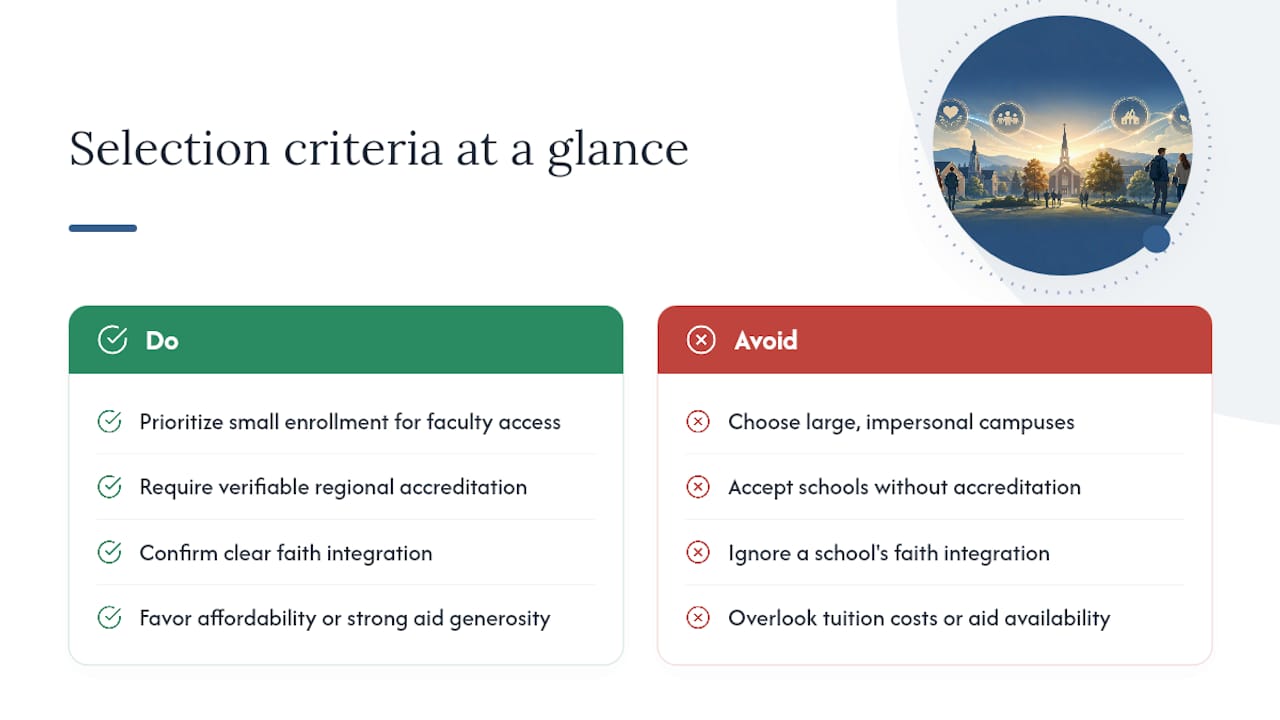
Selection prioritized enrollment small enough for genuine faculty access, verifiable regional accreditation, clear faith integration, and reasonable affordability or strong aid generosity. Sources included institutional pages, NCES and Department of Education data, the OnlineU affordability list, and Find Bible Schools’ own state-by-state listings. Figures reflect data current as of 2026 and should be reconfirmed directly with each institution before enrollment.
What Is Student Life Like Beyond Chapel and Ministry?
Small Christian college life extends well past worship services and Bible studies, even if faith remains the organizing thread. Athletics tend to run at the NAIA or NCAA Division III level, meaning walk-on opportunities are realistic even for students who weren’t recruited heavily in high school. Clubs skew toward outdoor recreation, music ensembles, and pre-professional groups (pre-med, business, education) rather than the sprawling club catalogs found at large state universities, simply because there are fewer students to fill them.

Housing is typically simpler too: most small Christian colleges house the majority of undergraduates on campus for at least the first two years, often with single-sex dorms or specific visitation policies tied to the school’s conduct code. That’s worth confirming directly, since it affects daily life more than almost any other campus policy.
Social life tends to center on small, repeatable gatherings, dorm events, intramural leagues, seasonal traditions, rather than large anonymous parties. For some students that’s exactly the draw; for others coming from a big public high school, it takes a semester to adjust to how quickly everyone knows your name. Ask current students directly how they spend a typical Friday night. The answer will tell you more about daily texture than any admissions brochure.
Why Faith-Fit Matters More Than People Admit
The conventional advice tells students to rank colleges by academic prestige first and worry about “vibe” later. That advice undersells how much a mismatched faith environment actually costs a family, not in dollars, but in transfer semesters, lost credits, and a student who disengages by sophomore year. Small colleges live or die on community fit precisely because there’s nowhere to hide if the culture doesn’t suit you. A large university lets you find your niche in a crowd of 20,000. A campus of 800 doesn’t offer that luxury, so getting the faith-life question right up front matters more here than it does almost anywhere else in higher education. Use the directory to compare options by state before you fall for a glossy campus photo.
— Grant
Find Your Match on Find Bible Schools
Our platform provides a comprehensive comparison tool to explore accredited institutions with state-by-state listings, accreditation checks, and program-level details, enabling you to compare small Christian colleges side by side without visiting multiple college websites.
If Tennessee or Kentucky are on your radar, start with the Bible colleges in Tennessee listing or the Kentucky school directory to see accredited options by state. For a broader search, browse the full school directory and narrow by program type, cost, and denominational fit before you request information from any single campus.