
Published August 21, 2026
Where to Find Accredited Seminaries Near You

The fastest way to find seminaries near you is to search a curated national directory like Find Bible Schools, then cross-check any promising result against the Association of Theological Schools (ATS) member list to confirm accreditation. Between those two resources, you can go from “I don’t know where to start” to a shortlist of accredited options in under fifteen minutes.
Two moves get you there fastest:
- Filter a directory by state or zip code. Find Bible Schools lets you narrow by degree level, denomination, and delivery format so you’re not scrolling through hundreds of unrelated listings.
- Run a targeted search or map query. Try “ATS-accredited seminary near [your city]” in Google, or drop the same phrase into Google Maps to see physical campuses within driving distance.
Whichever route you take, verify two things before you get attached to a school: its accreditation status and whether it actually offers the delivery format (on-campus, hybrid, or fully online) that fits your life right now. Everything else, including cost and program specifics, comes after those two boxes are checked.
Key Takeaways
Accredited seminaries near you are easiest to find through a curated national directory cross-checked against the ATS member list, prioritizing accreditation and delivery format before cost.
| Point | Details |
|---|---|
| Start with directory filters | Narrow by state, degree, and delivery format before comparing individual schools. |
| Verify accreditation independently | Cross-check every school against the ATS member list, since accreditation status can change. |
| Focus on net price, not sticker tuition | Request a financial-aid award letter to see what you’ll actually pay after aid. |
| Match program level to your goal | Choose M.Div., M.A., or doctoral tracks based on vocational outcome, not ambition alone. |
| Use Find Bible Schools as your starting point | Its directory of 213+ accredited institutions lets you filter by state, degree, and format in one place. |
Table of Contents
- What a U.S. Seminary Directory Actually Shows You
- How Do You Search for Seminaries Near You?
- Which Filters Actually Matter When Comparing Schools?
- What Does Seminary Actually Cost, and How Long Does It Take?
- How Do You Know If a Seminary Is Really the Right Fit?
- Why This Directory Is a Reliable Starting Point
- Editorial Perspective: What Actually Speeds Up This Search
- Find Your Next Step With Findbibleschools
- Frequently Asked Questions
- Sources
What a U.S. Seminary Directory Actually Shows You
A well-built seminary directory isn’t just a list of names. It’s organized around the filters that actually matter when you’re comparing theological schools nearby: state, city, degree level, denominational affiliation, accreditation type, and delivery format. Each of those fields answers a different question, and knowing what each one tells you saves you from wasting time on schools that were never going to fit.
State and city filters are the obvious starting point, but they’re also where most people stop too early. If you live in a smaller state, you might see only one or two accredited seminaries pop up. That doesn’t mean your options are limited. Many bible seminaries near you may actually be online or hybrid programs headquartered elsewhere, which is why delivery format matters as much as geography.
Reading a school profile
A typical directory entry gives you a compressed snapshot of what would otherwise take hours of digging through institutional websites. Look for these elements when you land on a profile:
- Accreditation status (ATS, ABHE, TRACS, or a regional accreditor, sometimes more than one)
- Degrees offered (M.Div., M.A., D.Min., Ph.D., or undergraduate options)
- Tuition band (a range rather than a single number, since most schools discount off the sticker price)
- Delivery format (on-campus, hybrid, or fully online)
- Campus culture summary (denominational tone, class size, community feel)
Profiles like the one for Fuller Theological Seminary or The Southern Baptist Theological Seminary show how this works in practice: accreditation up front, program list below it, and cost context that goes beyond a single sticker figure.
Find Bible Schools currently lists more than 213 accredited Bible colleges and seminaries across the United States, organized by state so you can browse coverage in your own backyard or compare across regions. That number matters because it means the directory isn’t a curated top ten. It’s broad enough that a search for local seminaries in a mid-size state usually returns more than one legitimate option, not a single default choice.
Coverage isn’t evenly distributed, though. Large seminaries have historically clustered in the “Bible Belt,” but significant programs have also grown in secular urban centers such as California, which has diversified where students can get theological training without relocating to the South. If you live outside a traditional seminary hub, that shift matters. It means a search for theological schools near you might turn up more locally rooted programs than you’d expect, especially once you widen the search to hybrid formats.
Tuition band and delivery format are the two labels most likely to trip people up. A tuition band isn’t a quote. It’s a published range that usually excludes housing, books, and fees, and it almost always sits above what most admitted students actually pay after aid. Delivery format, meanwhile, isn’t just “online vs. in-person.” Hybrid programs often require short on-campus residencies once or twice a year, which matters if you’re planning around a job or family schedule. Read both labels as starting points for a conversation with admissions, not final answers.
How Do You Search for Seminaries Near You?
Searching for accredited seminaries close to you works best as a three-step process: start broad in a directory, narrow with keywords, then verify with a map and an accreditation check. Skipping any one of those steps is how people end up applying to a school that turns out to be unaccredited, or discovering a great local option two months after enrolling somewhere else.
-
Start with location and degree filters. Open the national directory or a state-by-state list and filter by your state or zip code first, then narrow by degree type. If you know you want an M.Div. rather than a general M.A., set that filter early. It cuts the list dramatically and keeps you from comparing programs that were never real alternatives to begin with.
-
Layer in denomination and delivery format. If ordination pathway matters to you, add a denominational filter next. Then decide whether you’re open to hybrid or fully online formats, which usually expands your options well beyond your immediate zip code. For accreditation-specific results, add “ATS-accredited” directly into your search query. It’s a more reliable filter than “top seminary” or “best seminary,” which return marketing rankings more often than accreditation facts.
-
Cross-check with a map and the ATS list. Once you have two or three names, drop them into Google Maps to see actual drive times and campus locations, and check each one against the ATS member school list to confirm current accreditation status. Accreditation can change, and a school that was accredited five years ago in a blog post isn’t necessarily accredited today.
Search operators can speed up step two considerably. A query like "M.Div." "part time" site:.edu near [city] filters out marketing pages and surfaces official program pages instead. Similarly, searching "ATS-accredited seminary" [your state] tends to outperform generic seminary searches because it forces results toward accreditation-focused content rather than admissions ad copy.
Map search and directory search solve different problems. Use the map when driving distance or physical campus visits matter to you, particularly if you’re weighing in-person community against convenience. Use the directory when you care more about program specifics like degree structure, tuition, and denominational fit than about geography. Most people end up using both, in that order.
Pro Tip: If you’re looking for a part-time or certificate track rather than a full M.Div., add the program type directly into your query, like “M.Div. part time near Dallas” or “graduate certificate ministry online.” Generic seminary searches tend to surface the largest, most heavily marketed schools first, which aren’t always the ones offering flexible, part-time formats.
Which Filters Actually Matter When Comparing Schools?
Not every filter carries equal weight, and treating them all as equally important is how people end up choosing based on campus photos instead of substance. Four criteria should drive most of your decision: denominational alignment, program level, delivery format, and accreditation type.
Denominational alignment matters most if you’re pursuing ordination through a specific tradition. Many denominations require or strongly prefer graduates from seminaries within their own network, and skipping that alignment can mean redoing coursework later. If you’re not tied to a specific tradition, this filter matters less, though even nondenominational students often find that a school’s theological tone shapes classroom discussion in ways worth knowing in advance.
Program level should map to your actual vocational goal, not just your ambition. An M.Div. is the standard credential for pastoral ministry and most ordination tracks, typically requiring broad coursework in biblical languages, theology, and practical ministry. An M.A. is usually faster and more specialized, a better fit for chaplaincy, counseling, or academic preparation short of a doctorate. A D.Min. or Ph.D. makes sense only once you already have ministry experience or are aiming at teaching and research, and jumping straight to a doctorate without that foundation rarely serves students well.
Delivery format is a trade-off, not a simple preference. Fully online programs tend to cost less and fit around a job, but they offer less of the in-person mentorship and cohort relationships that shape ministry formation for many students. On-campus programs deliver that formation more directly but require relocation or a longer commute, which isn’t realistic for everyone. Hybrid formats split the difference, usually with periodic residencies layered onto online coursework.
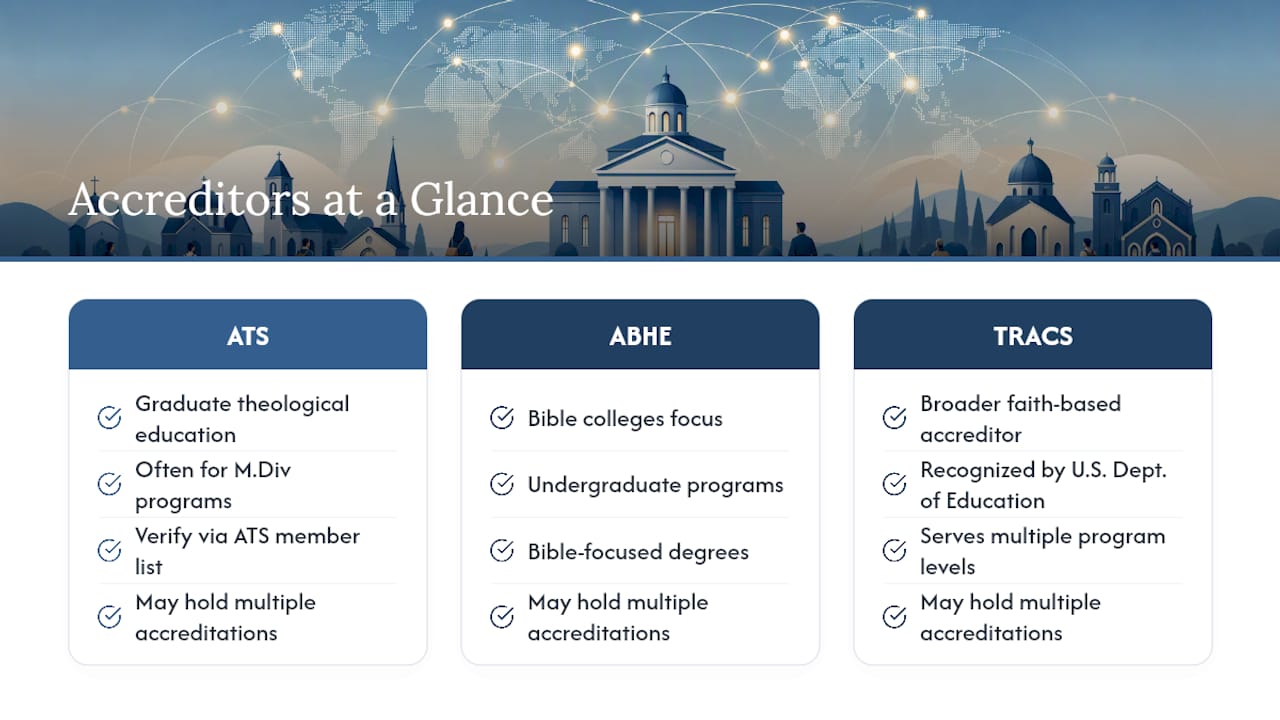
Accreditation is the one filter that should function as a gate, not just a preference. Look for one of these:
- ATS (Association of Theological Schools): the primary specialized accreditor for graduate theological education
- ABHE (Association for Biblical Higher Education): common among Bible colleges and undergraduate-focused institutions
- TRACS (Transnational Association of Christian Colleges and Schools): another faith-based accreditor recognized by the U.S. Department of Education
- Regional accreditors: broader institutional accreditation that some seminaries carry alongside a faith-based accreditor
A degree from an unaccredited school can limit your ability to transfer credits, pursue further education, or meet ordination requirements in some denominations. If a program can’t produce clear accreditation documentation, that’s reason enough to move on, regardless of how good everything else looks.
What Does Seminary Actually Cost, and How Long Does It Take?
Published seminary tuition varies enormously, and the range itself is the first thing worth understanding before you look at any single school’s number. Annual tuition can run roughly $8,000 at some institutions and well over $25,000 at others, before housing, books, fees, or travel for residency weeks. That spread isn’t a data error. It reflects real differences in institution type, location, program length, and whether a school is denominationally subsidized.
The number that matters more than sticker tuition is net price, the amount you actually pay after scholarships, denominational subsidies, and assistantships are applied. Many seminaries publish a high sticker price but discount it substantially for admitted students, especially those affiliated with a sponsoring denomination. Sticker price is the number in the marketing brochure; net price is the number on your actual bill, and the two can differ by thousands of dollars a year.
Beyond tuition, budget for these recurring costs:
- Housing, especially for on-campus or hybrid programs with residency requirements
- Books and course materials, which add up faster in theology programs heavy on required texts
- Technology, particularly for online programs requiring specific software or reliable high-speed internet
- Travel, if your hybrid program requires periodic on-campus intensives
Program length shapes your total cost as much as the tuition rate does. An M.Div. typically takes about three years full-time, covering biblical languages, theology, and supervised ministry experience. Most M.A. programs run one to two years, depending on concentration and course load. Doctoral timelines vary the most, often stretching well beyond three years depending on dissertation pace, cohort structure, and whether you’re studying full-time or part-time around existing ministry work.
Denominational sponsorship is worth investigating early, since it often comes with tuition remissions tied to a commitment to ordained ministry within that denomination. Get any such arrangement in writing before you build a budget around it. A verbal assurance from an admissions counselor isn’t the same as a documented aid agreement, and requirements can shift between your acceptance letter and your actual enrollment.
How Do You Know If a Seminary Is Really the Right Fit?
Fit isn’t something you can determine from a directory listing alone. It requires a short checklist and a handful of direct questions to admissions and financial aid, ideally before you submit an application rather than after.
-
Request accreditation documentation directly. Don’t rely on a website badge. Ask for the specific accreditor name and confirm it against the ATS member list or the relevant ABHE or TRACS directory.
-
Review faculty bios and sample coursework. Faculty credentials and published course syllabi tell you more about actual classroom rigor than any admissions brochure. Request a sample syllabus for a core course in your intended track.
-
Ask admissions about outcomes, not just curriculum. Cohort size, internship or field education placement rates, and typical post-graduation roles tell you what the program actually produces, not just what it teaches.
-
Ask financial aid for a realistic net-price estimate. Request a sample financial-aid award letter from a recent admitted student’s profile similar to yours, and ask directly about denominational discounts or assistantship opportunities.
Watch for a few red flags along the way: reluctance to produce accreditation proof, vague or shifting cost breakdowns, and an inability to name any recent alumni outcomes. A legitimate program should answer all three without hesitation.
Pro Tip: Ask admissions how many students in the last cohort actually completed the program on schedule. A school that can’t or won’t answer that question is often hiding a completion-rate problem behind strong marketing.
Why This Directory Is a Reliable Starting Point
Find Bible Schools lists more than 213 accredited Bible colleges and seminaries across the United States, built from institutional data and cross-referenced against ATS membership records rather than assembled from marketing copy alone. That distinction matters because plenty of seminary “top lists” online are really advertising placements dressed up as rankings.
This guide draws on that curated data along with publicly available cost and accreditation research, compiled by Grant for Findbibleschools.
Even with a solid directory in front of you, a few verification habits protect you from outdated or incomplete information:
- Confirm accreditation status directly with the ATS member list, since accreditation can lapse or change
- Request a current accreditation letter directly from any school before applying
- Ask for a sample financial-aid award letter rather than relying on published tuition alone
Editorial Perspective: What Actually Speeds Up This Search
Most advice on finding a seminary treats accreditation and cost as separate steps, researched in sequence. That’s backwards. The moment you find a school that looks promising, check its accreditation and request a net-price estimate in the same sitting. Waiting until after you’ve fallen for a campus tour or a compelling mission statement is how people end up rationalizing a school that never should have passed the first filter.
The bigger blind spot is geography. Readers searching for seminaries near them often assume “near” means “on-campus in my state,” when the more useful question is which delivery format actually fits their life. A hybrid program two states away with one annual residency can be more realistic than a local on-campus program that demands a full relocation.
Enrollment size gets overrated constantly. A large, well-known seminary isn’t automatically the better fit; program structure, denominational alignment, and net price matter more than headcount. Start with accreditation and delivery format, not brand recognition, and the rest of the decision gets considerably easier.
Find Your Next Step With Findbibleschools
You’ve now got the filters and the verification steps. What you might not have is a fast way to apply them without juggling a dozen open browser tabs. Findbibleschools is built specifically for that: a single directory covering 213+ accredited institutions, organized by state, degree, and denomination, so you can compare seminaries side by side instead of piecing together fragments from individual school websites.
If you’re weighing program types, the programs page breaks down M.Div., M.A., and doctoral tracks by vocational outcome. If accreditation is still confusing, the accreditation guide explains the difference between ATS, ABHE, TRACS, and regional accreditors in plain terms. And if you’re near a smaller market like Tennessee or Kentucky, the state pages show you exactly what’s accredited and available locally rather than leaving you to guess. Start by browsing the main directory and filtering by your state to see what’s actually within reach.
Frequently Asked Questions
How do I find seminaries near me that are actually accredited? Search a national directory like Find Bible Schools using your state or zip code, then confirm accreditation status directly against the ATS member school list. Accreditation badges on a school’s own website aren’t sufficient verification on their own.
What’s the difference between ATS, ABHE, and TRACS accreditation? ATS accredits graduate-level theological education, ABHE focuses on Bible colleges and undergraduate programs, and TRACS serves as a broader faith-based accreditor recognized by the U.S. Department of Education. Some schools hold more than one.
Are online seminaries a legitimate alternative to on-campus programs? Yes, provided the program carries the same accreditation as its on-campus equivalent. Online and hybrid formats often cost less and fit around existing work, though they typically offer less in-person mentorship than residential programs.
How much does seminary actually cost after financial aid? It varies widely, but net price after scholarships and denominational aid is often significantly lower than published tuition, which can range from roughly $8,000 to over $25,000 a year depending on the institution. Always request a financial-aid award letter for a realistic estimate.
Do I need a specific degree level to be ordained? It depends on your denomination. Many traditions require an M.Div. for ordination, while others accept an M.A. or equivalent. Confirm requirements with your denominational body before choosing a program, and consider resources like ordination-related planning guides once you’re closer to that milestone.
Sources
- Member School List
- Cost of a Seminary Education - United Theological Seminary
- Sticker price vs. net price: complete student guide