
Published September 14, 2026
213+ Non Denominational Bible Colleges: Verify Accreditation First

A non-denominational Bible college is a theological school that operates independently of a specific church governing body, drawing students and faculty from many church backgrounds under a shared statement of belief. Before you look at tuition or campus culture, verify two things: accreditation recognized by CHEA or the U.S. Department of Education, and whether the degree type actually matches your ministry or career goal. A curated database of these institutions exists to help you compare both.
TL;DR:
- Accreditation from recognized bodies like ATS, ABHE, or regional agencies is essential, as some smaller schools operate under religious exemption and may limit credit transfer.
- Degree type determines your ministry track, with an undergraduate focusing on foundational skills, an MDiv preparing for ordination, and an MA suited for counseling or teaching roles.
- The Statement of Faith and faculty backgrounds reveal a school’s true theological stance and influence classroom instruction more than marketing materials suggest.
- Online and accelerated programs can be useful but require verification of accreditation and transferable credits before enrollment.
- Non-denominational colleges emphasize broad doctrinal core over denominational confessions, offering more flexibility but potentially less specialized ordination preparation.
Table of Contents
- What Does “Non-Denominational” Actually Mean?
- How to Evaluate and Choose a Non-Denominational Bible College
- Undergraduate, Seminary, and Online Programs: Which Prepares You for What
- Which Accreditors Actually Matter, and How Do You Verify Them?
- What Does a Non-Denominational Bible Degree Actually Cost?
- Where to Find and Compare Accredited Programs
- Student Life and Spiritual Formation on a Non-Denominational Campus
- Who Teaches at Non-Denominational Bible Colleges?
- How Doctrinal Emphasis Differs From Denominational Bible Colleges
- Final Priorities: A Short Decision Roadmap
- Compare Accredited Programs Through Find Bible Schools
- Primary Sources for Verifying Accreditation and Program Facts
- Sources
- FAQ
What Does “Non-Denominational” Actually Mean?
The label has no legal definition, and that catches a lot of prospective students off guard. Two schools can both call themselves non-denominational and still teach very different things about baptism, spiritual gifts, or church leadership. According to the Association of Theological Schools, institutions use the term to signal independence from a specific denomination’s oversight, but theological stance still varies widely from campus to campus.
“Interdenominational” is a related but distinct term. It usually points to a formal coalition, a school built by several denominations cooperating on shared training, rather than a single institution avoiding church governance altogether. Non-denominational schools tend to emphasize a shared doctrinal core without any outside church body directing curriculum or ordination pathways.
That difference matters more than the label itself. Here’s what actually shapes your day-to-day experience on campus:
- The Statement of Faith, not the marketing copy, tells you what the school actually teaches on contested doctrines like eschatology, spiritual gifts, or the role of women in ministry.
- Faculty backgrounds reveal a school’s real theological lean, even when the institution presents itself as broadly evangelical or unaffiliated.
- Chapel and worship style often reflects a blend of traditions rather than one denominational liturgy, since students arrive from Baptist, Pentecostal, Presbyterian, and non-affiliated churches alike.
Read the Statement of Faith before you read the brochure. It’s the closest thing to a truth serum a school offers.
How to Evaluate and Choose a Non-Denominational Bible College
Comparing schools gets easier once you have a fixed sequence to work through, rather than jumping between tuition pages and admissions videos in no particular order. Follow these steps roughly in order:
- Confirm accreditation first. Check whether the school holds ATS, ABHE, or regional accreditation recognized by CHEA or the Department of Education. This single step eliminates more bad fits than any other filter.
- Match the degree to your goal. A bachelor’s degree suits early ministry preparation or a career pivot; an MDiv suits ordination-track pastoral work; an MA suits chaplaincy, counseling, or academic specialization.
- Read the Statement of Faith and faculty bios. ATS recommends this exact step to understand an institution’s theological posture and how it shapes classroom instruction.
- Compare delivery modes and cohort sizes. A 12 person residential cohort feels nothing like a 200 person online program, even if both schools list the same degree.
- Check admissions selectivity for red flags. A school that admits every applicant with no interview, essay, or pastoral reference may be prioritizing enrollment revenue over academic rigor.
Pro Tip: Email the registrar and ask two questions before you apply: “What percentage of your credits transfer to a regionally accredited graduate school?” and “Can I see your last two years of graduate outcomes?” A school confident in its numbers will answer both without hesitation.
Selectivity deserves a second look, because it cuts both ways. A highly selective seminary like Denver Seminary, which describes itself as committed to biblical authority while serving students from many denominational backgrounds, signals a different experience than a school with rolling open admissions and no minimum GPA. Neither approach is automatically wrong, but they produce different classrooms, different peer networks, and different post-graduation credibility with hiring churches.
Undergraduate, Seminary, and Online Programs: Which Prepares You for What
The degree type you choose determines your ministry track more than the school’s reputation does. Here’s how the common options break down:
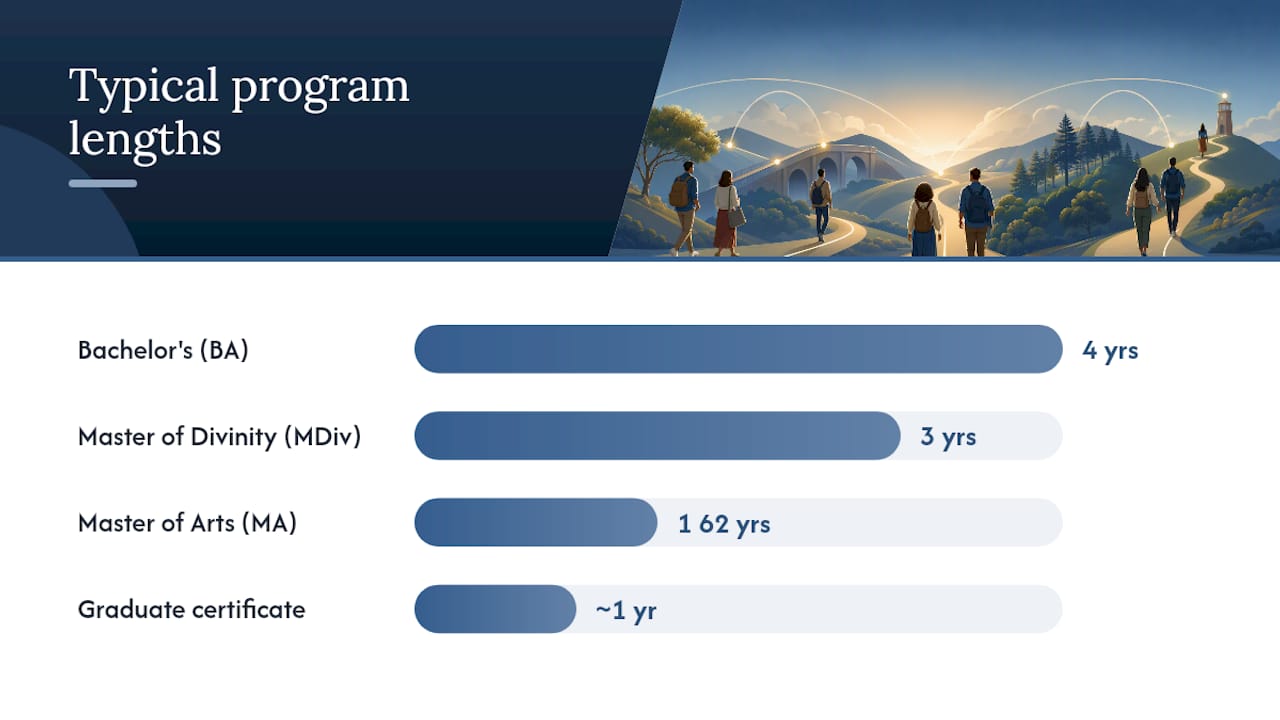
- Bachelor’s degree (BA in Bible or Biblical Studies): Prepares you for youth ministry, missions work, worship leadership, or a foundation before graduate study. Typically four years full time.
- Master of Divinity (MDiv): The standard credential for ordination in most non-denominational and evangelical churches. Usually three years, heavier in Greek, Hebrew, and pastoral practicum.
- Master of Arts (MA) in Theology, Counseling, or Biblical Studies: Shorter than an MDiv, often one to two years, suited to chaplaincy, academic teaching prep, or specialized counseling roles rather than pulpit ministry.
- Graduate certificates: Focused, often one year, useful for working professionals adding theological training without a full degree commitment.
Choose seminary over an undergraduate Bible college when you already hold a bachelor’s degree and are pursuing ordination, chaplaincy certification, or a teaching role that requires graduate credentials. Choose a Bible college first if you’re coming straight from high school or need foundational biblical languages and hermeneutics before graduate work makes sense.
Online and accelerated formats deserve a caution most brochures skip. A smaller college marketing an online-first or accelerated track can prepare you well for local church ministry, but if that program relies on a religious exemption rather than a recognized accreditor, credits may not transfer to a regionally accredited graduate school later. Always ask the registrar directly, in writing, whether credits transfer before enrolling. Programs like the ones cataloged in Find Bible Schools’ online guide list accreditation status alongside format, which saves you that email.
Which Accreditors Actually Matter, and How Do You Verify Them?
Three accreditation types show up across non-denominational schools, and they carry different weight depending on what you plan to do after graduation. The Association of Theological Schools accredits graduate theological education specifically and maintains a denominational search tool you can use to confirm member status directly. ABHE (Association for Biblical Higher Education) accredits undergraduate and some graduate Bible colleges. Regional accreditation, the same standard held by most secular state universities, carries the broadest recognition for transferring credits or applying to non-theological graduate programs.
- ATS: best for MDiv and graduate theological degrees; check membership through the ATS directory before applying.
- ABHE: common among undergraduate Bible colleges; solid for ministry preparation, though less universally recognized outside religious institutions.
- Regional accreditation: the strongest option if you might later pursue secular employment, a state license, or a PhD outside a seminary setting.
Here’s the detail that trips up a lot of applicants: some smaller Bible colleges operate under state religious exemptions rather than any of the accreditors above, which can limit credit transfer and recognition by secular employers or regionally accredited graduate schools. That doesn’t make the education worthless, but it does mean your degree may not travel well if your plans change.
Verify accreditation status yourself rather than trusting a school’s homepage badge. The Council for Higher Education Accreditation and the U.S. Department of Education both maintain official directories of recognized accreditors, and cross-checking a school against those lists takes about five minutes.
What Does a Non-Denominational Bible Degree Actually Cost?
Tuition structures vary more by delivery format than by school size. A full-time residential undergraduate program commonly bills by semester or year, part-time students often pay per credit hour, and online programs almost always price per credit, which makes them easier to compare directly against each other.
Beyond tuition, budget for costs that catalogs tend to bury in footnotes:
- Housing and meal plans, which can add thousands per year for residential students.
- Books and course materials, particularly for language-heavy MDiv coursework.
- Field education or practicum fees, common in ministry-track master’s programs and sometimes billed separately from tuition.
Pro Tip: Ask every school on your shortlist for their “net price after aid” figure for a student with your specific financial profile, not just the sticker price. Two schools with identical published tuition can differ by thousands once denominational scholarships, work study, and church partnership discounts are applied.
Scholarship sources for non-denominational students often come from three places: the institution’s own need-based aid office, denominational or church-specific scholarships (even at non-denominational schools, some funds are earmarked by a sponsoring congregation), and federal aid where the school’s accreditation status permits it. Comparing net cost, not list price, across two or three schools on your shortlist is the single most useful spreadsheet you’ll build during this process.
Where to Find and Compare Accredited Programs
A curated directory saves you from combing through dozens of individual admissions sites, but only if you know which filters to apply in the right order. Filter first by accreditation status, second by degree level, and third by delivery mode. Applying those filters in the reverse order tends to surface programs that look convenient but fail the accreditation check later.
Find Bible Schools organizes its listings around exactly that sequence, with a database covering more than 213 accredited theological institutions alongside state-specific pages. When you land on a program page, look for three things: the accreditor named explicitly (not just “accredited,” which means nothing without naming the body), the degree levels actually offered, and whether the listing distinguishes online from residential delivery.
- State pages help when you need to stay geographically close to family, a sponsoring church, or a local internship site. Tennessee and Oregon both have dedicated state listings worth checking if location matters to your search.
- Program pages typically list accreditation status, degree levels, and delivery mode side by side, which lets you compare two schools without opening ten browser tabs.
- The full national directory at Find Bible Schools is the fastest way to build an initial shortlist before narrowing by accreditation and program type.
Request the institutional catalog and transfer policy directly from admissions before applying, even if the directory page looks thorough. A catalog document, not a marketing page, is where transfer credit rules and graduation requirements are spelled out in binding detail.
Student Life and Spiritual Formation on a Non-Denominational Campus
Spiritual formation on a non-denominational campus tends to look different from a single-denomination school, mostly because the student body itself is blended. Chapel services often rotate speakers from multiple theological traditions rather than following one liturgical calendar, and worship style frequently mixes contemporary and traditional elements to avoid alienating any one background.
Small group structures, sometimes called discipleship cohorts or formation groups, replace the parish or diocese structure a denominational student might expect. These groups matter more at non-denominational schools precisely because there’s no external church hierarchy assigning mentors or accountability partners. Students build that structure internally, often through required practicum placements at local churches representing a range of traditions.
Community life also reflects the doctrinal breadth. You’ll likely sit in class next to a future Assemblies of God pastor, a nondenominational church planter, and a student headed toward Presbyterian ordination, all working from the same core curriculum but interpreting certain passages differently in discussion. That mix can be one of the more valuable parts of the experience, since it forces students to articulate and defend their convictions rather than assuming shared background. It can also create friction during doctrinally sensitive electives, which is exactly why reading a school’s Statement of Faith beforehand helps you know what’s settled and what’s open for debate in the classroom.
Who Teaches at Non-Denominational Bible Colleges?
Faculty at non-denominational institutions typically hold terminal degrees, a PhD or ThD in biblical studies, theology, or a related field, often earned at a mix of evangelical and secular research universities. That mixed academic pedigree is common precisely because non-denominational schools aren’t required to draw faculty from one denominational seminary pipeline.
Theological perspective among faculty tends to cluster around a broadly evangelical framework, affirming biblical authority and core Christian doctrines, while leaving room for disagreement on secondary issues like eschatology, church governance, or the charismatic gifts. That range is intentional at most non-denominational schools rather than accidental. It reflects the same blended student body described above, and it means two professors teaching the same course at the same school might land in different places on a given passage.
Checking faculty bios before enrolling tells you more than any accreditation badge about what you’ll actually experience in the classroom. Look for where faculty earned their doctorates, what they’ve published, and whether their bios mention denominational ordination or affiliation. A faculty roster heavy with graduates from one particular seminary tradition often signals a school’s real theological lean, even when its official Statement of Faith reads as broadly evangelical and unaffiliated.
How Doctrinal Emphasis Differs From Denominational Bible Colleges
Denominational Bible colleges teach from within a defined theological tradition, Presbyterian, Baptist, Pentecostal, or otherwise, with curriculum and ordination requirements set partly by that denomination’s governing structure. Non-denominational schools skip that external governance layer, which changes both what gets taught and how much room students have to disagree.
A denominational seminary will typically require adherence to a specific confession or catechism, the Westminster Confession for Presbyterian schools, for instance, as a condition of graduation or ordination-track certification. A non-denominational school’s Statement of Faith usually covers core evangelical convictions, the authority of Scripture, the nature of Christ, salvation by grace, while leaving secondary doctrines open to interpretation.
This has a real practical effect on your training. Denominational programs prepare you more narrowly but more thoroughly for ordination within that specific tradition. Non-denominational programs prepare you more broadly, which suits students uncertain of their denominational future or headed toward independent or non-denominational church ministry, but it can leave gaps if you later seek ordination within a tradition that expects specific confessional training you didn’t receive.
Final Priorities: A Short Decision Roadmap
Rank your priorities in this order: accreditation and outcomes first, theological fit second, cost and convenience third. Skipping straight to cost comparisons before confirming accreditation is the most common mistake applicants make, and it’s the one that causes the most regret three years into a degree that won’t transfer.
Online and accelerated formats make sense when your accreditation checks out and your life genuinely requires flexibility, not simply because the marketing page makes them sound easier. Your next three moves: request the catalog, verify accreditation against ATS or CHEA directly, then contact admissions with specific questions about transfer credit before you submit an application.
— Grant
Compare Accredited Programs Through Find Bible Schools
Find Bible Schools gives you the shortcut that a school’s own admissions page never will: a side by side view of accreditation status, degree levels, and delivery format across more than 213 institutions, without the marketing spin. Instead of opening a dozen browser tabs and cross-checking each school’s accreditor by hand, you filter once and compare directly.
Start with the state listings if location matters to your decision, or browse degree programs across all levels if you’re still deciding between a bachelor’s, an MDiv, or a graduate certificate. Listings often note accrediting bodies and delivery modes up front; referral partnerships with featured institutions may be disclosed to indicate editorial curation. If you already have a state in mind, Tennessee’s accredited school listing is a solid place to see how a filtered search looks in practice. Pick a state or program filter now, build your shortlist, and request catalogs from your top three before the semester deadline passes.
Primary Sources for Verifying Accreditation and Program Facts
Cross-check any claim in this guide against the primary sources themselves before you apply:
- ATS Denominational Search for confirming graduate theological accreditation and denominational affiliation.
- Council for Higher Education Accreditation for verifying whether a given accreditor is officially recognized.
- Denver Seminary as a representative example of a large multidenominational seminary’s program structure and mission statement.
- Find Bible Schools for a curated, state-by-state directory of accredited institutions and program details.
Sources
FAQ
Are There Free Bible Colleges?
A small number of Bible colleges offer full-tuition scholarships or work-study models that cover most or all costs, but true zero-tuition programs are rare and usually tied to specific denominational sponsorship or missionary training tracks. Check each school’s financial aid office directly, since “free” often means “fully covered by aid for qualifying students” rather than no listed tuition at all.
What Is the Best Non-Denominational Study Bible?
This depends on your theological starting point and reading level more than any single “best” answer, since study Bible notes reflect the editorial team’s own doctrinal leanings even when marketed as broadly evangelical. Ask your prospective school’s faculty which translation and study edition they use in coursework, since that choice often signals their interpretive approach.
What Is the Easiest Bible College to Get Into?
Selectivity varies widely, and schools with open or rolling admissions and no minimum GPA requirement are generally easier to enter than accredited seminaries requiring pastoral references and entrance essays. Easier admission isn’t automatically a red flag, but pair it with an accreditation check, since some open-admission schools rely on religious exemptions rather than recognized accreditors.
Are There Any Bible Colleges in Oregon?
Yes, Oregon has accredited Bible college options, and you can review the current Oregon listings to compare accreditation status and program types available in the state. Availability changes as schools open, close, or adjust accreditation, so check the listing directly rather than relying on older search results.
How Is a Non-Denominational Bible College Different From a Denominational One?
A non-denominational school operates independently of any single church governing body and draws faculty and students from many traditions, while a denominational college teaches within one defined tradition and often ties graduation to that denomination’s confession or ordination requirements. The practical difference shows up most in required coursework, faculty backgrounds, and how narrowly the Statement of Faith defines secondary doctrines.