
Published September 20, 2026
Applicants: Compare SBC’s Six and 213+ Baptist Seminaries
Baptist seminaries fall into three broad groups: the six seminaries owned by the Southern Baptist Convention, seminaries affiliated with other Baptist bodies or historically Baptist in identity, and independent Baptist institutions with no denominational governance. The platform tracks these alongside many accredited theological schools nationwide, providing side-by-side program and cost data. Before you shortlist anywhere, confirm accreditation status and whether the program actually matches your ministry calling.
TL;DR:
- Baptist seminaries vary significantly in governance, with SBC-affiliated schools under trustee oversight and others operating independently or interculturally.
- Costs differ widely, especially between SBC seminaries with denominational subsidies and interdenominational or independent institutions, which often offer merit or need-based aid.
- Program formats include on-campus, hybrid, and online options, each offering different levels of mentorship, community, and flexibility suited to students’ ministry goals.
- Accreditation by ATS or regional bodies is crucial for credit transfer, federal aid access, and denominational recognition, but verify specific ordination requirements beforehand.
- Campus community and location influence student experience, with most seminarians being older, often married, and actively engaged in ministry or international work.
Table of Contents
- What Are the Main Groups of Baptist Seminaries?
- What Should You Check in a Seminary’s Program Profile?
- How Do You Choose a Baptist Seminary?
- Why Does Accreditation Matter for a Baptist Seminary?
- Why Trust Findbibleschools to Compare Baptist Seminaries?
- What Does a Baptist Seminary Actually Cost?
- Where Are the Major Baptist Seminaries Located?
- Who Attends Baptist Seminaries, and What’s Campus Life Like?
- Author Perspective: Balancing Doctrinal Fit, Formation, and Practical Constraints
- Start Comparing Baptist Seminaries on Findbibleschools
- Sources
- FAQ
What Are the Main Groups of Baptist Seminaries?
Prospective students researching Baptist seminaries usually start in the wrong place: comparing campus photos before understanding governance. Governance determines almost everything else, from what faculty can teach to which denominational boards will recognize your degree for ordination.
The Southern Baptist Convention supports six seminaries directly through the Cooperative Program, and Sbc: The Southern Baptist Theological Seminary, Midwestern Baptist Theological Seminary, Southeastern Baptist Theological Seminary, Southwestern Baptist Theological Seminary, New Orleans Baptist Theological Seminary, and Gateway Seminary. These six operate under SBC trustee oversight, which means their doctrinal statements, presidential appointments, and program direction answer to the convention rather than an independent board.
Outside that formal structure sit schools with Baptist roots or strong Baptist enrollment that don’t answer to SBC trustees. Mid-America Baptist Theological Seminary trains students within a Baptist confessional framework but operates independently. Covenant Theological Seminary serves a Presbyterian denomination but draws cross-denominational interest, including from Baptist students seeking rigorous Reformed training. Fuller Theological Seminary and Asbury Theological Seminary are interdenominational, evangelical institutions that enroll significant numbers of Baptist students without requiring Baptist affiliation.
A few things to keep straight as you compare:
- SBC seminaries require some level of doctrinal alignment with the Baptist Faith and Message, though the specifics vary by role and program.
- Affiliated but independent seminaries (like Mid-America) may hold theology closer to SBC positions without the trustee relationship.
- Interdenominational seminaries (Fuller, Asbury) offer broader theological exposure, which suits students planning cross-denominational ministry or academic work.
The label “Baptist” covers a wide range of positions on baptism, ecclesiology, and biblical interpretation, so affiliation alone won’t tell you everything. Read the doctrinal statement before you read the brochure.
What Should You Check in a Seminary’s Program Profile?
Once you have a shortlist, the real comparison work starts. Program pages tend to bury the details that matter most under marketing copy, so know what you’re hunting for before you start reading.
Degree type drives outcome. A Master of Divinity is the standard credential for pastoral ordination and typically runs 72 to 96 credit hours, blending biblical languages, theology, and supervised ministry. A standalone MA (in counseling, missions, or biblical studies) trains for a specific vocational lane rather than general pastoral ministry. A Doctor of Ministry assumes you’re already serving in ministry and want advanced practical training, not an entry credential.
Delivery format changes the experience more than most applicants expect. Here’s a quick way to think through the trade-offs:
- On-campus gives you direct mentorship, chapel community, and informal access to faculty, but it usually means relocating and pausing full-time ministry income.
- Hybrid programs let you keep a ministry position while attending intensives, though they demand strong self-discipline for the online components.
- Fully online programs, covered in Findbibleschools’ guide to accredited online seminaries, offer the most flexibility but the least in-person formation, which matters if pastoral mentorship is central to your calling.
Campus culture shows up in details easy to miss on a glossy homepage: Does the school require a signed confessional statement, and does that statement match your convictions? Are chapel attendance and spiritual formation activities mandatory or optional? How closely tied is the school to a specific denominational body versus a broader evangelical network?
Pro Tip: Call the admissions office and ask directly whether faculty sign a confessional document like an Abstract of Principles. The answer tells you more about classroom perspective than any mission statement will.
Cost signals worth checking include per credit hour tuition, mandatory fees separate from tuition, and whether scholarships target specific groups (denominational members, bivocational pastors, military veterans).
How Do You Choose a Baptist Seminary?
Choosing between finalists comes down to five criteria, weighted according to your vocational goal rather than a generic ranking.
- Doctrinal fit: Does the school’s confessional statement match your convictions closely enough that you won’t spend three years arguing with your professors?
- Accreditation: Is the school accredited by the Association of Theological Schools or a regional body recognized by the Department of Education?
- Placement outcomes: Does the school publish job placement or ordination rates for graduates, or does it dodge the question?
- Faculty access: Are core theology courses taught by full-time faculty, or mostly by adjuncts you’ll never see again after the semester?
- Program length and total cost: What’s the realistic time to completion given your work schedule, and what’s the all-in cost including fees?
When you talk to admissions or faculty, ask specific questions rather than accepting brochure language: What percentage of M.Div. students complete required internships within the standard timeline? What denominational bodies recognize this degree for ordination? Is there a practicum requirement, and who supervises it?
Watch for red flags that should stop your application cold. Vague or unverifiable accreditation claims top the list. A school that can’t produce placement data, or won’t discuss it, is telling you something. Hidden fees that surface only after enrollment (technology fees, practicum fees, graduation fees) can add thousands to your published tuition. And doctrinal requirements that conflict with your own convictions won’t resolve themselves after acceptance. Sign nothing you don’t actually believe.
Why Does Accreditation Matter for a Baptist Seminary?
Accreditation isn’t paperwork. It determines whether your degree transfers, whether you qualify for federal aid, and whether your denomination will recognize it for ordination.
The Association of Theological Schools (ATS) is the specialized accreditor most theological seminaries pursue, evaluating degree programs specifically for ministry preparation. Regional accreditors like SACSCOC (common across the South) and NECHE (New England) evaluate the institution as a whole and matter for federal aid eligibility and multi-institution credit transfer. A seminary can hold one, both, or neither.
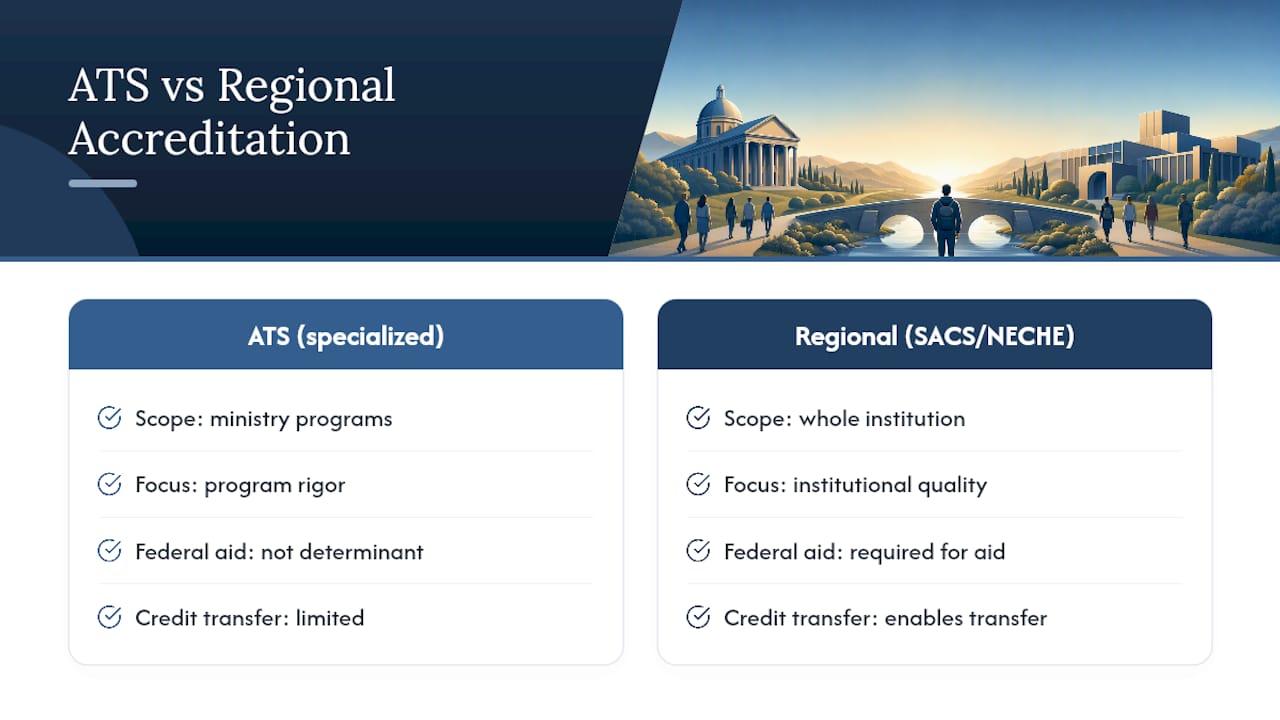
Both accreditation types affect practical outcomes directly. Without regional accreditation, credits often won’t transfer to another graduate program, and students typically can’t access federal student loans or grants. Without ATS accreditation specifically, some denominational ordination boards will ask more questions about your degree’s rigor.
Don’t assume your denomination automatically recognizes any accredited seminary. Ordination boards vary in what they require, and some maintain their own approved-schools lists independent of ATS or regional status. Call your ordination council before you enroll, not after you graduate.
Why Trust Findbibleschools to Compare Baptist Seminaries?
Findbibleschools maintains profiles for The Southern Baptist Theological Seminary and more than 213 other accredited institutions, each listing accreditation status, program types, and tuition side by side. That means you can run the doctrinal fit, accreditation, and cost checks described above without hunting across a dozen separate school websites.
Every profile surfaces the same checklist categories: degree types offered, delivery format, accreditation body, published tuition, and notable campus or denominational notes. The profiles are compiled by researchers who track these details so applicants don’t have to reverse engineer them from admissions brochures.
What Does a Baptist Seminary Actually Cost?
Tuition at Baptist seminaries ranges widely depending on denominational subsidy and institutional type, and the gap between the cheapest and most expensive options is larger than most applicants expect.
New Orleans Baptist Theological Seminary illustrates the denominational subsidy effect clearly: SBC-affiliated students pay roughly $355 per credit hour for on-campus courses, a rate held down by Cooperative Program funding that non-SBC students don’t receive at the same level. NOBTS also runs the Caskey Center, which offers targeted scholarship support for bivocational and church-planting ministers. That combination, subsidized base tuition plus targeted aid, is common across SBC seminaries, though exact rates differ by school and by student category (SBC-affiliated versus non-affiliated, in-state versus out-of-state where relevant).
Interdenominational seminaries without Cooperative Program funding typically charge higher per credit rates, since they lack a denominational base subsidizing tuition broadly. That doesn’t mean they’re worse deals. Many offer merit scholarships, need-based aid, and denominational partner discounts that can close the gap for the right applicant.
Financial aid patterns worth checking before you apply: Does the school offer discounted tuition for members of a specific denomination or association? Are there scholarships aimed at bivocational ministers, military veterans, or missionary appointees? Does the aid require a service commitment (serving a specific church body after graduation) that you need to weigh against your calling?
Always verify current tuition directly on the institution’s own site. Published rates change year to year, and scholarship programs come and go faster than most guides update.
Where Are the Major Baptist Seminaries Located?
Geography affects both your seminary experience and your practical logistics, since most M.Div. students juggle family, work, and church commitments alongside coursework.
The six SBC seminaries spread across distinct regions: The Southern Baptist Theological Seminary sits in Louisville, Kentucky, on a campus known for its historic quadrangle and clock tower. Southwestern occupies a large Fort Worth, Texas campus with extensive music and worship facilities reflecting its historic strength in church music programs. Southeastern is based in Wake Forest, North Carolina, on a wooded campus that formerly housed a different seminary before the SBC acquired it. Midwestern operates from Kansas City, Missouri, with a campus that has expanded significantly under recent enrollment growth tied to its emphasis on doctrinal clarity and ministry preparation. New Orleans Baptist Theological Seminary sits in a residential section of New Orleans, Louisiana, offering a distinctly urban ministry context. Gateway Seminary, formerly Golden Gate, relocated its main campus to Ontario, California, positioning itself for ministry training across the West Coast’s diverse religious landscape.
Beyond the SBC six, Covenant Theological Seminary sits in Saint Louis, Missouri, while Fuller is based in Pasadena, California, and Asbury in Wilmore, Kentucky, a small town built almost entirely around the seminary and its undergraduate counterpart.
Campus facilities generally include chapel spaces sized for daily or weekly required attendance, dedicated libraries with theological research collections, and increasingly, distance-learning studios supporting hybrid cohorts. If campus community matters to your formation, visit before enrolling. Photos rarely capture whether a campus feels alive or half empty.
Who Attends Baptist Seminaries, and What’s Campus Life Like?
Seminary student bodies skew older than typical graduate programs, since many students enter after several years in church ministry, secular careers, or missions work rather than straight from undergraduate study. Age diversity shapes classroom dynamics: discussions often draw as much on lived pastoral experience as on assigned reading.
Married students with families make up a substantial share of enrollment at most Baptist seminaries, which is why campus housing, family-friendly chapel programming, and spouse ministry tracks show up consistently across school profiles. International students, particularly from Latin America, Africa, and East Asia, add another layer of diversity at larger seminaries like Southwestern and Southeastern, often training for return ministry in their home countries.
Community life centers on chapel services, cohort-based coursework, and practicum placements at partner churches, which double as informal networking for post-graduation calls. Extracurricular ministry opportunities vary by school: some seminaries run active campus missions programs, church-planting incubators, or counseling clinics that let students practice under supervision before graduation. Ask specifically about practicum placement support during your campus visit or admissions call. It’s often a better predictor of your seminary experience than the marketing materials suggest.
Author Perspective: Balancing Doctrinal Fit, Formation, and Practical Constraints
Applicants often treat doctrinal fit and quality formation as if they’re the same thing. They’re not. A seminary can match your theology precisely and still offer weak mentorship, or challenge your convictions productively while producing better preachers. Weigh program type against your actual goal: pastoral placement rewards strong practicum structure, missions work rewards cross-cultural training, academic careers reward research faculty access. Use a directory to compare finalists side by side before you commit to a campus visit.
*— Grant
Start Comparing Baptist Seminaries on Findbibleschools
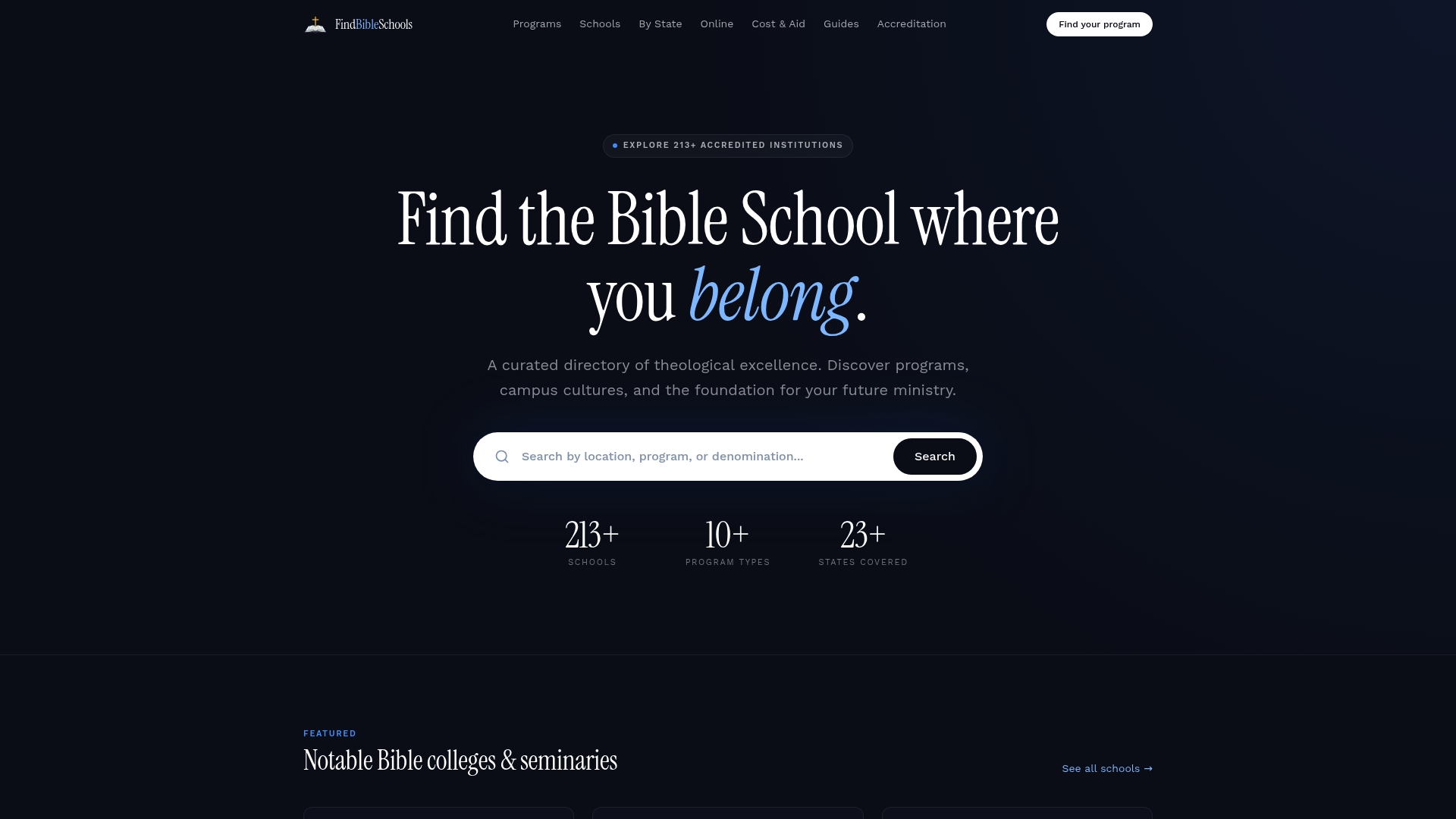
This platform allows searching by state, program type, or accreditation status, and lets users view tuition and confessional details consolidated on one screen instead of multiple websites.
Once you’ve narrowed your list using the criteria above, doctrinal fit, accreditation, placement outcomes, the next move is simple: pull up a few full school profiles, compare tuition and program length side by side, and reach out to admissions with the specific questions this guide outlined. If location matters to your decision, browse options like Bible colleges in Kentucky, home to two SBC seminaries, or check accredited online programs if relocating isn’t realistic. Start your comparison at Findbibleschools’ full directory and request information directly from your top three schools this week.
Sources
Confirm denominational affiliation directly at SBC.net’s seminary directory, and verify accreditation status through ATS or regional accreditor listings before applying anywhere.
FAQ
What Are the Six Southern Baptist Seminaries?
The Southern Baptist Convention supports six seminaries: The Southern Baptist Theological Seminary, Midwestern Baptist Theological Seminary, Southeastern Baptist Theological Seminary, Southwestern Baptist Theological Seminary, New Orleans Baptist Theological Seminary, and Gateway Seminary. Each operates under SBC trustee governance and receives Cooperative Program funding, which typically lowers tuition for SBC-affiliated students.
What Are the Three Types of Baptists?
Baptist life generally divides into three broad streams: Southern Baptists (the largest convention, represented by the six seminaries above), independent or fundamentalist Baptists who reject denominational affiliation entirely, and other Baptist conventions or associations, including historically Black Baptist denominations and Free Will Baptists, each with distinct theological emphases. Seminary choice often follows which stream a student’s home church belongs to.
Does the Baptist Church Support Donald Trump?
Baptist churches and seminaries don’t hold a single collective political position, since Baptist governance is deliberately decentralized down to the local church level. Political views vary widely across individual congregations, associations, and denominational bodies, and no seminary covered here issues an official political endorsement as an institution.
Which Southern Baptist Seminaries Are Considered the Best?
“Best” depends entirely on your program needs, since each of the six SBC seminaries carries different strengths, Southwestern in church music, Southeastern in missions, Southern in academic theology. Compare accreditation, placement outcomes, and program fit directly using a full seminary directory rather than relying on general reputation alone.