
Published September 10, 2026
213+ U.S. Profiles to Match Your Calling to a Worship Ministry Degree

Most students choose between three paths: a BA or BS in Worship Arts or Worship Ministry for entry-level musical leadership, an MA in Worship Studies or Worship Leadership for deeper theology and administrative advancement, or a D.Min/D.Ed.Min concentration for senior, research-level ministry roles. Prioritize accreditation and a real internship or capstone requirement over program name alone.
TL;DR:
- Accreditation and a clear internship or practicum pipeline are essential indicators of a program’s reliability and professional readiness preparation.
- Bachelor’s degrees focus on foundational skills in worship arts, while master’s programs deepen theological knowledge and prepare students for senior leadership roles.
- Hands-on experience through internships and demonstrated multi-instrument skills are critical for real-world worship leadership effectiveness.
- Alumni networks and specific church placement outcomes play a vital role in securing worship leadership positions after graduation.
- Clarifying each program’s worship philosophy and ensuring it matches your target ministry context can prevent costly mismatches and dropouts.
Table of Contents
- Comparing Worship Ministry Degree Programs Across the U.S.
- What You Actually Study in a Worship Ministry Program
- How Do You Choose the Right Worship Leadership Program?
- What Jobs Does a Worship Ministry Degree Actually Lead To?
- Planning Your Timeline, Credits, and Costs
- How Find Bible Schools Verifies Program Information
- Financial Aid, Scholarships, and Assistantships for Worship Ministry Students
- Do Alumni Networks Matter for a Worship Ministry Career?
- Certification and Ordination Pathways After Your Degree
- Staying Connected After Graduation
- What I’d Tell a Prospective Worship Student Right Now
- Find Your Next Worship Ministry Program on Find Bible Schools
- Sources
Comparing Worship Ministry Degree Programs Across the U.S.
Seven programs illustrate the range a prospective student is likely to encounter while researching a worship ministry degree, from production-heavy undergraduate tracks to seminary-level leadership degrees built for working church staff.
Grand Canyon University’s BA in Worship Arts (Worship Ministry emphasis) runs 120 credits and pairs theology coursework with a structured internship and access to recording studio resources through its Canyon Worship program. Liberty University offers a cluster of music and worship studies degrees spanning performance, songwriting, and worship leadership tracks, with both residential and online formats. Southern Baptist Theological Seminary’s MA in Worship Leadership totals 54 credits and includes courses like Introduction to Biblical Worship and History of Christian Worship and Song. Southwestern Baptist Theological Seminary’s MA in Worship Leadership blends musical training with theological study and offers both online and residential delivery. Malone University’s Worship Arts bachelor’s degree leans into worship technology and ministry internships. Northwest University’s BA in Worship and Music Studies combines conservatory-style musicianship with pastoral coursework. Crown College’s Worship Ministry BS rounds out the group with a leadership-and-administration focus alongside music training.
A few quick takeaways for narrowing your search:
- If you want a performance-and-production emphasis with a built-in internship, GCU and Malone are worth a close look.
- If a senior pastoral or worship-leadership role is the goal, an MA program like SBTS or Southwestern’s builds the theological depth churches expect for that level.
- If schedule flexibility matters because you already work in a church, check which of these programs (several do) offer online or hybrid delivery for graduate coursework.
What You Actually Study in a Worship Ministry Program
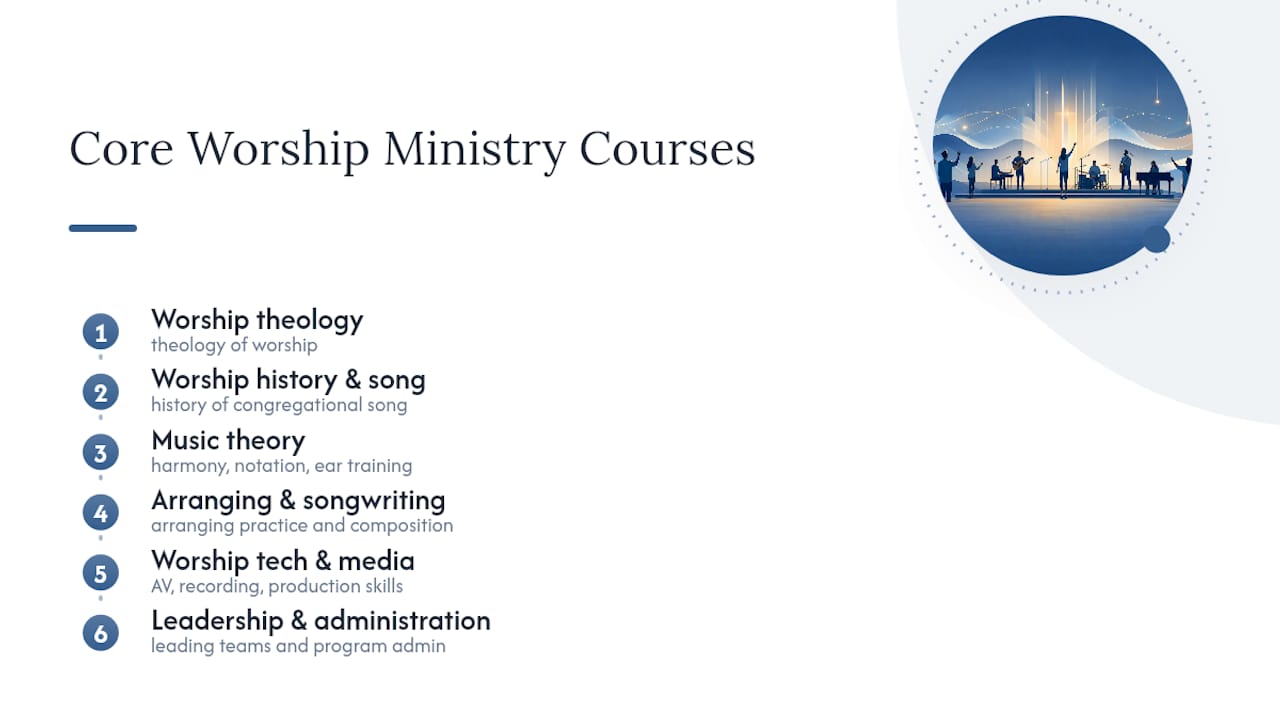
Coursework in most worship ministry programs clusters around a handful of recurring subjects: theology of worship, history of worship and congregational song, music theory, arranging and songwriting, worship technology and media, and leadership or administration. The exact course titles vary, but the pattern holds across nearly every program, from GCU’s Theology of Worship course to SBTS’s History of Christian Worship and Song.
Practicum requirements are where the real preparation happens. Internships place you inside an actual church’s worship ministry, capstones ask you to design and defend a worship project, and portfolios document your growth as a musician and leader. Grand Canyon University’s Center for Worship Arts pairs its internship with recording studio access and practice ensembles, giving students production experience most jobs will eventually require.

Multi-instrument competency matters more than many applicants expect. Most worship leaders serve on staff at small or mid-sized churches where one person often covers guitar, piano, and vocal leadership in the same service, so degree programs typically require a primary instrument plus demonstrated skill on at least one secondary instrument.

Yale’s online course in the foundations of Christian worship reinforces why this hands-on structure matters: faculty there emphasize lived, experiential learning as the mechanism that makes worship formation durable rather than merely theoretical.
Pro Tip: Ask any program you’re considering for a sample internship placement site list. A program that can name three or four partner churches by name has a functioning practicum pipeline; one that can’t is asking you to trust a process it hasn’t built yet.
How Do You Choose the Right Worship Leadership Program?
Start with accreditation. A regionally accredited institution, or one recognized by a theological accrediting body, protects your ability to transfer credits and qualify for federal financial aid. Verify this directly on the school’s website or through the accreditor’s own database rather than taking a marketing page’s word for it.
From there, work through this checklist before you apply anywhere:
- Confirm the degree level matches your career stage. Bachelor’s for foundational skill-building, master’s for leadership and theological depth.
- Check delivery format against your life. Full-time on-campus, hybrid, or fully online worship ministry courses each demand different schedules.
- Read the stated worship philosophy. Denominational tone and musical style vary widely, and a mismatch here causes more dropouts than academic difficulty does.
- Look for a named internship coordinator or placement process, not just a vague “practicum required” line.
- Request sample syllabi. A program confident in its curriculum will share them.
- Ask about recent graduate outcomes. Where are alumni serving now?
- Clarify audition or portfolio expectations early, since some programs require a recorded demo before you’re even considered.
Watch for red flags: a program page with no faculty bios, no course list beyond generic titles, or an internship description that never names a placement site. Those gaps usually mean the infrastructure behind the degree is thinner than the marketing suggests.
- Faculty background: are they working worship leaders, or purely academics?
- Cost transparency: is per-credit or per-semester pricing published, or hidden behind a “request info” form?
- Financial aid eligibility: tied directly to accreditation status.
What Jobs Does a Worship Ministry Degree Actually Lead To?
Graduates typically move into roles like worship pastor, music director, worship arts director, worship educator, or general church music staff. The Bureau of Labor Statistics frames music directors and composers, a category that includes church music directors, as a field where a bachelor’s degree is commonly the baseline expectation for hiring.
Degree level shapes the ceiling on responsibility. A bachelor’s graduate often starts leading a single service or team, while an MA in worship leadership or studies signals readiness for senior pastoral oversight, staff supervision, or multi-campus coordination. Build your resume while you’re still enrolled: lead services regularly, complete your internship at a church you’d actually want to work for, and finish a recording or arranging project you can point to in an interview.
Planning Your Timeline, Credits, and Costs
Budget roughly 120 credits for a bachelor’s degree and roughly 30 to 48 credits for most master’s programs, with some programs like SBTS’s MA in Worship Leadership having varied credit totals. Doctoral concentrations vary widely by institution and research focus.
Admissions typically ask for:
- An audition or recorded demo showcasing your primary instrument and vocal ability.
- Letters of recommendation, often from a pastor or worship leader who can speak to your ministry readiness.
- A statement of faith or sense of calling.
- Transcripts, undergraduate for grad applicants, high school for undergrad applicants.
Per-credit and per-semester rates change year to year, so confirm current numbers directly on each program’s page, then compare them against available scholarships and church-sponsored aid. Audition scheduling and application deadlines vary by school. Some run rolling admissions, others fixed cycles, so map your internship timeline against your target enrollment term early.
How Find Bible Schools Verifies Program Information
Find Bible Schools connects students with more than 213 accredited theological institutions across the country, collecting data on program type, cost, accreditation status, and campus culture for each one. Verification runs through published program pages, official accreditation listings, and posted tuition figures rather than secondhand summaries.
Tuition and course details change between academic years, so always confirm final numbers directly with the school’s admissions office before you commit to an application cycle. The directory is built to narrow your list, not replace that final conversation.
Financial Aid, Scholarships, and Assistantships for Worship Ministry Students
Federal aid eligibility depends entirely on a program’s accreditation status, which is why verifying accreditation isn’t just an academic exercise. It determines whether you can access FAFSA-based grants and loans at all. Beyond federal aid, most worship ministry programs offer denominationally tied scholarships, church-matching grants for students already serving on staff, and, at some institutions, worship-team assistantships that reduce tuition in exchange for leading chapel services or campus ensembles.
Graduate students should ask specifically about assistantship openings tied to the music or worship department. These positions often combine a tuition discount with hands-on leadership experience directing student ensembles or assisting faculty with chapel programming, which doubles as practicum credit in some programs. Denominational scholarships tend to require church membership or a pastor’s recommendation letter, so start that paperwork early in your application cycle. Church-sponsored aid, where a home congregation covers part of tuition in exchange for a post-graduation commitment to serve, is common enough in this field that it’s worth asking your own pastor about before you assume you’ll pay full price.
Do Alumni Networks Matter for a Worship Ministry Career?
They matter more in this field than in most. Church hiring runs heavily on personal recommendation and denominational connection, so a program’s alumni network functions as an informal job board. Programs with decades of graduates placed across a specific denomination, Southern Baptist Convention churches for SBTS and Southwestern graduates, for instance, give you a built-in referral pipeline the moment you finish coursework.
Ask admissions directly where recent graduates are serving now and whether the program hosts alumni events, mentorship pairings, or a job-posting board exclusive to graduates. A program that can name specific churches where alumni currently hold worship pastor positions is demonstrating a functioning network. One that can only point to a general “our graduates serve everywhere” statement probably hasn’t tracked its outcomes closely enough to help you.
Certification and Ordination Pathways After Your Degree
A worship ministry degree itself is academic, not a certification or ordination credential. Ordination remains a denominational process, handled by your church or denominational body rather than conferred by a college or seminary diploma. That said, seminary-level degrees, particularly an MA in Worship Leadership or Worship Studies, often satisfy or substantially reduce the academic prerequisites many denominations require before candidacy for ordination.
If ordination is part of your long-term plan, ask your target denomination directly what academic requirements it sets, then check whether your chosen program’s curriculum maps onto that list. Some seminaries build denominational ordination tracks directly into their worship leadership degrees, coordinating coursework with a specific denomination’s candidacy process. Others leave that coordination entirely to the student. Clarify this before enrolling if ordination, not just employment, is the end goal.
Staying Connected After Graduation
Finishing your degree isn’t the end of your professional development in this field. Denominational conferences, worship-specific training intensives, and continuing education units offered by seminaries keep working worship leaders current on both musical trends and theological thinking. Many graduate programs also maintain continuing education partnerships that let alumni audit select courses or attend workshops at reduced cost.
Professional networks built around worship ministry, some tied to specific denominations, others interdenominational, host annual gatherings where working worship leaders trade practical resources: chord charts, tech setups, team-training materials. Staying plugged into one of these communities after graduation often matters as much for long-term career growth as the original degree did, since worship trends and church technology shift faster than any curriculum can be rewritten.
What I’d Tell a Prospective Worship Student Right Now
The biggest mistake I see students make isn’t picking the wrong degree level. It’s picking a program whose worship philosophy doesn’t match the churches they actually want to serve. A conservatory-style program builds extraordinary musicians who sometimes struggle in a scrappy, three-chord contemporary church. A theology-heavy seminary MA can overprepare someone for a role that mostly needs someone who can run a smooth Sunday morning.
Match the program’s actual worship style, and its faculty’s ministry background, to the context you’re aiming for. Then call the program director, not just admissions, and ask to sit in on a rehearsal or chapel service if you can. Use a curated directory to build your shortlist first, so those conversations start with real candidates instead of a random name you found online.
— Grant
Find Your Next Worship Ministry Program on Find Bible Schools
Comparing a dozen program pages by hand, checking accreditation on one site, tuition on another, is the slow way to build a shortlist. A curated directory puts accreditation status, cost, campus culture, and program type side by side for many U.S. institutions, so you can compare a bachelor’s-level worship arts track against a graduate worship leadership program without opening twenty browser tabs.

Start with a seminary page like Trinity Evangelical Divinity School if graduate-level worship leadership is your target, or browse theology programs by degree level if you’re still deciding between a bachelor’s and master’s path. If cost is your biggest constraint, the site’s guide to affordable online Bible schools is worth a look before you narrow your list further. Whichever path fits your calling, request information directly from the schools on your shortlist today and get real answers before your next application deadline.
Sources
- Music directors and composers | Occupational Outlook Handbook | BLS
- BA in Worship Arts Degree: Worship Ministry Emphasis | Grand Canyon University
- Master of Arts in Worship Leadership - The Southern Baptist Theological Seminary
- Foundations of Christian Worship | Yale Online