
Published August 31, 2026
213+ Accredited U.S. ThM Programs Mapped: Costs, Tracks, Advisors

A Master of Theology (ThM) is an advanced, post-MDiv degree built for students seeking doctoral preparation or specialized scholarly and ministry study. Most ThM programs run one year full-time, though part-time, online, and hybrid tracks stretch that timeline to two or three years. Applicants generally need an MDiv or equivalent graduate theological training already completed.
TL;DR:
- ThM programs vary in length from one year full-time to three years part-time, with costs influenced by the chosen pace and format.
- Admission requires an MDiv or equivalent, a GPA of at least 3.0, language proficiency, and relevant research or ministry interests.
- Research-oriented tracks with a thesis and strong language skills better position students for PhD applications, while practicum tracks suit applied ministry roles.
- Accreditation status affects doctoral transferability and ordination eligibility, making it a key factor in program selection.
- Comparing programs through tools like Findbibleschools helps identify options that match your format, cost, and research focus efficiently.
Table of Contents
- What a ThM Program Actually Covers
- Choosing a Format: Full-Time, Part-Time, or Modular
- Admissions Requirements You Need Before You Apply
- Concentrations and How the Research Track Works
- What a ThM Actually Costs and How to Fund It
- Application Timeline: What to Do and When
- Where a ThM Leads: PhD, Teaching, and Ministry Leadership
- How Findbibleschools Helps You Compare ThM Options
- What Matters Most When You Choose a ThM
- Sources
What a ThM Program Actually Covers
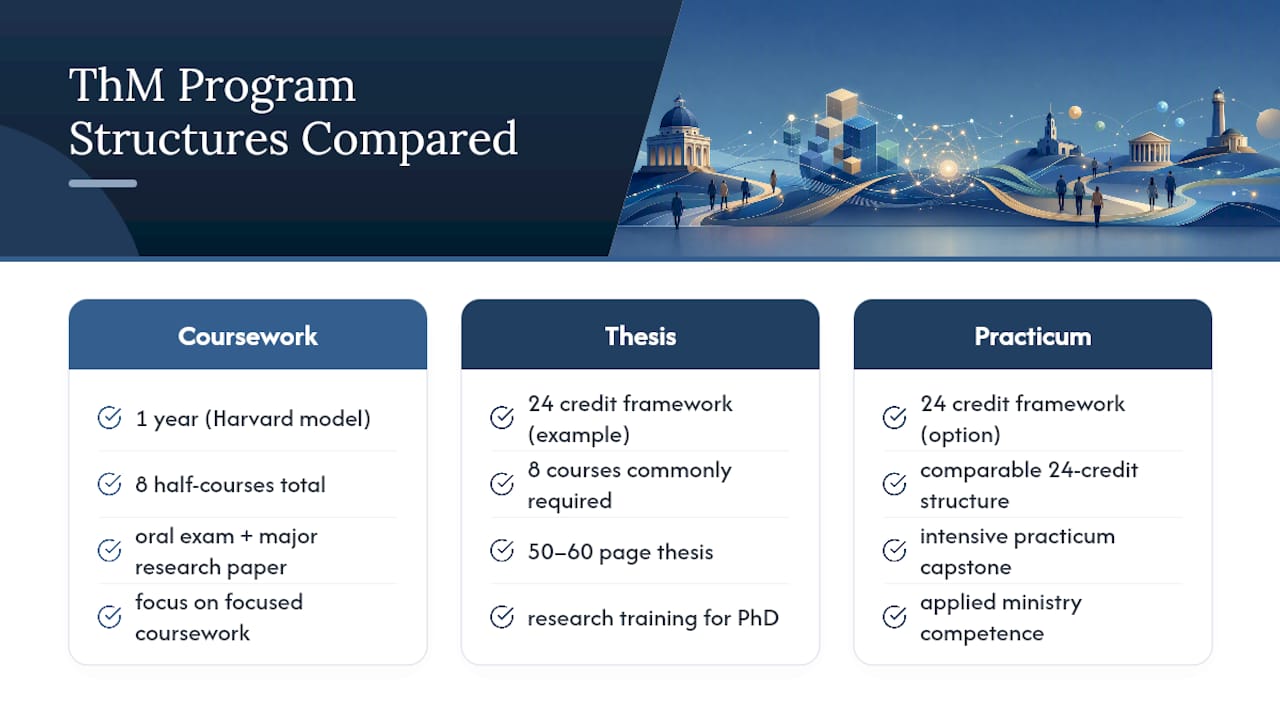
A ThM exists to sharpen scholarship past what an MDiv provides, whether the goal is a PhD application, a teaching post, or a more rigorous ministry specialization. Harvard Divinity School structures its ThM program around eight half-courses completed in one year, capped by an oral examination tied to a major research paper. That model, heavy on focused coursework and a defended capstone, shows up across the field, though the exact credit count varies by school.
Gordon-Conwell requires 24 credit hours across eight courses for some of its ThM tracks, while Boston College’s program allows either a 50- to 60-page thesis or an intensive practicum within a comparable 24-credit structure. That thesis-versus-practicum split matters more than it looks. A thesis track signals research training relevant to PhD admissions committees; a practicum track signals applied ministry competence relevant to search committees. Accreditation matters here too, since a ThM from a regionally or ATS-accredited seminary transfers cleanly into doctoral programs and satisfies most denominational ordination boards, while one from an unaccredited school often won’t.
Choosing a Format: Full-Time, Part-Time, or Modular
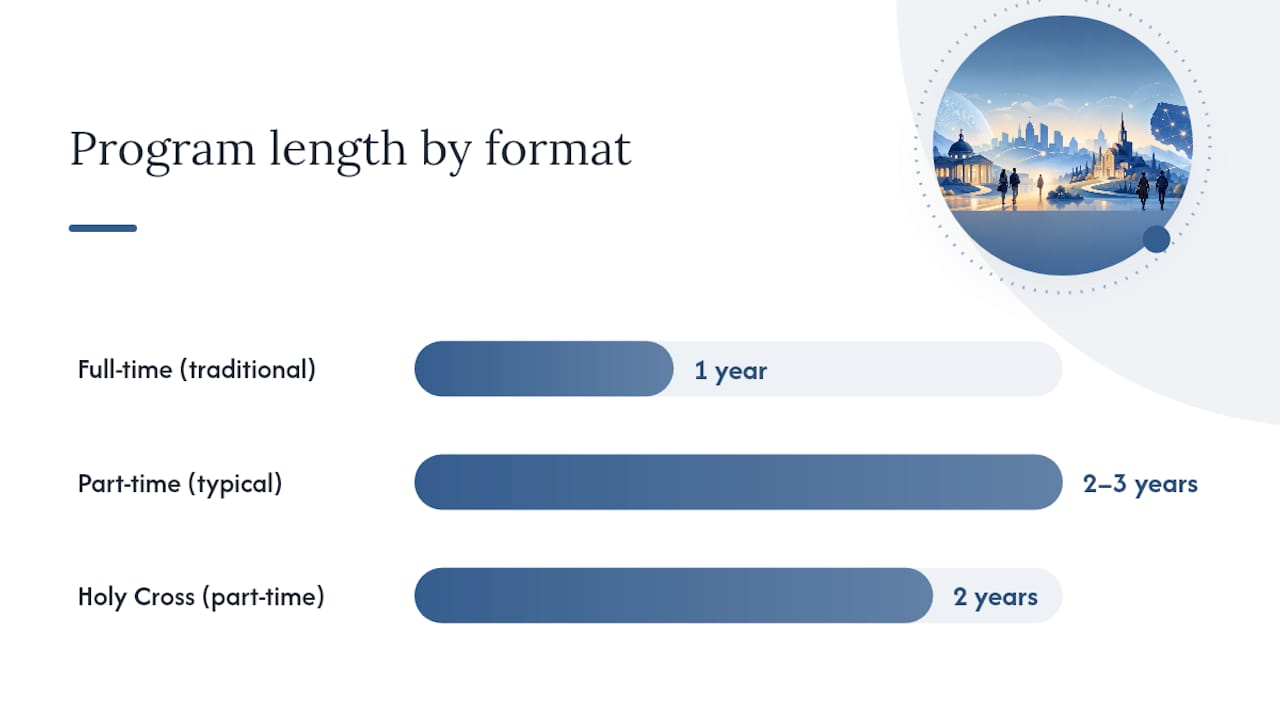
The traditional ThM is a one-year, full-time residency, but that’s no longer the only door in. Gordon-Conwell explicitly offers full-time one-year or part-time two-to-three-year pacing, and Holy Cross runs a 24-credit online ThM that splits into 18 credits of coursework plus 6 credits of thesis work, completed full-time in a year or part-time over two.
Working pastors have another option worth knowing about: modular formats. Westminster Theological Seminary combines online coursework with intensive residential modules, letting students knock out language requirements or seminars during a January intensive or summer week without relocating for a full academic year.
- Full-time, one year: fastest path, best for students heading straight into a PhD program or a specific ministry deadline.
- Part-time, two to three years: common for pastors staying in active ministry while studying.
- Online/hybrid: flexible, but confirm faculty availability for remote thesis supervision before enrolling.
- Modular/intensive: built for full-time ministers who can travel for short bursts rather than a semester.
Format changes total cost too. Stretching a program to three years usually means paying per credit over a longer span, even if the sticker price per credit stays flat.
Admissions Requirements You Need Before You Apply
Every ThM program checks for the same core readiness signal: prior graduate theological work done well. Gordon-Conwell sets a minimum 3.0 GPA and requires an MDiv or an academic MA carrying at least 60 credits. Here’s what to have ready before you start an application:
- A completed MDiv, MTS, or academic MA with a substantial credit load (60+ credits is a common floor).
- A graduate GPA of 3.0 or higher, though some programs will consider strong upper-level coursework if your overall GPA dipped early on.
- English proficiency scores (TOEFL or IELTS) if you completed prior degrees outside the U.S.
- Language competency evidence for Biblical or historical concentrations, typically Greek, Hebrew, or a modern research language like German or French.
- Transcripts from every post-secondary institution attended.
- A writing sample or your MDiv’s major paper, since committees want to see you can sustain an argument at length.
- Two to three letters of recommendation, ideally from professors who supervised your prior thesis or capstone work.
- A statement of purpose naming a probable research or ministry focus, not just “advanced study” in general terms.
- A current CV and, at some schools, an admissions interview or oral component.
Missing the language requirement is the most common stumbling block for students entering a Biblical studies concentration, so start that preparation early if it applies to you.
Concentrations and How the Research Track Works
Most ThM programs organize around a handful of concentrations: Biblical studies (Old or New Testament), systematic or historical theology, church history, practical theology, and Christian ethics. Boston College’s two-track model, advanced theological study versus advanced ministerial practice, is a clean way to think about the choice: pick theological study if you’re aiming at a PhD, pick ministerial practice if you want deeper applied training without the dissertation-length research commitment.
Research-track students typically take a methods or research seminar early, then build electives around a proposed thesis topic. Language exams shape what’s even possible to research; a student without Hebrew competency can’t credibly write a thesis on Hebrew poetics, for instance. Boston College’s thesis track runs roughly 50 to 60 pages, a length that demands real supervision, not just a final draft submitted cold. Practicum or project routes have looser deliverables and vary considerably by school, so ask for a sample syllabus or project rubric before committing to that path.
What a ThM Actually Costs and How to Fund It
Tuition for a ThM usually bills one of two ways: per credit hour or as a flat program fee for the full course of study. A one-year, full-time ThM concentrates that cost into twelve months, while a three-year part-time track spreads the same total (sometimes a bit more, once fees accumulate) over a longer runway, which matters if you’re budgeting around a ministry salary.
- Per-credit billing lets part-time students pace payments alongside a job or ministry role.
- Flat program fees are more common in accelerated one-year tracks.
- Teaching and research assistantships, often tied to a faculty member’s project, can offset a meaningful share of tuition.
- Denominational bodies and sending churches sometimes fund ThM study for pastors headed into specialized roles, so ask before assuming you’re funding this alone.
Pro Tip: Call the financial aid office before you apply, not after you’re accepted. Ask specifically for a net price estimate and the deadline for institutional scholarships, since many awards are first-come and separate from the general admissions deadline.
Application Timeline: What to Do and When
Most U.S. seminaries run an admissions cycle aimed at fall enrollment, with priority deadlines landing between December and March and final deadlines often stretching into summer. Missing the priority window usually costs you scholarship consideration even if the program itself has rolling admission.
- Nine to twelve months out: request transcripts from every prior institution; these take longer than you expect.
- Six to nine months out: draft your writing sample or refine your MDiv capstone into a submission-ready piece.
- Four to six months out: ask recommenders for letters, giving them at least six weeks of lead time.
- Three to four months out: secure proof of language competency if your concentration requires it.
- Two to three months out: email a potential thesis advisor directly, describe your research interest, and ask whether they’re taking students.
- At submission: confirm whether your target program requires an interview or oral component before you finalize the statement of purpose.
Rolling admissions programs will still consider late applicants, but funding and advisor availability shrink fast once the semester approaches.
Where a ThM Leads: PhD, Teaching, and Ministry Leadership
A ThM’s biggest payoff for most students is doctoral eligibility. PhD admissions committees weigh the thesis and language competency heavily, since both predict whether a candidate can sustain years of independent research. A thesis-track ThM with solid language exams is a stronger PhD application than a practicum-track ThM, even though both carry the same degree title.
Beyond the PhD track, a ThM opens seminary and college adjunct teaching, denominational research posts, and senior ministry roles that expect scholarly depth, like a preaching pastor or a seminary-affiliated chaplain. On a CV or job application, name your concentration and thesis topic specifically rather than just listing “ThM” as a line item. “ThM in New Testament studies, thesis on Pauline soteriology” tells a hiring or admissions committee far more than the degree name alone.
How Findbibleschools Helps You Compare ThM Options
Comparing ThM programs by hand means checking a dozen individual seminary websites for tuition, accreditation status, and format details that change from year to year. Findbibleschools solves that by listing 213+ accredited U.S. institutions with program pages built for side-by-side comparison.
Here’s a practical way to use it:
- Filter by degree type to isolate ThM offerings specifically, rather than sorting through MDiv and DMin listings.
- Compare delivery format (on-campus, online, hybrid) against your own scheduling constraints.
- Check accreditation notes and tuition figures on each school’s program page before you invest time in an application.
- Use the state-level directories, including Bible colleges in Tennessee and Bible colleges in Kentucky, if geography or residency matters to your decision.
| What you’re comparing | Why it matters |
|---|---|
| Accreditation status | Determines PhD transfer eligibility and ordination recognition |
| Tuition model | Per-credit vs. flat fee changes your total cost by format |
| Format offered | On-campus, online, hybrid, or modular fits different life stages |
| Concentration list | Confirms the school actually supports your research interest |
Once you’ve narrowed a shortlist, most program pages, including Trinity Evangelical Divinity School’s and Talbot School of Theology’s, let you request program information or schedule an admissions call directly.
What Matters Most When You Choose a ThM
Rankings and brand-name recognition matter less here than most applicants assume. What actually determines whether a ThM pays off is whether a specific faculty member in your concentration is available, willing, and good at supervising thesis work. A prestigious program with an overcommitted advisor produces a worse experience than a lesser-known seminary where a scholar in your exact niche has time for you.
Speed versus depth is the next real tradeoff. A one-year full-time ThM gets you to a PhD application faster, but a two-year part-time track often produces a stronger thesis simply because you’re not rushing language exams and coursework into a single academic year. If funding is tight, prioritize schools offering assistantships or denominational support over marginally better name recognition. And if you’re on the ministerial practice track rather than the research track, a structured practicum with real denominational alignment will serve your career better than an academically impressive but poorly supervised project.
— Grant