
Published September 29, 2026
For Seminary Applicants: Two Templates That Win Recommendation Letters

A seminary recommendation letter should confirm your academic readiness, your character, and, for ministry degrees, your ministerial potential. Ask each recommender early, and hand them a one-page packet with your résumé, a program summary, and the deadline. Most schools collect these letters through an online portal or an uploaded PDF, so recommenders who write with the right form in front of them tend to produce sharper, more usable letters.
TL;DR:
- Academic references should demonstrate specific examples of coursework or research that show readiness for graduate-level theology studies.
- Recommenders must be able to speak to the applicant’s character and ministerial potential through concrete incidents rather than general praise.
- It is crucial to select recommenders who know the applicant well academically and spiritually, ensuring they can provide detailed, specific endorsements.
- Submitting recommendation letters at least six weeks before the deadline with a prepared packet increases the likelihood of a strong, detailed letter.
- Using institutional reference forms and program-specific information helps recommenders tailor their letters to each school’s mission and requirements.
Table of Contents
- What admissions committees look for in a recommendation
- Who should write your seminary recommendation letters
- What to include in the letter: structure, length, and sample phrases
- Submission logistics: portals, FERPA waivers, and deadlines
- Two short templates: pastoral and academic reference
- Why this guidance holds up
- The one mistake that undermines most letters
- Let Find Bible Schools help you build the packet
- Key sources and sample forms to consult
- FAQ
What admissions committees look for in a recommendation
Admissions readers are not looking for enthusiasm alone. They want a recommender who can speak concretely to three areas: academic ability, personal character, and, for ministry-track degrees, evidence of ministerial promise. A professor who cites a specific paper or seminar discussion carries more weight than one who calls a student “a pleasure to have in class.”
Reference forms used across theological schools often ask how long the recommender has known the applicant and what the relationship involves, then follow with rating grids covering traits such as emotional stability and leadership, according to institutional form fields used by seminary programs. That structure tells you what to prepare your recommender to address.
- Academic readiness: grades, writing quality, classroom participation, and capacity for graduate-level study.
- Personal character: integrity, maturity, and how the applicant handles conflict or setbacks.
- Ministerial potential: preaching ability, pastoral care, and leadership within a church or ministry setting.
A letter built around two or three specific, named examples will always read as more credible than one built on general praise.
Who should write your seminary recommendation letters
Choosing the right recommenders matters as much as anything the letter says. Admissions committees expect a mix of academic and pastoral voices, and mismatched choices can weaken an otherwise strong application.
- Start with a professor who can speak to your academic performance, since most seminary programs, especially those leading to graduate degrees in religion, need someone who can vouch for classroom-level readiness.
- Add a pastor or church leader who can address your spiritual maturity and involvement in congregational life, particularly for MDiv or ministry-track applicants where at least one letter typically needs to speak to ministerial potential.
- If a church official is unavailable, a ministry supervisor, mission-trip leader, or long-term mentor can substitute, as long as they can offer specific, character-based examples rather than a general character reference.
- Avoid recommenders who know you only casually, since a recommender who cannot cite specifics will produce a letter that reads as generic no matter how well they mean it.
Pastoral reference forms usually require the applicant to complete a FERPA waiver and basic identifying information, while the pastor alone fills in the evaluation sections. Applicants should never complete those sections themselves.
What to include in the letter: structure, length, and sample phrases
A strong seminary letter follows a predictable shape, and giving your recommender that shape in advance saves them time and improves the result.
- Open with the relationship: how the recommender knows you and for how long.
- Give two or three specific examples of academic work, ministry involvement, or workplace character.
- Address ministerial or academic potential directly, connecting the examples to future graduate study or ministry.
- Close with a clear, unambiguous recommendation, not a vague compliment.
Most forms work best with a letter of one page, roughly 300 to 600 words, unless the application specifies a shorter text box. When a portal limits characters, recommenders should keep the relationship line short and spend most of the space on one strong example rather than several thin ones.
Sample phrases by recommender type:
- Academic: “In two semesters of coursework, [Name] consistently produced exegetical papers marked by careful attention to the original languages.”
- Academic: “Their contributions to seminar discussion showed a capacity for theological reasoning beyond what I typically see at the undergraduate level.”
- Pastoral: “I have watched [Name] lead our youth ministry for three years, and their preparation and pastoral instinct with struggling teenagers stood out repeatedly.”
- Pastoral: “Their handling of a difficult pastoral care situation last year showed maturity well beyond their age.”
- Workplace: “As a supervisor, I saw [Name] take initiative on projects no one assigned them, then follow through without being asked twice.”
- Workplace: “Their integrity under pressure, particularly during a difficult client conflict, told me everything I needed to know about their character.”
Pro Tip: Ask recommenders to name one moment, not a trait. “Reliable” is forgettable; the Tuesday they stayed late to finish a project no one else would touch is not.
Submission logistics: portals, FERPA waivers, and deadlines

Most seminaries now collect recommendations through a secure online portal: the applicant enters the recommender’s email, and the portal sends a direct link for the recommender to complete the form, a workflow similar to portal-based systems used across higher education admissions. Some programs still accept an uploaded PDF or a letter emailed directly to the admissions office, so check the specific instructions on the program’s page before assuming one method applies everywhere.
Nearly every form includes a FERPA waiver, which the applicant signs to give the recommender confidentiality. Signing it means you will likely never see the letter’s contents, which is intentional: admissions readers tend to trust confidential letters more than ones the applicant has reviewed.
- Ask 6 to 8 weeks before the deadline, never less than four.
- Send one polite reminder roughly two weeks before the due date if the portal shows no submission.
- Confirm receipt through the applicant portal rather than assuming an email reply means the letter arrived.
Two short templates: pastoral and academic reference
These snippets are meant to be adapted, not copied verbatim. Recommenders should adjust the specifics to match their own relationship with the applicant.
- Pastoral template: “I have served as [Name]'s pastor for [duration] and have watched them grow into a leader within our congregation. Two examples stand out: [ministry example one] and [ministry example two]. Their spiritual maturity, particularly evident in [specific situation], gives me full confidence in recommending them for graduate ministry study. I recommend them without reservation.”
- Academic template: “I taught [Name] in [course or program] over [duration] and can speak directly to their academic readiness for graduate theological study. Their work on [specific assignment or discussion] showed strong critical thinking and a grasp of the material beyond most of their peers. I recommend them with confidence for admission.”
Shorten either template to two or three sentences for a character-limited text box, or expand it into a full-page PDF letter when the program allows an attachment.
Why this guidance holds up
Find Bible Schools lists accredited institutions with detailed program pages, which gives applicants a practical way to tailor a recommender’s letter to a specific school’s mission and degree focus rather than writing something generic. Sharing a page like the one for Fuller Theological Seminary with your recommender lets them mention the program by name and connect your strengths to its actual coursework.
Before you approach anyone, gather three things: a short résumé, a link to the program page, and the exact deadline. That packet turns a vague request into one your recommender can act on immediately.

The one mistake that undermines most letters
The most common error is not a weak recommender. It is asking too late and handing them nothing to work with, which forces even a strong pastor or professor to write from memory alone.
The fix is simple: build a one-page packet, résumé, program summary, three suggested examples, and the deadline, and deliver it at least six weeks before the letter is due.
— Grant
Let Find Bible Schools help you build the packet
Gathering program details and admissions contacts for every recommender request gets tedious fast, especially when you are applying to more than one school.
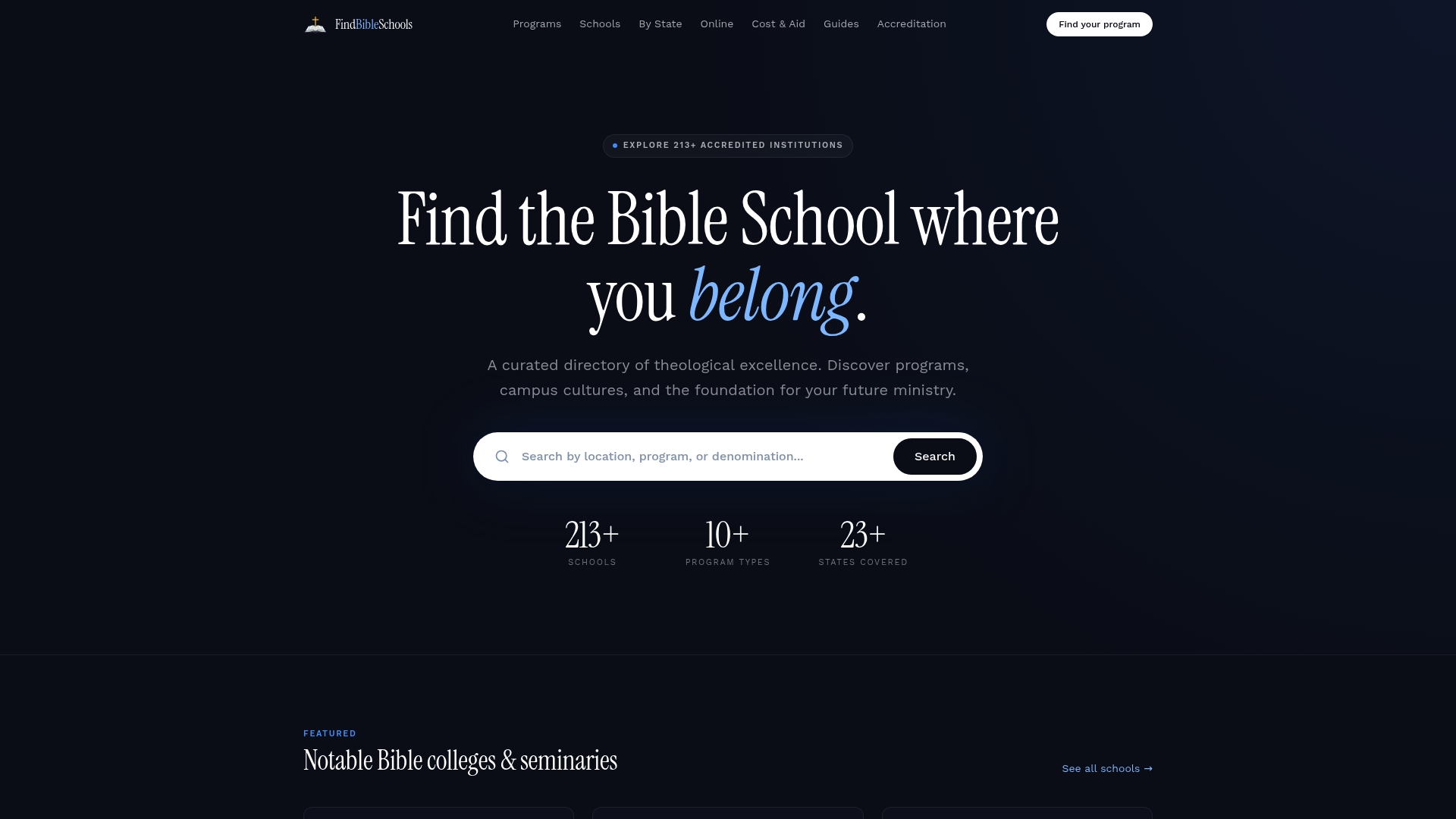
Our program and state pages, including listings like Bible Colleges in Tennessee and Bible Colleges in Ohio, give you the official admissions contact information and reference-form requirements to drop straight into the packet you hand your recommenders. Browse our directory of accredited schools to pull the right links before your next request.
Key sources and sample forms to consult
Reference forms vary by school, so verify the exact fields before your recommender starts writing. Sample institutional reference forms show how rating grids and narrative prompts typically work together, and general privacy governance pages explain why applicants should link recommenders to a program’s official page rather than a third-party summary.
FAQ
What is a good example of a recommendation letter?
A strong example opens by naming the relationship and its duration, gives two or three specific examples of academic work or ministry involvement, and closes with a direct, unambiguous endorsement. Letters built on named incidents, not general praise, read as far more credible to admissions readers.
Can I use ChatGPT to write a letter of recommendation?
A recommender can use an AI tool to organize structure or tighten phrasing, but the substance, specific examples, and honest assessment need to come from the recommender’s own knowledge of the applicant. Admissions readers are trained to spot generic language, so a letter without concrete, personal detail tends to undercut the applicant regardless of who drafted it.
What are impactful words to use in a letter of recommendation?
Words that describe observed behavior, such as “initiative,” “resilience,” “integrity,” and “pastoral instinct,” carry more weight than vague praise like “great” or “wonderful.” The impact comes less from any single word and more from pairing each trait with a specific example that proves it.
What not to say in a letter of recommendation?
Avoid generic praise with no supporting example, comparisons that feel exaggerated, and any language that suggests the recommender barely knows the applicant. A letter should never include information the applicant would not want shared, since most seminary applications ask the applicant to waive their right to see the letter’s contents.