
Published September 11, 2026
Seminary Housing: Use School Examples to Keep Costs Under 35%
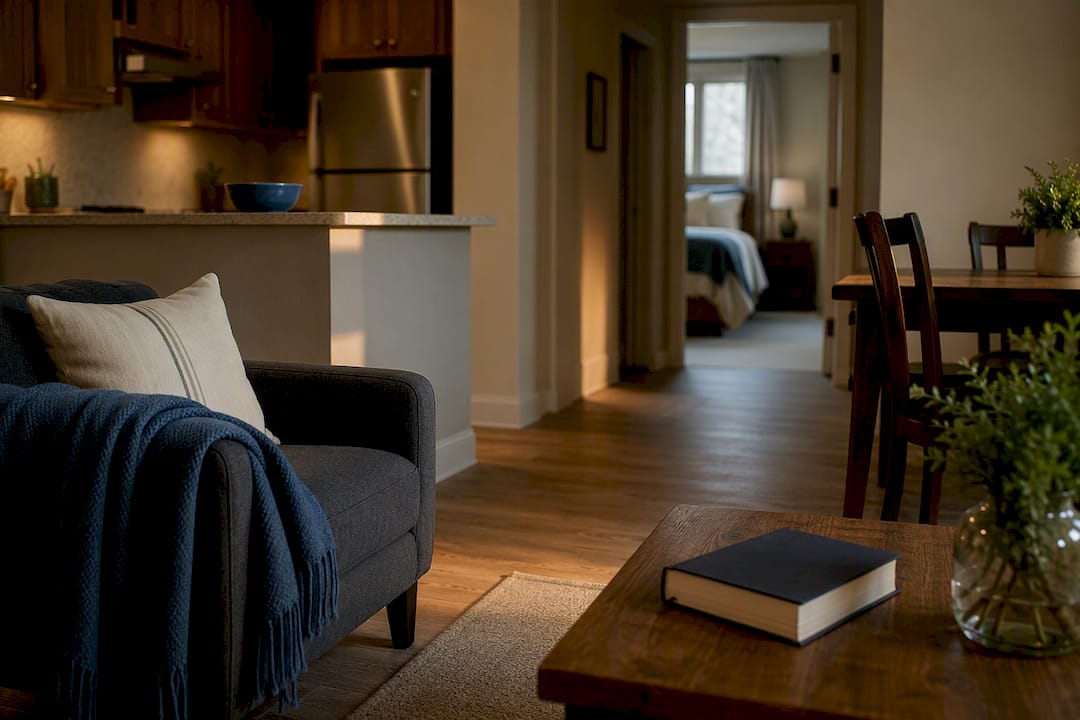
Seminary students usually choose one of three housing routes: on-campus housing (dorms or campus apartments), near-campus partnered apartments, or private rentals. Families tend to favor on-campus family units for the childcare and community they offer, while singles often weigh campus community against the best-priced near-campus option. Always confirm current pricing and availability with the seminary’s housing office before you commit.
TL;DR:
- Seminary housing options are typically limited by family composition, with family units often being in shorter supply than single-student accommodations.
- On-campus apartments generally cost between $1,185 and $1,455 monthly, with utilities included or billed separately, but require careful comparison with local rental markets.
- Applying early and gathering complete documentation can improve chances of securing preferred units, especially family housing, which operates on a rolling basis.
- Lease terms differ from standard apartments, often aligning with the academic calendar and requiring specific documentation if family status changes.
- Community building in on-campus housing offers built-in support networks, while private rentals require more proactive efforts to establish connections.
Table of Contents
- What Kinds of Seminary Housing Are Available?
- How Do You Apply for Seminary Housing?
- What Does Seminary Housing Actually Cost Compared to Renting Nearby?
- Where Should You Look for Housing, and Who Should You Ask?
- How Can You Cut Housing Costs as a Seminary Student?
- What Should You Know About Seminary Housing Leases?
- How Safe Is Seminary Housing?
- What Is Community Life Like in Seminary Housing?
- What Rules Govern Guests, Quiet Hours, and Conduct?
- Author Perspective: What the Housing Pages Don’t Tell You
- Find the Right School Page Before You Call the Housing Office
- Sources
- FAQ
What Kinds of Seminary Housing Are Available?
Most theological schools offer a version of the same three tiers, though the labels differ by campus. Single student housing usually means a dorm room or a shared suite, sometimes with a communal kitchen and bathroom down the hall. Campus apartments range from studios to three-bedroom units, and family units are typically standalone apartments or townhomes designed for spouses and children rather than roommates.
Furnishings and utility inclusions vary by school, but a pattern shows up across the country. Covenant Theological Seminary publishes floorplans for two- and three-bedroom apartments with utilities folded into the monthly rent. Union Theological Seminary in New York City prices its units below the surrounding market and bundles in utilities except for internet and phone. Columbia Theological Seminary and Garrett Evangelical Theological Seminary follow a similar model, with Garrett listing separate utility fee add-ons for some units rather than a flat all-inclusive rate.
Common on-campus amenities include:
- On-site laundry facilities (in-unit washer/dryer at some newer buildings)
- Playgrounds or shared green space at family-oriented campuses
- Assigned parking, often included in the base rent
- Basic internet in some buildings, billed separately in others
Near-campus “partnered” apartments work differently. These are privately owned complexes near the seminary that have negotiated a discounted rate or an application fee waiver for enrolled students. Dallas Theological Seminary maintains one of the more detailed examples of this model, listing several complexes with special student rent and amenities like pools or fitness centers that a typical dorm building would never offer.
How Do You Apply for Seminary Housing?
Housing applications almost always open after admission, and the timeline moves faster than most incoming students expect. Here is the general sequence:
- Accept your admission offer. Housing portals are usually locked until your enrollment status is confirmed.
- Log into the housing portal. Most seminaries assign a separate login from the academic student portal, often activated within a week or two of enrollment confirmation.
- Submit your housing application and any required deposit. Deposits typically range from one-time administrative fees to a full month’s rent held against move-out damage.
- Meet documentation deadlines. Some schools ask for proof of marriage or dependents for family units, income verification for subsidized rates, or a signed housing handbook acknowledgment. Both Union and Columbia publish full housing handbooks alongside their application portals.
- Confirm your assignment and move-in date, which often lands the week before orientation.
Eligibility rules differ, but a few show up consistently: full-time enrollment status, a paid deposit, and priority tiers that usually favor families with children over single students, since family units are in shorter supply. Apply as early as your admission timeline allows. Many housing offices open assignments on a rolling basis by term, and the best units go fast.
If you land on a waitlist, do not panic and do not assume nothing will open. Ask the housing office about temporary or short-term housing options while you wait, check whether local churches keep a list of short-term rentals for seminary families, and watch campus bulletin boards or student Facebook groups, where outgoing students often post sublets timed exactly to your semester start.
What Does Seminary Housing Actually Cost Compared to Renting Nearby?
The sticker price on a campus apartment rarely tells the whole story, and neither does a private listing on a rental site. A fair comparison has to account for everything you would otherwise pay separately.
Build your comparison around these line items:
- Base rent or housing fee
- Utilities (electric, gas, water, trash)
- Internet and phone
- Parking
- Renter’s insurance
- Meal plan, if applicable or required
- Commute cost and time (gas, transit passes, or lost study hours)
- Childcare, if you have dependents
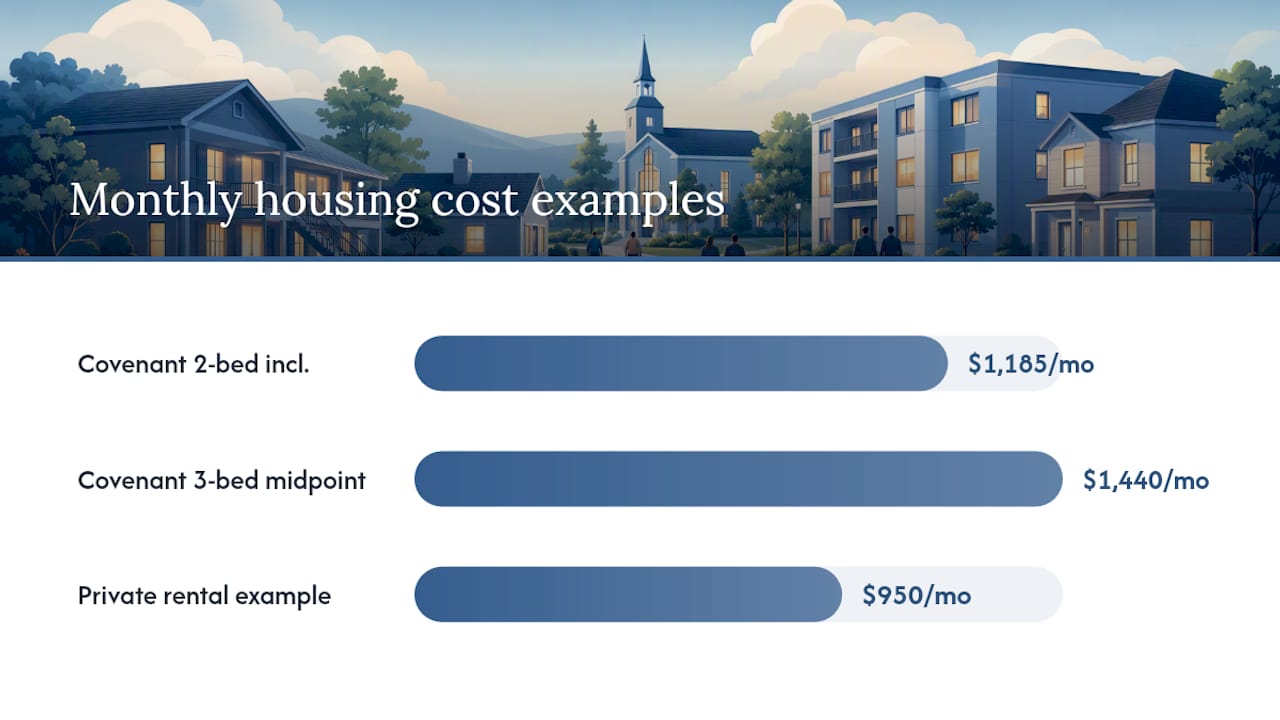
Pro Tip: Ask every housing office for a total monthly cost sheet, not just a rent figure. A $1,185 apartment that includes water, trash, and heat can beat a $950 private rental once you add separately metered utilities.
Covenant’s published rates put a two-bedroom on-campus apartment at $1,185 a month with utilities included, and a three-bedroom between $1,425 and $1,455 for full-time students. Garrett’s on-campus apartments run below typical Chicago-area market rents for comparable units, though the school itemizes some utility fees separately rather than folding them into rent. Neither figure tells you whether it beats your local market until you price out an equivalent private unit with all its separate utility bills included.
Union’s housing office makes an important point that applies almost everywhere: campus housing is often the most predictable cost precisely because it is subsidized relative to the surrounding market, which matters most in expensive cities and for tight family budgets. On-campus housing is not automatically cheaper, though. A shared house with three other students can undercut a solo campus apartment, and a 15-minute commute by car might cost less monthly than the convenience premium some campuses charge. Run the full math before assuming closer to campus means cheaper.
Where Should You Look for Housing, and Who Should You Ask?
Start with the seminary’s own housing office before you open a single rental app. Schools like Dallas Theological Seminary keep negotiated partner lists that are not always advertised on the public website, and staff can tell you which units on that list are family-friendly versus geared toward single students.
From there, widen your search using these resources:
- The seminary’s off-campus housing database or bulletin, if one exists
- Student social media groups and class cohorts, where outgoing students post subleases
- Local apartment complexes that specifically advertise student or “seminary rate” discounts
- Nearby churches, which sometimes maintain informal housing lists for seminary families
Before you tour or apply anywhere, gather proof of enrollment, a government ID, recent pay stubs or a financial aid award letter, and references if you are coming from out of state. On the tour itself, ask directly: Are utilities included, and which ones? What is the pet policy? What is the lease length, and does it align with the academic calendar? Is there a special student rate, and does that rate apply to renewals or only the first lease term?
That last question matters more than most students realize. Confirm whether a discounted student rate is a new-lease promotion or a rate that holds through renewal before you sign, because a complex that quotes a great deal for year one can jump to full market rate for year two.
How Can You Cut Housing Costs as a Seminary Student?
A few tactics consistently save money for both single students and families:
- Apply the moment your admission is confirmed. Early applicants get first pick of the cheapest and best-located units.
- Ask explicitly about partner rates. Housing offices do not always list every negotiated discount on the public website.
- Consider shared housing or a resident assistant role, which sometimes comes with reduced or waived rent in exchange for light duties.
- Ask about childcare subsidies or on-campus child care, since a campus with a play space or discounted daycare can offset a higher rent.
- Negotiate move-in fees, especially at private complexes that advertise “student rates,” where application or admin fees are sometimes waivable on request.
A workable budgeting rule: aim to keep housing at no more than 30 to 35 percent of your net monthly budget, adjusting upward slightly for larger families who need more bedrooms. Set aside a separate move-in fund for security deposits and first month’s rent before you ever start touring, since most leases require both at signing. And when comparing options, calculate the true monthly cost, not just quoted rent. Add utilities, commute expenses, and any fees the listing does not mention up front. On-campus housing tends to run higher on paper but lower in total cost once those extras are counted.
What Should You Know About Seminary Housing Leases?
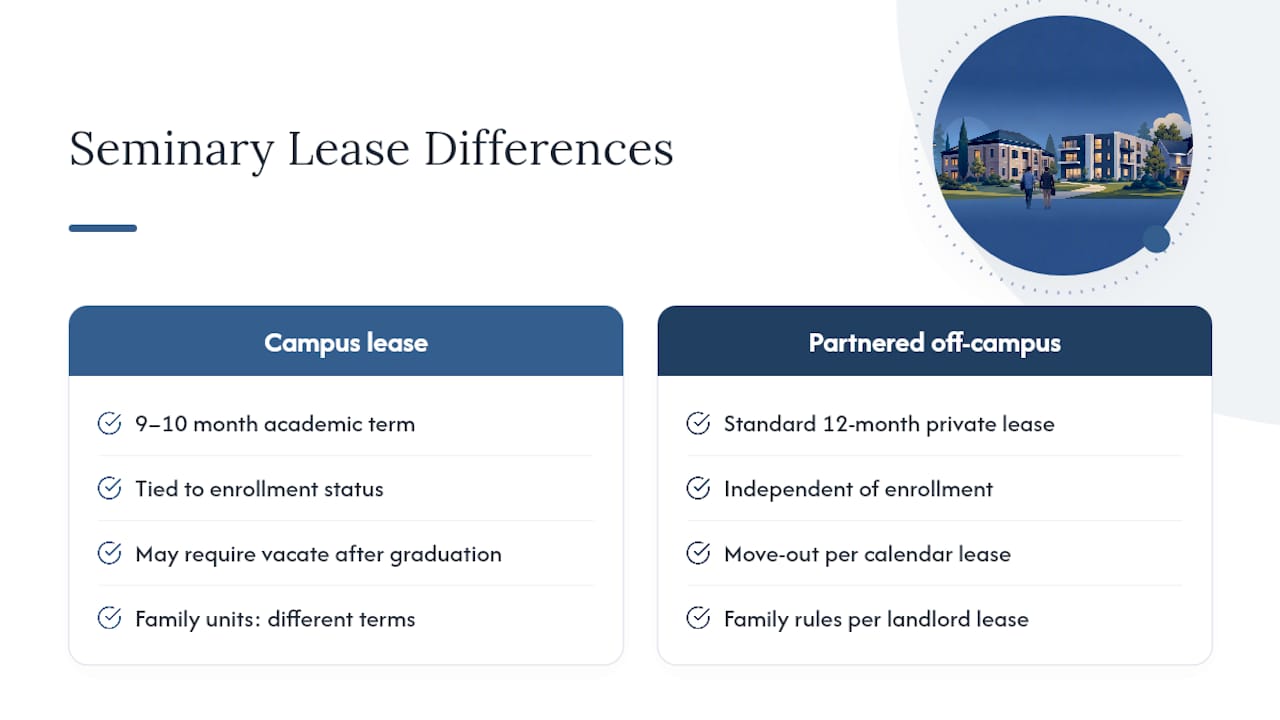
Seminary leases rarely run on the standard twelve-month cycle you would expect from a typical apartment complex, and that difference catches a lot of students off guard. Many on-campus housing agreements track the academic calendar instead, running roughly nine or ten months with an optional summer extension for students staying through a summer intensive or continuing research.
Read the lease for a few seminary-specific clauses before you sign. Some campus housing agreements tie your lease directly to enrollment status, meaning if you drop below full-time status or take a leave of absence, the housing agreement can terminate independent of the calendar date on the lease. Others include a clause requiring you to vacate within a set number of days after graduation or withdrawal, which matters if you are planning a summer internship or a cross-country move right after commencement.
Family units sometimes carry different terms than single-student housing, including longer notice periods for move-out and different guest or occupancy limits tied to lease size. If you are bringing a spouse or dependents, confirm whether both need to be named on the lease and whether the housing agreement requires updated documentation if your family situation changes during your enrollment.
Near-campus partnered apartments, by contrast, often use a standard twelve-month private lease, even when the seminary negotiated the discounted rate. That means normal landlord-tenant rules apply, including standard notice periods for renewal or non-renewal, which can differ sharply from the academic-calendar leases used on campus. Read both lease types side by side before deciding, and ask the housing office to clarify anything written in legal language you don’t fully follow. A five-minute question now beats a costly surprise at move-out.
How Safe Is Seminary Housing?
Campus housing tends to benefit from the same security infrastructure as the rest of the seminary, including controlled building access, campus security patrols, and emergency contact systems tied directly to student services. Ask specifically whether buildings use keycard or fob access, whether security cameras cover common entrances and parking areas, and whether campus security offers an escort service for students walking to and from evening classes or the library.
Family units deserve an extra layer of scrutiny. If you are relocating with children, ask about fenced play areas, whether visitor access to family housing sections is restricted, and how the campus handles emergency notifications for the buildings where families live specifically.
Near-campus partnered apartments and private rentals require you to do more of that homework yourself. Check whether the building has secured entry, ask current tenants (not just the leasing office) about their experience with maintenance response and any safety incidents, and look up the neighborhood’s general safety reputation independent of what a leasing agent tells you. A partner discount does not guarantee a safe building, only a lower rate.
Whichever route you choose, confirm the process for reporting maintenance issues that affect safety, like broken locks or non-functioning exterior lighting, and how quickly the housing office or landlord typically responds. Slow maintenance turnaround on a broken door lock is a bigger red flag than most students think to ask about during a tour.
What Is Community Life Like in Seminary Housing?
On-campus housing tends to build community almost by design. Shared laundry rooms, courtyards, and family playgrounds put students and their families in regular contact with classmates who understand the exact pressures of seminary life, from comprehensive exams to balancing ministry internships with coursework. That built-in support network is one of the strongest arguments for choosing on-campus housing over a cheaper but more isolated private rental.
Many campuses organize this informally through cohort housing, where students in the same degree program or entering class end up clustered in the same building or floor. Others formalize it further with resident chaplains, weekly community meals, or family potlucks designed specifically to connect spouses and children of seminarians who might otherwise feel disconnected from the academic side of campus life.
Family housing sections in particular often develop tight-knit micro-communities, since spouses raising children through a partner’s seminary years tend to lean on each other for childcare swaps, carpooling, and simple companionship during a demanding season. Near-campus partnered apartments retain some of this benefit, since a cluster of seminary students in the same complex still crosses paths regularly, even without the shared campus infrastructure.
Private rentals, by contrast, put the burden of building community entirely on you. That does not mean isolation is inevitable. Many students in private housing stay connected through campus chapel, student organizations, or shared classes, but it does mean community will not happen automatically the way it can in a dorm hallway or family housing complex. If community is a top priority, weigh that against any cost savings a private rental offers.
What Rules Govern Guests, Quiet Hours, and Conduct?
Seminary housing agreements typically include a code of conduct that extends beyond what a standard apartment lease would require, since most schools operate under a denominational or institutional statement of faith that shapes community expectations. Expect the handbook to cover guest policies, noise restrictions, and general conduct standards tied to the school’s mission.
Guest policies usually distinguish between short daytime visits, which are typically unrestricted, and overnight stays, which often require advance notice to a resident director or housing office, particularly in single-student dorms. Family units generally carry more flexible guest policies than single-student housing, reflecting the different privacy expectations of a family apartment versus a shared dorm floor.
Quiet hours are close to universal, typically running from around 10 or 11 p.m. to early morning, with stricter enforcement during final exam periods. Some campuses extend quiet expectations into daytime “study hours” in shared buildings, especially near libraries or common study spaces.
Conduct codes at many seminaries also address alcohol use, overnight opposite-sex guest policies in single-student housing, and general community behavior standards consistent with the school’s denominational identity. These policies vary meaningfully by institution and tradition, so read the specific handbook for your school rather than assuming a rule from one seminary applies at another. Near-campus partnered apartments and private rentals generally follow standard landlord conduct clauses instead, with far fewer faith-based conduct requirements, which is worth factoring in if campus-specific conduct policies feel restrictive for your situation.
Author Perspective: What the Housing Pages Don’t Tell You
Reviewing housing pages across more than 213 accredited institutions on Findbibleschools makes one pattern obvious: the schools that publish detailed floorplans and exact rent figures, like Covenant and Garrett, tend to be more transparent across the board, from accreditation details to financial aid disclosures. That correlation is not proof of anything specific about housing quality, but it is a reasonable signal worth weighing when you are choosing between two similar programs. Rates, waitlist rules, and partner apartment lists change from year to year and sometimes from term to term, so treat everything in this guide as a starting framework and verify current numbers directly with each school’s housing office before you budget around them.
— Grant
Find the Right School Page Before You Call the Housing Office
There are platforms that collect seminary program information in one place, listing tuition, accreditation status, denominational fit, and often links to campus life and housing details, to help you find what you need before contacting a housing office.
If you already have a program or region in mind, start with a specific school page like Covenant Theological Seminary, which publishes some of the more detailed housing pricing in the country, or Dallas Theological Seminary, known for its partner apartment network. Searching by state works too. Bible colleges in Tennessee and Bible colleges in Kentucky are useful starting points if you are weighing regional cost of living alongside program fit. Search for schools near your intended campus on Findbibleschools, shortlist two or three that fit your budget and calling, and then contact admissions and housing directly to confirm current rates and availability.
Sources
- America’s Largest Seminaries in 2023–24
- Student Housing | Covenant Theological Seminary
- Apartment Options
- Union Housing - Union Theological Seminary
FAQ
What Are the Largest Seminaries in the United States?
Liberty University’s Rawlings School of Divinity reported 4,050 full-time equivalent students, making it the largest seminary in the country by that measure. Other large programs include Southern Baptist Theological Seminary and Dallas Theological Seminary, both of which enroll thousands of students across residential and online formats.
Is Fuller Theological Seminary LGBTQ Affirming?
Fuller Theological Seminary holds to a traditional evangelical statement of faith and community standards, and it is not classified as LGBTQ affirming in its official policies. Prospective students should review Fuller’s current community standards directly on its official pages, since policies can be updated and vary from what other seminaries in the same tradition require.
What Is the Biggest Seminary in the US by Enrollment?
By full-time equivalent enrollment, Liberty University’s Rawlings School of Divinity ranks as the largest seminary in the country, with 4,050 FTE students reported. Enrollment scale like this affects housing supply, since larger schools generally need more family and single-student units to keep pace with demand.
What Is the Average Cost of Seminary School?
Seminary tuition and housing costs vary widely by school, denomination, and program level, so there is no single average that applies across the board. Published examples show on-campus housing alone running from roughly $1,185 a month for a two-bedroom apartment at Covenant Theological Seminary to below-market rates at Union Theological Seminary in New York City, and comparing a specific school’s tuition and housing page directly is the only reliable way to budget accurately.
Does On-Campus Housing Include Utilities?
Most on-campus seminary housing includes basic utilities like water, trash, and heat in the monthly rent, though internet and phone are frequently billed separately. Confirm the exact inclusions with each school’s housing office, since the details differ even among schools that advertise “utilities included.”