
Published September 11, 2026
Choose the Right Seminary for Women, With a Checklist and 213 Profiles

Seminary is a legitimate and often transformative option for women pursuing ministry, deeper theological study, or vocational discernment. The right next step is practical: decide your vocational aim, compare program types and formats, then check finances and support structures at each school. A comprehensive online directory is a reasonable place to start building that shortlist.
TL;DR:
- Most seminary programs offer targeted scholarships and denominational support, so applicants should research combined funding options to lower net costs.
- Online and hybrid formats provide flexible study options for women balancing ministry, work, or family commitments, though in-person programs often offer stronger mentorship.
- Schools with ongoing women-focused support structures, such as dedicated centers and mentoring programs, demonstrate deeper institutional commitment than one-time events.
- When evaluating schools, clarify their doctrinal stance on women’s ministry roles and ask for recent outcomes data to ensure alignment with your vocational goals.
- Certificate programs serve as accessible entry points for women testing a call, with less time and financial commitment than full degrees like the MDiv or ThM.
Table of Contents
- Why Women Attend Seminary for Theological Formation
- Seminary Program Types and Tracks for Women
- Paying for Seminary Without Drowning in Debt
- Finding Real Women-Focused Support on Campus
- How to Choose the Right Seminary Program
- Admissions Requirements and How to Prepare
- Comparing Seminary Options Through Findbibleschools
- A Word of Encouragement for Women Considering Seminary
- Compare Women-Friendly Seminary Programs Today
- Primary Sources and Further Reading
- Sources
- FAQ
Why Women Attend Seminary for Theological Formation
Theological literacy is not a luxury for women in ministry. It is protection. The CBE International essay on theological formation makes a direct case that sustained study strengthens women’s discernment and spiritual agency, making them harder to mislead through distorted or manipulative teaching and better equipped to participate fully in ministry rather than sit on its edges.
Motivations vary widely, but a few patterns show up again and again among women who apply:
- Preparing for formal leadership in women’s ministry, counseling, or discipleship roles
- Training for missions work, chaplaincy, or cross-cultural ministry
- Pursuing teaching or publishing careers in biblical or theological studies
- Seeking personal formation and a deeper, more disciplined walk with Scripture
- Discerning a call that has been unclear or unconfirmed for years
Seminary differs from independent Bible study in ways that matter. You get structured accountability, faculty mentoring from scholars who have spent decades in the text, and peer relationships that sharpen your thinking through disagreement, not just affirmation. That combination is difficult to replicate on your own.
One caveat worth naming early: denominations differ sharply on which public ministry roles are open to women. Some ordain women to pastoral ministry without restriction; others reserve ordination for men while training women extensively for teaching, counseling, and diaconal roles. Knowing where a school and its sponsoring denomination stand before you enroll saves you from a painful mismatch later.
Seminary Program Types and Tracks for Women
Degree options for women in seminary break down into a few clear categories, and picking the right one starts with naming your goal, not browsing a catalog.
The Master of Divinity (MDiv) is the broadest professional degree, typically three years, and the standard credential for ordination tracks, chaplaincy, and most pastoral or associate ministry roles. A Master of Arts (MA) in theology or biblical studies is shorter and often more flexible, suited to teaching, writing, or lay leadership rather than ordination. Certificate programs run a single year or less and work well for women testing a call before committing to a full degree. Doctoral programs (ThM, DMin, PhD) serve women aiming at academic teaching or advanced specialized ministry.
Several schools have built tracks specifically around women’s vocational paths:
- Southeastern Baptist Theological Seminary offers an MDiv concentration in Ministry to Women, preparing graduates for church and denominational ministry roles outside the pastoral track.
- Concordia Theological Seminary runs a Master of Arts in Deaconess Studies, with formation specific to diaconal service.
- Northern Seminary pairs its general MA offerings with a Women and Ministry specialization through its Center for Women in Ministry.
Format matters as much as degree type. Residential programs build community and put you in the same room as mentors and classmates every week, which many women find irreplaceable during a season of discernment. Online and hybrid options, common at schools like Gordon-Conwell Theological Seminary, let you study while parenting, working, or serving in a current ministry role, though you will need to work harder to build mentoring relationships without a physical campus.
Paying for Seminary Without Drowning in Debt
Funding a seminary education takes more than one scholarship application. It usually takes a combination.
- Institutional scholarships offered directly by the seminary, often need-based or merit-based, and sometimes designated specifically for women in ministry.
- Denominational support, where your sending church or denomination covers part or all of tuition in exchange for a ministry commitment after graduation.
- External scholarships from foundations, women’s ministry networks, or theological associations unrelated to any single school.
- Work-study and campus employment, which reduces net cost while adding relevant ministry or research experience to your resume.
- Employer or church tuition assistance, particularly if you already work on staff somewhere.
Some schools now advertise low-cost or debt-free program models. These are worth investigating, but the label alone tells you little. Program structures, eligibility rules, and what counts toward “debt-free” vary widely, so ask for specifics rather than taking the marketing at face value.
When comparing offers, calculate net cost, meaning tuition and fees minus aid, plus realistic living expenses, not the sticker price alone. Most scholarship deadlines fall months before enrollment deadlines, so build your financial aid timeline before your admissions timeline, not after.

Pro Tip: If a school doesn’t list a scholarship specifically for women in ministry, ask the financial aid office directly whether targeted funds exist. Many are awarded quietly, on request, rather than advertised on the main aid page.
Finding Real Women-Focused Support on Campus
Not every “women’s program” is built the same. Some are a single annual event; others are sustained institutional infrastructure with real depth.
A Center for Women in Ministry, like the one at Northern Seminary, typically bundles mentoring, dedicated scholarships, programming, and an alumni network into one ongoing structure rather than a one-off gesture. That kind of sustained programming, not a single chapel service or luncheon, is the reliable signal of institutional commitment to women’s formation.
Before enrolling, ask schools directly:
- Is there a formal mentoring structure for women, and who leads it?
- Does the school offer cohort-based programs or peer groups for women specifically?
- Where do practicum and internship placements typically send women graduates?
- What is the reporting structure if a student experiences harassment or discrimination?
- How many women serve on faculty, and in what departments?
Treat vague answers as a warning. A school that can only point to a chapel talk from three years ago, with no ongoing programming, scholarship line, or named staff contact, is offering symbolism rather than support.
How to Choose the Right Seminary Program
Choosing well means comparing schools on the same criteria side by side, not falling for whichever glossy brochure arrives first.
- Confirm theological and denominational fit. Read the school’s doctrinal statement and ask directly what roles it ordains or licenses women into.
- Ask for outcomes data. Request completion rates and where recent graduates work now, not just a list of famous alumni from decades ago.
- Evaluate faculty expertise and availability. Ask whether faculty teach, advise, and mentor, or whether teaching is handled mostly by adjuncts with limited office hours.
- Check practicum and ministry placement support. Ask where women specifically have been placed in the last two years.
- Compare true cost. Request a written estimate of tuition, fees, and typical living costs for your situation, not the published sticker price.
- Ask for alumni contacts. A school confident in its outcomes will connect you with recent graduates willing to talk honestly.
| Criterion | What to ask | Red flag |
|---|---|---|
| Theological fit | What ministry roles are women ordained or licensed for? | Vague or evasive answer |
| Outcomes | What is the completion rate and recent job placement? | No data offered |
| Mentoring | Who mentors women students, and how often? | No named contact |
| Cost | What is my net cost after aid? | Only sticker price given |
| Community | Is there an ongoing women’s cohort or center? | Single past event cited |
Use this checklist against three to five schools at once. Patterns emerge fast once you see the answers side by side.
Admissions Requirements and How to Prepare
Most graduate seminary programs require a bachelor’s degree, official transcripts, two or three references, a personal statement describing your calling, and often an interview. Certificate programs and some non-degree continuing education tracks skip the bachelor’s requirement entirely, making them a practical entry point if you’re switching careers or testing a call before committing years and tuition to a full MDiv.
Start your application timeline roughly nine to twelve months before your intended start date. References and scholarship applications both take longer than expected, and many aid deadlines land well before the general admissions deadline.
If you have no formal theology background, don’t let that stop you:
- Certificate programs at schools like Moody Bible Institute offer a low-stakes bridge into graduate-level work.
- Part-time MDiv tracks let you build foundational coursework gradually while working.
- Admissions offices frequently recommend preparatory reading lists or non-credit courses so you arrive ready, not overwhelmed, in your first semester.
Comparing Seminary Options Through Findbibleschools
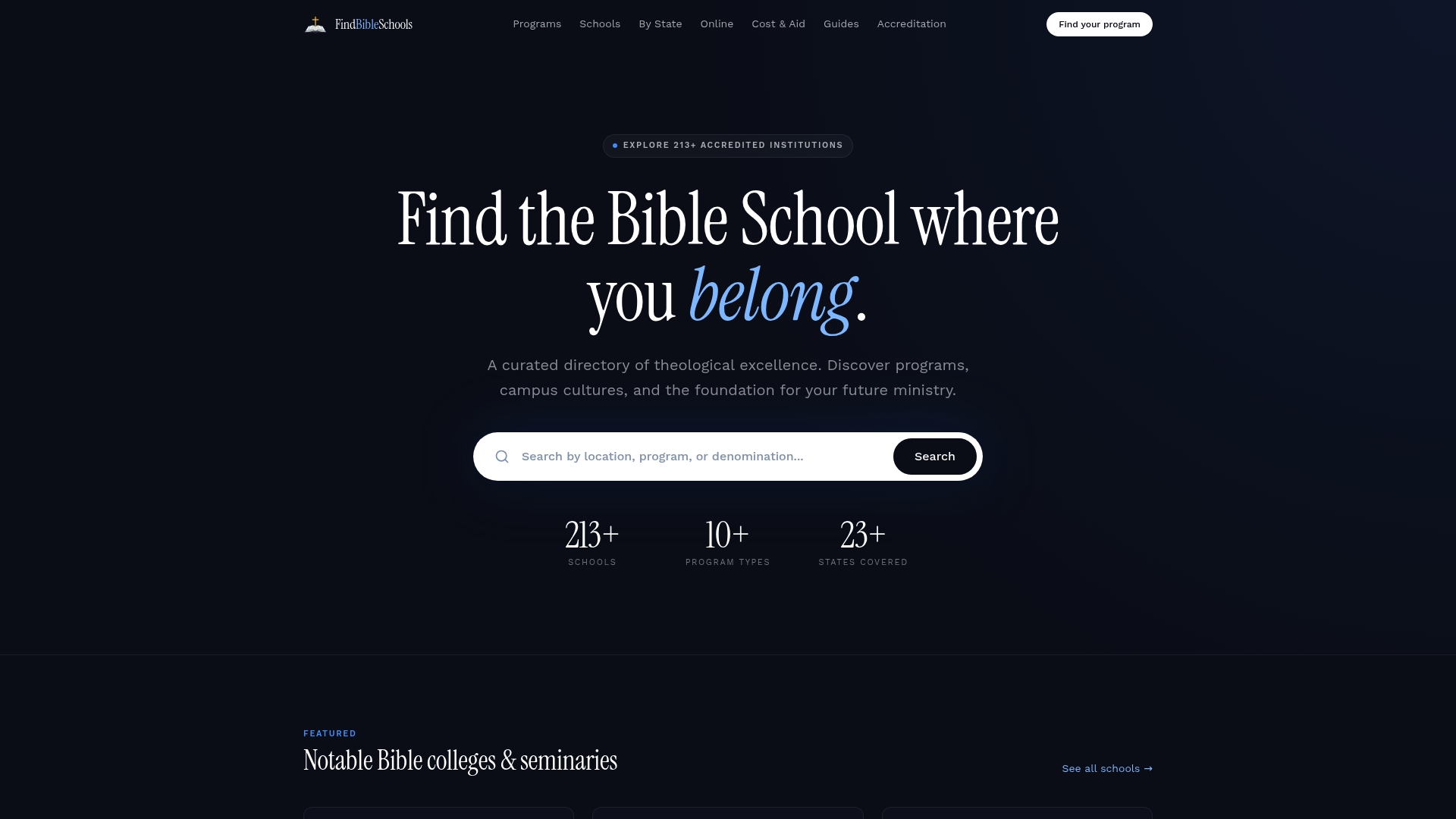
Building a shortlist gets easier once you can compare programs side by side instead of digging through a dozen separate websites. Findbibleschools maintains profiles for more than 213 accredited theological institutions, with details on program types, tuition, accreditation status, and campus culture in one format.
Practical ways to use it:
- Filter by degree type (certificate, MA, MDiv, doctoral) to match your vocational goal
- Compare tuition and accreditation side by side across multiple schools at once
- Review campus culture notes before reaching out to admissions, so your questions are sharper
- Use school profiles, such as Fuller Theological Seminary or Covenant Theological Seminary, as a starting template for the comparison checklist above
A Word of Encouragement for Women Considering Seminary
Sustained theological formation changes how you read Scripture, lead, and counsel others, and that shift is worth pursuing seriously. No school gets everything right. Institutions vary in how deeply they support women, so discernment matters as much as ambition. Use the tools available, ask admissions teams hard questions, and trust the process enough to start it.
— Grant
Compare Women-Friendly Seminary Programs Today
Findbibleschools gives you one place to compare seminary programs for women instead of chasing tuition figures and accreditation notes across a dozen separate school websites. That matters most when you’re weighing a Ministry to Women track against a general MDiv, or a residential program against an online one, and need the numbers side by side to make a real decision.
Start by browsing theology programs and degree types to see how MDiv, MA, and certificate tracks stack up against your timeline and budget. If you want a specific school to compare against, Talbot School of Theology at Biola University is a solid benchmark for evaluating faculty mentoring and program depth. Before you commit anywhere, review our guide to ATS accreditation so you know exactly what that credential guarantees and what it doesn’t. Pick two or three schools from your shortlist and reach out to their admissions offices this week.
Primary Sources and Further Reading
For deeper reading: the CBE International essay on theological formation, Northern Seminary’s Center for Women in Ministry, Concordia’s Deaconess Studies MA, and SEBTS’s Ministry to Women track. For historical context on women’s role in Scripture, see this overview of women in the Bible.
Sources
- Let Them Learn: Why Theological Formation Still Matters, Especially for Women — CBE International
- Center for Women in Ministry | Northern Seminary
- Master Of Arts In Deaconess Studies–Residential | Concordia Theological Seminary, Fort Wayne
- MDiv (Ministry to Women) - Southeastern Baptist Theological Seminary
FAQ
Can women go to seminary?
Yes. Women attend and graduate from seminary programs across nearly every denomination, though the ministry roles open to them after graduation vary by denominational teaching.
Why would a woman go to seminary?
Common reasons include preparing for ministry leadership, counseling, missions, or teaching roles, deepening personal theological formation, and discerning an unclear calling with structured guidance and mentoring.
Are there any free seminaries?
Fully free seminaries are rare, but many schools offer significant scholarships, denominational funding, or low-cost program models that dramatically reduce net cost. Verify the specific terms directly with the financial aid office rather than relying on marketing language.
Do you need a four-year degree to go to seminary?
Most graduate degrees like the MDiv or MA require a bachelor’s degree, but certificate programs and some non-degree continuing education tracks do not, making them a practical entry point for women without a prior theology background.