
Published September 24, 2026
Four Things Your Seminary Application Essay Must Prove and Verify

Your seminary application essay has to do four things at once: state your sense of call in plain language, back it up with two or three concrete examples of ministry or spiritual formation, connect your goals to what the specific program actually offers, and follow that program’s word count and formatting rules exactly. Miss any one of these, and even a beautifully written essay reads as incomplete to an admissions committee.
TL;DR:
- A strong seminary essay must demonstrate a clear sense of call with a specific scene and include concrete examples of ministry or spiritual growth.
- Essays should be concise, around 350 to 600 words, structured to introduce a vocational claim, support it with stories, include a theological reflection, and connect to the specific program.
- Tailoring the essay to the program involves researching its mission, faculty, and unique features, and referencing these details to show genuine fit and preparation.
- Applicants must follow formatting rules exactly, avoid generic language and excessive repetition, and ensure their stated goals align with the program’s offerings.
- Verifying prompts, word limits, and policies directly from each school’s admissions page helps prevent costly mistakes and ensures the essay meets all requirements.
Table of Contents
- What Do Seminary Admissions Committees Expect From a Seminary Application Essay?
- How Long Should a Seminary Application Essay Be?
- How Do You Draft and Revise a Seminary Application Essay?
- What Do Strong Seminary Essay Examples Actually Do?
- What Should Be on Your Seminary Application Submission Checklist?
- Why Trust Find Bible Schools for Seminary Application Research?
- What Common Mistakes Weaken a Seminary Application Essay?
- How Do You Tailor a Seminary Essay to a Specific School or Denomination?
- How Should You Address Weaknesses or Gaps in Your Background?
- How Do You Reflect on Your Faith Journey Authentically?
- How Do You Use Scripture and Theology Well in a Seminary Essay?
- The Gap Between Advice and Practice
- Compare Programs and Check Essay Prompts Before You Draft
- Sources
- FAQ
What Do Seminary Admissions Committees Expect From a Seminary Application Essay?
Most seminary application essay prompts cluster around three or four recurring questions, even when the wording changes from school to school. Committees want to understand your sense of call, see evidence of your gifts and ministry experience, hear where you want to go professionally or vocationally, and sometimes read a distinct statement of faith. Bethany Seminary’s admissions instructions, for instance, spell out specific topics and page limits rather than leaving applicants to guess.
The trap is treating these prompts like a checklist. A reader can tell within a paragraph whether you are answering the question or performing an answer you think they want. The stronger move is to let one real narrative do double duty. A summer spent leading a youth ministry can demonstrate call, gifts, and goals all at once, if you write it that way instead of splitting it into three disconnected sections.
A few reusable building blocks work across most applications:
- A moment when you first sensed a vocational pull, described with a specific scene rather than a general feeling
- A leadership or service role where you saw tangible fruit, even if it was small (a Bible study that grew, a conflict you helped resolve)
- A clear statement of what you hope the degree will let you do that you cannot yet do
United Theological Seminary’s admissions guidance reinforces this pattern, encouraging applicants to show motivation and concrete background rather than abstract piety.
How Long Should a Seminary Application Essay Be?
Word limits vary, but the math is consistent enough to plan around. One page double-spaced runs roughly 500 to 600 words, and many programs ask for 350 to 500 words per individual prompt. Some schools want a single combined statement; others break the essay into three or four shorter responses. Check the exact number before you draft, because trimming a 900-word essay down to 400 later is far harder than writing tight from the start.
A structure that scales up or down works better than one built for a specific word count:
- Open with a one-sentence vocational claim that tells the reader exactly what you believe you are called to do.
- Follow with one or two concrete stories that support that claim, no more.
- Add a short theological or intellectual reflection on what that experience taught you.
- Close by naming the specific program and explaining why it fits your next step.
Formatting matters more than applicants expect. Use a standard readable font with appropriate margins, and submit in the format requested by the application portal, commonly PDF. Include your name and the essay title on the document itself, since files get separated from their online submission context more often than applicants realize.
How Do You Draft and Revise a Seminary Application Essay?
Start before you’re ready to write a polished sentence. Spend ten minutes freewriting answers to blunt prompts: “When did I first take my faith seriously as an adult decision?” or “What is the hardest pastoral conversation I’ve had?” Vanderbilt Divinity School’s admissions guidance recommends exactly this kind of timed exercise to surface material you would not reach through outlining alone.
From there, a workflow that actually gets finished looks like this: rough outline, a focused first draft written in one sitting without editing, a structural pass to check whether the essay answers the prompt, a line edit for voice and clarity, then a final read aloud to catch anything that sounds stiff on the page but stranger out loud.
Before you submit, run the draft against this checklist:
- Does every paragraph contain a specific detail, not just a general spiritual claim?
- Have you avoided phrases like “I’ve always felt called” without ever showing what that call looks like in action?
- Are scripture references and any citations formatted consistently?
- Does your stated goal actually match what this specific program offers?
- Has someone else read it for grammar and tone?
Pro Tip: Read your closing paragraph out loud to someone who has never met you. If they can’t tell you what program you’re applying to or why, the fit section needs more specificity.
Reviewers notice vagueness fast, and an essay that claims a dramatic call but never proves it through experience is the single most common red flag. A close second: goals that don’t line up with the program’s actual strengths, which signals you didn’t research the school before applying.
What Do Strong Seminary Essay Examples Actually Do?
Published examples are useful less for their content than for their structure. A personal statement written for Yale Divinity opens by naming a specific tension the applicant experienced between academic doubt and pastoral service, rather than a generic declaration of faith. That single move accomplishes something most drafts miss: it gives the reader a reason to keep reading in the first sentence.
Three moves worth studying and adapting:
- The vocational opening. Instead of “I believe God has called me to ministry,” a stronger version names the moment that belief became unavoidable: a hospital room, a mission trip, a conversation that didn’t go the way it was supposed to.
- The compact anecdote. One short story, tightly told, does more work than three loosely summarized experiences. A single paragraph about mediating a conflict between two church volunteers can demonstrate pastoral maturity better than a full paragraph of resume-style bullet points.
- The closing that names the program. Generic closings (“I look forward to growing in this program”) do nothing. A closing that names a specific concentration, faculty member, or degree track shows the committee you’ve actually read their site.
A statement that ties a concrete personal turning point directly to the institution’s specific program track, rather than describing faith in the abstract, tends to read as more credible to admissions readers evaluating formation and fit.
If you’re working with a tighter word count, cut the anecdote to two or three sentences and let the vocational opening and program-fit closing carry more weight. If you have room to expand, the theological reflection paragraph is usually where added depth pays off most.
What Should Be on Your Seminary Application Submission Checklist?
Before you hit submit, confirm the small details that trip up otherwise strong applications: correct filenames, the right file type (usually PDF), any supplemental documents like a resume or pastoral reference, and whether your essay’s stated goals match the rest of your application materials. Portals like a school’s online application system often list these requirements explicitly, so check the actual page rather than relying on memory from a previous cycle.

AI policy deserves specific attention. Program-level rules can differ from what the broader institution states, and GradPilot’s reporting on conflicting AI policies found that applicants sometimes encounter contradictory guidance between a seminary’s general policy and a specific program’s admissions page. When that happens, follow the stricter rule.
Using AI for brainstorming or grammar checks is generally treated differently than using it to generate the reflective content itself. Capital University’s commentary on AI in seminary formation argues that AI-written reflections can bypass the exact formative process admissions committees are trying to evaluate.
- Confirm filenames match what the portal requests
- Verify supplemental documents (resume, references, transcripts) are complete
- Re-read the program’s specific AI and originality policy, not just the school’s general statement
- Email admissions directly if anything is ambiguous, and keep a copy of their response
Why Trust Find Bible Schools for Seminary Application Research?
A comprehensive directory offers profiles of many accredited theological programs across various degree levels, including details on tuition, accreditation, and campus culture sourced from program pages. That matters here because essay prompts, word limits, and supplemental requirements change from school to school and year to year.
Before finalizing an essay, use a program’s page to verify the exact prompt wording, confirm accreditation status, and check whether financial aid materials need to accompany your application. Program pages for schools like Fuller Theological Seminary or Trinity Evangelical Divinity School are built for exactly this kind of cross-check. Findbibleschools does not replace the admissions office, but it saves you from drafting an essay based on outdated or secondhand instructions.
What Common Mistakes Weaken a Seminary Application Essay?
The most frequent failure is generic spiritual language standing in for actual evidence. “I feel called to serve God’s people” tells a committee nothing they can evaluate; a specific story about what serving God’s people has actually looked like tells them everything. Committees read hundreds of these essays and can spot a template from the first paragraph.
A second common mistake: writing one essay and sending it everywhere with only the school’s name swapped out. Admissions readers can tell when a fit paragraph was written for a different institution, especially if it mentions a concentration or faculty focus that doesn’t exist at their school.
Ignoring format instructions is a smaller but avoidable error. Submitting 900 words when the limit is 500, or skipping a required subheading structure, signals carelessness before the committee even reads your content. Similarly, essays that answer only the surface of a prompt (naming a goal without explaining why that goal requires this specific degree) leave the reader unconvinced.
Finally, watch for a mismatch between your stated goals and the program itself. If your essay describes a passion for hospital chaplaincy but you’re applying to a program with no chaplaincy track or clinical pastoral education partnership, that gap reads as a lack of research rather than ambition.
How Do You Tailor a Seminary Essay to a Specific School or Denomination?
Generic essays get generic responses. Tailoring starts with reading the actual mission statement and degree descriptions on the school’s site, not just skimming the homepage. If a seminary emphasizes Reformed theology, contemplative practice, or urban ministry, your essay should show you understand what that emphasis means in practice, not just repeat the phrase back.
Denominational fit matters even more directly for schools tied to a specific tradition. An essay for a program requiring ordination sponsorship should name your denominational affiliation and any endorsement process you’ve started, since the committee needs to know you understand the institutional path ahead of you. A nondenominational or interdenominational seminary, by contrast, may care more about how you’ve engaged across traditions than which one you belong to.
Small details signal genuine research: naming a specific concentration, referencing a faculty member’s area of focus, or connecting your goals to a distinctive program feature like a residency requirement or a specific field education model. None of this requires flattery. It requires specificity that could only apply to that one school.
How Should You Address Weaknesses or Gaps in Your Background?
A gap in your academic record, a late start to ministry, or a nontraditional path into seminary does not need to be hidden. Admissions committees see plenty of applicants with unconventional timelines, and an essay that acknowledges a weakness briefly and moves toward what you learned from it usually reads as more credible than one that pretends everything has been smooth.
The key is proportion. Spend one or two sentences naming the gap honestly (a low GPA semester, a career change, a period of doubt), then pivot quickly to what changed and what evidence now exists that you’re ready. Don’t let the weakness dominate the essay or turn into an extended apology.
If the gap is academic, a program may want a brief explanation in a separate section rather than buried in your personal statement. Check whether the application has a place for that context so your essay can stay focused on call and fit rather than damage control.
How Do You Reflect on Your Faith Journey Authentically?
Authenticity in a faith reflection comes from specificity, not intensity. An essay that describes one real moment of doubt, one real conversation that changed your thinking, or one real failure and what it taught you will almost always read as more genuine than an essay reaching for dramatic spiritual language throughout.
Avoid the temptation to narrate your faith journey as a smooth upward arc. Real formation includes stalled seasons, unresolved questions, and relationships that shaped you in ways you’re still processing. Naming that complexity, briefly and honestly, tends to build more trust with a reader than a testimony that sounds rehearsed.
Write toward the specific program’s questions rather than a generic conversion narrative. If the prompt asks about your sense of call to a particular kind of ministry, your faith journey reflection should build toward that call, not wander through your entire spiritual biography.
How Do You Use Scripture and Theology Well in a Seminary Essay?
Scripture references work best when they’re load bearing, not decorative. Quoting a verse because it sounds appropriate, without connecting it to your actual argument or story, reads as filler to a committee trained to notice exactly that. A single well chosen passage tied directly to your call narrative does more than three loosely related citations.
The same principle applies to theological vocabulary. Terms like “sanctification,” “missio Dei,” or “kenosis” can demonstrate real theological literacy, but only if you use them precisely and in service of your point. Dropping technical language to sound prepared, without demonstrating you understand what the term means in context, often backfires with readers who know the field well.
If your program follows a specific citation style for academic work, that same discipline benefits your essay. Guides on writing seminary research papers, including Logos’s guide on structuring theological writing, recommend narrowing focus and tracking sources carefully, habits that translate directly into a tighter, more credible personal statement.
The Gap Between Advice and Practice
Most seminary essay advice tells applicants to “be authentic” and “show your call,” which is true but nearly useless without a mechanism. Authenticity isn’t a tone you adopt. It’s a byproduct of specificity: a real scene, a real conversation, a real consequence. Applicants who struggle usually aren’t lacking sincerity. They’re defaulting to abstraction because it feels safer than naming an actual moment that might sound too small or too messy for an admissions committee.
The conventional advice also underweights fit. Plenty of guides focus entirely on the writing craft and treat “why this program” as an afterthought paragraph tacked on at the end. That’s backwards. A committee reading hundreds of essays a cycle can tell within a paragraph whether an applicant researched their specific program or is running the same essay through every application.
If there’s one thing to prioritize first, it’s this: find the one story that proves your call, then find the one program detail that proves you belong there. Everything else in the essay supports those two anchors.
— Grant
Compare Programs and Check Essay Prompts Before You Draft
Findbibleschools works as your research layer before you write a single sentence, not after. Where a generic advice article can tell you what a strong essay looks like, only the school’s own admissions page tells you the exact prompt, word limit, and supplemental documents your application actually needs. That distinction saves you from writing a polished essay to the wrong specifications.
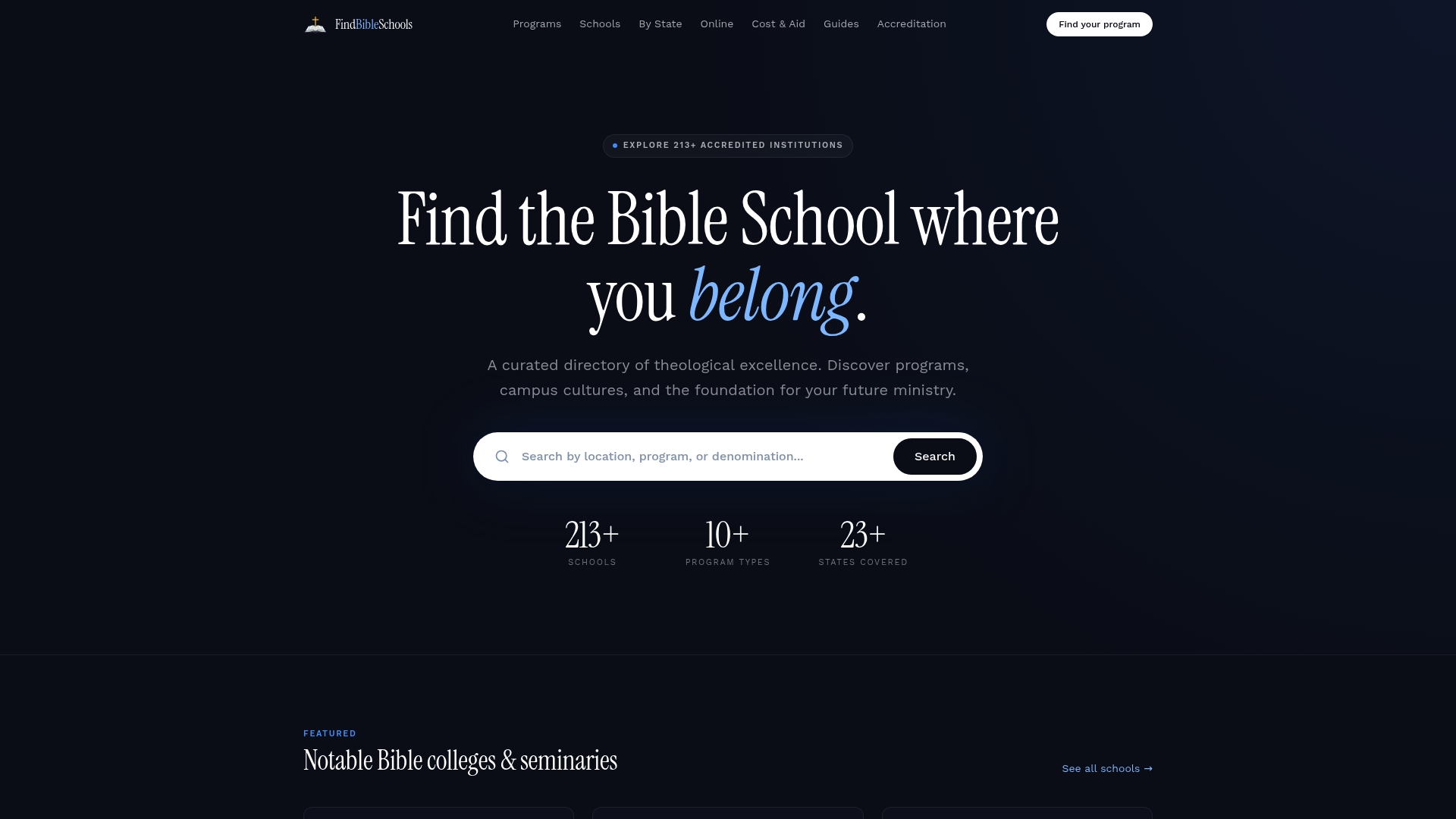
This resource can be used to locate program pages, compare tuition and accreditation among schools being considered, and find scholarship information before finalizing budget plans. If you’re still narrowing your list, the Bible Colleges by State directory lets you compare regional options side by side. Once you’ve settled on a target school, check its program page directly, such as Trinity Evangelical Divinity School’s admissions details, to confirm the exact essay requirements before you submit anything.
Sources
- Application Essay Instructions — Bethany Seminary
- Seminary Application Essay: Successful Yale Divinity Example — Garrett Ham
- Same school, different AI rules — GradPilot
- Theological reflections on the use of AI in seminary — Capital University
- Guidance for Vanderbilt Divinity School application essays — Vanderbilt Divinity
FAQ
Is it hard to get accepted into seminary?
Acceptance difficulty varies widely by program and degree level. Many M.Div. and MA programs have moderate acceptance standards focused on spiritual readiness and academic capability, while competitive PhD and select denominational tracks can be considerably more selective, so checking a specific program’s page matters more than general assumptions about seminary admissions.
What are some good topics for a theological essay?
Strong topics connect a specific personal experience to a theological question, such as how a season of doubt shaped your understanding of grace, or how a ministry experience clarified your calling to a particular field like chaplaincy or pastoral counseling. The strongest seminary application essay topics avoid abstract theology detached from lived experience.
How do I write a strong seminary application essay?
Open with a clear, specific statement of your vocational call, support it with one or two concrete stories rather than general claims, add a short theological reflection, and close by naming the specific program and why it fits your goals. Programs like Fuller Theological Seminary list exact prompts and word limits worth checking before you draft.
Can I mention religion in my college or seminary essay?
Yes, and for a seminary application it’s expected. Admissions committees are specifically looking for evidence of your faith formation, sense of call, and theological thinking, so avoiding religious content would work against the purpose of the essay.
Is using AI to write my seminary essay allowed?
Policies vary by program, and some schools distinguish between AI used for brainstorming or grammar checks versus AI used to generate the actual reflective content. Because program-level rules can contradict broader institutional policy, always check the specific program’s admissions page and follow the stricter standard if you’re unsure.