
Published September 9, 2026
Compare Reformed seminaries fast with 213+ accredited profiles

Reformed seminaries are graduate institutions that train pastors, scholars, and church leaders within the confessional Reformed tradition, grounded in documents like the Westminster Standards or the Three Forms of Unity. Among the most widely recognized are Westminster Theological Seminary, Reformed Theological Seminary, Covenant Theological Seminary, Calvin Theological Seminary, and Puritan Reformed Theological Seminary. A successful match combines an accredited degree, a confessional statement that fits the student’s convictions, and real ministerial formation through supervised field education.
TL;DR:
- Most reputable Reformed seminaries hold both regional and ATS accreditation, which ensure academic quality and recognition for ministry ordination.
- Confessional fidelity varies by school, with some emphasizing scholarship and others pastoral training, so matching your doctrinal convictions is crucial.
- Degree choices like MDiv, MA, DMin, or PhD suit different ministry goals, and hybrid or online formats often include mandatory supervised ministry components.
- Tuition can range from 400 to 700 per credit hour, but students should evaluate net costs after aid, as denominational support often lowers expenses significantly.
- Prioritize confessional fit, accreditation, ministerial formation, faculty credibility, and affordability when selecting the best seminary for your calling.
Table of Contents
- What Are the Leading Reformed Seminaries?
- What Do Accreditation and Confessional Affiliation Actually Guarantee?
- Which Degree Fits Your Ministry Goal?
- What Does a Reformed Seminary Education Cost?
- How Should You Choose Between Reformed Seminaries?
- How Findbibleschools Helps You Compare These Options
- What Actually Matters More Than the Catalog
- Compare Reformed Seminaries Side by Side
- Sources
What Are the Leading Reformed Seminaries?
Every school on this list holds to historic Reformed confessions, but each expresses that commitment differently in curriculum, campus culture, and vocational focus. Some lean academic, training scholars and future professors. Others build their entire program calendar around preparing men for the pulpit. Knowing which is which saves you from applying to three schools that all sound alike on paper but feel nothing alike once you visit.
- Westminster Theological Seminary (Glenside, Pennsylvania): Confessionally Reformed and Christ-centered in its academic philosophy, Westminster trains students for both scholarship and pastoral ministry, with degree tracks running from the MDiv through the PhD. Best for students who want rigorous biblical languages and systematic theology alongside pastoral formation. See the Westminster program and tuition profile for admissions specifics.
- Reformed Theological Seminary (multiple U.S. campuses plus online): RTS builds its identity around ministry-ready education, and the school reports that more than 90 percent of its faculty are ordained or actively serving in ministry rather than career academics alone. Best for students who want a large, multi-campus network with strong denominational ties across Presbyterian and Reformed bodies. Check the RTS programs and accreditation page for campus-by-campus details.
- Covenant Theological Seminary (St. Louis, Missouri): Covenant’s MDiv runs 99 credit hours and includes biblical-language study built into a whole-person approach to pastoral training, not just academic coursework. Best for students who want a smaller, tightly knit campus community with a strong emphasis on mentoring. The Covenant tuition and program summary lays out cost and curriculum side by side.
- Calvin Theological Seminary (Grand Rapids, Michigan): Calvin markets itself explicitly as a Reformed seminary rooted in the Christian Reformed Church tradition, and it backs that identity with scholarship support that frequently reduces how much students borrow. Best for students drawn to the Dutch Reformed heritage and denominational placement pipeline. Review the Calvin school profile for aid figures.
- Puritan Reformed Theological Seminary (Grand Rapids, Michigan): PRTS centers its curriculum on Reformed experiential theology, the branch of Reformed thought concerned with how doctrine shapes the inner life of faith, and pairs it with close mentorship for both church and academic paths. Best for students who want a smaller cohort and direct access to faculty outside the classroom.
- Gordon-Conwell Theological Seminary (South Hamilton, Massachusetts, with additional campuses): Gordon-Conwell sits closer to the broader evangelical world than the confessionally Reformed schools above, but it draws heavily on Reformed faculty and coursework, making it a reasonable option for students who want theological breadth alongside Reformed depth. The Gordon-Conwell program page outlines its degree tracks.
- Additional confessionally aligned options: Schools tied to the 1689 Baptist Confession or smaller Presbyterian bodies also train Reformed pastors, though at a smaller scale than the institutions above. Findbibleschools’ full directory of Bible colleges and seminaries lets you filter by confessional statement to surface these less prominent programs.
Notice how the “best for” line changes for each entry. That variation is the point. A school that is exactly right for a future systematic theology professor may be the wrong fit for a man headed straight into a small rural pulpit, even if both schools teach the same confession.
What Do Accreditation and Confessional Affiliation Actually Guarantee?
Accreditation and denominational affiliation answer two different questions, and confusing them is the single most common mistake in seminary research. Accreditation verifies academic quality against an external standard. Confessional affiliation tells you what the school believes and teaches. You need both answers, separately, before you enroll.
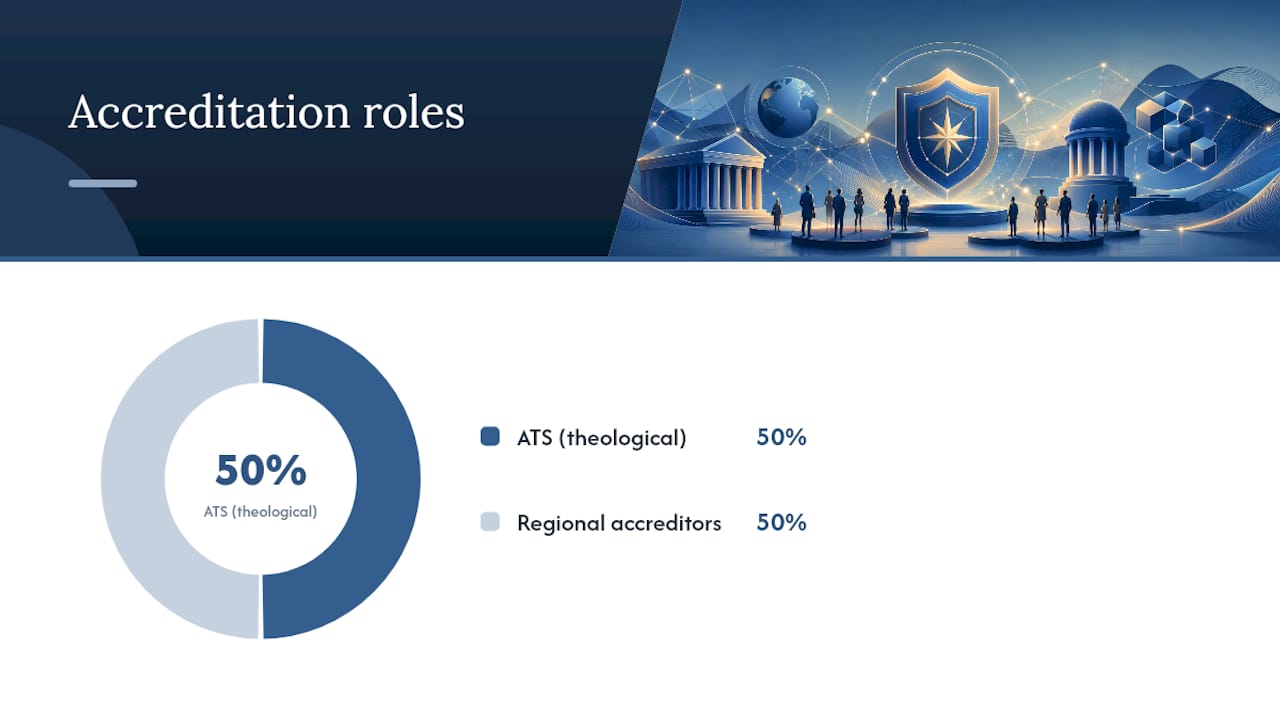
The Association of Theological Schools (ATS) is the specialized accreditor for graduate theological education in North America, and most credible Reformed seminaries hold ATS accreditation on top of regional accreditation from a body like the Higher Learning Commission or SACSCOC. Regional accreditation matters for federal financial aid eligibility and for transferring credits into a different graduate program later. ATS accreditation matters for denominational bodies that require it before ordaining a candidate. A school missing either one is not automatically illegitimate, but it puts more burden on you to verify how transferable and how recognized the degree will be.
Confessional affiliation shows up in specific documents: the Westminster Standards, the Three Forms of Unity (Belgic Confession, Heidelberg Catechism, Canons of Dort), or the 1689 Baptist Confession. Reformed seminaries typically publish their governing confession directly on their about or academics pages, and faculty are usually required to affirm it in writing.
Before trusting any catalog listing, run this quick check:
- Search the school’s accreditation page for both a regional accreditor and ATS status, then confirm both on the accreditor’s own website, not just the school’s claim.
- Locate the school’s confessional statement and read it, not just the summary label (“Reformed” alone tells you little).
- Check whether faculty are required to sign the confession annually, which signals ongoing doctrinal accountability rather than a one-time formality.
- Confirm the accreditation is current, since some accreditors publish a public list of institutions currently in good standing.
Which Degree Fits Your Ministry Goal?
The degree letters matter less than what they train you to do. A Master of Divinity (MDiv) is the standard credential for ordained pastoral ministry, typically running 72 to 99 credit hours depending on the school, and it usually includes biblical Hebrew and Greek. An MA in theology or biblical studies is shorter, often built for lay leaders, missionaries, or students testing a call before committing to a full MDiv. A Doctor of Ministry (DMin) is a practitioner’s doctorate for working pastors who want advanced training without leaving their pulpit, while a PhD prepares graduates for teaching and academic scholarship.
Delivery mode varies more than most applicants expect:
- Traditional residential programs remain the default at schools like Westminster and Covenant, especially for the MDiv.
- Many Reformed seminaries now offer low-residency or fully online MA and even MDiv tracks, useful for students already serving in a church who cannot relocate.
- Field education and supervised ministry placements are usually required regardless of delivery mode, so “online” rarely means “no in-person ministry component.”
- Language requirements (Hebrew and Greek) remain standard for the MDiv at most Reformed seminaries, even in hybrid formats.
What Does a Reformed Seminary Education Cost?
Tuition among Reformed seminaries ranges widely, generally landing somewhere between $400 and $700 per credit hour, which means a full MDiv can run tens of thousands of dollars before aid. Location, denominational subsidy, and endowment size drive most of the difference. A denominationally subsidized school with strong church support often charges noticeably less per credit than an independent seminary covering its full costs through tuition alone.
Financial aid comes from several overlapping sources:
- Institutional scholarships based on merit, need, or denominational ministry commitment.
- Denominational subsidies that lower tuition directly for students headed into that body’s ordained ministry.
- Church-sponsored support, where a sending congregation covers part or all of a student’s costs.
- Work-study and part-time ministry positions on or near campus.
Calvin Theological Seminary is a useful example here: the school promotes scholarship support substantial enough to meaningfully reduce loan borrowing for many students, which is worth asking about directly during admissions rather than assuming from the published tuition rate alone.
Pro Tip: Ask every admissions office for the actual average net price after aid, not the sticker tuition rate. The gap between the two can change which school is genuinely cheaper.
How Should You Choose Between Reformed Seminaries?
Ranking criteria in the right order prevents the most common regret students report: choosing a school for prestige or location and discovering the confessional fit was wrong only after enrolling. Weigh these in roughly this priority order:
- Confessional fit: does the school’s governing confession match your own convictions, not just a general “Reformed” label?
- Accreditation: does it hold both regional and ATS accreditation appropriate to your denomination’s ordination requirements?
- Ministerial formation: are supervised internships, preaching opportunities, and mentoring built into the curriculum, not offered as an afterthought?
- Faculty credentials: are professors ordained, actively serving, or purely academic, and does that balance match what you want to become?
- Cost and schedule fit: can you actually afford it, and does the delivery mode match your life circumstances?
When you get admissions on the phone, ask specifics rather than generalities: exact field education hour requirements, placement rates into ordained ministry, average class size in core theology courses, and whether faculty sign the confession annually. Watch for red flags like vague or unverifiable accreditation claims, no required supervised ministry experience, or admissions staff who dodge direct questions about tuition and aid.
Pro Tip: If a school cannot name a specific accreditor you can verify independently within thirty seconds of asking, treat that as a serious warning sign, not a minor gap.
How Findbibleschools Helps You Compare These Options
Findbibleschools tracks profiles across more than 213 accredited theological institutions nationwide, which makes side-by-side comparison of accreditation status, degree offerings, and cost far faster than checking each seminary’s site individually.
- Filter by accreditation type, degree level, or delivery mode to narrow the field quickly.
- Compare tuition and program length across multiple Reformed and confessionally aligned schools at once.
- Review school-level pages built specifically for prospective students weighing denominational fit against cost.
What Actually Matters More Than the Catalog
Confessional fidelity gets most of the attention in seminary research, and it should stay near the top of your list. But mentoring relationships and supervised ministry experience often shape a pastor’s readiness more than the exact wording of a confession does. Visit campus if you can, and ask to sit in on a class or a chapel service before you commit.
— Grant
Compare Reformed Seminaries Side by Side
Reading confessional statements and comparing tuition across five or six seminary websites takes hours you probably do not have if you are still working full time or serving in a church. Findbibleschools built its directory to shorten that process: filter by accreditation, degree level, or delivery mode, and pull up program and tuition summaries for schools like Reformed Theological Seminary without opening a dozen separate tabs.
Some listings on the site are sponsored placements from participating seminaries, and that is disclosed directly on those pages so you always know which profiles are paid features versus standard directory entries. If your search extends beyond the confessionally Reformed schools profiled here, the full seminary and Bible college directory covers accredited institutions across every major theological tradition. Start by pulling up the Reformed Theological Seminary profile or browsing the directory filters to build your own shortlist today.
Sources
- Westminster Theological Seminary | To Christ, Despite All, We Hold
- Covenant Theological Seminary | Training for a Lifetime of Ministry
- Reformed Theological Seminary
- Calvin Theological Seminary: A Reformed Seminary
- Puritan Reformed Theological Seminary