
Published August 20, 2026
What a PhD in Theology Actually Requires and Costs

A PhD in theology is a research doctorate that trains scholars for academic teaching, publication, and advanced ministry research, distinct from a Doctor of Ministry (DMin) or Doctor of Theology (ThD), which serve practicing clergy more directly. Most programs run four to six years across three stages: coursework, comprehensive exams, and dissertation research. Funding is common at research-focused seminaries, but the number of guaranteed years and stipend amounts vary by school, so verify the details for each cycle you apply to.
Before you go further, get three things settled:
- Decide whether your goal is academic research, teaching, or ministry leadership.
- Identify two or three concentrations that match your interests (biblical studies, systematic theology, ethics, church history).
- Check the language and prerequisite requirements at each program you’re considering, since these differ widely between institutions.
Key Takeaways
A theology PhD demands four to six years of staged work (coursework, comps, dissertation) and hinges on securing multi-year funding and a faculty mentor actively working in your subfield.
| Point | Details |
|---|---|
| Know your degree type | Choose a PhD for research and teaching goals; choose a DMin for applied pastoral ministry instead. |
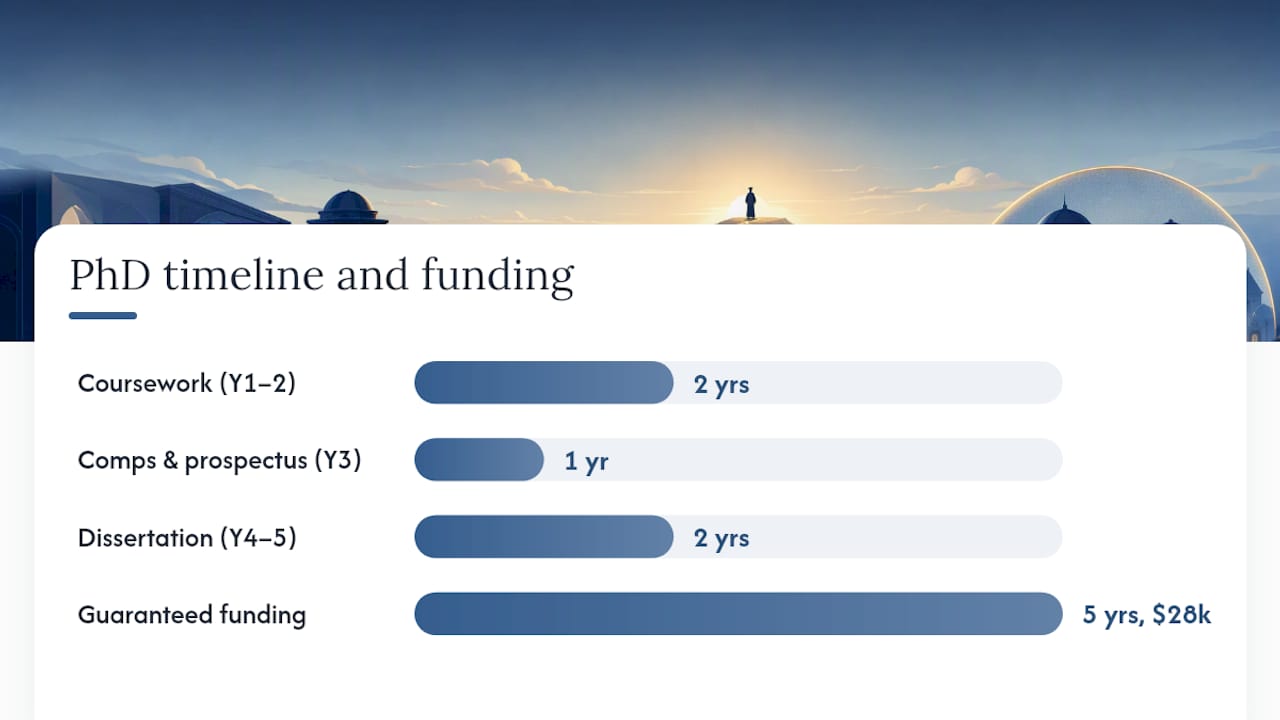
| Map the timeline early | Expect coursework in years 1 to 2, comps and prospectus in year 3, and dissertation work in years 4 to 5. |
| Verify funding specifics | Ask for exact stipend amounts and guaranteed years, since packages like Loyola’s five year, $28,000 stipend vary widely by school. |
| Vet faculty, not just rankings | Confirm a faculty member is actively publishing and advising students in your specific concentration. |
| Use Find Bible Schools to compare | Filter accredited programs by degree type and concentration, then contact admissions directly to confirm current funding. |
Table of Contents
- PhD Theology Programs vs. ThD and DMin: What Sets Them Apart
- Who Should Pursue a Theology PhD, and Where Graduates End Up
- How Does a Theology PhD Program Unfold Year by Year?
- Matching Your Research Interests to Program Strengths
- Building a Competitive Application: Documents, Languages, and Timing
- What Funding Actually Looks Like, and How to Compare Offers
- Evaluating Programs: Questions That Actually Reveal Fit
- Using Find Bible Schools to Research and Compare U.S. PhD Programs
- External Funding and Scholarships Beyond the Program Package
- What Actually Matters When Choosing a Program
- Compare Accredited PhD Programs Through Find Bible Schools
- Frequently Asked Questions
- Sources
PhD Theology Programs vs. ThD and DMin: What Sets Them Apart
The three doctorates look similar on paper but train for different destinations. A PhD emphasizes original research and prepares graduates for faculty positions, scholarly publishing, and academic leadership. A ThD, offered by fewer U.S. schools, often overlaps with the PhD in rigor but sometimes carries a stronger denominational or confessional identity. A DMin is a professional doctorate built for working pastors, focused on applied ministry projects rather than a dissertation grounded in original scholarship.
Accreditation shapes how much any of these degrees will count once you finish. Programs recognized by the Association of Theological Schools (ATS), alongside regional accreditors, carry weight with hiring committees and other institutions. A few points worth checking early:
- Confirm ATS accreditation or equivalent regional accreditation before applying.
- Ask whether the program’s PhD graduates have landed teaching posts at accredited colleges or seminaries.
- Choose a PhD if your goal is research and faculty work; choose a DMin if you’re staying in pastoral ministry and want applied training instead.
Who Should Pursue a Theology PhD, and Where Graduates End Up
Most successful applicants arrive with a completed MDiv or equivalent master’s degree, a track record of independent research (often a substantial master’s thesis), and a clear sense of the questions they want to spend five years answering. Some come straight from seminary; others have taught, pastored, or worked in nonprofit ministry and are returning to formalize their scholarship.
Career outcomes cluster around a few paths:
- Tenure-track or adjunct teaching at seminaries, divinity schools, or Christian colleges.
- Continued ministry leadership, now backed by deeper theological training.
- Research and writing roles at nonprofits, think tanks, or publishing houses.
Programs like Notre Dame’s report placing a high share of their graduates into academic positions, which reflects the competitiveness of admission as much as the strength of the training. Realistic baseline competitiveness means a strong graduate GPA, at least one language beyond English, and evidence you can sustain independent research for years, not months.
How Does a Theology PhD Program Unfold Year by Year?
The shape of a PhD is fairly consistent across top U.S. programs, even though the details vary by school.
- Years 1 and 2 are coursework years. You take doctoral seminars in your concentration, begin or continue research-language study, and typically serve as a research assistant or teaching assistant. Princeton Theological Seminary structures its PhD program around exactly this pattern: two years of coursework before comprehensive exams.
- Year 3 is when comprehensive exams and the dissertation prospectus (sometimes called a proposal) come due. This is the pivot point. Passing comps confirms you have mastered the field broadly enough to narrow into original research; the prospectus is your committee’s sign off on the specific project ahead.
- Years 4 and 5 (sometimes longer) are dedicated to dissertation research and writing. Most programs also expect you to teach as instructor of record during these years, not just assist. Princeton requires students to complete a Teaching Apprenticeship Program combining a colloquium, actual teaching experience, evaluations, and coaching so graduates leave with real classroom credentials, not just a dissertation.
Pro Tip: Ask any program directly how many students in the last five cohorts finished within the stated timeline. A program that can’t answer, or answers vaguely, is telling you something about its own data.
Loyola University Chicago publishes one of the clearer timelines in the field: coursework in years 1 and 2, comps and prospectus in year 3, dissertation writing in years 4 and 5, with a guaranteed five years of funding at a stipend of $28,000 annually. That kind of specificity is rare, and it’s worth using as a benchmark when other schools describe funding in vaguer terms.
Matching Your Research Interests to Program Strengths
Concentrations vary in name but cluster around familiar territory: New Testament, Old Testament, systematic theology, Christian ethics, church history, practical theology, and increasingly, world Christianity or global church studies. Notre Dame’s PhD, for instance, spans concentrations from Christianity and Judaism in Antiquity to Liturgical Studies and Moral Theology and Christian Ethics, giving applicants a sense of how broadly a single department can specialize.
Some programs also allow interdisciplinary work, pairing theology with philosophy, history, or religious studies departments at an affiliated university.
- Read faculty publication lists from the last three to five years, not just bios.
- Check who has supervised recent dissertations in your subfield.
- Look for departmental centers or research clusters tied to your topic.
Pro Tip: A famous name on the faculty roster means little if that scholar hasn’t supervised a dissertation in years. Ask the graduate coordinator directly who is actively advising students right now.
Building a Competitive Application: Documents, Languages, and Timing
A strong PhD application in theology usually includes the same core components, though weighting differs by school.
- Transcripts from every institution attended, plus a CV that highlights research and teaching experience.
- A statement of purpose that names a specific research question, not a general love of theology.
- A writing sample, often a revised master’s thesis chapter or seminar paper, showing original argument and careful use of sources.
- Three academic references, ideally from professors who can speak to your research capacity, not just classroom performance.
- Prior theological master’s degree (an MDiv or equivalent) confirmed, along with a competitive graduate GPA. Fuller Theological Seminary cites 3.5 as a benchmark GPA for its PhD applicants.
- Language readiness, often ancient languages like Greek or Hebrew plus modern research languages such as German or French, depending on your concentration.
Deadlines cluster around December and January for fall admission the following year. Reach out to a potential faculty supervisor well before you submit, since many programs expect applicants to have identified a likely mentor by the time they apply.
What Funding Actually Looks Like, and How to Compare Offers
Full funding is the norm at research-focused seminaries, but “funded” can mean very different things from one offer letter to the next. The most common model is a multi-year fellowship combining tuition remission with an annual stipend, often paired with assistantship duties in the early years and instructor-of-record teaching later.

Concrete numbers help more than averages. Loyola guarantees five years of funding with a $28,000 annual stipend, a figure worth using as a reference point when a school describes its package in general terms. Princeton’s program similarly builds fellowship support into a five-year course of study tied to its coursework and dissertation stages.
When an offer arrives, check these before accepting:
- The exact stipend amount and whether it’s guaranteed for all funded years or contingent on satisfactory progress.
- Whether tuition is fully remitted or only partially covered.
- Health insurance coverage, and whether dependents can be added.
- Summer funding, since many stipends only cover the academic year.
- Travel or research funds for conferences, archives, or fieldwork.
Evaluating Programs: Questions That Actually Reveal Fit
Rankings and brochures tell you less than direct conversations with faculty and current students. A short list of pointed questions produces far better comparison data than a glossy program page.
Ask about mentorship frequency: how often does an advisor meet with doctoral students, and is that consistent across the faculty or dependent on which person you land with? Ask about publication expectations during the program, typical time-to-degree for the last several cohorts, and cohort size, since a program admitting one student a year offers a very different experience than one admitting eight.
- Faculty fit: is someone actively publishing and advising in your specific subfield right now?
- Funding security: is the guarantee written down, or verbal and contingent?
- Time-to-degree: what do the last five graduates’ actual timelines look like, not the catalog’s stated ideal?
- Placement record: does the program track and share where graduates landed?
- Library and research resources: are the archives, databases, and interlibrary loan systems adequate for your topic?
Pro Tip: If a program can’t produce a placement list or gets vague about time-to-degree, treat that as a red flag equal to a funding gap. Data avoidance usually means the data isn’t flattering.
Using Find Bible Schools to Research and Compare U.S. PhD Programs
Findbibleschools tracks accreditation status, program pages, tuition figures, and campus culture notes across more than 213 institutions, which narrows the search considerably. A practical approach: filter by degree type to isolate doctoral programs, filter again by concentration, then review funding notes before reaching out to admissions directly.
- Start with the full program directory to compare degree types side by side.
- Cross-check specific schools, like Fuller Theological Seminary’s profile, against admissions details discussed here.
- Contact admissions offices directly once you’ve narrowed to two or three finalists.
External Funding and Scholarships Beyond the Program Package
Institutional funding rarely covers every expense, and external sources can fill real gaps, especially for research travel, dissertation-year support, or dependents’ health coverage. Denominational bodies frequently offer scholarships or grants for members pursuing advanced theological study, particularly for students already ordained or in ministry roles connected to that denomination.
Foundation grants aimed at religious scholarship exist too, often tied to specific research areas like biblical studies, church history, or theological ethics. Some are modest, covering a single conference trip or a summer of language study; others fund an entire dissertation year when institutional support runs out before the degree is finished.
A few practical notes:
- Denominational scholarship programs often require ordination or membership status, so confirm eligibility before applying.
- Foundation and association grants for religious research typically have their own deadlines separate from admissions cycles, often in the fall or winter for the following academic year.
- Dissertation-completion fellowships exist specifically for students in their final writing year, filling the gap after multi-year departmental funding ends.
- Travel grants for archival research or conference presentations are common and worth pursuing even if your core funding is secure, since they free up your stipend for living expenses.
Treat external funding as a supplement, not a substitute, for a program’s own guarantee. A school with a strong internal package and a track record of students winning external grants signals a healthy research culture, not just generous accounting.
What Actually Matters When Choosing a Program
Applicants spend enormous energy on rankings and comparatively little on the two factors that predict whether they’ll actually finish: whether a specific faculty member is available and willing to mentor them, and whether the funding guarantee survives contact with reality. A program with a famous department and no advisor actively working in your subfield is a worse bet than a lesser-known program with a mentor who answers emails and has a recent dissertation to show for it.
The vocational question matters just as much as the practical one. A PhD is a research degree, and academic hiring in theology is tight. If your calling is pastoral leadership rather than scholarship and teaching, a DMin or master’s-level path may serve you better than five years chasing a professorship that may not materialize. That’s not a discouragement. It’s a filter that saves years.
Compare Accredited PhD Programs Through Find Bible Schools
Choosing between a handful of seminary websites means digging through inconsistent formatting, buried tuition pages, and admissions offices that answer emails on their own schedule. Findbibleschools solves that by putting accreditation status, concentrations, tuition, and campus notes for over 213 institutions in one place, so you can compare programs side by side instead of rebuilding that research yourself from scratch.
Start with the directory of accredited schools nationwide to see which states and institutions match your concentration and funding needs, or go straight to a specific school profile like Covenant Theological Seminary if you already have a program in mind. Once you’ve shortlisted two or three schools, reach out to their admissions offices directly to confirm current-year funding and faculty availability before you commit to an application cycle.
Frequently Asked Questions
How long does a PhD in theology take to complete? Most U.S. programs take four to six years, split between two years of coursework, a year for comprehensive exams and the dissertation prospectus, and two or more years for dissertation research, writing, and defense.
Is funding guaranteed for theology PhD programs? Guaranteed multi-year funding is common at research-focused seminaries, but the number of funded years and stipend amounts vary. Loyola, for example, guarantees five years at a $28,000 annual stipend, while other schools structure support differently, so confirm details with each admissions office.
What’s the difference between a PhD and a ThD in theology? Both are research doctorates, but a ThD is offered by fewer U.S. institutions and often carries a stronger denominational identity, while a PhD is the more widely recognized research degree for academic hiring.
Do I need a master’s degree before applying to a theology PhD program? Yes. Nearly every competitive program requires a prior theological master’s degree, typically an MDiv or its equivalent, along with a strong graduate GPA.
What languages do theology PhD programs require? Requirements vary by concentration but commonly include classical languages like Greek or Hebrew plus reading competency in one or more modern research languages such as German or French.
What can I do with a theology PhD besides teaching? Graduates move into seminary and college faculty roles, continued ministry leadership backed by advanced scholarship, and research or writing positions at nonprofits and publishing houses.
Sources
- PhD Programs | Loyola University Chicago
- Doctor of Philosophy in Theology (Ph.D.) | University of Notre Dame
- Theology PhD Program - Princeton Theological Seminary