
Published August 18, 2026
Which Pastoral Ministry Degree Fits Your Calling?

A pastoral ministry degree trains you for preaching, pastoral care, and congregational leadership, and the credential level you need depends entirely on the role you’re aiming for. An associate or bachelor’s degree prepares you for entry-level church staff positions, youth ministry, or missions work. A Master of Divinity (M.Div.) is the standard credential for ordination and senior pastor roles in most denominations. A Master of Arts in ministry (MAPM or similar) fits specialized tracks like counseling or chaplaincy, while a Doctor of Ministry (D.Min.) or PhD serves advanced practitioners and academics.
Most accredited undergraduate pastoral ministry programs run 124 to 127 credit hours, while graduate-level ministry degrees often land closer to 36 credit hours with supervised fieldwork built in. Here’s how the common ministry roles map to degree level:
- Church staff, youth ministry, missions support: Associate or bachelor’s degree
- Ordained senior pastor, church planter: M.Div. (required by many denominations)
- Chaplaincy, pastoral counseling, ministry specialization: MA or MAPM
- Seminary teaching, denominational leadership: D.Min. or PhD
Accreditation from bodies like the Association of Theological Schools (ATS) or ABHE matters at every level, and a directory like Find Bible Schools helps you compare accredited programs side by side before you commit to one.
Key Takeaways
Choosing the right pastoral ministry degree depends on matching the credential level to your specific ministry goal, then verifying accreditation and supervised ministry requirements before you apply.
| Point | Details |
|---|---|
| Match degree to role | An associate or bachelor’s fits entry-level church staff; an M.Div. fits ordination-track senior pastor roles. |
| Confirm accreditation first | Look for ATS, ABHE, TRACS, or regional accreditation before applying, since it affects aid and ordination. |
| Weigh supervised ministry hours | Graduate programs often require 36 credit hours plus 108 clock hours of supervised ministry, a strong quality benchmark. |
| Budget realistically | Compare tuition across delivery modes and ask about denominational scholarships before committing. |
| Compare programs on Find Bible Schools | Use the directory of 213-plus accredited institutions to filter by accreditation, denomination, and degree level. |
Table of Contents
- Pastoral Ministry Degree Types, Length, and Delivery Options
- What Should You Check Before Choosing a Program?
- What Does Tuition Cost and What Can You Earn After?
- How Do You Apply and Know a Program Fits?
- Where Can You Compare Accredited Pastoral Ministry Programs?
- What Actually Determines Whether a Pastoral Degree Pays Off?
- How Find Bible Schools Helps You Compare Programs Faster
- Frequently Asked Questions
- Sources
Pastoral Ministry Degree Types, Length, and Delivery Options
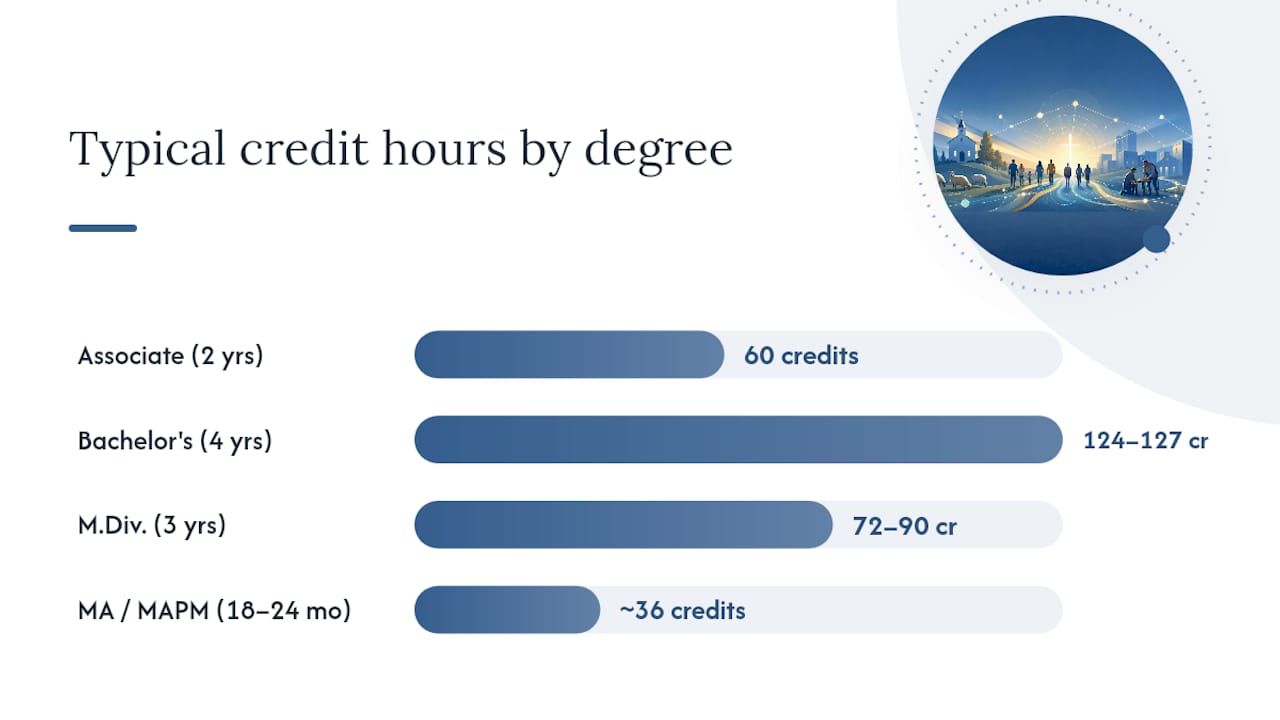
Each degree level trains you differently, and the differences matter more than most applicants realize going in. An associate degree (roughly 60 credits) gives you foundational Bible knowledge and basic ministry skills in about two years, often as a stepping stone toward a bachelor’s. A bachelor’s degree in pastoral ministry or pastoral studies typically requires 124 to 127 credit hours and covers biblical interpretation, expository preaching, counseling, and worship, usually finishing in four years full time.
The M.Div. is the graduate benchmark for ordination, generally requiring 72 to 90 credits and three years of full-time study. An MA in ministry narrows the focus, sometimes to about 36 credit hours with supervised ministry components, finishing in 18 to 24 months. D.Min. and PhD programs run longer, often three to six years, and target working pastors or aspiring professors.
| Degree Level | Typical Credits | Typical Length (Full-Time) | Common Delivery Modes |
|---|---|---|---|
| Associate | 60 | 2 years | On-campus, online |
| Bachelor’s | 124 to 127 | 4 years | On-campus, online, hybrid |
| M.Div. | 72 to 90 | 3 years | On-campus, hybrid |
| MA/MAPM | ~36 | 18 to 24 months | On-campus, online, hybrid |
| D.Min./PhD | Varies by program | three to six years | Hybrid, low-residency |
Some schools shorten the path by combining undergraduate and graduate credit, letting you enter an M.Div. with fewer remaining hours. Nearly every program, at every level, builds in supervised internships or field placements. Transfer credit policies vary widely, so ask early if you’re bringing credits from another institution.
What Should You Check Before Choosing a Program?
Accreditation is the single filter that determines whether your degree counts for financial aid, transfer, and ordination. In the U.S., the main accreditors for theological education are the Association of Theological Schools (ATS), the Association for Biblical Higher Education (ABHE), TRACS, and regional accreditors that cover broader higher education. A program lacking recognized accreditation can leave graduates unable to transfer credits or qualify for federal aid, and some denominations won’t recognize the degree for ordination at all.
Beyond accreditation, denominational fit deserves real scrutiny. A Southern Baptist congregation, a Presbyterian church, and a nondenominational network each have different expectations for ordination coursework, so check whether a program’s theological tradition lines up with where you plan to serve.
Faculty credentials and published outcomes are the trust signals worth chasing down before you apply:
- Ask for faculty bios listing earned degrees and ministry experience, not just titles
- Request published course lists so you know exactly what you’re studying, not a marketing summary
- Look for placement data or alumni outcomes, even informal figures a program shares on request
- Confirm whether internships or supervised ministry hours are built into the curriculum or left to you to arrange
Pro Tip: Email the admissions office and ask specifically which accrediting body covers the program and whether that accreditation is current. A program that hesitates to answer directly is telling you something.
Graduate programs like the MAPM often require 108 clock hours of supervised ministry with a field supervisor plus a final practicum. That structure is a good benchmark for judging whether a program you’re considering takes practical training seriously or treats it as an afterthought.

What Does Tuition Cost and What Can You Earn After?
Tuition for pastoral ministry degrees varies by institution type more than by delivery mode. Undergraduate programs at Bible colleges often run lower than private Christian universities, while graduate seminary tuition can climb considerably per credit hour, especially at large-name institutions. Online and hybrid delivery sometimes reduces costs by cutting housing and commuting expenses, though tuition per credit is often similar to on-campus rates.
Financial aid sources worth pursuing include FAFSA-eligible federal aid (available at accredited nonprofit institutions), denominational scholarships tied to your home church or conference, and institutional aid packages that many seminaries offer to students pursuing ordination tracks.
Career paths after graduation split along predictable lines. Senior and associate pastor roles typically expect an M.Div., especially in denominations with formal ordination processes. Youth and children’s ministry positions often accept a bachelor’s degree. Chaplaincy and pastoral counseling roles usually require a graduate degree with a clinical or counseling emphasis. Church planting and parachurch organizations tend to value practical experience alongside formal credentials, sometimes more heavily than the degree title itself.
Undergraduate pastoral ministry programs commonly require 124 to 127 credit hours with a minimum 2.0 GPA to graduate, a useful benchmark when comparing how efficiently different schools get you to the finish line.
Pro Tip: If cost is a major factor, look for programs that let undergraduate credits roll directly into a graduate degree. Combining your bachelor’s and M.Div. tracks can save a full semester or more of tuition.
How Do You Apply and Know a Program Fits?
Admissions requirements for pastoral ministry programs are fairly consistent across schools, though the details shift by degree level. Expect to submit transcripts, a personal statement or statement of faith, pastoral or church references, and sometimes a writing sample. Graduate programs often add interview requirements or minimum undergraduate GPA thresholds.
A realistic application timeline looks like this:
- Six to nine months out: Research programs, request information, and narrow your list to three or four schools.
- Four to six months out: Request transcripts, secure references, and draft your personal statement.
- Two to three months out: Submit applications and prepare for interviews if required.
- One month out: Confirm financial aid packages and enrollment deposits.
Before committing, ask each program pointed questions:
- How many supervised ministry or internship hours does the degree require, and who arranges the placement?
- Does the program actively support students pursuing ordination, or is that left entirely to the student?
- What percentage of graduates are placed in ministry roles within a year of finishing?
Watch for red flags too. A program that can’t clearly state its accreditor, offers no supervised ministry component, or provides no faculty bios on its website deserves a second look before you apply.
Where Can You Compare Accredited Pastoral Ministry Programs?
Comparing programs one website at a time is slow and inconsistent, since schools present tuition, accreditation, and curriculum data differently. A directory of accredited U.S. Bible colleges and seminaries lets you filter by accreditation status, delivery mode, denomination, and degree level in one place, which is a faster way to build a genuine short list.
Several U.S. seminaries consistently show up on prospective students’ shortlists and are worth reviewing directly: Fuller Theological Seminary, Westminster Theological Seminary, Gordon-Conwell Theological Seminary, Dallas Theological Seminary, Reformed Theological Seminary, Moody Bible Institute, The Southern Baptist Theological Seminary, Wheaton College Graduate School, and Cedarville University. Each carries a different denominational flavor and program structure, so treat this as a starting point for research, not a ranked list.
Once you have three or four candidates, take these next steps:
- Schedule a campus visit or virtual info session to gauge culture fit
- Ask admissions for a sample course syllabus, not just a course title list
- Request current placement statistics for graduates in your intended track
- Compare published tuition and financial aid figures directly against each other
Building a short list this way, grounded in accreditation and outcomes rather than name recognition alone, tends to produce better decisions than chasing a school’s reputation.
What Actually Determines Whether a Pastoral Degree Pays Off?
Most guides on this topic treat degree choice as a checklist exercise: pick the highest credential you can afford, get accredited, done. That advice misses the real decision point. The credential level matters less than whether the program’s practical training matches the ministry role you actually want. A bachelor’s graduate with strong internship experience and a clear denominational reference network often lands a youth ministry role faster than an M.Div. graduate who spent three years mostly in the classroom.
Accreditation gets treated as a formality, but it’s the single filter most likely to bite you later, whether that’s a denomination refusing to recognize your ordination coursework or a lender denying aid because the school never held ATS or ABHE accreditation. Denominational fit gets underweighted too. Prospective students often pick a well-known seminary before checking whether its theological tradition even aligns with where they hope to serve.
If you take one thing from this, prioritize fit and supervised ministry hours over prestige. Use a directory to compare programs on those specific terms before you fall in love with a name.
How Find Bible Schools Helps You Compare Programs Faster
Find Bible Schools is the practical alternative to piecing together tuition, accreditation, and curriculum details from a dozen separate seminary websites. Instead of hunting down each school’s accreditation status one page at a time, you search a directory covering more than 213 accredited U.S. institutions and see the numbers side by side.
Three things make the directory genuinely useful when you’re narrowing your list. First, you can compare tuition and accreditation status across schools without opening a dozen browser tabs. Second, program pages break down degree levels, delivery modes, and denominational affiliation, so you’re not guessing which M.Div. fits your ordination track. Third, you can request information directly from schools you’re serious about, rather than cold emailing admissions offices one by one.
Start by browsing the full theology and Bible degree directory to see how programs at every level stack up, then filter by state if location matters to your decision. Bookmark the two or three schools that fit best, and request program information before your next application deadline.
Frequently Asked Questions
Do I need an M.Div. to become a pastor? It depends on your denomination. Many mainline and evangelical denominations require an M.Div. for ordination, while others accept a bachelor’s degree plus ministry experience, particularly in nondenominational or church-planting contexts.
How long does an online pastoral ministry degree take? Timelines mirror on-campus programs. A bachelor’s typically takes four years full time, and a graduate ministry degree often takes 18 months to three years, depending on credit load and whether you study full or part time.
Can I complete a pastoral ministry degree while working full time? Yes. Most bachelor’s and graduate ministry programs now offer online or hybrid formats built for working adults and bivocational ministers, though supervised ministry hours still require real-world placement time.
What’s the difference between a pastoral ministry degree and a general biblical studies degree? A pastoral ministry degree focuses on applied vocational skills, preaching, counseling, and church leadership. A biblical studies degree leans more academic, emphasizing languages, exegesis, and theology, useful for those considering further graduate study or teaching.
Does accreditation affect ordination? Often, yes. Many denominations only recognize coursework from ATS, ABHE, or regionally accredited institutions when reviewing candidates for ordination, so confirming accreditation before enrolling protects your future ordination path.
Sources
- Pastoral Ministry Degree | Welch College | Christian College in Gallatin, TN
- Pastoral Ministry | University of Northwestern, St. Paul
- Master of Arts in Pastoral Ministry — Oblate School of Theology
Cross-check each program’s own admissions and curriculum pages before applying, and confirm internship or supervised ministry requirements directly with the school.