
Published August 22, 2026
Online MDiv Programs: How to Choose an Accredited Fit

An online MDiv is a graduate-level ministry degree, typically 72 to 96 credits, that you can complete largely or entirely from home while working, pastoring, or raising a family. Before comparing schools, check two things first: whether the program carries Association of Theological Schools (ATS) accreditation, and what its residency or practicum expectations actually require. Those two signals determine whether a degree will satisfy an ordination council, a chaplaincy endorsing body, or a future doctoral admissions committee.
Before you request information from any seminary, do these two things:
- Verify accreditation directly. Check the school’s ATS status on its own accreditation page rather than trusting marketing copy.
- Request a curriculum and practicum sheet. Ask admissions to send exact credit breakdowns, residency dates, and supervised ministry requirements in writing.
Key Takeaways
Choosing an online MDiv comes down to confirming ATS accreditation covers your exact program format and getting your denominational body’s acceptance in writing before you enroll.
| Point | Details |
|---|---|
| Verify accreditation scope | Confirm ATS status applies to the online or hybrid version of the program, not just the residential degree. |
| Check ordination acceptance separately | Ask your denominational leader directly whether they’ll accept this specific school’s online MDiv. |
| Get transfer credit in writing | Request a credit-by-credit evaluation from the registrar, not a verbal estimate from admissions. |
| Match format to your life | Fully online, hybrid with intensives, and cohort models trade off community, travel, and scheduling flexibility differently. |
| Use Findbibleschools to compare | Filter over 213 accredited institutions by format and accreditation status before contacting admissions offices individually. |
Table of Contents
- What Does an Online MDiv Program Cover?
- Fully Online, Hybrid, or Cohort: Which MDiv Format Fits?
- Why Does ATS Accreditation Matter for Ordination and Chaplaincy?
- How Do You Choose the Right Online MDiv Program?
- Representative Online MDiv Programs Worth Comparing
- How Transfer Credits Affect Your Time to Graduation
- What Support Do Online MDiv Students Actually Get?
- What Prospective Students Consistently Get Wrong
- Compare Accredited Online MDiv Programs Through Findbibleschools
- Sources
What Does an Online MDiv Program Cover?
An MDiv builds ministers through five recurring pillars: biblical studies (Old and New Testament, often including original languages), systematic theology, church history, homiletics or preaching, and pastoral care. Most programs braid these academic tracks together with a supervised ministry practicum, so coursework and hands-on formation happen in parallel rather than one after the other.
Credit totals vary more than newcomers expect. Oral Roberts University’s online MDiv runs 73.5 credits, while other ATS-accredited programs stretch closer to 96 depending on language requirements and denominational standards.
- Full-time students typically finish in three to four years.
- Part-time students, common among working pastors, often take five to six years.
- Capstones vary by school: some require a thesis, others an integrative ministry project tied to the practicum site.
A quick gut check on credit load: a 73.5-credit online MDiv and a 96-credit MDiv can differ by more than a full year of study, so ask every school for its exact number before comparing tuition side by side.
Fully Online, Hybrid, or Cohort: Which MDiv Format Fits?
Format decides how much of your formation happens on a screen versus in a room with other students. Three models dominate the U.S. market right now.
- Fully online, no residency. Denver Seminary’s online MDiv is built entirely around flexible virtual engagement, with no campus visits required to graduate.
- Hybrid with short intensives. George Fox University’s Portland Seminary runs a cohort-based MDiv combining weekly online discussion with an annual in-person BridgeWeek intensive.
- Asynchronous with instructor-led sessions. ORU pairs flexible start dates with scheduled virtual workshops, landing between the fully async and fixed-cohort extremes.
Synchronous cohort models build tighter peer relationships and more direct faculty access, since everyone moves through the same courses together. Asynchronous formats trade some of that community for scheduling freedom, which matters if you’re preaching most Sundays or working a rotating shift.
Pro Tip: Ask admissions exactly how the practicum gets arranged for remote students. Some seminaries help place you locally; others expect you to line up a supervising pastor yourself before enrollment.
Why Does ATS Accreditation Matter for Ordination and Chaplaincy?
ATS accreditation functions as a practical filter more than an academic formality. Many denominational ordination councils and chaplaincy endorsing agencies specifically request an ATS-accredited MDiv before certifying candidates, and most Th.D. or D.Min. programs require it for admission.
Chaplaincy boards and a wide range of denominations explicitly list ATS accreditation as a credentialing requirement, not a preference. Skipping this check can mean discovering years into ministry that your degree doesn’t satisfy the board reviewing your endorsement.
Verifying accreditation takes three steps: check the school’s own accreditation page, cross-reference the ATS commission list directly, and ask admissions in writing which specific ATS status applies to the online delivery format (some schools accredit their residential MDiv but are still extending that status to online cohorts).
- Confirm the accreditation covers the online or hybrid version of the program, not just the campus-based degree.
- Ask whether regional accreditation (through bodies like the Higher Learning Commission) applies alongside ATS status.
- Request the accreditation letter or public record rather than relying on a website badge alone.
Findbibleschools maintains a directory covering over 213 accredited theological institutions across the United States, organized so you can filter by accreditation status, program level, and delivery format before you ever fill out an inquiry form.
How Do You Choose the Right Online MDiv Program?
Ranking your priorities before you start comparing schools saves months of back-and-forth with admissions offices. Work through this order:
- Accreditation status. Confirm ATS accreditation applies to the specific delivery format you’ll enroll in.
- Ordination or chaplaincy alignment. Ask your denominational leader which credentials your ordination body actually requires.
- Residency and practicum structure. Determine whether the program needs travel, and how often.
- Cost and financial aid. Get a real per-credit rate and total estimated cost, not a headline tuition figure.
- Faculty access. Ask how office hours, advising, and mentorship work for remote students specifically.
- Language requirements. Confirm whether Greek and Hebrew are required, optional, or substitutable with additional ministry coursework.
When you call admissions, ask these questions verbatim: “Does your ATS accreditation cover this online cohort?” “How many in-person days are required, and where?” “Who supervises my practicum, and do you help me find a site?” “What percentage of your online graduates are accepted for ordination by name-brand denominations?” Then ask your denominational leader directly: “Will your council accept an online MDiv from this specific school?”
Pro Tip: Treat “fully online, no residency” claims as a starting point, not a guarantee. Get the residency policy in writing from admissions, since some programs quietly require in-person practicum hours even when their marketing emphasizes flexibility.
Red flags worth walking away from: a school that won’t specify its ATS status in writing, vague answers about practicum supervision, or per-credit tuition that isn’t published anywhere on the program page.
Representative Online MDiv Programs Worth Comparing
These profiles are illustrative snapshots, not a ranked list. Confirm every detail directly with each school before applying, since credit requirements and tuition change from year to year.
- Liberty University: large-scale online MDiv with multiple concentration tracks and flexible enrollment windows.
- Moody Bible Institute: tuition has been cited around $565 per credit in published program comparisons, useful as a cost benchmark.
- Regent University: hybrid options with concentrations in chaplaincy and organizational leadership.
- Denver Seminary: fully online, no residency requirement, emphasis on flexible virtual engagement.
- Oral Roberts University: 73.5 credits, instructor-led virtual workshops, flexible start dates.
- George Fox University (Portland Seminary): hybrid cohort model with annual BridgeWeek intensives.
- Fuller Theological Seminary: broad specialization menu spanning theology, missiology, and marriage and family studies.
- Asbury Theological Seminary: Wesleyan formation tradition with online and hybrid delivery.
- Trinity Evangelical Divinity School: strong academic reputation with rigorous language requirements.
- Dallas Theological Seminary: long-standing dispensational tradition with flexible online cohorts.
Specializations across these programs commonly include chaplaincy, ministry leadership, biblical languages, preaching, and spiritual formation, so match your concentration choice to your actual vocational target rather than picking the broadest option by default.
How Transfer Credits Affect Your Time to Graduation
Transfer credit policies can shave a full year off your MDiv or add unexpected delay, depending entirely on how a school evaluates your prior coursework. Most ATS-accredited seminaries will accept transfer credit from another ATS-accredited institution more readily than from a Bible college or unaccredited program, even when the course content looks nearly identical on paper.
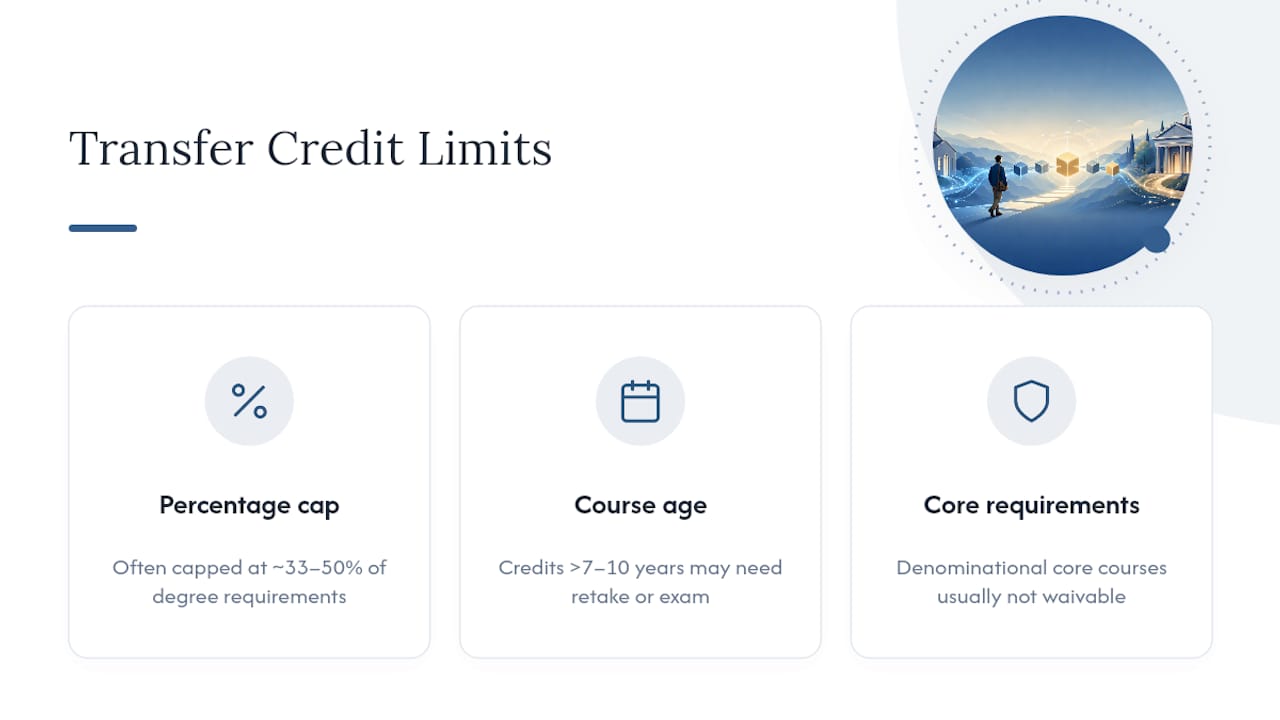
Expect three common limits. Schools typically cap transfer credit at a percentage of total degree requirements, often somewhere between one third and one half of the program. Course age matters too. Credits earned more than seven or ten years ago sometimes require a retake or a competency exam, especially in biblical languages, where retention fades fast. And denominational core requirements (a specific polity course, a required chapel or formation component) usually can’t be waived no matter how much transfer credit you bring in.
Ask admissions for a written transfer credit evaluation before you enroll, not after. A verbal estimate during a recruiting call and the formal evaluation from the registrar’s office can differ substantially once your actual transcripts are reviewed. If you’re coming from a bachelor’s-level Bible program or a non-accredited certificate track, ask specifically whether those credits count at all, since many ATS schools only transfer graduate-level coursework into an MDiv.
The practical upshot: a promising “we accept transfer credit” answer during your first phone call means nothing until you have the credit-by-credit breakdown in writing, tied to specific courses on your transcript.
What Support Do Online MDiv Students Actually Get?
Support infrastructure separates a seminary that’s genuinely built for remote students from one that simply uploaded lectures to a portal. Academic advising is the first test: ask whether your advisor is a dedicated online-program staffer or a general faculty member juggling residential students too, since dedicated advisors tend to respond faster and know the online curriculum’s quirks better.

Library access matters more than most applicants expect going in. Confirm the school provides full digital access to theological journal databases (ATLA Religion Database is the standard in the field) and interlibrary loan for physical texts you can’t get digitally. A seminary without robust remote library access will leave you improvising research for major papers.
Technical support and platform requirements round out the picture. Most programs run on a standard learning management system like Canvas or Moodle, and few have unusual hardware demands beyond a reliable internet connection and a webcam for synchronous sessions or video-based assignments. Ask specifically about support hours: a help desk that closes at 5 p.m. Eastern doesn’t help a student submitting work at midnight after a full workday.
Finally, ask how the school handles pastoral and personal support for online students. Some seminaries assign a cohort mentor or a designated staff chaplain for remote learners; others leave you to seek that out on your own. Given that MDiv formation is meant to shape character alongside competence, this gap is worth probing before you enroll, not after your first crisis of confidence in week three.
What Prospective Students Consistently Get Wrong
The conventional advice on choosing an online MDiv treats accreditation as a checkbox: does the school have it, yes or no. That framing misses the actual risk. Accreditation status can apply to a school’s residential programs while its online delivery lags behind, and plenty of applicants never think to ask the question that way. The real due diligence question isn’t “is this school accredited,” it’s “is this specific online program, in this specific format, covered by that accreditation.”
The second gap is denominational, not institutional. Ordination councils vary enormously in what they’ll accept, and a degree that satisfies one presbytery or district might get flagged by another for insufficient in-person formation hours. Too many applicants confirm accreditation and stop there, assuming that settles the ordination question. It doesn’t. Your denominational leader’s answer matters as much as the ATS commission’s.
If there’s one thing worth prioritizing above cost or convenience, it’s getting both answers in writing before you enroll: accreditation scope from the school, and acceptance confirmation from whoever will ultimately ordain or endorse you.
— Grant
Compare Accredited Online MDiv Programs Through Findbibleschools
Findbibleschools exists for exactly the comparison problem this article just walked through: verifying accreditation, checking format fit, and getting real cost figures without chasing down a dozen separate admissions offices yourself.
Our directory covers more than 213 accredited theological institutions nationwide, filterable by accreditation status, degree level, and online or hybrid format, so you can shortlist ATS-accredited MDiv programs in minutes instead of weeks of scattered searching. Start with Bible Colleges by State to see accredited options in your region, or go straight to a program page like Trinity Evangelical Divinity School to see how we lay out tuition, accreditation, and program structure side by side. If you already know your denominational requirements, use the directory now to pull two or three accredited programs and request their curriculum sheets this week.
Sources
- Accreditation (NBTS excerpt referencing ATS)
- Research
- Master of Divinity (M.Div.) Degree Online - ORU
- Online Master of Divinity (MDiv) Program | Portland Seminary
- Master of Divinity | Fully Online | Seminary