
Published August 27, 2026
Compare 213 Accredited Online Bible Degrees in Minutes

Accredited online Bible degrees are available at every level, from short certificates to doctoral programs, and the flexibility to study while working or pastoring has never been more common. The real question isn’t whether a program exists online. It’s whether the one you’re eyeing carries recognized accreditation, transfers credit cleanly, and fits your schedule. Findbibleschools exists to help you compare those factors across accredited institutions rather than guess from a single school’s marketing page.
TL;DR:
- Accreditation by ATS, ABHE, or regional bodies significantly influences credit transferability, employer recognition, and eligibility for federal financial aid.
- Program costs depend heavily on graduation timeline, transfer credits, and enrollment status, making personalized estimates vital over published rates.
- Cohort-based online programs foster community and accountability through shared coursework and scheduled synchronous activities, unlike self-paced formats.
- Specializations like pastoral ministry or biblical studies align with specific career goals, while licensure requirements may extend beyond degree completion.
- Use dedicated comparison tools and a structured checklist to evaluate accreditation, faculty, practicum, and costs, streamlining decision-making.
Table of Contents
- What Are the Different Levels of Online Bible Degrees?
- How Do You Verify a Bible College’s Accreditation?
- Which Ministry Concentration Fits Your Calling?
- What Does an Online Bible Degree Actually Cost?
- How Do You Compare Programs Without Getting Overwhelmed?
- How Findbibleschools Helps You Compare Accredited Online Programs
- Do Online Bible Programs Offer Real Community?
- Author Perspective: Pragmatic Planning For Students Balancing Ministry and Study
- Find Your Program Through Findbibleschools
- Sources
What Are the Different Levels of Online Bible Degrees?
Choosing a credential level starts with an honest look at your goal, not just your available time. A church volunteer wanting deeper Scripture literacy needs something very different from someone pursuing ordination or a teaching post at a Christian college.
- Certificate programs suit lay leaders, small-group teachers, or anyone testing the waters before committing to a full degree.
- Associate degrees work well for bivocational ministry staff who want a foundation in biblical studies without a four-year commitment.
- Bachelor’s degrees are the standard entry point for ordination tracks, missions work, and academic advancement into graduate study.
- Master’s degrees fit pastors, chaplains, and counselors who need advanced theological training or licensure prerequisites.
- Doctoral programs target experienced ministers and academics aiming for senior pastoral roles, seminary teaching, or specialized research.
Delivery format shapes how fast you move through any of these. Many schools now run 8-week accelerated terms with year-round start dates, letting a working adult finish a bachelor’s degree in less calendar time than a traditional 16-week semester schedule allows. Cohort-based programs move a fixed group through coursework together, which builds accountability but locks you into a shared pace. Self-paced, asynchronous formats give you more control but demand more self-discipline.
How Do You Verify a Bible College’s Accreditation?
Accreditation determines whether your credits transfer, whether employers respect your degree, and whether you qualify for federal financial aid. Three types matter most in theological education: the Association of Theological Schools (ATS), which accredits graduate seminary programs; the Association for Biblical Higher Education (ABHE), common among undergraduate Bible colleges; and regional accreditors like the Higher Learning Commission (HLC), which many broader Christian universities carry alongside or instead of a faith-specific accreditor.
Verifying a school’s status takes four concrete steps:
- Cross-check the claimed accreditor’s own directory rather than trusting a badge on the school’s homepage.
- Read the school’s published credit-transfer policy to see how many credits they’ll accept from other accredited institutions.
- Scan the program page for faculty credentials, a full course list, and any practicum requirements — transparent tuition per credit and detailed faculty bios are reliable signs of a well-run program.
A school without federal aid eligibility isn’t automatically illegitimate, but it should raise questions you ask admissions directly. Findbibleschools’ accreditation guide breaks down ABHE, ATS, TRACS, and regional standards side by side if you want the comparison without visiting a dozen accreditor websites.
Which Ministry Concentration Fits Your Calling?
Most online Bible degrees let you specialize once you’re past the general education core, and the concentration you pick often maps directly to the ministry role you’re aiming for.
- Pastoral ministry concentrations cover preaching, church administration, and pastoral counseling, aimed at students heading toward a lead or associate pastor role.
- Biblical studies concentrations dig into hermeneutics, biblical languages, and exegesis, favored by those bound for further graduate work or teaching.
- Christian counseling tracks blend theology with counseling theory, though many states require additional licensure hours before you can practice professionally.
- Online ministry concentrations teach digital ministry tools, social media strategy, and web-based discipleship, built for leaders growing a congregation’s online presence.
- Worship arts programs combine music theory and worship theology for students planning to lead a church’s music ministry.
Graduate-level programs often layer in a ministry practicum or applied project regardless of concentration. Some MDiv and ministry degree programs explicitly note that chaplaincy or counseling roles require credentials beyond the degree itself, so ask admissions early whether your target role needs licensure on top of the coursework.
What Does an Online Bible Degree Actually Cost?
Per-credit pricing varies widely across accredited Bible colleges, and the total cost of your degree depends less on the sticker price and more on how quickly you finish. A bachelor’s program billed by the credit hour can look identical in per-credit cost to a competitor, yet cost thousands more if it runs on 16-week semesters instead of accelerated 8-week terms.
Pro Tip: Ask admissions for a written net-price estimate after financial aid and scholarships, not just the published per-credit rate. Sticker price and actual cost are rarely the same number.
A few factors that move your total bill more than people expect:
- Enrollment status. Full-time students often finish faster and pay less in cumulative fees than part-time students who stretch a degree across extra years.
- Term structure. Accelerated terms compress the timeline, which reduces the number of terms you’re paying institutional fees on.
- Transfer credit. Every credit you bring in from prior coursework is one you don’t pay for again.
- Financial aid eligibility. Confirm the school’s federal aid status through ED.gov’s OPE resources before assuming grants or loans apply.
Findbibleschools’ cost breakdown guide walks through real per-credit ranges, and the affordable options guide profiles lower-cost accredited schools worth comparing before you commit to a more expensive name-brand option.
How Do You Compare Programs Without Getting Overwhelmed?
A short checklist beats an open-ended search every time. Before you request information from a school, confirm these eight items:
- Accreditation type and current status (verified independently, not just claimed)
- Total credit hours required and how many transfer credits the school accepts
- Full tuition and fee structure, including technology or practicum fees
- Delivery format: asynchronous, cohort, or a hybrid of both
- Faculty credentials listed publicly, not just department names
- Practicum or supervised ministry requirements and how placements are arranged
- Student support services, including academic advising and a dedicated success coach
- Refund and withdrawal policies, especially for accelerated terms with shorter drop windows
When you talk to admissions, ask pointed questions: What’s the maximum number of transfer credits accepted? How are practicum placements arranged for students who don’t live near a partner church? What does the refund policy look like if you withdraw mid-term? Vague answers to any of these are a warning sign, and so is a program page with no accreditation statement, no visible faculty bios, or tuition figures buried behind a “request info” form.
How Findbibleschools Helps You Compare Accredited Online Programs
Findbibleschools curates more than 213 accredited theological institutions, with filters for program level, accreditation type, and delivery format built directly into the directory. Instead of visiting a dozen individual school sites and reconciling inconsistent information, you can narrow the field in a few clicks.
A practical way to use it:
- Filter by degree level (certificate through doctoral) to match your current goal.
- Filter by accreditation type to confirm you’re only comparing institutions that meet ATS, ABHE, or regional standards.
- Review individual program pages for course lists, faculty bios, and tuition details before requesting information.
- Check the accreditation guide if you’re unsure how ABHE differs from HLC or regional accreditation.
The online program hub is the fastest starting point if you already know roughly what level and format you’re looking for.
Do Online Bible Programs Offer Real Community?
Distance learning used to mean isolation, and for some programs, it still does. But accredited online Bible colleges have gotten better at building genuine connection into the coursework itself, not just bolting on a discussion forum nobody uses.
Cohort-based master’s programs are the clearest example. Students move through core courses together, often meeting for live webinars or synchronous sessions alongside ORU’s ministry practicum work, which means you’re studying alongside the same group of classmates for a full academic year or more. That structure creates natural accountability partners and, often, ministry contacts who last well beyond graduation.
Asynchronous programs build community differently, usually through smaller discussion groups, faculty office hours, and occasional regional gatherings some schools schedule for online students. Practicum placements add another layer: supervised ministry work usually connects you with a local church or organization, giving you mentorship from someone actually doing the work you’re training for.

Ask admissions directly how their program builds interaction beyond discussion boards. Some schools host annual on-campus intensives for online students specifically to create face-to-face time. Others lean entirely on video cohorts. Neither approach is wrong, but knowing which one you’re signing up for matters if community and mentorship are part of why you’re pursuing ministry education in the first place.
Author Perspective: Pragmatic Planning For Students Balancing Ministry and Study
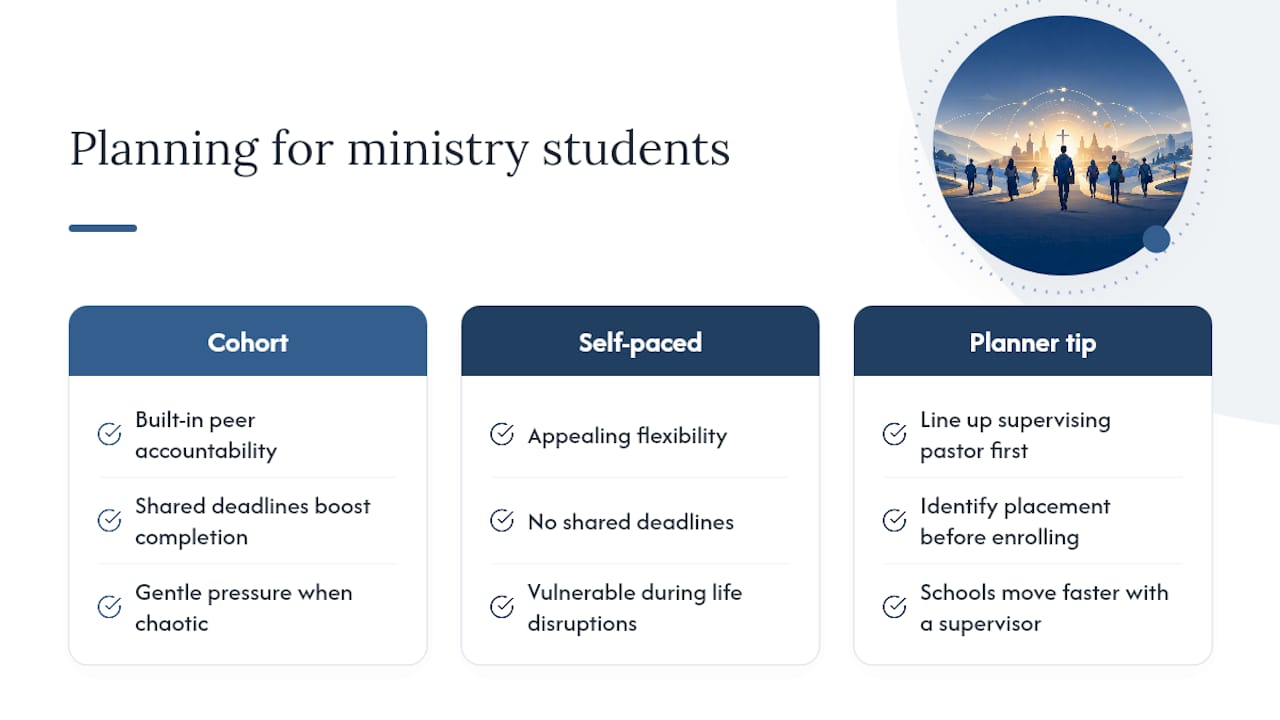
Working adults consistently underestimate how much a cohort structure helps when life gets chaotic. Self-paced programs sound appealing until a funeral, a mission trip, or a sick kid derails your week and there’s no one expecting you at a shared deadline. Cohorts build in that gentle pressure.
Line up your supervised ministry placement before you enroll, not after your first term starts. Schools move faster when you already have a supervising pastor identified.
— Grant
Find Your Program Through Findbibleschools
Findbibleschools gives you side-by-side accreditation and program data across 213 accredited institutions, so you’re not stitching together tuition figures and accreditation claims from a dozen separate school websites yourself.
Start by browsing the online programs hub, filtering by degree level and accreditation type until you’ve narrowed the list to schools that actually fit your calling and your budget. From there, review individual listings like Moody Bible Institute or explore state-by-state options through the full directory if location still matters for occasional campus visits or practicum placements. Once you’ve shortlisted two or three programs, use the checklist questions from this guide when you contact admissions. The theology programs overview is a good next stop if you’re still deciding between degree levels before narrowing by school.