
Published August 30, 2026
Accredited Online Bible Certificates That Transfer: U.S., 6–12 Months

An online Bible certificate is a short, fully online academic program, often asynchronous, built to deepen biblical knowledge or prepare busy adults for ministry roles without the time or cost of a full degree. It typically runs 12 to 18 credits and takes 6 to 12 months to finish. The right fit depends on whether you need a credential fast, want to test ministry education before committing to a degree, or simply want structured biblical study on your own schedule.
TL;DR:
- Accreditation from recognized bodies is crucial for ensuring that credits transfer and that the certificate holds credibility within denominational and secular institutions.
- Nearly all programs run asynchronously with 8-week modules, allowing completion in 6 to 12 months for 12 to 18 credits at a significantly lower cost than full degrees.
- Choosing a reputable school with qualified instructors and clear transfer policies can maximize the certificate’s value for future ministry or educational pursuits.
- Certificates serve specific roles, such as lay leadership, support staff, or ministry testing, and are generally suited for those with limited time or budget for a full degree.
- Verification of accreditation, faculty credentials, transferability, and clear start dates should be prioritized over course titles or price when selecting a program.
Table of Contents
- What an Online Bible Certificate Typically Covers
- Who These Certificates Are For (and When to Choose One)
- Format, Duration, and How Enrollment Cycles Work
- Cost and Financial Aid Options
- Accreditation and How to Verify a Program
- How to Choose the Right Program: A Practical Checklist
- How to Apply and What the Timeline Looks Like
- Why You Can Trust Findbibleschools to Find Accredited Programs
- Recognition and Credibility Among Churches and Denominations
- Enrollment Requirements and Prerequisites
- Types of Certificates: Introductory, Specialized, and Advanced
- Support Services for Online Students
- Applying the Certificate in Practical Ministry Settings
- Comparing Online and In-Person Bible Certificate Programs
- What Actually Matters When Choosing a Certificate
- Find and Compare Accredited Programs Through Findbibleschools
- Sources
What an Online Bible Certificate Typically Covers
Most programs build around a core set of courses that give students a working foundation in Scripture and ministry basics rather than a comprehensive theological education. You will see significant overlap from school to school because accrediting bodies and denominational expectations shape the curriculum in similar ways.
Common courses include:
- Old Testament survey
- New Testament survey
- Hermeneutics (how to interpret Scripture responsibly)
- Biblical theology
- Evangelism and discipleship
- A ministry practicum or applied field component
Programs built around this coursework tend to run 12 to 18 credits, with Corban University’s Biblical Studies Certificate requiring 18 credits total. That credit range translates into real outcomes: qualified lay leadership, the ability to teach a Sunday school class or small group Bible study with confidence, support roles in youth ministry, and a tested foundation before committing to a bachelor’s or master’s program. Many institutions, including Liberty University, build ministry-focused courses directly into the certificate rather than treating practical skills as an afterthought.
Who These Certificates Are For (and When to Choose One)
A certificate makes sense for a specific set of situations, not everyone exploring theological education.
- Church volunteers and lay leaders who need practical, credentialed training without leaving their current job or ministry role.
- Bi-vocational ministers who serve part time and need flexible coursework that fits around a separate career.
- Church staff (administrative, worship, or youth roles) whose responsibilities have grown to include teaching or pastoral care.
- Prospective degree students who want to test whether seminary-style coursework fits their learning style and schedule before enrolling in a two-to-four-year program.
Choose a certificate when your goal is a specific skill set on a short timeline. Choose a full degree when ordination, a pastoral position, or licensure in your denomination requires it. Time and cost separate the two clearly: a certificate asks for months and a few thousand dollars, while a degree asks for years and a proportionally larger investment.
Format, Duration, and How Enrollment Cycles Work
Nearly all online Bible certificates run asynchronously. That means no set class time. You log in, complete readings and assignments, and post to discussion boards on your own schedule within weekly deadlines. Expect roughly 5 to 8 hours of coursework per week per class, depending on how many courses you take at once.
Duration and structure follow a fairly consistent pattern across the market:
- Course modules typically run 8 weeks, with several start dates offered throughout the year
- Full certificate completion generally takes 6 to 12 months
- Total credit requirements usually fall in the 12 to 18 credit range
Corban University’s program illustrates this well: an 18-credit certificate with flexible start dates and a 6 to 12 month completion window for most students. Liberty University follows a similar model, delivering its certificate in 8 week courses with multiple start dates each year, which lets working adults enroll close to whenever they decide to start rather than waiting for a single fall or spring intake.
Transfer credit policy matters here too, even at the certificate stage. If you might apply certificate credits toward a future degree, confirm in writing how many credits the school will accept and from where. Policies vary enough between institutions that assuming “credits transfer” without asking is a common and avoidable mistake.
Cost and Financial Aid Options
Certificate pricing generally follows a per-credit or per-course model rather than a flat annual tuition rate, which makes it easier to estimate your total cost upfront. Private seminaries and Bible colleges often price per credit hour, while some universities bundle certificate coursework into a broader tuition structure shared with their degree programs. Either way, a 12 to 18 credit certificate costs meaningfully less than a full degree simply because there are fewer credits to buy.
Several funding paths can reduce that cost further:
- Institutional scholarships specific to ministry or biblical studies students
- Employer tuition support, common for church staff pursuing continuing education
- GI Bill and other veteran education benefits, where the institution and program qualify
- Monthly payment plans that spread per-course costs over the term
Pro Tip: Before you pay for a credit-bearing certificate, check whether your specific goal (basic Bible literacy, a teaching credential for your own congregation) can be met by a free, noncredit option first. Organizations like Christian Leaders Institute offer free completion certificates for foundational training, though these do not carry transferable academic credit the way an accredited certificate does.
Accreditation and How to Verify a Program
Accreditation is the single most important factor separating a credential that transfers and counts toward future study from one that does not. In the U.S., regional accreditation (through bodies recognized by the Department of Education) carries the broadest transferability, while faith-based accreditors common to seminaries, such as the Association for Biblical Higher Education, are widely respected within ministry circles but can transfer less predictably to secular institutions.
Before enrolling, work through this verification process:
- Confirm the program’s accreditor and check that it is federally recognized
- Request the school’s transfer credit policy in writing, not verbally from an admissions counselor
- Ask specifically about articulation agreements with degree programs you might pursue later
- Clarify whether the certificate is credit bearing or noncredit, since the two are handled very differently by receiving institutions
Moody Online is a useful example of how this should work in practice: its certificate is positioned as ministry preparation, and the school states plainly that credits may transfer toward related degree programs. That kind of upfront clarity is what you should expect from any program you consider. If a program is noncredit but offers a well-documented competency certificate, it can still hold real value for basic training. Just don’t expect a receiving institution to award academic credit for it.
How to Choose the Right Program: A Practical Checklist
Six factors determine whether a certificate is worth your time and money: accreditation, credit transferability, delivery format and weekly time commitment, faculty credentials, actual course content, and total cost.
When you contact admissions offices, ask these six questions directly:
- Will these credits transfer toward a bachelor’s or master’s program, and to which schools specifically?
- What are the credentials of the instructors teaching these courses?
- What is the realistic weekly time commitment for one course?
- Is a ministry practicum or field component required, and what does it involve?
- When is the next start date, and how many start dates run each year?
- What is the refund policy if I need to withdraw?
Pro Tip: Ask for instructor credentials before you ask about tuition. A program taught by faculty with earned doctorates and pastoral experience is worth more than a cheaper option taught by adjuncts with no ministry background, even if the course titles look identical on paper.
Watch for red flags: no accreditation information listed anywhere on the site, vague course descriptions that don’t name specific topics, or no clear estimate of weekly time commitment. Programs confident in their quality state these details plainly.
How to Apply and What the Timeline Looks Like
The application process for most online certificates is intentionally lightweight compared to degree admissions.
- Request information from the program and review the course list and start dates.
- Submit transcripts if the program requires proof of a high school diploma or prior college work.
- Enroll for an upcoming 8-week or semester start date.
- Set up your payment plan or apply for available financial aid before your first course begins.
Processing usually takes days to a couple of weeks once your transcripts are in, and because most programs offer several start dates per year, you rarely wait long to begin. Pace yourself realistically: one course at a time works well for people juggling full-time work or active ministry responsibilities, while two courses per term suits those with more flexible schedules.
Why You Can Trust Findbibleschools to Find Accredited Programs
Findbibleschools curates detailed program information across more than 213 accredited theological institutions in the United States, covering everything from short certificates to doctoral programs. Every school profile on the platform includes accreditation status, program type, cost information, and delivery format, so you are not left guessing whether a certificate you found through a search engine actually holds up to scrutiny.
The verification work happens before you ever see a listing: accreditation is checked against recognized accrediting bodies, and program details are curated rather than scraped from marketing pages. You can browse the full range of theology programs and Bible degrees to compare certificate options against degree pathways, or start with a guide to accredited online Bible schools if verification is your main concern before applying anywhere.
Recognition and Credibility Among Churches and Denominations
How much weight a certificate carries within a specific church or denomination depends less on the word “certificate” itself and more on the institution that issued it. A certificate from a regionally accredited university or a seminary recognized within your denominational network tends to carry real credibility with search committees and ordination boards, because they know the coursework meets a documented standard.
Denominational recognition varies more than most first-time students expect. Some denominations maintain formal lists of approved institutions for lay leadership training or licensure pathways, and a certificate from a school on that list can satisfy specific requirements outright. Independent or nondenominational churches tend to weigh the content and the issuing school’s reputation more than the credential type, since they aren’t bound by a denominational approval process.
The practical move is to ask your own church leadership or denominational office directly which institutions they recognize before enrolling, rather than assuming any accredited certificate will automatically satisfy a leadership or teaching requirement. This is especially important if your long-term goal involves licensure or ordination, since some pathways require specific coursework, a minimum credit threshold, or a certificate from an institution affiliated with that denomination. A certificate from a well-known seminary like Moody or Liberty tends to carry broad recognition simply because so many church leaders are already familiar with those institutions’ reputations, even outside their own denominational tradition.
Enrollment Requirements and Prerequisites
Most undergraduate-level online Bible certificates set a low bar for entry, which is part of what makes them accessible to working adults without recent academic experience. A high school diploma or its equivalent is the standard baseline requirement, and Liberty University’s admissions process reflects this common pattern across undergraduate certificate programs.
Prior college coursework generally is not required for entry-level certificates, though you may need to submit transcripts if you’re hoping to transfer credit in or out. Graduate-level certificates operate differently. Since they build on bachelor’s-level coursework, most require an undergraduate transcript showing a completed degree, and some ask for a minimum GPA, typically somewhere in the 2.5 to 3.0 range depending on the institution.
Beyond academic history, a handful of programs ask for a brief statement of faith or a short essay describing your ministry goals, particularly at schools with a strong denominational identity. This isn’t a rigorous admissions barrier so much as a way for the school to confirm mission alignment. Age and prior ministry experience are rarely formal requirements, which is part of why these programs work well for adults changing career direction later in life or stepping into ministry roles they didn’t originally plan for.
If you’re unsure whether your educational background qualifies you for a specific certificate, the fastest path is contacting admissions directly. Requirements shift enough between institutions, and even between certificate tiers at the same school, that assuming eligibility without checking can cost you time during the application window.
Types of Certificates: Introductory, Specialized, and Advanced
Not every online Bible certificate serves the same purpose, and understanding the tiers helps you avoid picking one that’s either too basic or more advanced than you’re ready for.
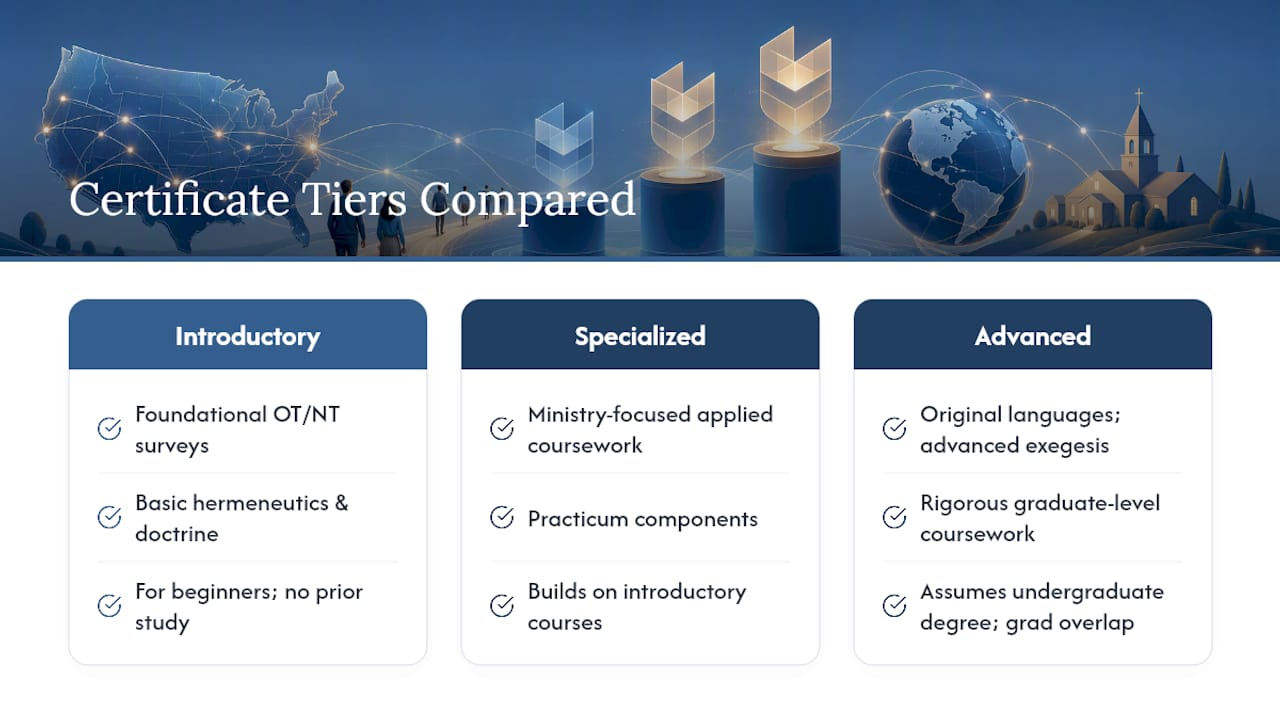
Introductory certificates cover foundational biblical literacy: Old and New Testament surveys, basic hermeneutics, and an overview of Christian doctrine. These suit readers who want structured Bible knowledge without any ministry-specific application, or who are testing whether theological study fits before committing further.
Specialized certificates narrow the focus toward a specific ministry function, such as youth ministry, worship leadership, or biblical counseling. These build on introductory coursework but add practicum components and applied coursework tied directly to that ministry area, making them the better choice once you know which role you’re preparing for.
Advanced certificates, sometimes labeled graduate certificates, assume an undergraduate degree already in hand and dig into more rigorous coursework: original language study, advanced theology, or focused biblical exegesis. These typically carry more weight if you eventually apply toward a master’s degree, since the coursework overlaps more directly with graduate-level requirements.
The practical implication is straightforward: match the certificate tier to where you actually are, not where you hope to end up eventually. Someone with no prior biblical education gains little by jumping straight into an advanced certificate’s coursework, while an experienced ministry volunteer may find an introductory program too light to justify the time investment.
Support Services for Online Students
The asynchronous format that makes these certificates flexible also means support structures matter more than they would in a traditional classroom, where a professor’s office hours are just down the hall.
Most established programs provide academic advising specifically for certificate students, distinct from degree-track advising, to help with course sequencing and credit planning. Tutoring support is typically available through the same learning management system used for coursework, often via written feedback on assignments rather than in-person sessions, though some schools offer live video office hours for students who want direct interaction with faculty.
Mentoring varies more by institution. Schools with a strong denominational identity or ministry focus sometimes pair certificate students with a faculty mentor or current pastor for informal guidance on applying coursework to real ministry situations. This isn’t universal, so it’s worth asking about directly if mentorship matters to your decision.
Technical support tends to be the most consistent offering across programs, since every school running an online certificate depends on a functioning learning management system. Expect a dedicated help desk, either by phone, chat, or email, for login issues, submission problems, or platform navigation questions. Given that most students juggle coursework around a job or ministry responsibilities, response time on tech support requests is worth asking about before you enroll, particularly if an assignment deadline could be affected by a platform glitch.
Applying the Certificate in Practical Ministry Settings
The value of an online Bible certificate shows up less in the diploma itself and more in what you’re equipped to do with it inside your local church.
Graduates commonly step into teaching roles first, whether that’s leading a Sunday school class, facilitating a small group Bible study, or teaching a confirmation or membership class. The hermeneutics and Bible survey coursework translates directly into the ability to prepare a lesson that’s both accurate and accessible to a lay audience, which is often the exact gap volunteer teachers face without formal training.

Youth ministry is another common application. Certificate holders often move into a support or lead role working with a church’s youth program, using the discipleship and evangelism coursework to shape how they mentor teenagers and structure programming. Church administrative and worship staff sometimes complete a certificate specifically to add teaching or pastoral care responsibilities to an existing role, expanding what they’re qualified to do within the same church.
For those weighing a longer path, the certificate frequently functions as a low-risk way to confirm ministry calling before committing to seminary. Completing 12 to 18 credits and finding the coursework compelling, rather than draining, is a meaningful signal before investing years and a much larger sum into a full degree.
Comparing Online and In-Person Bible Certificate Programs
The core academic content between online and in-person Bible certificates is often nearly identical, since most schools running both formats use the same faculty and course requirements for each. The real differences show up in delivery, cost, and the kind of learning experience each format supports.
In-person programs offer direct, real-time interaction with instructors and classmates, which some students find essential for working through difficult theological questions or building ministry relationships they’ll carry forward. They also typically require a fixed schedule and, often, relocation or commuting, which is exactly the friction online programs are built to remove.
Online certificates trade that in-person interaction for flexibility. Asynchronous coursework lets you study around a full-time job, family responsibilities, or an active ministry role without pausing any of them. Cost is frequently lower too, since online delivery removes campus housing and some facility fees from the equation, even when tuition per credit is similar across formats.
The honest tradeoff is community. In-person programs build cohort relationships almost automatically through shared classrooms; online programs require more intentional effort through discussion boards, video office hours, or a faculty mentor relationship to get the same sense of connection. For most busy adults balancing work and ministry, the flexibility of an online format outweighs that tradeoff, but it’s worth naming rather than glossing over when you’re deciding between the two.
What Actually Matters When Choosing a Certificate
The conventional advice on this topic spends too much time on course titles and not enough on accreditation and transfer policy, and that’s backwards. Two certificates can list nearly identical courses, Old Testament survey, hermeneutics, discipleship, and produce very different outcomes depending on whether the issuing institution is regionally accredited and whether the credits actually go anywhere afterward.
If I had to prioritize one thing for a reader stepping into this search right now, it would be this: verify the accreditor before you look at anything else, including price. A cheap noncredit certificate is fine if your goal is personal growth or basic training for your own congregation. It becomes a problem when you assumed those credits would count toward a future degree and they don’t.
The second priority is asking about faculty credentials directly, not assuming a low price means low quality or a high price guarantees strong instruction. Programs like Corban’s certificate, built around flexible 8-week modules, work precisely because they treat working adults as serious students, not an afterthought market. That’s the standard worth expecting from any program you consider.
— Grant
Find and Compare Accredited Programs Through Findbibleschools
Findbibleschools gives you something a general search engine can’t: curated comparisons across accredited U.S. institutions, so you can filter by program type and delivery format instead of clicking through dozens of individual school websites to find the same basic facts.
Start by browsing the full range of theology programs and Bible degrees to see how certificates stack up against associate and bachelor’s options at the same institutions. If a specific state’s options matter to you, browsing by location, such as accredited Bible colleges in Tennessee or Kentucky, narrows the search further. For readers weighing a seminary-level path alongside a certificate, school profiles like Moody Bible Institute and Trinity Evangelical Divinity School list tuition, accreditation, and program details side by side. Once you’ve narrowed your options, request information directly from the schools that fit, and compare responses before you commit to an enrollment date.