
Published August 21, 2026
Missionary Training Schools: Formats, Costs, and Timelines

Missionary training schools are structured programs that prepare Christians for cross-cultural ministry through spiritual formation, practical skills, and supervised field experience. Most fall into three formats, and the right pick depends on your timeline and goals:
- Online programs suit those balancing work, family, or a sending church’s schedule and wanting flexible, self-paced formation.
- In-person intensives fit candidates who want immersive community, hands-on mentoring, and supervised local ministry within weeks or months.
- Multi-phase or internship pathways work best for those pursuing long-term field placement, since they combine classroom study, cultural immersion, and a supervised internship over a year or more.
Accreditation, college credit, and structured field immersion vary widely between programs, and they’re often what separates a serious training pipeline from a weekend seminar.
Key Takeaways
The right missionary training program depends on matching format to your timeline, verifying field-experience hours and accreditation, and confirming post-field debriefing before you enroll.
| Point | Details |
|---|---|
| Match format to your stage | Choose online for flexibility, intensives for immersion, or multi-phase pathways for long-term placement goals. |
| Expect staged timelines | Programs range from one week orientations to three year pathways with classroom, immersion, and internship phases. |
| Confirm credit and accreditation | Ask whether credit is transcript-based through an accredited institution before enrolling. |
| Verify post-field care | Confirm whether debriefing and re-entry support are included, subsidized, or billed separately. |
| Use a directory before applying | Compare accredited programs on Findbibleschools to build a shortlist before contacting admissions. |
Table of Contents
- What Are the Main Formats for Missionary Training Programs?
- How Long Does Missionary Training Usually Take?
- What Does the Curriculum Actually Cover?
- Who Should Enroll and What Do Programs Require?
- What Do These Programs Cost, and How Do People Pay for Them?
- How Do You Choose the Right Missionary Training Program?
- How Findbibleschools Helps You Compare Accredited Programs
- An Editorial Take on Choosing Missionary Training
- Sources
What Are the Main Formats for Missionary Training Programs?
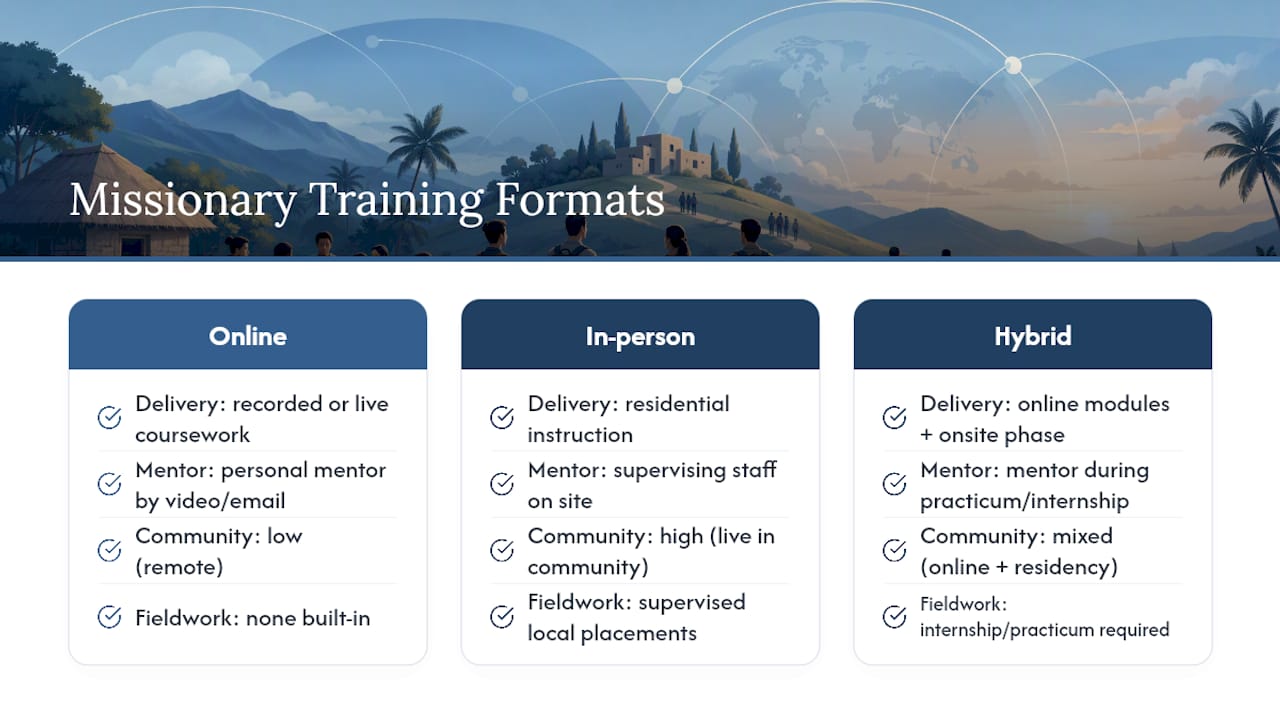
Online missions training programs typically pair recorded or live coursework with a personal mentor who checks in by video call or email. They work well for candidates still raising support, finishing a degree, or living far from a training center, since the coursework travels with you. The tradeoff is less face-to-face accountability and no built-in fieldwork.
In-person intensives concentrate everything into a residential experience, often at a dedicated mission training center. Trainees live in community, attend daily instruction, and get supervised fieldwork through local ministry partnerships. This format delivers the fastest immersion but demands relocating for weeks or months.

Hybrid programs blend the two: online modules for theology and doctrine, followed by an in-person internship or practicum where trainees apply what they studied under a mentor’s direct supervision. Internship components are where hybrid programs earn their reputation, since agencies use them to test whether a candidate can actually function cross-culturally before departure.
College credit and formal certification aren’t universal. Some intensives offer credit for an added fee, while others don’t offer it at all, so confirm this before enrolling if credit matters to your plans.
Pro Tip: Ask every program directly whether credit is transcript-based through an accredited institution or simply a certificate of completion. The difference matters if you later apply to seminary.
How Long Does Missionary Training Usually Take?
Program length depends entirely on your goal. A short exposure trip teaches you almost nothing about long-term readiness; a multi-year pathway builds it deliberately.
- One-week orientations introduce missions concepts and help you discern a general call.
- One to five month intensives cover cross-cultural skills, spiritual formation, and supervised ministry hours, and these ranges are typical across established training programs.
- Six to twelve month certificate programs add language study and deeper fieldwork, often bridging into a formal internship.
- One to three year pathways stage everything from classroom instruction to overseas immersion to a supervised internship, ending in a documented departure-readiness checkpoint.
Each stage has downstream effects. Longer pathways give you more runway to raise financial support and build language competency before you ever board a plane, which is exactly why agencies rarely rush candidates through them.
What Does the Curriculum Actually Cover?
Strong programs organize curriculum around three areas: head, heart, and hands.
- Spiritual and theological formation covers doctrine, calling, and personal discipleship, often through mentored small groups.
- Cross-cultural competence includes language acquisition basics, communication style, and adjusting to unfamiliar social norms.
- Practical ministry skills cover evangelism methods, safety and security protocols, and field mentoring under an experienced worker.
Programs that treat language acquisition as a measurable milestone, rather than a passing mention, tend to produce trainees who adjust faster once they’re actually on the field. That’s a meaningful distinction when comparing two programs that look similar on paper.
Some schools structure this hands-on piece directly into the weekly schedule. Many combine classroom instruction with several hours of supervised local ministry each week, which forces trainees to apply lessons almost immediately rather than waiting until departure. Readiness gets confirmed through mentor evaluations, language benchmarks, and a final departure-readiness check, not a single exit exam.

Who Should Enroll and What Do Programs Require?
Missionary training schools draw a wider range of candidates than most people expect: college students discerning a call, career changers stepping away from stable jobs, retirees offering decades of professional experience, and entire families preparing to relocate together.
Most programs share a few baseline prerequisites.
- Endorsement or referral from a sending church or denominational body.
- A minimum age, commonly 18, though family-track programs vary.
- Doctrinal alignment with the sponsoring organization or agency.
- Willingness to complete background checks and health screenings.
If you’re still discerning whether missions work fits your calling, a short exposure trip makes more sense than committing to a full pathway. Short-term intensives are genuinely useful for discernment, but they usually don’t substitute for the depth a longer prefield pathway provides once long-term placement becomes the goal.
What Do These Programs Cost, and How Do People Pay for Them?
Cost structures shift by format. Online programs tend to charge tuition-style fees covering coursework and mentoring access. In-person intensives add room, board, and sometimes supervised-ministry placement fees. Multi-phase pathways bundle all of that across a longer stretch, plus travel costs for cultural immersion trips.
- Tuition and program fees, which cover coursework, housing, and mentoring.
- Scholarships and grants offered directly by training centers or partner seminaries.
- Sending-church support and personal fundraising through a support-raising network.
- Agency-run milestone trainings tied to a percentage of required financial support raised, which some organizations use to pace additional workshops as candidates near departure readiness.
That last point matters more than it sounds. Agencies that stage training around support milestones aren’t being bureaucratic. They’re making sure candidates are financially and logistically ready before investing further training resources, which protects both the trainee and the mission.
How Do You Choose the Right Missionary Training Program?
Use a short checklist before applying anywhere, and don’t skip the phone call.
- Confirm format fit. Does the delivery model (online, intensive, hybrid) match your schedule and family situation?
- Verify field experience. Does the program include supervised fieldwork, or is it classroom-only?
- Check accreditation and credit. Is credit transcript-based, and through what accredited institution?
- Ask about alumni outcomes. What percentage of graduates reach the field, and in what timeframe?
- Review post-field care. Is debriefing included, subsidized, or a separate fee?
- Get cost transparency. Request an itemized breakdown before committing financially.
When you call admissions, ask pointed questions: What’s your mentor-to-trainee ratio? How do you teach language acquisition, and how do you measure progress? What security training do you provide before overseas placement? What does your debriefing policy actually include? A program with a documented departure-readiness checklist and measurable mentor sign-offs tends to prepare trainees more thoroughly than one that only promises general “preparation”.
Watch for red flags: vague answers about fieldwork hours, no written post-field care policy, or reluctance to share alumni placement numbers.
Pro Tip: Request a sample week schedule showing exact hours for classroom time, supervised ministry, mentoring, and language study. It reveals more about a program’s real priorities than any brochure will.
How Findbibleschools Helps You Compare Accredited Programs
Findbibleschools maintains a directory of over 213 accredited theological institutions across the United States, many offering missions-focused tracks alongside standard degree programs. Each listing includes accreditation status, degree levels from associate through doctorate, tuition indicators, and notes on campus culture, so you’re not guessing at fit before you reach out.
You can filter listings to separate online programs from in-person options, and distinguish credit-bearing degrees from shorter certificate tracks. Several profiles, including Moody Bible Institute and Gordon-Conwell Theological Seminary, detail practical ministry components worth comparing against a program’s stated field-training hours.
The strongest comparisons happen when you treat a directory listing as a starting point for questions, not a final answer. Pull two or three profiles that match your format and timeline, then call each admissions office with the same checklist.
Pro Tip: Before contacting any program, write down your non-negotiables (format, cost ceiling, credit requirement) so every conversation stays focused on what actually matters to your situation.
If you’re searching by geography, the Bible schools near me landing page lets you narrow by state and program type, and pages like Bible colleges in Kentucky show how listings break down region by region.
An Editorial Take on Choosing Missionary Training
Most advice on this topic treats “missionary training” as one monolithic thing you either do or skip. That framing is wrong, and it leads candidates to either over-commit to a multi-year pathway before they’ve discerned anything, or under-commit to a weekend seminar and call it preparation.
The research here points to a clearer priority order: figure out your format first, because it determines everything downstream, from cost to fieldwork exposure to how much post-field support you’ll receive later. A candidate still discerning a call should choose a short intensive, not a three-year pathway. Someone already sensing a long-term placement should skip the shopping-around phase and go straight to a staged program with documented readiness checkpoints.
What’s consistently underrated is post-field debriefing. Programs sell prefield training aggressively, but the agencies that build in structured re-entry support tend to see better long-term retention and well-being among the missionaries who return. Ask about that policy before you ask about tuition. It tells you more about whether an organization actually cares for its people once the fieldwork ends.
— Grant