
Published September 3, 2026
7 ELCA, 2 LCMS Lutheran Seminaries: Costs, Formats, Candidacy
Lutheran seminaries in the United States are organized primarily around two denominational networks: the Evangelical Lutheran Church in America (ELCA), which operates seven seminaries, and the Lutheran Church—Missouri Synod (LCMS), which trains pastors through two residential institutions. From Luther Seminary in St. Paul to Concordia Theological Seminary in Fort Wayne, each school follows a distinct candidacy path toward ordination. What follows breaks down the full list, the program formats each offers, admissions differences between the two synods, and how to evaluate quality before you apply.
TL;DR:
- ELCA seminaries tend to focus on leadership and urban ministry, while LCMS institutions emphasize a stricter certification process aligned with denominational standards.
- M.Div. programs, typically three years full-time, are required for ordination, with online and hybrid formats increasingly available for working students.
- Admission generally involves transcripts, references, essays, and interviews, but the LCMS path requires certification after vicarage and exams before receiving a call.
- Accreditation by both regional agencies and the Association of Theological Schools ensures academic and theological quality, with cost and placement rates crucial for evaluation.
- Denominational alignment and formation fit outweigh reputation, and comparing costs, scholarship opportunities, and program formats helps identify the best seminary choice.
Table of Contents
- Which Lutheran Seminaries Serve U.S. Students?
- What Degree Programs and Formats Do Lutheran Seminaries Offer?
- How Do You Apply and Qualify for Ordination?
- How Do You Evaluate Seminary Quality and Accreditation?
- How Do You Choose the Right Lutheran Seminary?
- How Findbibleschools Helps You Compare Lutheran Seminaries
- What Matters Most When Choosing a Seminary?
- Ready to Compare Lutheran Seminaries Side by Side?
- Where to Verify Seminary Details Before You Apply
- Sources
Which Lutheran Seminaries Serve U.S. Students?
The ELCA operates seven primary seminaries, each tied to a regional cluster of congregations and each carrying its own institutional flavor. The LCMS, by contrast, concentrates its pastoral formation into two seminaries with a shared theological approach and a stricter certification process before ordination.
ELCA seminaries:
- Luther Seminary (St. Paul, MN): the largest ELCA seminary by enrollment, known for its leadership programs and strong online course catalog.
- Lutheran School of Theology at Chicago (Chicago, IL): situated in a major urban hub with deep ties to Hyde Park’s academic community, including nearby University of Chicago resources.
- United Lutheran Seminary (Gettysburg & Philadelphia, PA): formed by the 2017 merger of the Gettysburg and Philadelphia seminaries, now operating as one institution across two Pennsylvania campuses.
- Lutheran Theological Southern Seminary (Columbia/Hickory, SC): the primary ELCA option serving the Southeast, with strong ties to Southern synods.
- Pacific Lutheran Theological Seminary (Berkeley, CA): notable for its participation in the Graduate Theological Union, giving students cross-registration access to a consortium of other seminaries and divinity programs in the Bay Area.
- Trinity Lutheran Seminary (Columbus, OH): affiliated with Capital University, blending seminary formation with a broader university campus.
- Wartburg Theological Seminary (Dubuque, IA): a smaller, tight-knit community often cited for its intensive formation model and rural ministry preparation.
Several of these seminaries carry prior institutional names worth knowing before you search. United Lutheran Seminary, for instance, only exists in its current form because of the 2017 merger. If you’re researching using older directories or alumni records, you may see the Gettysburg and Philadelphia campuses listed separately.
LCMS seminaries:
- Concordia Seminary (St. Louis, MO): the LCMS’s flagship institution, with the denomination’s largest residential M.Div. cohort.
- Concordia Theological Seminary (Fort Wayne, IN): the second LCMS seminary, similarly sized and offering comparable degree tracks with its own distinct campus culture.
Both LCMS seminaries operate under the same synod-wide certification structure, a detail that matters more than campus choice for LCMS-track students. Smaller Lutheran bodies and interdenominational study centers exist too, but the ELCA and LCMS institutions above account for the overwhelming majority of Lutheran pastoral education in the country.
What Degree Programs and Formats Do Lutheran Seminaries Offer?
Most Lutheran seminaries build their curriculum around the Master of Divinity (M.Div.), the standard credential for ordained parish ministry. Alongside it, schools typically offer a Master of Arts (MA) for students pursuing chaplaincy, education, or lay leadership roles, plus a Doctor of Ministry (D.Min.) for working pastors seeking advanced practical training. Certificate programs round out the options for students who want theological education without a full degree commitment.
- M.Div.: three years full time, required for ordination in both ELCA and LCMS tracks.
- MA: one to two years, geared toward non-ordained ministry, education, or nonprofit work.
- D.Min.: post-M.Div. credential, usually completed part time by active pastors.
- Certificates: shorter, focused study in areas like youth ministry or biblical languages.
Delivery formats have diversified. Online and hybrid options have grown across ELCA seminaries, letting working students complete coursework remotely while traveling for intensives. Vicarage or internship placements, typically a full year embedded in a congregation, remain a fixed requirement for M.Div. students regardless of format. Pacific Lutheran Theological Seminary’s participation in the Graduate Theological Union also lets students cross-register for specialized coursework, including cross-cultural and interfaith studies, that a single seminary couldn’t offer alone.
How Do You Apply and Qualify for Ordination?
Admissions packets across Lutheran seminaries look fairly similar on paper. Expect to submit these core components:
- Undergraduate transcripts, generally requiring a bachelor’s degree before enrollment.
- Letters of reference, often including one from a home pastor or synod representative.
- A personal essay or statement of call describing your sense of vocation.
- An admissions interview, sometimes combined with a psychological or discernment assessment.
Where the two synods diverge is candidacy. ELCA students work through a synod-level candidacy committee alongside their coursework, a process that runs in parallel with seminary study rather than gating it. LCMS students face a stricter checkpoint: the seminary faculty must certify a candidate before he can receive a call to serve as an ordained pastor. That certification comes only after vicarage, comprehensive exams, and faculty review, which makes the LCMS path more linear but also less flexible if a student needs to pause or change tracks. Lay ministry students in both denominations can often pursue MA-level coursework without entering the ordination track at all.
How Do You Evaluate Seminary Quality and Accreditation?
Regional accreditation confirms a seminary meets baseline academic standards recognized by the U.S. Department of Education, but theological schools carry an additional layer: accreditation by the Association of Theological Schools (ATS), which evaluates faculty qualifications, library resources, and ministry formation specifically. A seminary lacking ATS accreditation isn’t automatically disqualifying, but it should raise questions.
Before applying, check:
- Regional and ATS accreditation status, verified directly on the seminary’s site.
- Denominational alignment with your home congregation or synod.
- Faculty credentials and student-to-faculty ratios.
- Quality and structure of supervised ministry or vicarage placements.
- Published placement or call-rate data, where available.
- Total cost of attendance, not just sticker tuition.
Watch for vague outcome claims and seminaries reluctant to share placement statistics. Pro Tip: Call the financial aid office directly and ask for a written breakdown of total cost after scholarships, not just the advertised tuition rate. Verbal estimates during a campus visit often exclude fees that show up later.
How Do You Choose the Right Lutheran Seminary?
Start with vocation. If you’re pursuing ordination, your denominational roster (ELCA or LCMS) narrows your options immediately, since cross-denominational transfers mid-process are rare and complicated.
- Confirm your target seminary matches your synod’s candidacy requirements.
- Compare program format (residential, hybrid, online) against your ability to relocate or travel.
- Weigh total cost, scholarship availability, and expected debt against projected ministry income.
- Ask admissions about vicarage placement rates, faculty availability, and average time to certification.
- Request a call with current students, not just admissions staff, during any campus visit.
A short checklist comparing three to five finalists, side by side on format, cost, and denominational fit, usually reveals the right choice faster than ranking by reputation alone.
How Findbibleschools Helps You Compare Lutheran Seminaries
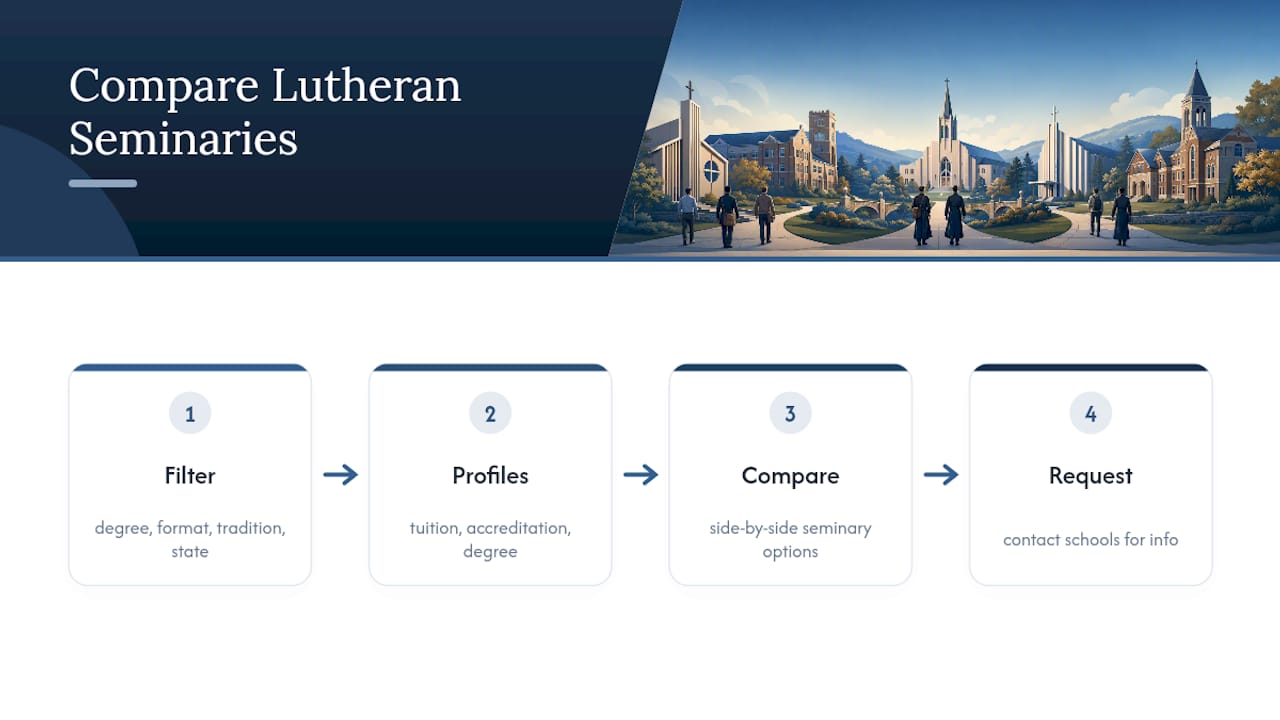
This platform curates detailed profiles across many accredited theological schools in the U.S., including program types, degree levels, tuition ranges, and accreditation status in one comparable format. You can filter by degree (M.Div., MA, D.Min.), by study format, or by denominational tradition, then request program information directly from schools like Covenant Theological Seminary or explore listings by state to see what’s available near you. For Lutheran students specifically, this means comparing formation quality and cost across seminaries without digging through multiple separate institutional websites.
What Matters Most When Choosing a Seminary?
Formation fit and denominational alignment should outrank reputation every time. A seminary with a famous name means little if its candidacy process doesn’t match your synod’s requirements or its community doesn’t support how you actually learn. Debt load matters just as much: ministry salaries rarely justify heavy loan burdens, so weigh scholarship offers as seriously as program prestige. Start your search by listing your denominational requirements first, then filter schools against them, rather than falling for the opposite order.
— Grant
Ready to Compare Lutheran Seminaries Side by Side?
This service gives you one place to compare accredited seminary programs by cost, format, and denominational fit, instead of piecing together information from multiple scattered institutional sites.

Whether you’re weighing an ELCA seminary against an LCMS track or comparing a residential M.Div. against a hybrid option, you can pull up detailed program and tuition profiles for schools like Reformed Theological Seminary or browse Bible colleges in Ohio to see what’s within driving distance. Visit a school profile now and request program information directly to get real answers on tuition, scholarships, and admissions timelines before you commit to an application.
Where to Verify Seminary Details Before You Apply
Aggregated lists are a starting point, not a final answer. Confirm admission deadlines, scholarship terms, and program updates directly with each institution.
- List of ELCA seminaries, for the full roster and historical mergers.
- LCMS Seminary Education, for certification and candidacy rules.
- ELCA Seminaries site, for official program details and denominational resources.
Sources
- List of ELCA seminaries — Wikipedia
- Seminary Education — The Lutheran Church—Missouri Synod
- ELCA Seminaries — ELCA Seminaries site