
Published September 29, 2026
4 Things to Verify Before Enrolling in a Hybrid Seminary Program

Hybrid seminary programs combine online coursework with scheduled in-person residencies, and they are a credible route to a ministry degree when the school documents formation outcomes and holds appropriate accreditation. Before comparing formats or costs, confirm four things: institutional and program-level accreditation, Title IV or FAFSA eligibility, a defined residency schedule, and evidence that the program actually measures spiritual and vocational formation, not just coursework completion.
TL;DR:
- Accreditation at both the institution and program level is essential to ensure the degree’s transferability, recognition for ordination, and eligibility for federal financial aid.
- Hybrid programs often include a mix of synchronous, asynchronous, and residency courses, with residencies typically requiring specific dates and including hands-on ministry components.
- Supervised ministry hours and formative assessments should be documented through clear competency maps, rubrics, and portfolio requirements, especially for direct assessment components.
- Most hybrid Master of Divinity programs span three to four years full-time or five to seven years part-time, with fixed residency schedules aligned to students’ work commitments.
- Prospective students should verify how well programs align with denominational recognition, track alumni placement, and compare costs, residencies, and formation quality through centralized resources.
Table of Contents
- Hybrid program formats: synchronous, asynchronous, HyFlex, and residencies
- Accreditation, Title IV, and financial-aid implications
- Curriculum, formation, and assessment in hybrid theological education
- Timeline, credit load, and residency commitments
- How to evaluate and choose a hybrid seminary program
- Student experience and outcomes with hybrid formation
- Advising students on hybrid versus residential formation
- How Find Bible Schools helps you compare hybrid programs
- Sources
- FAQ
Hybrid program formats: synchronous, asynchronous, HyFlex, and residencies
“Hybrid” means different things at different schools, so the label alone tells you little. Synchronous courses meet at set times over video conferencing, requiring the same weekly commitment as a campus class, while asynchronous courses let you complete readings, discussion posts, and assignments on your own schedule within a term. HyFlex courses let students choose, week to week, whether to attend live, watch a recording, or complete an asynchronous track, which suits students whose ministry schedules shift seasonally.
Residencies are the in-person anchor of most hybrid programs. They typically run a few days to two weeks, occur once or twice a year, and combine worship, integrative seminars, and faculty mentoring that is hard to replicate online. Before enrolling, ask for specifics rather than general assurances.
- Request a course-by-course delivery calendar showing which classes are synchronous, asynchronous, or residency-based.
- Ask how many residencies the degree requires and where they take place.
- Confirm whether residencies include supervised ministry components or are purely academic.
Accreditation, Title IV, and financial-aid implications
Accreditation determines whether your degree transfers, whether denominations recognize it for ordination, and whether you can use federal financial aid to pay for it. The Standards of Accreditation from the Association of Theological Schools require accredited master’s programs to state clear student learning outcomes and evaluate them regularly as part of institutional review, which is the paper trail you want to see before applying.
Some hybrid programs also include direct-assessment or competency-based components, and these carry extra regulatory weight. According to the ATS Commission on Accrediting’s guidelines on direct assessment, schools offering direct assessment must document fourteen separate factors, including competency maps and assessment rubrics, and often need approval from the U.S. Department of Education before those courses count toward Title IV eligibility.
Direct-assessment theological programs are relatively rare among seminaries, according to the ATS Commission on Accrediting’s guidelines, so most hybrid programs still rely on traditional credit-hour structures for aid purposes.
Before applying, take these steps:
- Verify accreditation at both the institution and specific degree level, not just the school’s homepage.
- Ask admissions whether any courses use direct assessment and, if so, whether those courses are Title IV eligible.
- Request the school’s most recent accreditation letter or self-study summary if it is not posted publicly.
Curriculum, formation, and assessment in hybrid theological education
A well-built hybrid program does more than deliver lectures online. It maps intellectual, spiritual, human, and vocational formation to specific, assessable outcomes, often visible in a competency map that ties each course to a skill or character quality the program expects graduates to demonstrate.
Practical ministry work fills the formation gap that a screen cannot. Supervised placements, assigned mentors, worship leadership opportunities, and structured reflection papers give hybrid students the same hands-on grounding that residential students get through daily campus life, just distributed across a home church or ministry site instead.
- Ask for a sample competency map or rubric used to evaluate student growth.
- Ask how supervised ministry hours are logged, mentored, and assessed.
- Request an example of a culminating project, such as an integrative portfolio or capstone paper.
Pro Tip: Ask for a sample syllabus from a second-year course, not just the introductory one; it shows whether formation expectations deepen as students advance.
Timeline, credit load, and residency commitments
Most Master of Divinity programs run around 72 to 96 credit hours, and hybrid formats spread that load across online terms plus periodic residencies rather than a single continuous campus stay. Expect an orientation residency early in the program, one or more midpoint immersions, and a final integrative seminar near graduation.
- Full-time students often complete a hybrid MDiv in three to four years, similar to residential pacing.
- Part-time students, common among working ministers, may take five to seven years depending on course load per term.
- Compare each program’s calendar against your work or ministry schedule before committing, since residency dates are usually fixed and non-negotiable.
How to evaluate and choose a hybrid seminary program
Choosing well means weighing formation quality against convenience, especially if ordination or denominational credentialing is the end goal. Start with the factors that carry the most consequence if they go wrong.
- Confirm accreditation at the program level and ask whether your denomination has specifically recognized graduates of this program for ordination.
- Review the documented learning outcomes and how the school measures them, not just a general mission statement.
- Evaluate the residency schedule against your work and family obligations before enrolling, not after.
- Ask how supervised ministry placements are arranged, especially if you live far from the main campus.
- Compare total cost and financial-aid eligibility, including whether any courses fall outside Title IV coverage.
Watch for vague formation language such as “we care about your spiritual growth” with no accompanying rubric or assessment method, and for program pages that describe accreditation loosely without naming the accrediting body.
Pro Tip: When a program’s formation claims and its assessment documents do not match, trust the documents. A syllabus with clear rubrics tells you more than a paragraph of mission language.

Student experience and outcomes with hybrid formation
Curated program pages, such as those for Gordon-Conwell Theological Seminary or Fuller Theological Seminary, typically list tuition, accreditation status, and residency requirements side by side, which makes it easier to compare formation structures across schools before applying.
Flexible scheduling in hybrid formats may allow students to apply coursework directly to ministry during their studies, especially if they remain active in local church roles. Programs that pair coursework with structured discipleship practice, similar to the approach described in Bold Faith Apparel’s guide to discipling new believers, tend to produce graduates who feel ready for pastoral responsibility immediately after graduation.
- Ask a program for its graduation rate and typical time-to-completion for hybrid students specifically.
- Ask whether the school tracks placement into pastoral or ministry roles after graduation.
- Ask whether alumni from the hybrid track have been accepted for ordination in your denomination.
Program pages that list accreditation, residencies, and cost together give prospective students a faster way to compare formation quality across schools, according to Find Bible Schools, which curates that information for over 213 accredited theological schools.
Advising students on hybrid versus residential formation
Hybrid formats fit working ministers, students tied to a specific geographic ministry context, and those who need to apply coursework immediately in a local church setting. Residential study still serves students better when a denomination expects intensive communal formation or when a student needs the daily accountability of campus life to thrive. My working checklist: check the denomination’s expectations first, then match the format to the student’s actual weekly capacity, not their ideal one.
— Grant
How Find Bible Schools helps you compare hybrid programs
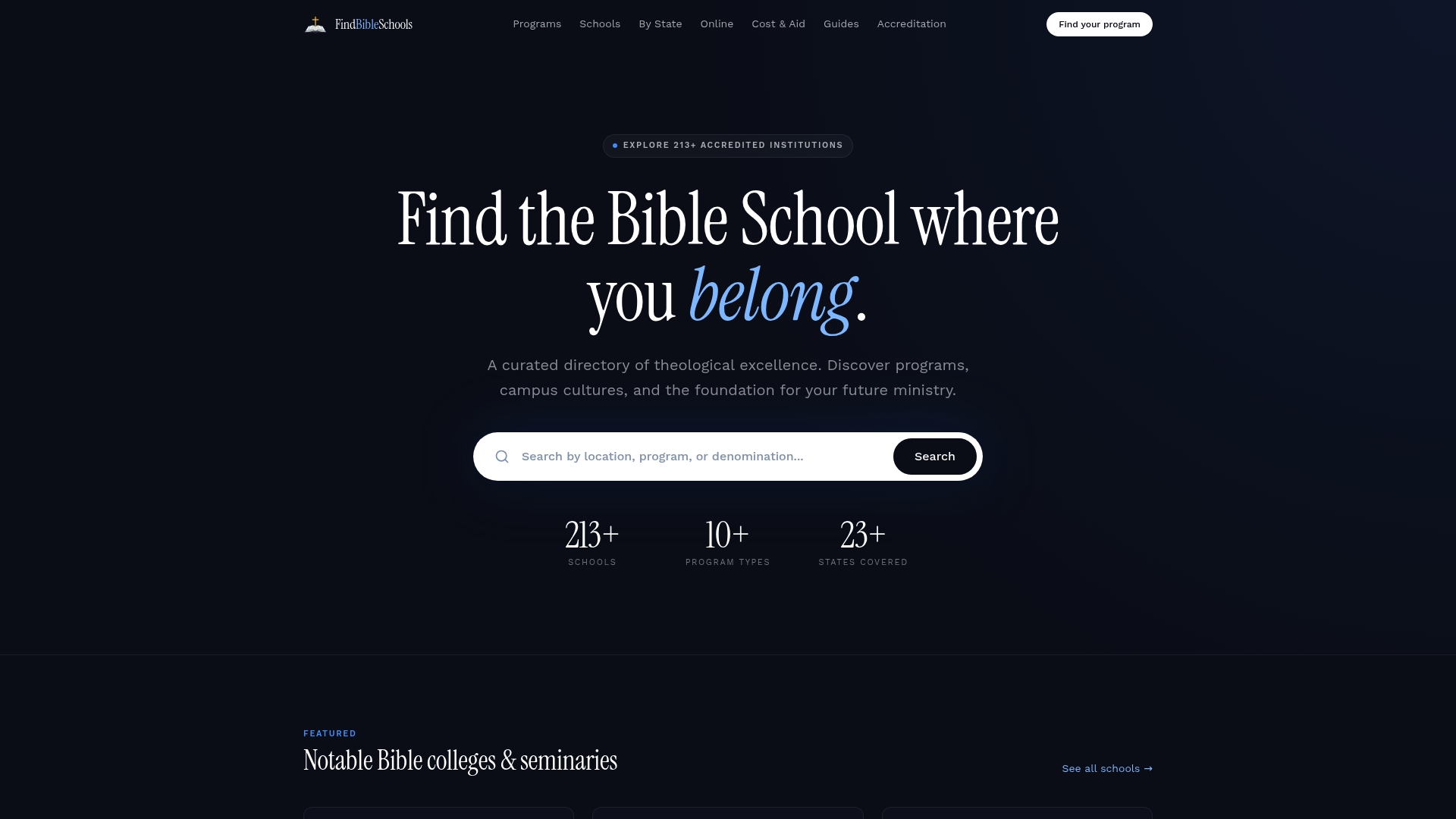
Choosing a hybrid seminary program means comparing accreditation, residency schedules, and cost across schools that rarely present that information the same way, which is exactly the gap Find Bible Schools was built to close. The platform lists program type, accreditation status, tuition, and residency structure side by side so you can filter for hybrid formats without digging through a dozen separate school websites.
- Browse detailed school pages such as Covenant Theological Seminary or Trinity Evangelical Divinity School for accreditation and program specifics.
- Use state directories, including Bible Colleges in Tennessee and Bible Colleges in Kentucky, to find hybrid programs with residencies near you.
- Check the accredited online and hybrid programs guide for a broader overview before narrowing your search.
Start comparing programs directly on Find Bible Schools to see accreditation, cost, and residency details in one place before you apply.
FAQ
Can I get a seminary degree online?
Yes, many accredited seminaries offer fully online or hybrid degrees, though most Master of Divinity programs still require some in-person residency for formation and supervised ministry. Confirm accreditation and residency requirements before assuming a program is entirely remote.
What is the shortest MDiv program available?
MDiv length varies by school and pacing, with full-time hybrid students often finishing in three to four years depending on credit load per term. Program length is set by each school’s curriculum, so compare specific degree plans rather than assuming a standard timeline.
Can I get a free seminary degree online?
Free seminary degrees are uncommon, though some schools offer scholarships, denominational grants, or reduced tuition for specific student groups. Check each program’s financial aid page and ask admissions directly about available funding before assuming a cost.
Does FAFSA pay for seminary?
FAFSA and other Title IV aid can apply to accredited seminary programs, but eligibility depends on the school’s accreditation status and whether any courses use direct assessment, which sometimes falls outside standard aid coverage. Ask admissions specifically whether your intended program and courses are Title IV eligible before enrolling.