
Published August 24, 2026
Fully Online DMin Programs: What Working Pastors Should Know

Yes, accredited fully online Doctor of Ministry programs are available across the United States, and several carry approval from the Association of Theological Schools for distance delivery. They are built for experienced ministry leaders who want applied research training and stronger leadership tools without stepping away from their congregations.
TL;DR:
- Fully online ATS-approved Doctor of Ministry programs typically require 30 to 36 credits and take three to four years to complete.
- Most applicants must have a Master of Divinity degree or equivalent plus three to five years of ministry experience to qualify.
- The final project involves designing and executing a ministry intervention, often starting in year two or three, with varying faculty mentoring support.
- Costs are mainly per-credit, with tuition around $300 per credit and additional fees, but travel and residency requirements can significantly impact the total expense.
- Reviewing accreditation, delivery format, credit requirements, project process, and full costs is essential when comparing programs.
Table of Contents
- What Is an Online DMin, and Who Should Consider One?
- Program Structure: Credits, Timelines, and Residency Rules
- Admissions and Academic Prerequisites
- Cost, Scholarships, and Funding Options
- How to Compare Online DMin Programs Without Getting Overwhelmed
- Notable Fully Online and ATS-Approved DMin Programs
- Why Trust These Notes: Findbibleschools’ Data and Method
- Balancing Ministry and Doctoral Work
- How Findbibleschools Helps You Compare Programs Faster
- Sources
What Is an Online DMin, and Who Should Consider One?
A Doctor of Ministry is a professional terminal degree, one level beyond the Master of Divinity, built around applied practice rather than academic theory alone. Where a PhD in theology trains scholars, a DMin trains practitioners who already lead. The degree exists to sharpen someone already doing ministry work, not to introduce them to it.
The typical online DMin candidate has spent years in vocational ministry already. Pastors looking to refine preaching or organizational leadership make up a large share of enrollees, alongside hospital and military chaplains, missions directors, and parachurch executives who need doctoral-level credentials for teaching or denominational advancement. Few candidates are fresh out of seminary. Most are balancing a full ministry calendar with coursework, which is exactly why the online format has become so common.
Programs generally aim at two outcomes:
- Leadership development, through coursework in organizational theory, pastoral counseling, homiletics, or ministry contexts specific to the student’s track
- A capstone ministry project, where the student designs, implements, and evaluates a real intervention in their own ministry setting rather than writing a traditional academic dissertation
That second point separates a DMin from other doctorates. A Doctor of Ministry (DMin) | Candler School of Theology student, for example, is expected to leave with a completed project tied directly to their congregation or organization, not just a stack of published research. If your goal is a credential that changes how you lead on Monday morning, that project-based structure matters more than the letters after your name.
Program Structure: Credits, Timelines, and Residency Rules
Most accredited DMin programs require around 30 to 36 credit hours, and completion generally takes several years depending on course load and how quickly a student moves through the final project. Palmer Theological Seminary’s online DMin, for instance, sits at 36 credits, while Doctor of Ministry (DMin) | Candler School of Theology is designed around roughly 32 credit hours over a three-year track.
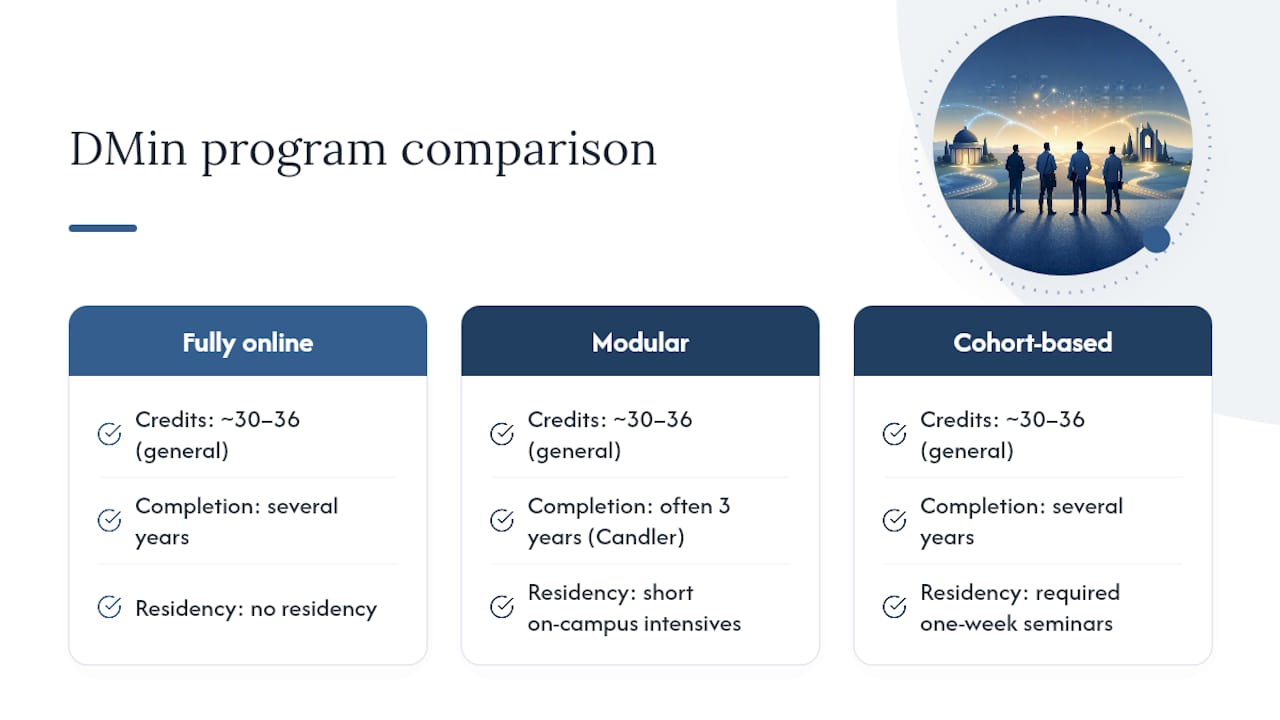
The bigger variable is delivery format, and this is where applicants get tripped up. Three formats dominate the field:
Fully online, no residency. A handful of ATS-approved programs, including Doctor of Ministry Online DMin Degree | Regent University, advertise delivery models that let qualifying students finish without ever traveling to campus. Regent markets itself as one of the earlier ATS-approved programs to reach this level of flexibility.
Modular with short intensives. This is the more common model among established seminaries. Doctor of Ministry - The Southern Baptist Theological Seminary runs its DMin as a mix of online coursework and short residential seminars, meaning most of the work happens from home but the calendar still includes on-campus weeks. Candler follows a similar pattern, folding several short campus visits into its three-year schedule.
Cohort-based online with mandatory seminars. Boston University’s BU Virtual DMin combines online cohort courses with required one-week intensive seminars delivered in person, so “online” here means most, not all, of the coursework.
The final project itself typically gets underway in year two or three, after core coursework, and runs through proposal, implementation, and written evaluation. Ask any program directly when project work begins and how much faculty mentoring is built into that phase. It varies more than the marketing copy suggests.
Admissions and Academic Prerequisites
Getting into an online DMin program is less about test scores and more about proving you already have real ministry experience to research and build on. Most programs share a common baseline:
- A Master of Divinity or equivalent master’s degree, typically with a minimum GPA around 3.0. Some programs accept a related master’s degree with additional coursework requirements if you did not complete a traditional MDiv.
- Several years of vocational ministry experience, often three to five years minimum, since the entire degree assumes you have a live ministry context to work from.
- A complete application file, which usually includes official transcripts, a ministry résumé or portfolio documenting your leadership history, a scholarly writing sample, letters of reference from supervisors or denominational leaders, and a preliminary statement or proposal describing the ministry problem you want to research.
If your master’s degree isn’t a traditional MDiv, don’t assume you’re locked out. Many seminaries offer bridge coursework or advanced standing review for applicants with a related master’s plus significant ministry tenure. It’s worth a direct conversation with an admissions counselor before you write off a program based on a checklist item on its website. Reviewing a school’s program page for its specific prerequisite language saves time compared with guessing from generic degree descriptions.
Cost, Scholarships, and Funding Options
Tuition for online DMin programs is charged almost universally on a per-credit basis, which means your total cost depends heavily on how many credits your target program requires and what its fee structure looks like. Palmer Theological Seminary lists tuition of $300 per credit plus $30 in fees per credit for its 2026–2027 online DMin, which works out to roughly $11,880 for the full 36-credit program, one of the more accessible per-credit figures among accredited options.
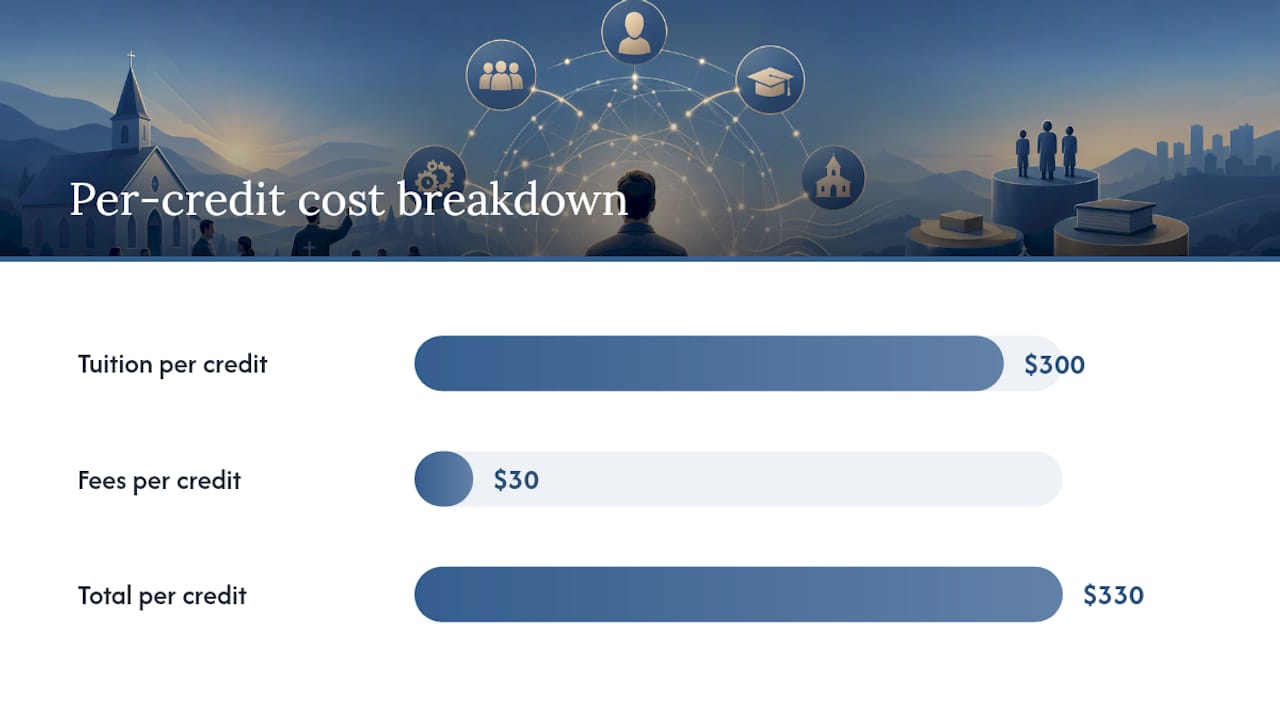
That figure is useful as a benchmark, but advertised per-credit pricing doesn’t always capture the full cost once you add mandatory fees, project supervision costs, and travel for any required residencies or intensive seminars.
Funding sources worth checking before you commit:
- Institutional scholarships and denominational grants tied to specific seminaries or church bodies
- Federal student aid eligibility, which varies by program and requires direct confirmation with the school’s financial aid office
- Military education benefits for chaplains and veterans, often accepted at seminaries with established VA relationships
- Employer or denominational tuition assistance, common for pastors sponsored by their congregation or judicatory
Before comparing programs on sticker price alone, calculate the real net cost: credits times per-credit rate, plus fees, plus any travel and lodging tied to residential weeks. A program that looks cheaper per credit can end up costing more once you factor in three or four mandatory trips to campus. Findbibleschools’ breakdown of online Bible college costs walks through how to build that full estimate, and its guide to more affordable programs is a useful cross-check once you have a shortlist.
How to Compare Online DMin Programs Without Getting Overwhelmed
Every seminary website makes its own program sound like the obvious choice. Cutting through that requires a short, consistent checklist you apply to every school on your list.
- Confirm accreditation first. Look for explicit approval from the Association of Theological Schools, the primary accrediting body for North American theological education. A program that’s vague about its accreditation status, or references an unfamiliar accreditor with no ATS connection, should move to the bottom of your list immediately.
- Pin down the actual delivery format. Ask directly: is this 100% online with zero campus visits, or does it require modular intensives? Get the exact number of required residential weeks and their typical length in writing, not just a marketing phrase like “primarily online.”
- Check credit hours and realistic timeline. Most run 30 to 36 credits over two to four years; anything wildly outside that range deserves a closer look at why.
- Ask about the final project process. Who supervises it, when does it start, and does the program offer any path to publish or present the finished work?
- Weigh faculty fit and denominational alignment. A DMin cohort works best when your project mentor understands your ministry context, so ask who teaches in your specific track.
- Calculate full cost, including fees, materials, and residency travel, not just the advertised per-credit rate.
Pro Tip: Call the admissions office and ask this exact question: “How many students in your last three cohorts completed the DMin project on the original timeline?” A hesitant or vague answer tells you more about program support than anything on the website.
Watch for red flags: schools that can’t clearly describe their capstone process, accreditation language that sounds impressive but doesn’t name ATS, or a “fully online” claim that turns out to hide a mandatory two-week residency buried in the fine print.
Notable Fully Online and ATS-Approved DMin Programs
These seven programs illustrate the range of formats and costs currently available, from genuinely residency-free tracks to hybrid models with short campus stays.
- Palmer Theological Seminary DMin (online). Fully online, 36 credits, with per-credit tuition around $300 plus $30 in fees for the 2026–2027 academic year, making it one of the more budget-friendly fully online options.
- The Southern Baptist Theological Seminary DMin. Offered in both online and modular formats, combining online coursework with short residential seminars rather than a strictly residency-free structure.
- Candler School of Theology (Emory) DMin. Predominantly online, roughly 32 credit hours, designed for three-year completion with several short campus visits spread across the program.
- Boston University DMin (BU Virtual). Structured as online cohort courses paired with required one-week in-person intensive seminars, a model that keeps most work remote but not entirely residency-free.
- Regent University DMin. One of the earlier programs to gain ATS approval for a delivery model that can be completed online with no residency requirement for qualifying tracks, with a strong emphasis on leadership training.
- Howard University DMin (online). A two-year program design offered in online modular format, with the university’s program pages describing delivery that may not require residency for certain tracks.
- Liberty University DMin. Markets a for-credit, fully online delivery option, with program pages listing accreditation notes and featured coursework alongside a stated 100% online claim.
Standout differences worth flagging: Palmer’s per-credit cost is notably lower than several peer programs, Regent’s no-residency claim stands out among ATS-approved schools, and Candler’s three-year design with built-in campus visits appeals to students who actually want some in-person cohort connection.
Why Trust These Notes: Findbibleschools’ Data and Method
Findbibleschools hosts profiles on more than 213 accredited theological institutions across the United States, covering programs from associate degrees through doctoral tracks. The program facts referenced here were checked against each school’s own program pages and cross-referenced with Association of Theological Schools listings, rather than pulled from marketing summaries alone.
That verification matters in a field where “online” gets used loosely. Use Findbibleschools’ filters for online delivery and accreditation status to build your own shortlist, and check tuition ranges directly against each school’s current program page before applying, since figures like Palmer’s shift by academic year.
Balancing Ministry and Doctoral Work
The hardest part of an online DMin isn’t the coursework. It’s protecting the hours you need for the ministry project while your congregation or organization still expects a full-time leader. Programs with clear project timelines and responsive faculty mentors make that balance manageable; vague ones make it brutal.
If you’re serious about starting, request catalogs from two or three programs and schedule a real conversation with an admissions advisor before you write a single application essay.
— Grant
How Findbibleschools Helps You Compare Programs Faster
Findbibleschools gives working ministry leaders a shortcut past the marketing pages: search filters for online delivery, accreditation status, and tuition range let you narrow more than 213 accredited institutions down to the handful that actually fit your budget and schedule.
Instead of opening a dozen browser tabs to compare residency rules and per-credit costs one seminary at a time, you can pull up curated profiles side by side. Start with the Trinity Evangelical Divinity School profile if a rigorous evangelical academic tradition matters to your search, or check the Covenant Theological Seminary page if denominational alignment with the Presbyterian Church in America is a priority. If accreditation verification is still your biggest open question, Findbibleschools’ accreditation guide walks through exactly what to check before you submit an application. Pick two or three programs from your shortlist and request information directly through their Findbibleschools profile pages today.
Sources
- Doctor of Ministry (DMin) in Contextual Leadership | Online | Palmer Theological Seminary
- Doctor of Ministry - The Southern Baptist Theological Seminary
- Doctor of Ministry (DMin) | Candler School of Theology
- Doctor of Ministry Online DMin Degree | Regent University