
Published October 6, 2026
Denominational Scholarships: Tap $2M+ Funds for U.S. Seminary Students

Denominational scholarships are grants that churches, denominational foundations, seminaries, and district or conference offices award to students pursuing ministry or theological education. They remain one of the more overlooked funding sources for U.S. seminary students, often stacking with federal and institutional aid. Your first move: check your denomination’s foundation site and your seminary’s outside-awards page, then file the FAFSA.
TL;DR:
- Most denominational scholarships require verified church membership of at least one year and full-time enrollment at an accredited institution.
- Applying early, especially after filing the FAFSA on October 1, increases chances of priority consideration for aid and helps prevent delays in award renewal.
- Many regional and local funds are available through district, conference, or church nominations, often with less competition than national programs.
- Denominational awards typically provide $4,000 or less annually, so combining them with institutional aid and federal loans remains the most effective strategy.
- Prioritizing schools with clear denominational ties or active outside-award notes ensures alignment with available funding sources and increases the likelihood of financial support.
Table of Contents
- Where to Look First for Denominational and Faith-Based Awards
- Major Denominational Scholarship Programs Worth Investigating
- Eligibility, Renewal, and Nomination Rules to Expect
- How Denominational Awards Interact With FAFSA and Institutional Aid
- Finding Local, Conference, and District-Level Scholarship Pots
- Application Checklist and Annual Timeline
- How Find Bible Schools Helps You Compare Programs With Aid in Mind
- A Few Honest Words for Ministry-Track Students
- Find the Right School Before You Chase the Scholarship
- FAQ
- Sources
Where to Look First for Denominational and Faith-Based Awards
Most students start their scholarship search in the wrong place. Instead of scrolling generic scholarship aggregators, go straight to the sources that denominations themselves maintain, since these list awards that rarely surface in broader searches.
National denominational foundations are the highest-yield starting point because they centralize dozens of individual funds under one application. The General Board of Higher Education and Ministry publishes a scholarship FAQ that walks United Methodist students through eligibility and portal timing, and similar hubs exist for other traditions.
Your seminary’s financial aid or “outside scholarships” page is the second stop. These pages often list denominational, regional, and private funds that the school has vetted for its own students, saving you the work of searching blind. You can compare how different schools present this information by browsing Bible colleges by state to see which institutions publish detailed scholarship notes.
A few other channels fill in the gaps:
- General scholarship databases (filter by “religious,” “ministry,” or “theology” to surface faith-based listings mixed in with secular ones)
- Your home church’s bulletin, newsletter, or finance committee, which may know of small funds never advertised online
- District, conference, or diocesan offices, which frequently administer their own pots separate from the national foundation
- Employer or denomination-affiliated nonprofits, especially if you already work in ministry or a church-related job
Major Denominational Scholarship Programs Worth Investigating
Not every denomination funds theological education the same way, and knowing the shape of each program helps you prioritize where to apply first.
The United Methodist Church runs two closely related channels. The General Board of Higher Education and Ministry administers scholarships tied to church membership and accredited enrollment, with its FAQ noting that many awards require annual reapplication and that some carry a seven-year eligibility window while a student works toward a degree. The United Methodist Higher Education Foundation runs a parallel track, and its 2025 reference guide describes more than $2 million awarded annually to nearly 1,000 students, with matching programs like Dollars for Scholars that can multiply a local church’s gift when the congregation participates.
UMHEF awards a substantial amount annually to a large number of students, reflecting how United Methodist funding flows through matching partnerships between local churches, the foundation, and the school rather than a single national pot, according to UMHEF’s reference guide.
Assemblies of God students should look to AGTrust, whose “Making THE Difference” program distributes awards through affiliated colleges rather than directly to applicants. A past award cycle saw $123,000 split among 119 students across 17 Assemblies of God colleges, which signals that your best path into this fund runs through your chosen school’s financial aid office rather than a standalone national application.
Presbyterian Church (U.S.A.) students have access to an annual scholarship program supporting up to roughly 100 college students, with a basic award near $4,000 and supplemental funding available for students of color. Eligibility requires PC(USA) membership and full-time enrollment at an accredited institution.

Catholic students generally find funding closer to home: dioceses, parishes, and the institutions themselves often run smaller, locally administered funds rather than one centralized national scholarship, so checking with your diocese’s vocations or education office is usually more productive than searching nationally.
Other traditions follow similar patterns worth a quick check:
- Lutheran students can look to synod offices and seminary-specific endowed funds
- Baptist students (particularly in Southern Baptist and American Baptist circles) should check state convention offices alongside their seminary
- Orthodox and Jewish students often find aid through seminary-specific funds tied to their ordaining body rather than a single umbrella foundation
- Interfaith foundations sometimes fund ministry students regardless of denomination, so it is worth asking your seminary’s aid office whether any apply to your program
Eligibility, Renewal, and Nomination Rules to Expect
Denominational scholarships share a common set of eligibility checkpoints, even though the details vary by program. Knowing these in advance saves you from applying to awards you cannot actually win.
- Recorded church membership, often for a minimum period (commonly a year or more) before you apply, verified through your pastor or church office
- Accredited enrollment, meaning you must be admitted to or attending a school recognized by a legitimate accreditor, as most denominational funds will not pay toward unaccredited programs
- A minimum GPA, which varies by program but typically sits in the 2.5 to 3.0 range for continued eligibility
- Annual reapplication, since GBHEM’s scholarship FAQ notes that most awards are not automatically renewed and instead require you to reapply and sometimes resubmit references each year
- Nomination or quota limits, used by some programs and local conferences that cap the number of applicants a congregation or district can forward in a given cycle
- Supporting documentation, which usually includes a transcript, a letter from your pastor or church leadership, a personal statement describing your ministry calling, and sometimes your FAFSA Student Aid Report
Our guide to scholarship types at Bible schools breaks down how merit, need, and ministry-specific criteria differ across programs, which is useful context before you start matching your profile to specific awards.
How Denominational Awards Interact With FAFSA and Institutional Aid
Filing the FAFSA is usually worth doing even if you expect most of your funding to come from denominational sources. The form opens October 1 each year, and Studentaid recommends filing as soon as possible afterward for priority consideration, since many institutional and even some denominational awards reference your FAFSA results to assess need.
Filing early after the October 1 opening date supports priority consideration for many nonfederal and institutional aid decisions, according to federal FAFSA guidance, which also notes that nonfederal assistance is often weighed alongside your federal aid package.
A few practical points matter once you start stacking awards:
- Outside scholarships can reduce institutional need-based aid, since schools must adjust packages so your total aid does not exceed your cost of attendance
- Notify your school’s financial aid office as soon as you receive a denominational award, since most schools require this for verification
- Timing matters: awards that arrive after your aid package is finalized can trigger a repackaging delay, so report them early in the cycle
Our guide to using FAFSA for Bible school walks through verification steps specific to theological programs if you want more detail on this process.
Finding Local, Conference, and District-Level Scholarship Pots
Some of the least competitive denominational money never reaches a national list. District and annual conference offices frequently run their own scholarship funds, and Pacific Northwest UMC’s scholarship page illustrates how these regional pots operate separately from national foundations like GBHEM or UMHEF.
To surface these opportunities:
- Ask your pastor directly, since many district funds are distributed through congregational nomination rather than open application
- Call your conference or diocesan office and ask what scholarship funds exist for students pursuing ministry
- Ask your seminary’s financial aid office for a list of congregation, district, or regional funds past students have used
- Read district newsletters and bulletins, where smaller funds are sometimes announced without ever appearing on a searchable website
Pro Tip: Build a relationship with your district or conference staff early, since local committees often use informal nomination systems that favor students they already know.
Application Checklist and Annual Timeline
Denominational scholarships follow a loose but predictable annual rhythm, and missing a window usually means waiting a full year.
- October 1: File the FAFSA as soon as the cycle opens, since studentaid.gov confirms this supports priority consideration for many aid decisions tied to it
- Fall through winter: Contact your church, district office, and seminary financial aid office to request lists of available funds and deadlines
- January 1: Many denominational portals, including UMHEF’s general application, open around this date, so mark it on your calendar
- Gather documents early: transcript, pastor reference letter, personal statement describing your calling, proof of enrollment, and your FAFSA Student Aid Report
- Spring: Submit applications ahead of posted deadlines, since some denominational committees close early once quotas are filled
- After notification: Report every award to your school’s financial aid office immediately to avoid repackaging delays
A strong personal statement often separates similar applicants, and this guide to writing scholarship essays offers practical structure for making your ministry story specific rather than generic. Our Bible school cost and financial aid guide also covers how these awards typically fit into a full cost-of-attendance picture.
How Find Bible Schools Helps You Compare Programs With Aid in Mind
We maintain a directory of accredited theological institutions across the United States, organized by program type, accreditation status, campus culture, and cost. When you are trying to match your denominational background to a school likely to administer or recognize outside awards, we let you filter by state, degree level, and tradition rather than reading through dozens of individual admissions pages.
We built this because denominational funding decisions often depend on which school you attend, not just which church you belong to. Comparing programs at Covenant Theological Seminary or Asbury Theological Seminary side by side helps you see which institutions are affiliated with the denominational funds you are already pursuing.
A Few Honest Words for Ministry-Track Students
The biggest mistake we see is treating denominational scholarships as a backup plan instead of a first stop, applied for too late in the cycle after institutional deadlines have already passed. Start your search the same month you start your admissions applications, not after.
Combine denominational aid with institutional scholarships and the FAFSA rather than betting on one source. Use our directory to confirm which schools your denomination actually funds before you commit to an application.
— Grant
Find the Right School Before You Chase the Scholarship
We help you work backward from funding to fit: browse accredited programs by state and tradition, then check each school’s page for the denominational ties and outside-award notes that matter to your application.
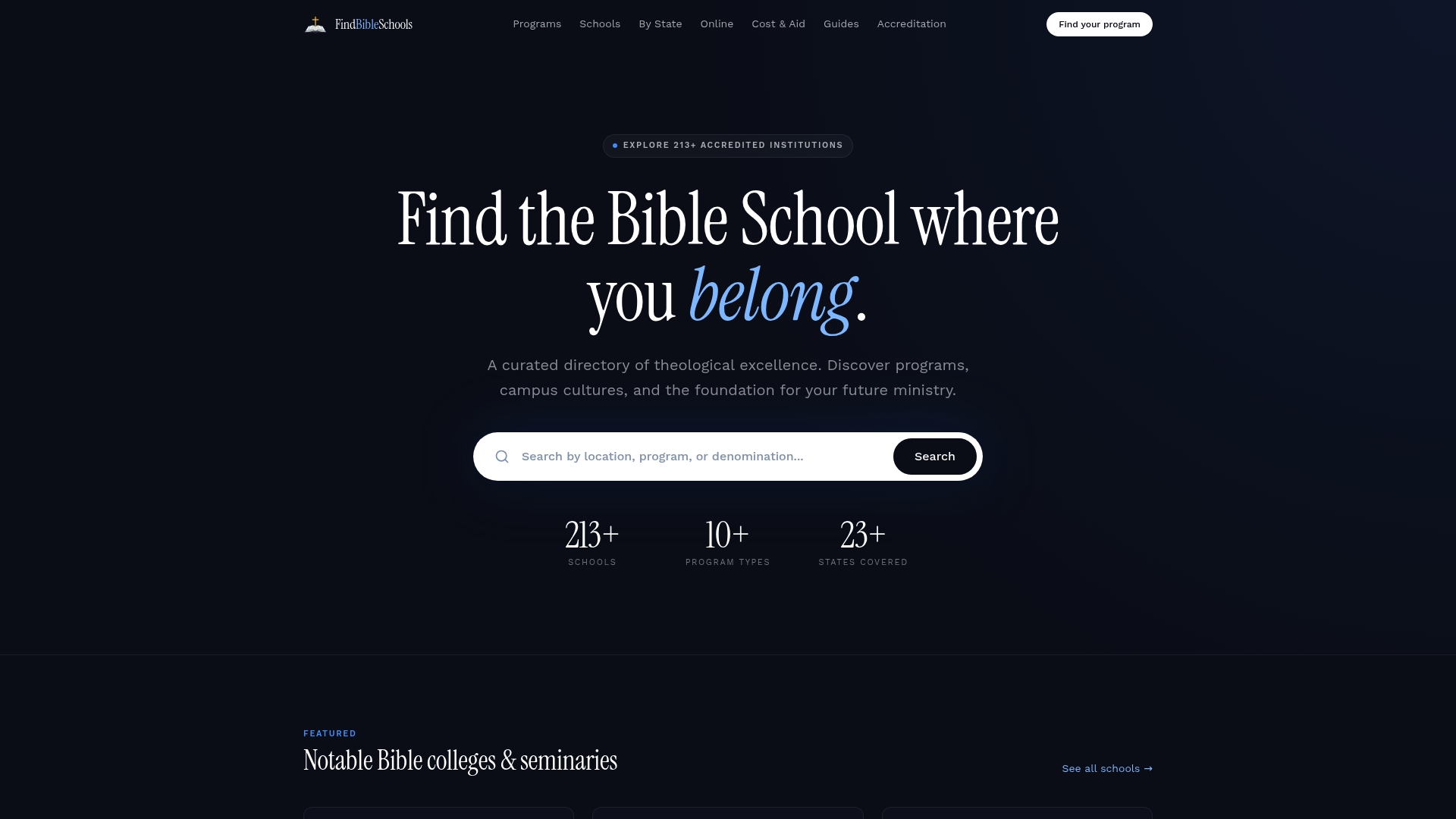
Searching by location often reveals which schools have active denominational partnerships near you. Our listings for Bible colleges in Kentucky and Bible colleges in Tennessee show how regional concentration of schools within a tradition can make local conference funding easier to track down.
- Compare accredited programs by state, degree level, and denominational affiliation
- Review individual school pages for tuition, accreditation, and program details before applying for outside aid tied to that institution
- Use our cost and financial aid guides to see how denominational awards typically fit into a full aid package
Start with our directory of accredited Bible colleges and seminaries to find programs that match both your calling and your funding options.
This article is general information, not a substitute for advice from a qualified financial advisor. Consult a qualified financial professional about your own circumstances before acting on anything here.
FAQ
Are there full scholarships available for pastors?
Full-ride denominational scholarships exist but are uncommon; most programs, like the Presbyterian Church (U.S.A.)'s roughly $4,000 basic award, are designed to supplement rather than fully cover tuition. Combining a denominational award with institutional aid and federal loans is the more typical path to covering full costs.
What is the Chick-fil-A scholarship program?
This is a corporate scholarship program unrelated to any specific denomination or theological tradition, so it falls outside the scope of denominational or faith-based ministry funding. Students should check its own eligibility terms directly rather than assuming it functions like a church-affiliated award.
How do I get a full scholarship to study in the USA?
There is no single guaranteed path to a full scholarship, but stacking aid sources improves your odds: file the FAFSA early for federal and institutional aid, then layer in denominational awards from your church, conference, or national foundation. Programs like UMHEF’s matching funds can multiply a local church contribution, which sometimes closes a meaningful gap in your total package.
What is the easiest scholarship to get for seminary?
Local and district-level denominational funds, administered through your own congregation or conference office, are generally less competitive than national programs because fewer students know they exist. Asking your pastor or your seminary’s financial aid office directly about these smaller pots is usually more productive than applying to large national competitions.
Sources
- Free Application for Federal Student Aid (FAFSA) July 1, 2026 - June 30, 2027
- Studentaid
- Scholarship FAQ - General Board of Higher Education and Ministry
- UMHEF 2025 reference guide (scholarship details)