Published September 17, 2026
Place Any Church on 2 Axes to Decode Its Denominational Distinctives
Denominational distinctives are the specific doctrinal, sacramental, and governance commitments that set one Christian tradition apart from another. Nearly all of them trace back to two underlying questions: where does religious authority actually live, and how much doctrinal or ethical flexibility does a tradition permit? Once you can place a church on those two axes, surface differences like music style or dress code stop being confusing and start making sense. This article walks through the three major branches, the axes that organize their differences, detailed family profiles, and a practical way to evaluate any congregation you visit.
TL;DR:
- Most doctrinal differences across denominations are rooted in the authority axis, with some traditions prioritizing Scripture alone and others emphasizing church tradition and hierarchy.
- The second key axis is doctrinal flexibility, where some traditions treat confessions as fixed dogma, while others allow doctrine to develop over time.
- Major families like Catholic and Orthodox hold authority through sacraments and tradition, whereas Reform and Baptist traditions lean towards Scripture-based authority and local governance.
- Evaluating a church involves examining its stance on final authority, sacrament practices, governance structure, and doctrinal flexibility through direct questions and primary documents.
- Seminary choices often reflect denominational distinctives, making curriculum and faculty statements useful for understanding a tradition’s core commitments.
Table of Contents
- What Are Denominational Distinctives, and Why Do They Exist?
- The Two Axes That Explain Most Doctrinal Differences
- Denominational Profiles: How the Major Families Compare
- How to Evaluate a Church’s Denominational Distinctives Yourself
- Where Denominational Identity Shows Up in Theological Education
- Studying Denominational Differences Without Losing Charity
- Finding a School That Matches Your Tradition
- Sources
- FAQ
What Are Denominational Distinctives, and Why Do They Exist?
Every Christian tradition traces back to one of three major branches: Roman Catholic, Eastern Orthodox, and Protestant. Roman Catholicism recognizes the pope as the visible head of the global church and holds that authoritative teaching flows through both Scripture and church tradition, interpreted by the magisterium. Eastern Orthodoxy shares much of that sacramental structure but rejects papal authority, organizing instead around a communion of self-governing churches (Greek, Russian, Antiochian, and others) united by shared liturgy and the decisions of the ancient ecumenical councils.
Protestantism is less a single church than a family of movements born from the 16th-century conviction that Scripture alone, not church tradition, should govern doctrine. That single starting point splintered into dozens of distinct families, each with its own answer to questions Luther and Calvin left open. Reference guides tend to group them the same way, since the pattern is consistent enough to be useful shorthand, as the Gospel Coalition’s quick guide to Christian denominations demonstrates.
Here is a working map of the major Protestant families you will encounter:
- Anglican/Episcopal: Retains bishops, formal liturgy, and sacramental theology closer to Catholic and Orthodox practice, while affirming Scripture’s final authority.
- Lutheran: Built on Martin Luther’s doctrine of justification by faith alone, with the Augsburg Confession as its defining statement.
- Reformed/Presbyterian: Traces to John Calvin and John Knox, emphasizes God’s sovereignty, and governs itself through elected elders rather than bishops.
- Methodist/Wesleyan: Grew out of John Wesley’s emphasis on personal holiness and gradual spiritual growth, historically organized through a connectional bishop system.
- Baptist: Insists on believer’s baptism by immersion and congregational self-governance, with no denominational hierarchy above the local church.
- Pentecostal/Charismatic: Centers worship and doctrine on the ongoing work of the Holy Spirit, including spiritual gifts like tongues and healing.
- Non-denominational: Deliberately avoids formal denominational ties, though most still land recognizably within evangelical or charismatic theological territory.
Notice how each family answers the same underlying question differently: who has the authority to interpret Scripture, and how much room is there to disagree once that interpretation is settled? That is the pattern the rest of this article unpacks.
The Two Axes That Explain Most Doctrinal Differences
Most people try to sort churches by surface traits: hymns versus worship bands, formal robes versus jeans, silence versus shouting. Those differences are real, but they are symptoms, not causes. The deeper structural commitments sit on two axes: where authority lives, and how much doctrinal flexibility a tradition tolerates.
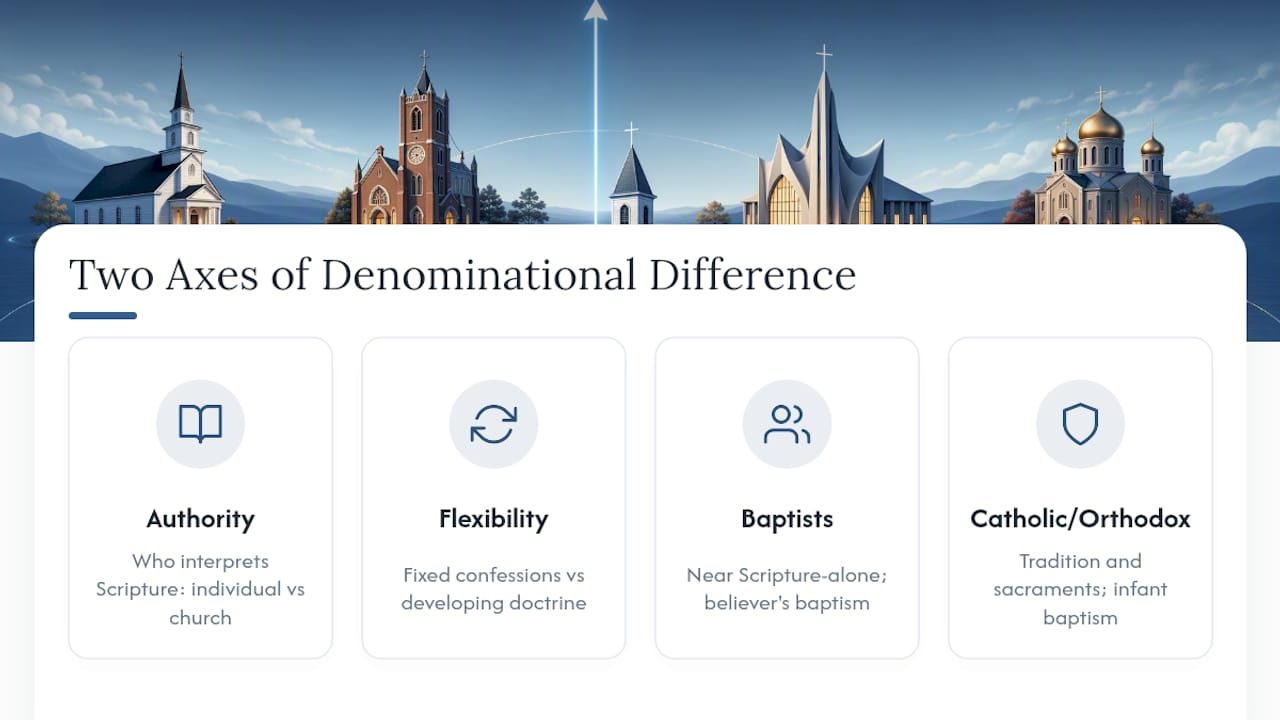
Axis one is the locus of authority. On one end, a tradition holds that Scripture alone is the final word, interpreted by the individual believer or a congregation under the Holy Spirit’s guidance. On the other end, a tradition holds that Scripture must be read through the lens of church tradition, sacraments, and ordained clergy who carry teaching authority passed down through history. Baptists sit near the Scripture-alone end. Roman Catholics and Eastern Orthodox sit near the tradition-and-sacrament end. Most Protestant families land somewhere in between, leaning toward Scripture but still respecting confessional documents and ordained leadership.
Axis two is doctrinal and ethical flexibility. Some traditions treat their confessions as fixed, non-negotiable boundaries; others treat doctrine as something that can develop alongside culture and new biblical scholarship. This axis explains why two churches with nearly identical worship styles can land in completely different places on issues like ordination requirements or the interpretation of contested biblical passages.
An analysis of denominational positions across several traditions, scored on multiple doctrinal dimensions, found that these two factors alone account for a large majority of the variance in denominational identity, according to BibleTimes’ study on what distinguishes the major branches of Christianity. That is a strikingly clean result for something as messy as religious history.
Denominational identity is not primarily about music or building architecture. It is about who holds interpretive authority, and how much room a tradition leaves for that interpretation to shift over time. Two churches can look nearly identical on a Sunday morning and still diverge sharply once you ask who gets the final say on doctrine.
You can watch these axes play out in real practice. Baptism, for instance, splits almost entirely along the authority axis: traditions that emphasize individual faith and Scripture tend toward believer’s baptism by immersion, while traditions that emphasize sacramental grace passed through the church tend toward infant baptism. Communion theology splits the same way. Views on ordination, especially regarding gender, split largely along the flexibility axis. Worship formality tends to track the authority axis too, since traditions built around sacrament and clergy usually keep more liturgical structure than traditions built around Scripture and preaching.
Statistic to remember: two variables (authority and flexibility) predict roughly three-quarters of the doctrinal variance across dozens of denominations. If you learn to ask those two questions about any church, you will understand it faster than you would by cataloging a dozen surface details.
Denominational Profiles: How the Major Families Compare
Here is what changes, and what stays consistent, once you look past the surface at authority, sacraments, and structure across the major Christian families.
Roman Catholic. Authority rests in Scripture and sacred tradition together, interpreted by the magisterium under the pope. Catholics recognize seven sacraments, including the Eucharist, which they hold becomes the actual body and blood of Christ through transubstantiation. Baptism is typically administered to infants. Governance is hierarchical, running from parish priest to bishop to pope. Worship follows a fixed liturgical structure centered on the Mass. This family tends to fit readers drawn to historical continuity, sacramental depth, and a single global teaching authority.
Eastern Orthodox. Authority rests in Scripture and the decisions of the ancient ecumenical councils, preserved through apostolic succession, but without a single earthly head equivalent to the pope. Orthodoxy also holds seven sacraments (often called “mysteries”), with a real presence understanding of the Eucharist that resists the precise philosophical language Catholicism uses. Infant baptism, typically by triple immersion, is standard. Governance is a communion of self-governing national or regional churches (Greek, Russian, Antiochian, and others) linked by shared faith rather than central command. Worship is highly liturgical, often lengthy, and rich in icons and chant. This tradition tends to draw people seeking ancient, unbroken continuity with the early church, expressed through mystery rather than systematic explanation. Both Catholic and Orthodox communities generally see themselves as historic communions predating the modern concept of “denomination” altogether, a distinction worth remembering when comparing them to Protestant families, as Christian Way’s overview of why denominations differ notes.
Anglican/Episcopal. Authority blends Scripture, tradition, and reason, a formula often called the “three-legged stool.” Anglicans retain sacramental practice close to Catholic form, including belief in Christ’s real presence in communion, though interpretations vary widely across the tradition’s broad internal spectrum. Baptism is usually administered to infants. Governance runs through bishops in historical succession, though authority is more distributed than in Rome. Worship follows the Book of Common Prayer, blending liturgical formality with room for varying levels of ceremony. This family often fits people who want liturgical depth without submitting to a single central authority.
Lutheran. Authority is Scripture alone, formally defined through the Augsburg Confession, which still functions as the doctrinal anchor for most Lutheran bodies today. Lutherans affirm two sacraments (baptism and communion) and hold that Christ is truly present in the Eucharist, though not through the same transubstantiation framework Catholics use. Baptism, typically infant baptism, is understood as a means of grace rather than a symbolic act alone. Governance varies by synod, ranging from more centralized to more congregational models. Worship tends toward structured liturgy with strong hymn traditions. This tradition suits readers who want the doctrinal precision of the Reformation paired with sacramental seriousness.
Reformed/Presbyterian. Authority is Scripture alone, formalized in confessional documents like the Westminster Confession. Reformed theology treats baptism and communion as ordinances rather than sacraments carrying inherent grace, though most Reformed churches still see communion as a genuine, if spiritual, means of encountering Christ. Baptism practice includes infants in most Reformed bodies, reflecting covenant theology. Governance is representative: elected elders (presbyters) at multiple levels, from local session to regional presbytery to national general assembly, rather than bishops or a single pastor’s authority. Worship is typically more restrained, centered on preaching and structured order. This family tends to fit readers drawn to doctrinal precision, covenant theology, and shared church governance.
Methodist/Wesleyan. Authority is Scripture, read through what is often called the “Wesleyan quadrilateral” of Scripture, tradition, reason, and experience. Methodists practice two ordinances, baptism (open to infants or adults) and communion, understood as means of grace that nurture ongoing sanctification rather than a single moment of salvation. Governance historically runs through a connectional system with bishops overseeing regional conferences, distinct from congregational independence. Worship style varies widely, from traditional liturgy to contemporary formats, depending on the specific congregation. This tradition often fits readers focused on practical holiness, gradual spiritual growth, and social engagement.
Baptist. Authority is Scripture alone, interpreted by the local congregation without denominational hierarchy imposing doctrine from above. Baptists hold two ordinances, believer’s baptism by full immersion and communion, both understood as symbolic acts of obedience rather than channels of sacramental grace. Baptism is reserved for those old enough to profess personal faith, never infants. Governance is congregational: each local church calls its own pastor and makes its own decisions, sometimes loosely affiliated with a larger convention for missions and resources. Worship centers on preaching, typically in a less formal, less liturgical style. This family suits readers who prioritize local church autonomy and a clear, individual profession of faith.
Pentecostal/Charismatic. Authority is Scripture, understood as actively confirmed by the Holy Spirit’s present-day activity, including gifts like tongues, prophecy, and healing. Baptism is by immersion, reserved for believers, alongside a distinct “baptism in the Holy Spirit” many Pentecostals see as a separate experience from water baptism. Communion functions as a symbolic ordinance. Governance ranges from strongly congregational to more centralized denominational oversight, depending on the specific group. Worship is expressive and spontaneous, often extending well beyond a fixed order of service. This tradition tends to attract readers who prioritize direct spiritual experience and expect the miraculous to remain active today.
Non-denominational. Authority is Scripture, typically interpreted through a broadly evangelical lens without a formal confessional document binding the congregation. Sacramental practice varies by church but usually mirrors Baptist or charismatic patterns: believer’s baptism and symbolic communion. Governance is independent, often centered on a strong lead pastor or elder team with no outside denominational accountability. Worship formats vary enormously from one congregation to the next. This category fits readers who want doctrinal simplicity and local flexibility over historical or confessional identity.
How to Evaluate a Church’s Denominational Distinctives Yourself
You do not need a theology degree to figure out where a church actually stands. You need the right questions, asked in the right order.
- Attend a service before you read anything else. Notice the order of worship, how communion is handled, and whether the sermon centers on Scripture, sacrament, or personal application.
- Read the church’s confession or statement of faith. Most churches publish one online; if a congregation is Presbyterian, Lutheran, or Anglican, look up the historic document behind it (Westminster Confession, Augsburg Confession, Thirty-Nine Articles) rather than relying on a paraphrase.
- Ask leadership directly about authority. A simple question like “what settles a doctrinal disagreement here?” reveals more than a mission statement ever will.
- Observe how baptism and communion are practiced. Who receives them, how often, and what the pastor says they accomplish tells you exactly where the church sits on the authority axis.
- Compare what you find against the two-axis framework. Does the church lean toward Scripture-alone or Scripture-plus-tradition? Does it treat its doctrine as fixed or as open to development?
Before you visit, run through this checklist of concrete questions:
- Where does final doctrinal authority rest: Scripture alone, or Scripture plus tradition and clergy?
- How many sacraments or ordinances does this tradition recognize, and what do they believe actually happens during them?
- Who governs the local congregation: a bishop, a body of elders, or the congregation itself?
- What does ordination require, and who is eligible?
- How does this tradition handle disagreement on contested ethical or doctrinal questions?
Pro Tip: Always ask a church leader to point you to the specific creed or confession their tradition holds to, then read it yourself rather than trusting a secondhand summary. The Apostles’ Creed and Nicene Creed are shared across nearly all historic traditions, so any major departure from them is worth asking about directly.
Where Denominational Identity Shows Up in Theological Education
Denominational distinctives are not abstract once you start comparing seminaries. Course requirements, faculty statements of faith, and ordination tracks all reveal a school’s theological commitments just as clearly as a church’s Sunday liturgy does. Some platforms catalog this information, tracking denominational affiliation, accreditation, and program focus across numerous accredited theological institutions in the United States.
A school like Covenant Theological Seminary builds its curriculum around Reformed confessional theology, while Asbury Theological Seminary reflects Wesleyan holiness distinctives in its ministry formation programs. Comparing course requirements across schools like these is often a faster way to understand a tradition’s actual priorities than reading a denomination’s official website, since a curriculum has to commit to specifics that a mission statement can avoid. Readers exploring a specific tradition’s theology programs and degree types can see exactly how denominational commitments translate into required coursework, faculty expectations, and ordination pathways.
Studying Denominational Differences Without Losing Charity
The biggest mistake people make when comparing denominations is assuming the tradition they know best is the neutral baseline and everything else is a deviation from it. Every tradition looks strange from outside its own assumptions. Reformed theology sounds cold to a Pentecostal ear; Pentecostal worship sounds chaotic to a Presbyterian ear. Neither reaction is wrong, exactly, but neither is a substitute for actually understanding what the other tradition believes and why.
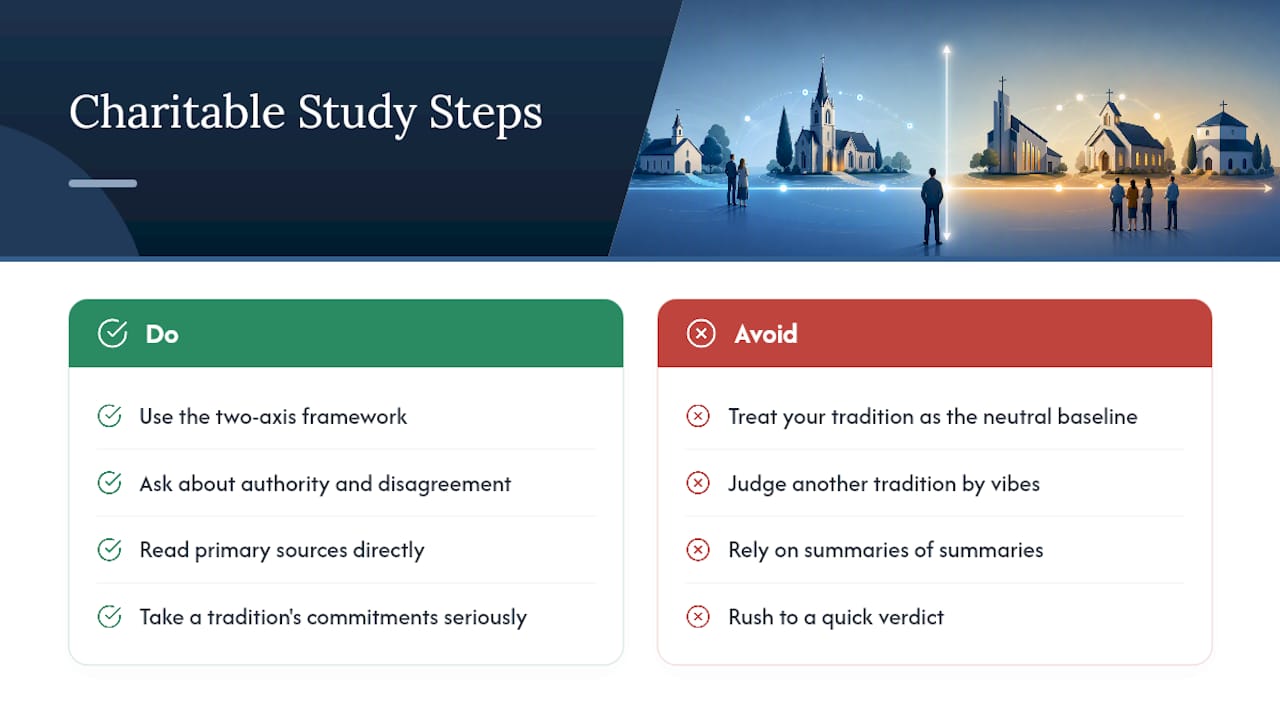
The two-axis framework helps here because it forces a more honest comparison. Instead of asking “which church is right,” you can ask “what does this tradition believe about authority, and how much room does it leave for disagreement.” That question is answerable through primary documents, not vibes.
Anyone doing this seriously should read primary sources directly, not summaries of summaries. Sit with the Augsburg Confession before dismissing Lutheran sacramental theology. Read the Westminster Confession before assuming Reformed governance is just bureaucracy. Charity toward a tradition starts with taking its own stated commitments seriously, on its own terms, before deciding what to think of them. Use the checklist earlier in this article, and let it slow you down rather than speed you toward a verdict.
— Grant
Finding a School That Matches Your Tradition
If you already know where you land on the authority and flexibility axes, the next practical step is finding a seminary or Bible college that shares your convictions rather than fighting them for three years. There are directories that serve as alternatives to guessing your way through denominational websites one at a time: these let you filter accredited institutions by denominational affiliation and program focus in one place, instead of cross-referencing accreditation status, tuition, and doctrinal statements across dozens of separate school sites.

You can browse profiles like Trinity Evangelical Divinity School for evangelical and interdenominational training, Westminster Theological Seminary for Reformed and Presbyterian formation, or Reformed Theological Seminary for another confessionally Reformed option. Each profile lays out accreditation status, degree levels, and cost side by side, so you are comparing real programs instead of marketing copy. If you already know your state, you can also search accredited Bible colleges and seminaries by location to narrow the list before you dig into individual schools. Start with your tradition’s core confession, then use the directory to find the schools actually built to teach it.
Sources
- What Distinguishes the Major Branches of Christianity? | BibleTimes
- Quick Guide to Christian Denominations
- The Key Differences of the 7 Major Christian Denominations
FAQ
What are the 12 major denominations of Christianity?
There is no single official list, but most reference guides group Christianity into three branches (Roman Catholic, Eastern Orthodox, and Protestant) and then break Protestantism into major families such as Anglican, Lutheran, Reformed/Presbyterian, Methodist, Baptist, Pentecostal, and non-denominational. Counting Catholic and Orthodox as two, that gives you roughly nine to twelve recognizable groups depending on how finely you split Protestant subfamilies, a pattern reflected in guides like the Gospel Coalition’s overview.
What are the 7 mainline denominations?
“Mainline” typically refers to historically established, often more theologically progressive Protestant bodies in the United States, commonly including denominations within the Methodist, Presbyterian, Lutheran, Episcopal, American Baptist, Disciples of Christ, and United Church of Christ traditions. The term distinguishes them from evangelical and Pentecostal denominations, though the boundaries have blurred as individual congregations within these bodies vary widely in theology.
What do you mean by denominational?
A denomination is a distinct organized group within Christianity that shares a specific set of doctrinal commitments, governance structure, and often a confessional document, while still recognizing itself as part of the broader Christian faith. Roman Catholic and Eastern Orthodox communities generally see themselves as historic communions rather than “denominations” in this modern sense, since the term developed mainly to describe the branching Protestant movements, as Christian Way’s history of denominational difference explains.
What was Charlie Kirk’s religious affiliation?
This falls outside the scope of denominational theology this article covers, and reliable details on that specific affiliation are not addressed in the sources used here.
How do I compare denominational distinctives across churches I’m considering?
Ask each church where final doctrinal authority rests, how many sacraments or ordinances it recognizes, and how it structures governance and ordination. Findbibleschools’ directory of accredited theological schools lets you compare how different institutions build their programs around these same distinctives, which is often a faster way to see a tradition’s real priorities than reading a denomination’s website alone.