
Published August 20, 2026
Which Christian Counseling Degree Fits Your Calling?

If you want state licensure as a professional counselor, you generally need a CACREP-aligned master’s degree, such as a Master of Arts in Counseling (MAC), that meets your state board’s coursework and supervised-hours requirements. If your goal is church or parachurch ministry, a Master of Arts in Biblical Counseling (MABC), an MDiv with a counseling emphasis, or ACBC certification will typically serve you better than a clinical degree. If you’re just starting out, a bachelor’s degree in Christian psychology or biblical studies builds the foundation for either path later.
- Licensure track: CACREP-aligned MA in Counseling, plus your state board’s hours
- Ministry track: MABC, MDiv with counseling focus, or ACBC or NACC certification
- First steps: Compare accredited programs at Find Bible Schools and check aid eligibility at Studentaid
Key Takeaways
Matching your Christian counseling degree to your actual career goal, licensure, ministry, or entry-level work, determines nearly every other decision about accreditation, cost, and format.
| Point | Details |
|---|---|
| Match degree to goal | Choose a CACREP-aligned MA for licensure; choose an MABC or MDiv for church ministry. |
| Accreditation drives two things | It determines federal aid eligibility and whether your state board accepts your coursework. |
| Confirm practicum logistics early | Ask exactly how online programs place students in supervised hours before enrolling. |
| Certification isn’t licensure | ACBC and NACC credentials suit ministry roles but don’t replace a state LPC license. |
| Compare programs before applying | Findbibleschools lets you filter 213+ accredited institutions by accreditation, format, and cost. |
Table of Contents
- What Christian Counseling Degree Options Actually Prepare You For
- How Do Accreditation and Licensure Fit Together?
- How Many Credit Hours and Practicum Hours Will You Need?
- Verifying Online Christian Counseling Programs Before You Enroll
- Do You Need Certification, Licensure, or Both?
- What Will a Christian Counseling Degree Actually Cost You?
- A Quick Checklist Before You Apply
- What Can You Expect to Do With This Degree?
- How Denominational Perspective Shapes Counseling Approach
- Why Licensure Requirements Differ by State
- Keeping Your License or Certification Current
- Ethics in Christian Counseling: Where Faith and Clinical Standards Meet
- How Findbibleschools Helps You Compare These Programs
- Start Comparing Accredited Christian Counseling Programs
- Frequently Asked Questions
- Sources
What Christian Counseling Degree Options Actually Prepare You For
A bachelor’s degree in Christian psychology, biblical studies, or human services gives you the theological and behavioral-science foundation for graduate work. It rarely qualifies you to counsel independently, but it opens doors to youth ministry, case management, or church support roles while you plan your next step.
At the graduate level, the distinction that matters most is clinical versus ministry orientation.
- Clinically oriented MA (MAC/MACC): built around CACREP-style coursework, aimed at state licensure as an LPC or similar credential
- M.A. in Biblical Counseling (MABC): scripture-centered training for church, parachurch, or ACBC-aligned counseling roles, as Southeastern Baptist Theological Seminary’s program illustrates
- MDiv with counseling emphasis: prepares you for pastoral counseling and ordination tracks; it usually requires additional clinical coursework if you later want licensure
The tradeoff comes down to scope of practice. An MDiv gives you preaching, theology, and pastoral care credentials that a clinical MA doesn’t touch, but a clinical MA gives you a path to insurance-reimbursed private practice that a ministry-focused degree generally does not.
How Do Accreditation and Licensure Fit Together?
Accreditation determines two things: whether you qualify for federal financial aid, and whether your degree satisfies your state licensing board’s education requirements. These are separate questions, and conflating them is the most common mistake applicants make.
Regional accreditors (SACSCOC, HLC, and similar bodies) and specialized accreditors each play a distinct role. The Association of Theological Schools (ATS) and the Association for Biblical Higher Education (ABHE) accredit seminaries and Bible colleges specifically, while CACREP accredits counseling programs against the standards most state boards use to evaluate licensure applicants.
- Confirm the program holds regional or ATS/ABHE accreditation, which affects federal aid eligibility.
- If licensure is your goal, verify CACREP accreditation or ask directly whether coursework meets your specific state board’s requirements, since programs may prepare graduates for licensure without holding CACREP status.
- Check your state licensing board’s website for the exact course categories and supervised-hours minimums it requires.
Look for explicit licensure-preparation language on the program page, published practicum-hour counts, and visible accreditation badges. Dallas Theological Seminary’s MAC program is a useful model of how this is typically presented.
Pro Tip: Call the state licensing board directly before you enroll. Program marketing describes intent, but the board decides eligibility, and the two don’t always agree.
How Many Credit Hours and Practicum Hours Will You Need?
Clinical master’s programs aimed at licensure commonly meet the credit hour range required by most state boards for LPC eligibility. Ministry-focused MABC programs often have fewer credit hours because they aren’t built around a licensing board’s checklist.
- Practicum and internship sequencing usually starts after core coursework, with supervised hours logged under a credentialed supervisor.
- Online students should confirm whether supervision happens locally or through the seminary’s placement network, since many programs pair online coursework with in-person residencies or local practicum sites to satisfy hours requirements.
- Ask directly whether the school assists with placement or expects you to find your own supervised site, since placement support varies widely between institutions.
Confirm your practicum supervisor holds the credential your state requires. A supervisor without the right license or certification can invalidate hours you’ve already logged.
Verifying Online Christian Counseling Programs Before You Enroll
Online programs generally run as asynchronous (self-paced coursework), synchronous “OL-Live” (scheduled video classes), or hybrid models that combine online coursework with short on-campus residencies. Each format handles practicum differently, and that difference is where online applicants run into trouble.
- Confirm the school is authorized to enroll students in your state, since some programs restrict enrollment by state.
- Ask exactly how practicum placement works for distance students and whether the school assists with finding a local supervisor.
- Get residency dates and location requirements in writing before you commit to a term.
- Watch for vague practicum descriptions, missing accreditation details, or unclear answers about who supervises your hours. Those are signs the program hasn’t built out its distance-learning infrastructure.
Pro Tip: If an admissions rep can’t tell you exactly how practicum placement works for online students, that’s your answer. Ask a second time in writing.
Do You Need Certification, Licensure, or Both?
Certification and licensure solve different problems, and mixing them up leads to real career setbacks. Licensure is a state-regulated legal credential that permits independent clinical practice; certification is a professional or denominational credential that signals training and competency but carries no legal authority to practice as a licensed counselor.
- ACBC (Association of Certified Biblical Counselors) alignment typically requires supervised biblical counseling hours and coursework that some MABC programs, like Mission University’s online track, build directly into a 45-hour degree plan.
- NACC’s Board Certified Christian Counseling Program offers a shorter, certificate-length pathway, often around 15 credit hours, designed for ministry credentialing rather than clinical practice.
- Certification alone usually works for church staff and parachurch counseling roles but is not a substitute for an LPC if you plan to bill insurance or practice independently outside a ministry setting.
What Will a Christian Counseling Degree Actually Cost You?
Start at studentaid.gov and file the FAFSA, since accredited programs are generally where federal grants and loans apply. Regional and specialized accreditation status is what determines your eligibility, which is one more reason to confirm it before you apply.
- Compare per-credit tuition against flat program pricing. Per-credit rates reward part-time pacing; flat pricing rewards finishing fast.
- Budget separately for practicum or supervision fees, which many programs bill outside standard tuition.
- Ask about residency travel costs if the program is hybrid.
Cost-lowering levers worth exploring: institutional scholarships tied to denomination or ministry service, transfer credit for prior coursework, employer tuition benefits if you already work in a ministry or counseling setting, and simply slowing your pace to spread cost over more terms.
A Quick Checklist Before You Apply
Use this during your first call with admissions.
- Is the program regionally accredited, and does it hold ATS, ABHE, or CACREP accreditation relevant to your goal?
- Does the program explicitly state whether it prepares graduates for licensure or for ministry certification?
- How does practicum supervision work for your delivery format, and who assists with placement?
- Is the school authorized to enroll students in your state?
- What are faculty credentials, and what is the realistic total cost including fees?
Pro Tip: Ask the practicum coordinator directly, not just admissions. Admissions sells the program; the practicum coordinator knows what actually happens in year two.
Red flags: no visible accreditation, vague answers about supervision, and admissions staff who can’t name the state boards their graduates typically qualify for.
What Can You Expect to Do With This Degree?
Graduates typically land in church counseling ministries, Christian counseling centers, hospital or hospice chaplaincy, or, with an LPC, private practice. Licensure is the primary lever that expands your scope. It allows independent, insurance-reimbursed practice that a ministry credential alone doesn’t unlock, and earning potential shifts accordingly by state.
- Church counselor or pastoral care staff: typically ministry-credentialed, not state-licensed
- Christian counseling center clinician: usually requires LPC or equivalent
- Private practice: requires state licensure in nearly every case
Quick mapping: want private practice? Pursue a CACREP-aligned MA. Want church ministry? Pursue an MABC or ACBC path.
How Denominational Perspective Shapes Counseling Approach
Not every Christian counseling program teaches the same method, and the differences trace back to theological tradition rather than clinical technique. Nouthetic and biblical counseling models, most closely associated with ACBC-aligned training, treat Scripture as sufficient for addressing personal and relational struggles and tend to be skeptical of integrating secular psychological frameworks without careful theological filtering.
Integrationist models, common in evangelical seminaries with APA-adjacent psychology departments, blend clinical psychology with biblical principles, viewing common-grace insights from psychology as compatible with, not opposed to, biblical truth. Reformed and confessional seminaries often lean integrationist but filter psychological concepts tightly through their doctrinal statements. Pentecostal and charismatic programs may incorporate deliverance ministry or spiritual warfare frameworks into counseling training in ways more cessationist traditions do not.
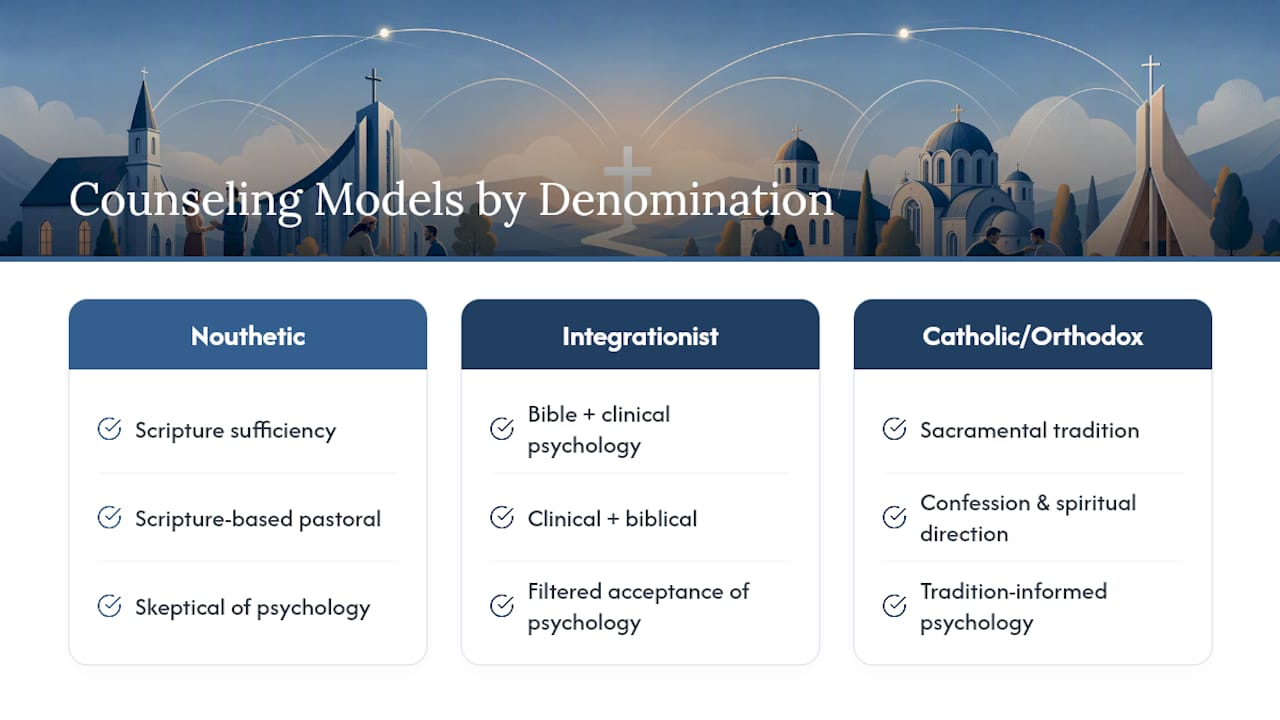
Catholic and Orthodox institutions, while less common in the biblical counseling space specifically, often draw on sacramental theology, confession, and spiritual direction traditions that differ meaningfully from Protestant biblical counseling models.
None of this is a matter of one approach being more legitimate than another. It matters practically because the counseling model a program teaches will shape how you’re trained to handle cases involving mental illness, trauma, and psychiatric medication. If you plan to work across denominational lines, look for a program that acknowledges other traditions even while training you in its own. If you plan to serve within a specific denomination, ask directly whether the program’s theological commitments align with the church bodies you intend to serve.
Why Licensure Requirements Differ by State
State licensing boards, not seminaries, set the rules for who can call themselves a Licensed Professional Counselor, and those rules vary enough that a degree perfectly suited for licensure in one state can fall short in another. Some states require CACREP accreditation specifically; others accept any regionally accredited counseling degree that covers the right course categories. Supervised-hours minimums for full licensure commonly range between roughly 2,000 and 4,000 hours depending on the state, and post-graduate supervision requirements differ just as widely.
This matters most for online students, since the state where you complete supervised hours, not necessarily the state where your school is based, is usually the one whose board you answer to. If you take an online program based in one state but plan to practice in another, confirm reciprocity or portability rules early. Some states have streamlined licensure endorsement agreements; others require you to redo coursework or hours that don’t map cleanly onto their standards.
The practical fix is simple, even if it takes a few phone calls: identify the state where you intend to practice, pull up that state’s counselor licensing board page, and compare its education and hours requirements against your target program’s curriculum before you enroll, not after. Programs can tell you what they’re built to prepare you for. Only the board can tell you whether it counts.
Keeping Your License or Certification Current
Licensure and certification aren’t one-time achievements. LPCs typically must complete continuing education (CE) hours on a renewal cycle set by their state board, often in the range of 20 to 40 hours every one to two years, sometimes with specific requirements like ethics or suicide-prevention training built in. Missing a renewal deadline can lapse your license entirely, which means reinstatement paperwork and, in some states, additional coursework.

ACBC certification carries its own maintenance expectations, generally centered on continued supervised counseling and involvement in ACBC-affiliated ministry rather than a fixed CE-hour count. NACC’s certificate-based credentials similarly expect ongoing engagement with the organization rather than a heavy annual CE burden, which is part of why ministry-focused credentials appeal to bivocational counselors juggling church responsibilities alongside a day job.
Whichever credential you hold, build a simple habit early: track your renewal date, log CE hours as you complete them rather than scrambling before a deadline, and keep records of supervision or ministry involvement if your certification requires it. Many licensed counselors treat continuing education as a chance to specialize, picking CE courses in trauma-informed care, grief counseling, or marriage and family work that sharpen a niche practice rather than just clearing a requirement.
Ethics in Christian Counseling: Where Faith and Clinical Standards Meet
Christian counselors navigate two ethical frameworks simultaneously, and the tension between them is real. State licensing boards hold LPCs to secular codes of conduct, typically built around informed consent, confidentiality, non-discrimination, and avoiding harm regardless of a client’s beliefs. Denominational or ACBC-aligned counseling ethics add scriptural fidelity, pastoral accountability, and, in many cases, an expectation that counseling will point clients toward biblical truth rather than remaining neutral on moral questions.
The friction shows up most clearly around informed consent and referral. A licensed Christian counselor who declines to affirm a client’s choices on religious grounds still has a legal and ethical duty to disclose that stance upfront and refer appropriately rather than leaving a client stranded mid-crisis. Confidentiality carries similar tension in church settings, where pastoral counselors often lack the legal privilege a licensed clinician has, meaning what’s shared with a pastor may not carry the same confidentiality protections as what’s shared with an LPC.
Dual-role conflicts are common in ministry counseling specifically. A pastor counseling a congregation member is simultaneously a spiritual authority, sometimes an employer or employee within the same church structure, and a counselor, which creates boundary issues that clinical training programs address explicitly and some ministry-track programs address less formally. Any program worth choosing should teach you how to recognize when a client’s needs exceed your training and require referral to a licensed clinician, a psychiatrist, or emergency services. Faith commitment doesn’t replace clinical judgment, and the best programs teach both without pretending one covers for gaps in the other.
How Findbibleschools Helps You Compare These Programs
Findbibleschools curates accreditation status, delivery format, tuition, and program details across more than 213 accredited U.S. theological institutions, which makes it possible to filter for exactly what your goal requires, whether that’s CACREP status for licensure or an ACBC-aligned MABC for ministry. Use it to cross-check accreditation claims and delivery logistics before you call admissions, so your first conversation with a school is about fit, not fact-finding.
Start Comparing Accredited Christian Counseling Programs
Findbibleschools is the direct way to compare accredited Christian counseling degree programs side by side, without spending weeks tracking down accreditation status and tuition figures one seminary website at a time. You can filter by degree level, delivery format, and accreditation type, so a program that doesn’t meet your state’s licensure requirements or ministry certification goals never makes your shortlist in the first place.

Browse the full directory of accredited Bible colleges and seminaries to see program pages that lay out accreditation, tuition, and delivery format in one place, or start with the guide to accredited online programs if distance learning is your priority. If a program in a specific state catches your eye, the Kentucky Bible colleges page and similar state directories show you what’s locally available. Most program pages let you request information directly from the school, so you can get real answers about practicum placement and licensure prep before you commit to an application.
Frequently Asked Questions
Do I need a master’s degree for a Christian counseling career, or is a bachelor’s enough? A bachelor’s degree in Christian psychology or biblical studies can qualify you for entry-level ministry support roles, but licensed clinical practice and most ministry counseling certifications require a master’s degree.
Can I get a christian counseling degree online and still qualify for state licensure? Yes, many CACREP-aligned programs offer hybrid or synchronous online formats, but they still require in-person practicum hours or short residencies, so confirm placement support before enrolling.
What’s the difference between a biblical counseling degree and a clinical counseling master’s? A biblical counseling degree, like an MABC, trains you for church and ministry settings and often aligns with ACBC certification, while a clinical master’s prepares you specifically for state licensure requirements.
Is certification in Christian counseling the same as being licensed? No. Certifications like ACBC or NACC’s board certification signal ministry-focused training and competency, but only a state-issued license permits independent clinical practice.
How long does a masters in Christian counseling typically take? Clinical master’s programs aimed at licensure often run 60 or more credit hours and take two to three years full-time, while ministry-focused MABC programs can run shorter, sometimes 36 to 48 credits.
Sources
- Federal Student Aid | FAFSA
- Master of Arts in Counseling (MAC) | Dallas Theological Seminary
- MA in Biblical Counseling - Southeastern Baptist Theological Seminary
- Board Certified Christian Counseling Program | NACC