
Published October 5, 2026
Prospective Seminarians: Vocation First, Narrow to 3–5 Seminaries

The seminary that fits you best is the one that forms your character and sharpens your calling, not simply the one with the most recognizable name. Before researching individual schools, run every option through three filters: theological and doctrinal fit, a delivery format that matches your season of life, and verified accreditation. The sections below walk through each filter and the practical steps that follow.
TL;DR:
- Accreditation details are crucial, and only schools listed in the Association of Theological Schools directory are reliably recognized for transfer and employment.
- Degree programs, especially those required for pastoral ordination, must align with your vocational goals, with the Master of Divinity being the standard credential.
- Online and hybrid formats provide flexibility but require careful confirmation of how they handle supervised ministry placements and synchronous coursework.
- Federal aid programs offer up to $20,500 per year through Direct Unsubsidized Loans, with additional options available for students who arrange financing early.
- Prioritize doctrinal and spiritual formation aspects, such as mentoring and chapel attendance, over logistics unless your call to ministry is already clear.
Table of Contents
- Build a Checklist Before You Compare Schools
- Choosing Between Online, Residential, and Hybrid Formats
- Verifying Accreditation and Degree Recognition
- Paying for Seminary: Federal Aid and Other Funding Routes
- Assessing Theological Fit and Spiritual Formation
- Evaluating Campus Life and Ministry Outcomes
- Applying: Steps and a Realistic Timeline
- Find Bible Schools: Evidence Behind This Guide
- A Note on Making the Call
- Compare Accredited Seminaries Side by Side
- FAQ
- Sources
Build a Checklist Before You Compare Schools
Vocational outcome should drive every other decision. A seminary can offer excellent academics and still fail to prepare you to preach, counsel, or lead a congregation if formation and mentoring are thin. Before comparing tuition or campus amenities, ask whether a program will actually shape you for the work you sense you are called to do.
Once that question is settled, a focused checklist keeps the search efficient:
- Does the doctrinal statement match what you believe, and do faculty publicly hold to it?
- Is there a required practicum or field placement tied to a local church?
- Does the degree align with your goal (an M.Div. is the standard credential for pastoral ordination in most denominations)?
- Is the school’s accreditation current and verifiable?
- Is tuition, fees, and available aid published clearly, or do you have to request it?
- What does campus life look like day to day, and does it fit your family situation?
- What do graduates typically do in their first few years after finishing?
Pro Tip: If you already sense a clear call to pastoral ministry, weight formation and doctrinal fit above every other factor. Logistics like cost and location matter, but they should narrow a list that formation has already shaped.
Choosing Between Online, Residential, and Hybrid Formats
Residential programs offer cohort-based formation: chapel life, informal mentoring from faculty, and easier access to local church placements that often turn into first calls after graduation. For students who can relocate and attend full time, this format tends to produce the deepest relational formation.

Online and hybrid programs give working students and parents the flexibility to study without uprooting a family or leaving a job. The trade-off is that supervised ministry experience has to be arranged deliberately, so confirm how a program handles field placements before enrolling, and ask about any synchronous class requirements.
Full-time versus part-time study carries its own trade-offs:
- Full-time study compresses the degree into a shorter timeline but reduces capacity for outside income.
- Part-time study lets you keep a job and family rhythms intact, but stretches the degree over several more years.
- Either path affects total cost, since tuition accumulates differently depending on pace.
- Ask admissions directly about residency requirements, cohort access, and how placements are supervised for part-time or distance students.
For more detail on how online seminaries structure ministry supervision, see our guide to accredited online Bible colleges and seminaries.
Verifying Accreditation and Degree Recognition
Accreditation determines whether your degree will be recognized by denominations, employers, and other schools if you transfer or pursue further study. The Association of Theological Schools is the primary accreditor for theological degrees in the United States, and its directory is the place to confirm a school’s current status rather than relying on a school’s own marketing claims.
A few distinctions matter here:
- Institutional accreditation covers the school as a whole; programmatic accreditation covers a specific degree, and both affect how credits transfer.
- Accredited status is also tied to eligibility for federal financial aid, so a lapse in accreditation can affect your ability to borrow.
- Ask the registrar directly for documentation of current accreditation status rather than assuming a school’s website is up to date.
Our ATS accreditation guide walks through how to read a school’s accreditation history in more detail.
Paying for Seminary: Federal Aid and Other Funding Routes
Graduate students can borrow up to $20,500 per school year through Direct Unsubsidized Loans, with Direct PLUS loans available as an additional option once a credit check is completed. That figure is a useful benchmark when comparing total cost of attendance across schools, since it represents the standard annual federal ceiling for most graduate borrowers.
The FAFSA is the gateway to nearly all federal aid, and graduate students are generally treated as independent applicants, so file it early rather than waiting until admission decisions arrive.
Beyond federal loans, a few other funding routes are worth pursuing:
- Denominational scholarships tied to ordination tracks or sponsoring churches.
- Institutional scholarships and work-study positions offered directly by the seminary.
- Net-price calculators, which most schools publish to estimate real costs after aid.
Before committing, request a net-price estimate from each finalist, speak directly with the financial aid office, and compare total cost of attendance side by side rather than sticker price alone.
Assessing Theological Fit and Spiritual Formation
Reading a doctrinal statement closely, and checking faculty bios against it, tells you whether a school’s day-to-day teaching will reinforce or challenge what you already believe. Formation is harder to see on paper, so look for concrete markers rather than mission-statement language.
Strong formation programs typically include:
- Required mentoring relationships with faculty or senior pastors, not just optional advising.
- Chapel attendance woven into the weekly rhythm rather than treated as an elective.
- Supervised ministry placements and preaching labs with real feedback.
- Small-group discipleship structures that extend beyond the classroom.
Pro Tip: Ask current students directly how often faculty meet with them one-on-one. The answer tells you more about real formation than anything printed in a brochure.
Some denominations require or strongly prefer specific seminaries for ordination, so confirm that requirement with your denominational body before applying rather than after. A list of discipleship questions can help you evaluate how seriously a school takes mentoring when you talk with faculty or current students.

Evaluating Campus Life and Ministry Outcomes
Campus culture is easiest to judge in person, but a virtual class visit, a student panel, or honest conversations found through alumni social media groups can substitute when travel is not possible.
Ministry placement strength is worth confirming directly rather than assuming:
- Ask for a list of partner churches that regularly host field-education students.
- Request internship listings and the names of current field-education supervisors.
- Ask what placement rates and common first jobs look like for recent graduates.
Treat a lack of internship information, no published alumni outcomes, or vague answers about church partnerships as warning signs rather than oversights.
Applying: Steps and a Realistic Timeline
Most applications require transcripts, recommendation letters, a written statement of call, and often an interview; some denominational tracks also require background checks.
- Spend the fall researching programs, requesting information, and narrowing a shortlist of three to five schools.
- Visit campuses or attend virtual sessions in late fall or early winter.
- Submit applications between January and March, since many programs set priority deadlines in this window.
- Compare admission offers on formation fit, placement opportunities, finances, and denominational requirements before accepting.
- After acceptance, handle housing, financial-aid paperwork, and any required contact with your denomination’s ordination board.
Find Bible Schools: Evidence Behind This Guide
We built a directory connecting students with many accredited theological institutions, curating program types, tuition figures, and accreditation status for each one. That lets you compare schools side by side rather than piecing together information from dozens of separate websites. Our Fuller Theological Seminary program page shows the kind of detail available on every listing.
A Note on Making the Call
Pick the seminary that will shape your character and your doctrine first. Everything else on this checklist exists to confirm the logistics once that primary question is answered, ideally alongside prayer and counsel from people who already know your calling.
— Grant
Compare Accredited Seminaries Side by Side
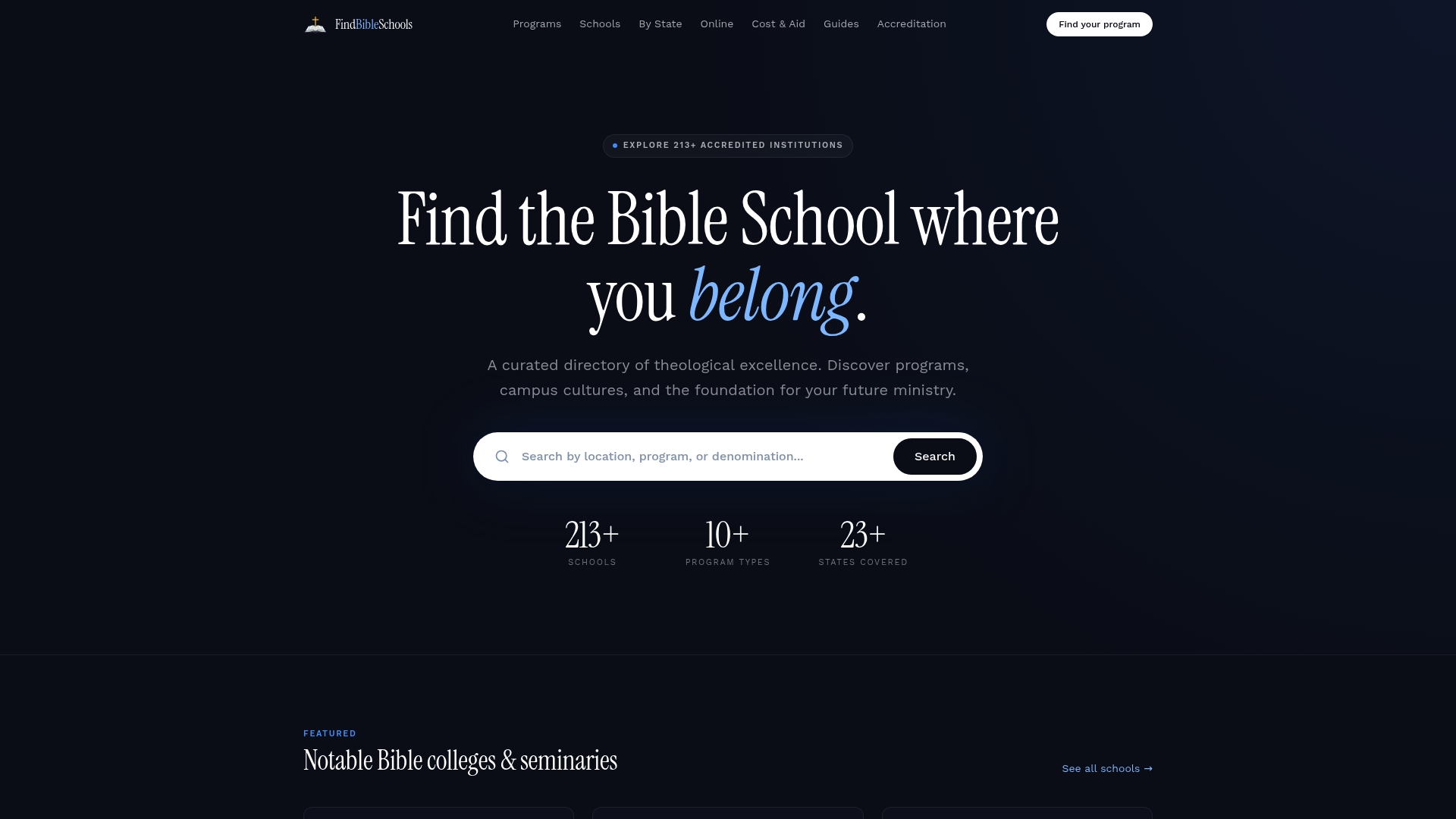
We make it straightforward to compare accredited seminaries on tuition, program type, and accreditation status without digging through dozens of individual websites. Browse schools by program type or look closely at a specific listing like Trinity Evangelical Divinity School to see tuition and accreditation details laid out clearly before you apply.
FAQ
How do you know if seminary is for you?
A sense of calling confirmed by people who know you well, combined with real interest in Scripture, theology, and pastoral care, is the clearest signal. Many schools offer audit courses or informational interviews that let you test that calling before committing to full enrollment.
What is the 80/20 rule in churches?
It is worth understanding as a ministry-leadership concept, but it has no bearing on how to choose a seminary.
Which seminaries are considered the most conservative?
Theological conservatism varies by denomination and doctrinal statement rather than by a single ranking, so the better approach is reading a school’s own doctrinal statement and denominational affiliation directly. Our theology programs overview lets you filter schools by tradition to compare doctrinal commitments yourself.
How much does seminary usually cost?
Cost varies widely by school and program length, but federal borrowing for graduate students is capped at $20,500 per year through Direct Unsubsidized Loans, with Direct PLUS loans available after a credit check for costs beyond that limit. Requesting a net-price calculator estimate from each school you are considering gives a more accurate picture than published tuition alone.
Why does accreditation matter for a seminary degree?
Accreditation affects whether your credits transfer, whether employers and denominations recognize your degree, and whether you can access federal financial aid. The Association of Theological Schools directory is the most reliable place to confirm a school’s current accreditation status.
Sources
- Federal student loan changes 2026-27 (University of Iowa financial aid summary)
- Financial aid for graduate or professional students (Federal Student Aid brochure)
- ATS annual data tables 2025-2026