
Published October 13, 2026
Choosing a Bible College? Check Accreditation, Transfer, and Cost

The first step in choosing a Bible college is naming the exact degree and ministry outcome you want, then confirming accreditation, transfer rules, and total cost in writing before you apply anywhere. Run three checks immediately: who accredits the school, whether its transfer policy is published, and what a complete cost estimate looks like after aid. We built Find Bible Schools to help you compare accredited programs against these exact criteria.
TL;DR:
- A bachelor’s degree typically requires at least 120 semester hours, including 30 in Bible and theology; ordination track roles may eventually require graduate study.
- Transfer credit depends on GPA, course content, institutions, and articulation agreements, so request a written transcript evaluation and compare syllabi before enrolling.
- Calculate net cost after grants and scholarships, including fees, housing, meals, books, transportation, and required ministry trips, and check remaining Pell eligibility if transferring.
- Ask for retention, completion, and outcome figures for your specific program because schoolwide averages can conceal weaker results for the degree you are considering.
Table of Contents
- What a Bible college is and how it differs from seminaries and Christian colleges
- Program types and degree levels: which to pick for your goals
- Accreditation and transferability: what to verify and why it matters
- Cost and financial aid: how to get a true total-cost estimate
- Key choosing criteria beyond the brochure
- Transfer credits and pathway planning: preserve your credits
- How to decide: a practical checklist to compare finalists and enroll
- Publisher perspective: how Find Bible Schools helps narrow choices
- Start comparing accredited programs today
- FAQ
- Sources
What a Bible college is and how it differs from seminaries and Christian colleges
A Bible college is primarily an undergraduate institution built around a Bible and theology core, paired with practical ministry formation such as preaching, discipleship, or missions training. A seminary, by contrast, offers graduate professional formation, including degrees like the Master of Divinity, typically for students pursuing ordination or pastoral leadership. A Christian college sits in between: it offers broader liberal-arts requirements with far fewer required Bible credits than a Bible college.
- Bible college: undergraduate, Bible-centered core, ministry formation included.
- Seminary: graduate-level, professional theological training for ordination-track roles.
- Christian college: liberal-arts degree with limited required theology coursework.
Baccalaureate accreditation standards from the Association for Biblical Higher Education call for a minimum of 120 semester hours, including at least 30 semester hours in Bible and theology.
Program types and degree levels: which to pick for your goals
Your target role should decide your program level, not the other way around. A certificate suits short-term lay training. An associate degree prepares students for entry-level ministry support roles. A bachelor’s degree builds foundational leadership for pastoral, youth, or missions work. A Master of Theological Studies or Master of Divinity supports professional, ordination-track ministry. A Doctor of Ministry or PhD targets advanced leadership, teaching, or academic research.
- Certificate: introductory ministry skills; confirm the expected length with the school.
- Associate: entry-level ministry roles; confirm the expected length with the school.
- Bachelor’s: pastoral or missions leadership foundation; confirm the expected length with the school.
- Master’s (MTS/MDiv): professional ministry preparation; check ordination requirements with the relevant church or authority.
- Doctoral (DMin/PhD): several years; advanced leadership or scholarship.
If ordination is your goal, plan for a graduate degree eventually, even if you start at the bachelor’s level.
Accreditation and transferability: what to verify and why it matters
Accreditation determines whether your credits transfer, whether you can access federal financial aid, and whether your degree will be recognized for licensure or ordination. For biblical and theological programs, look for recognition from the Association for Biblical Higher Education or the Association of Theological Schools, alongside regional accreditation where broader transfer recognition matters.
- Ask which agency accredits the institution and confirm it is recognized for your intended use, whether that is licensing, ordination, or further graduate study.
- Request the school’s written transfer-evaluation policy rather than relying on a verbal estimate from admissions.
- Confirm the accreditor allows the institution to participate in Title IV federal aid programs.
Accreditors are expected to confirm that institutions publish transfer criteria, timelines, articulation agreements, and written rationales when credit is denied, so you are entitled to ask for these in writing before enrolling. Our accreditation guide breaks down how ABHE, ATS, TRACS, and regional accreditors differ.
Pro Tip: Email the registrar, not just admissions, for the written transfer policy. Registrars handle the actual credit evaluations and give more precise answers than recruitment staff.
Cost and financial aid: how to get a true total-cost estimate
Advertised tuition rarely reflects what you will actually pay. Ask each school for a written estimate covering tuition, fees, housing, meals, books, transportation, and any required ministry trips, then subtract grants and scholarships to reach your real net cost.
- Request net cost after aid, not just the published tuition rate.
- Ask for written debt counseling, refund rules, and satisfactory academic progress policies.
- If you are transferring, confirm your remaining Pell eligibility with the financial-aid office before assuming full awards carry over.
ATS accreditation standards require schools to review educational debt, explore alternative funding, and communicate borrowing consequences to students. A low sticker price can still mean real financial risk if completion takes longer than planned or if fees and living costs are left out of the estimate. Transfer students should also know that Federal Student Aid guidance requires schools to calculate what percentage of your Pell Scheduled Award you have already used before disbursing further funds.
Key choosing criteria beyond the brochure
Marketing materials rarely tell you what daily life or academic rigor actually looks like. Weigh these factors instead, and ask pointed questions of admissions and faculty.
- Theological and denominational alignment: confirm the school’s statement of faith matches your convictions before you apply.
- Ministry emphasis and class size: ask how many required Bible credit hours the program carries and how large upper-level ministry classes typically run.
- Internship and field education: ask for the internship placement rate and how field placements are supervised.
- Delivery mode: decide whether online, on-campus, or hybrid study fits your schedule and learning style.
- Faculty credentials: ask what terminal degrees faculty hold and whether they teach or merely supervise upper-level courses.
Pro Tip: Ask for program-level retention and completion data, not institution-wide averages. A strong overall graduation rate can mask a weak outcome in the specific program you are considering.
Program-level outcome data tends to be far more informative than general marketing claims, since it reflects what students in your exact program actually experienced.

Transfer credits and pathway planning: preserve your credits
Credit transfer outcomes depend heavily on your GPA, the type of institution you are leaving and entering, how closely your courses match in content, and whether an articulation agreement exists between the schools. Research on credit mobility shows that transferring from a two-year to a four-year institution tends to produce better credit outcomes than less conventional transfer paths.
- Request a written preliminary transcript evaluation before you commit to enrollment.
- Compare course syllabi side by side rather than relying on course titles alone.
- Confirm any existing articulation agreement and its specific timeline.
- Submit transcripts as early as possible, since evaluations can take weeks.
Our guide on whether Bible college credits transfer walks through what actually counts toward a new program.
How to decide: a practical checklist to compare finalists and enroll
Once you have two to four finalist schools, work through the same sequence for each one so your comparison stays apples-to-apples.
- Confirm the degree level matches your ministry or career goal.
- Verify accreditation and request the written transfer policy.
- Get a written total-cost estimate, including net cost after aid.
- Request program-level retention, completion, and outcome data.
- Visit campus or sit in on a class, whether in person or online.
- Compare final financial offers and note every deadline for deposits and FAFSA submission.
Keep every admissions reply and cost estimate in writing. A saved email carries more weight than a remembered conversation if a quoted cost or policy changes later.
Publisher perspective: how Find Bible Schools helps narrow choices
We curate accredited programs so you can compare options instead of combing through individual school sites. Our directory provides information to help you compare programs. Use the checklist alongside our listings to move from a long list of options to a short, verified one.
— Grant
Start comparing accredited programs today
Once you know your target degree level, the fastest next step is comparing accredited schools side by side rather than researching one at a time. We built our directory around exactly that kind of comparison, organized by program type and accreditation status so you are not stuck guessing which schools actually qualify.
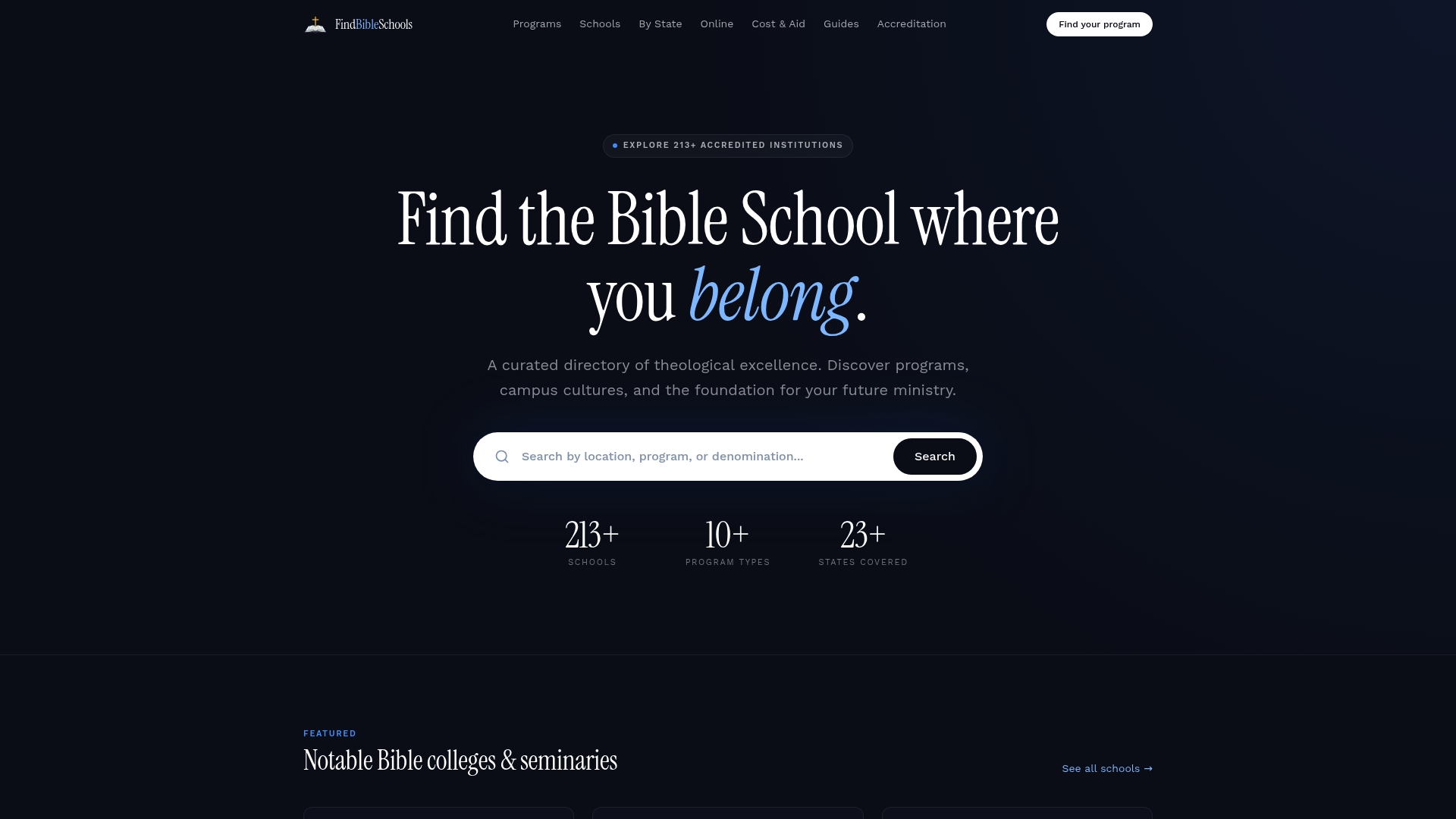
- Browse the full directory of accredited Bible colleges and seminaries to see options by program level.
- Compare bachelor’s in theology programs or online Bible college options if flexibility matters most.
- Request a written cost estimate and transfer-evaluation link directly from any listed program page before you apply.
FAQ
What are the 5 P’s of the Bible study method?
Definitions vary across ministries, but a common version lists Position, Preparation, Prayer, Patience, and Practice as a framework for personal Bible study. Bible colleges typically teach formal hermeneutics and exegesis courses rather than relying on a single mnemonic, so expect more rigorous methods once you enroll.
What Bibles should I stay away from?
This is a theological and denominational question rather than an academic one, and the right translation depends on your tradition and the school’s doctrinal statement. Ask your prospective school which translations its faculty use in coursework, since many programs have a preferred study translation for exegesis classes.
How long does it take to go to Bible college?
A certificate can take under a year, an associate degree around two years, and a bachelor’s degree around four years of full-time study. Program length depends on credit-hour requirements and whether you attend full-time or part-time, so confirm the expected timeline with each school’s registrar.
How do I choose what to study in the Bible?
Within a Bible college program, your course of study is largely set by the required Bible and theology core, often at least 30 semester hours for a bachelor’s degree. Beyond required courses, choose electives that match your ministry goal, whether that is pastoral leadership, missions, or biblical languages.
What should I check before choosing a Bible college?
Confirm the school’s accreditation, request its written transfer and total-cost policies, and compare program-level outcome data rather than general marketing claims. These three checks catch most of the costly surprises prospective students run into after enrollment.
Sources
- ATS Commission Standards of Accreditation
- Transfer Students and Remaining Eligibility | 2026-2027 Federal Student Aid Handbook