
Published September 2, 2026
4 CPE Units and 2,000 Hours: U.S. Chaplain Boards and Seminary Fit
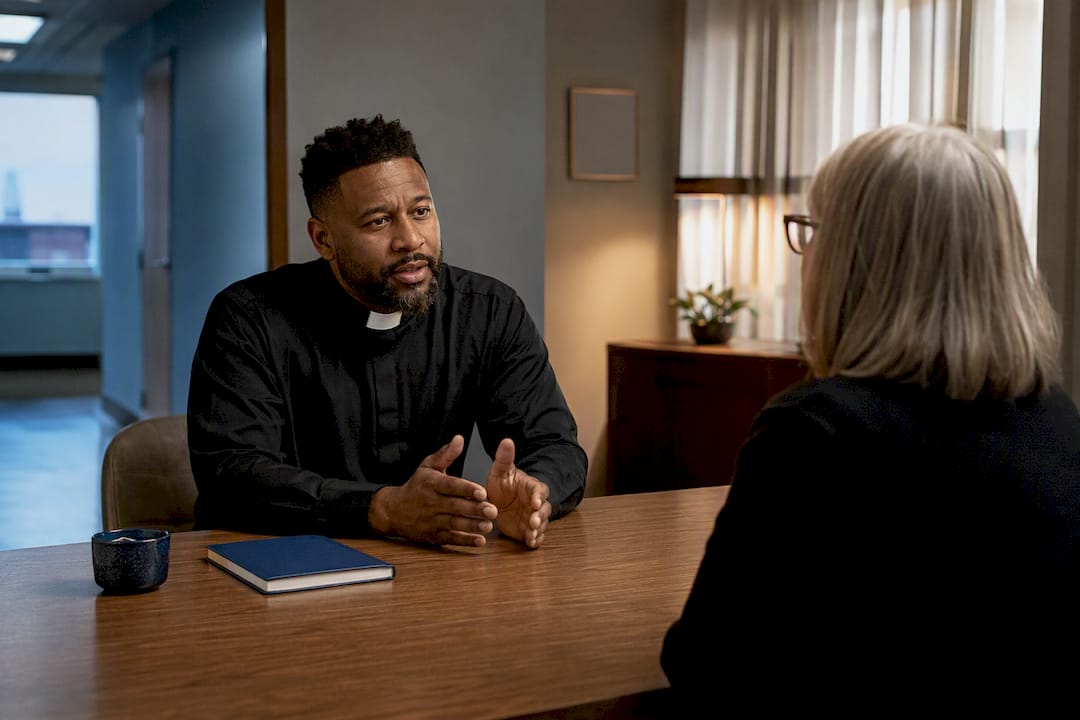
To apply for board chaplain certification in the United States, you generally need a qualifying graduate degree, a set number of Clinical Pastoral Education (CPE) units, a current ecclesiastical endorsement, documented supervised chaplaincy hours, and a competency portfolio reviewed in a committee interview. Exact thresholds vary by certifying body, and many hospitals or VA facilities specifically require board certification or ACPE-accredited CPE before they will hire.
TL;DR:
- Selecting the certifying body first is crucial because different organizations have distinct coursework, endorsement, and CPE requirements that impact your pathway.
- Completing four accredited CPE units and gathering documented supervised hours are mandatory, along with securing a current endorsement letter and assembling a reflective competency portfolio.
- A graduate degree from a CHEA or ATS-approved institution is required, with specific credit hour thresholds: 72 for BCCI, 48 for NACC, and a flexible option for SCA; foreign degrees typically need evaluation.
- The certification process often takes several years due to degree, CPE, and portfolio requirements, with costs including tuition, fees, and travel, especially for part-time or non-residency options.
- Maintaining ongoing certification involves periodic renewal, continuing education, and adherence to ethical codes, which are vital for employment in hospitals, VA facilities, and other healthcare settings.
Table of Contents
- Chaplain Certification Requirements: A Step-by-Step Checklist
- Education and Degree Requirements for Chaplain Certification
- How Many CPE Units Do You Need for Chaplain Certification?
- Endorsement vs. Ordination: What Certifying Bodies Actually Require
- What Goes in a Chaplain Certification Portfolio?
- APC/BCCI vs. NACC vs. SCA: How Chaplain Certification Bodies Differ
- How Long Does Chaplain Certification Take, and What Does It Cost?
- Choosing a Seminary That Meets Chaplain Education Requirements
- Renewal and Continuing Education for Certified Chaplains
- Ethical Standards and Professional Conduct for Certified Chaplains
- An Editorial Take on Chaplain Certification Requirements
- Find Accredited Programs That Meet Chaplain Certification Requirements
- Sources
Chaplain Certification Requirements: A Step-by-Step Checklist
Certification is less a single test than a sequence of milestones, each dependent on the one before it. Working through them in order saves you from the most common mistake candidates make: finishing coursework or CPE before confirming it actually satisfies the certifying body they end up choosing.
- Pick your certifying body first. APC/BCCI, NACC, and SCA each set slightly different coursework, endorsement, and CPE rules, so choosing early prevents wasted credits.
- Verify your graduate coursework. Confirm your degree and credit hours meet the threshold, or submit an equivalency worksheet if your background is nonstandard.
- Complete your CPE units. Enroll through an accepted provider and track unit completion carefully, since most bodies require your hours to be documented, not just implied by job history.
- Secure your endorsement and hour verification. Request a current ecclesiastical endorsement letter and gather employer sign-off on your supervised chaplaincy hours.
- Build your portfolio and rehearse. Assemble competency evidence and run mock interviews with a board-certified mentor before submitting.
Education and Degree Requirements for Chaplain Certification
Graduate education sits at the foundation of every chaplain certification requirement, and it’s usually the first thing that trips up career-changers who assumed a bachelor’s degree and ministry experience would be enough. It won’t be, at least not for board certification.
BCCI requires 72 semester hours of qualifying graduate education for Board Certified Chaplain (BCC) status, or 48 semester hours for Associate Certified Chaplain (ACC). NACC sets its own graduate degree minimum and layers on specific coursework tied to USCCB directives for Catholic candidates. SCA takes a different approach, listing a 30-credit master’s option for one of its pathways, with more flexibility around how equivalencies are calculated.
Acceptable degree titles typically include the Master of Divinity (MDiv), a Master of Arts in pastoral studies, or a Master of Science in spiritual care. What matters most is where the degree came from:
- Degrees from CHEA or ATS-recognized institutions are the smoothest path through review.
- Foreign or non-CHEA degrees usually require a NACES credential evaluation plus a Graduate Education Equivalency Worksheet.
- Many bodies expect at least 24 semester hours of professional competence coursework spread across core subjects like theology, ethics, and pastoral care theory, even within a qualifying degree.
- Transferable graduate coursework from unrelated programs can sometimes fill gaps, but only after the certifying body confirms it counts.
Pro Tip: Request an early equivalency review the moment you suspect your degree is nonstandard. Waiting until the full application stage almost always delays processing, sometimes by months.
How Many CPE Units Do You Need for Chaplain Certification?
Clinical Pastoral Education is the hands-on core of chaplain training, and it’s non-negotiable regardless of which certifying body you choose. BCCI requires four CPE units for BCC status and two units for ACC, a split most other bodies mirror even when their language differs slightly.
CPE providers matter almost as much as the unit count. ACPE-accredited centers dominate the hospital and VA hiring landscape, and many institutions won’t consider CPE completed through non-ACPE programs like CASC/CPEI or CPSP variants unless the employer explicitly accepts them. Verify acceptance with your target employer before investing a year in a program that might not transfer.
What counts toward your CPE and clinical hours:
- Paid chaplaincy work in hospitals, hospice, or institutional settings.
- Supervised volunteer clinical work documented by a CPE supervisor or clinical site.
- Residency placements tied to an accredited CPE center.
What generally does not count:
- Unsupervised parish-only ministry, no matter how many years you’ve logged.
- Informal counseling or pastoral visits without a documented clinical supervision structure.
Statistic Callout: BCCI counts a 2,000-hour post-CPE experience requirement toward BCC applications, with the clock starting only after your fourth CPE unit is complete. Confirm this threshold directly with your chosen certifying body, since some accept equivalent supervised experience on a different timeline.
Endorsement vs. Ordination: What Certifying Bodies Actually Require
Ordination and endorsement get confused constantly, and the distinction matters more than most candidates realize. Ordination confirms your standing within a denomination. Endorsement is a separate, specific document confirming your faith group considers you suitable for institutional chaplaincy work, which is why NACC and other bodies require it as its own line item, distinct from ordination papers.
A typical endorsement package includes:
- A letter on official denominational letterhead confirming your standing and fitness for chaplaincy.
- Specific language many certifying bodies require, so check the exact wording your faith group needs to include.
- A current date, since expired endorsements are one of the most common reasons applications stall.
Candidates from nontraditional or smaller faith traditions aren’t automatically excluded. Some certifying bodies allow mentored education pathways or alternative endorsement arrangements when a formal denominational structure doesn’t exist. If you fall into this category, contact the certifying body’s credentialing office directly rather than assuming you’re ineligible.
Practical tip: Request your endorsement letter months before you need it. Denominational bodies often move slower than certification deadlines allow.
What Goes in a Chaplain Certification Portfolio?
The portfolio is where all your prior work gets translated into evidence, and it’s typically the single most time-consuming part of the process. NACC guidance notes that portfolio preparation often takes several months, even for candidates with strong clinical backgrounds, because writing reflective evidence is a different skill than doing the pastoral work itself.
- Reflective case studies. Written accounts of specific patient or family encounters that demonstrate your clinical reasoning and pastoral judgment.
- Competency mapping. Evidence tied to each of the roughly 29 standardized chaplaincy competencies, covering areas like professional identity, ethical practice, and interdisciplinary collaboration.
- Supporting documentation. Transcripts, CPE unit verification, your endorsement letter, and staff verification of supervised hours.
- Committee interview. A panel typically evaluates your portfolio responses, clinical judgment, and self-awareness, usually several weeks to a few months after submission.
The interview itself tends to probe how well you can articulate what you did and why, not just whether you did it. Committees look for specific, reflective language over generic ministry anecdotes.
Pro Tip: Work with a board-certified mentor throughout portfolio development, not just at the end. Mentors catch vague competency evidence before a committee does, and mock interviews reduce the anxiety that trips up otherwise well-prepared candidates.
APC/BCCI vs. NACC vs. SCA: How Chaplain Certification Bodies Differ
The three major U.S. certifying bodies share a common structure but diverge in meaningful ways that should shape which one you pursue.
- APC/BCCI follows the most widely recognized pathway: defined credit hours, four CPE units, 2,000 post-CPE hours, endorsement, and a portfolio-plus-interview review. It’s also the credential most frequently referenced by hospital systems as a baseline expectation.
- NACC serves Catholic chaplaincy specifically, requiring faith-group membership, coursework aligned with USCCB directives, and a similarly structured portfolio and interview process.
- SCA offers alternative pathways with more flexible credit acceptance and, notably, does not require faith-group endorsement the way the other two bodies do. Policy details change periodically, so review current SCA requirements directly before assuming equivalency with older guidance.
VA hiring adds another layer. The VA’s chaplaincy credentialing page lists which certifying organizations it accepts for GS-level hiring, and specialty certifications can affect eligibility for GS-12 and higher roles. ACPE-accredited CPE carries particular weight in VA hiring decisions, so candidates who complete CPE through a non-ACPE provider should confirm acceptance with VA human resources before applying, not after.
How Long Does Chaplain Certification Take, and What Does It Cost?
Most candidates underestimate the timeline. Between finishing a graduate degree, completing four CPE units, accruing 2,000 post-CPE hours, and preparing a portfolio, the realistic path from start to board certification runs several years for someone beginning from scratch, longer if CPE units are spread across part-time enrollment.
Budget for these categories:
- Graduate tuition, which varies widely by seminary and program length.
- CPE or residency fees, plus travel if your program isn’t local.
- Certifying-body application fees, separate from CPE and tuition costs.
- Transcript requests and equivalency evaluation fees if your degree needs NACES review.
Statistic callout: Because the 2,000-hour post-CPE requirement only starts counting after your fourth CPE unit, candidates who complete CPE part-time often add a full year or more to their overall timeline compared to those in full-time residency programs.
Ways to reduce cost and time include employer-supported residencies, stipend-based CPE programs, denominational scholarships, and part-time study options that let you keep working while completing coursework.
Choosing a Seminary That Meets Chaplain Education Requirements
Not every seminary program lines up cleanly with certifying-body credit thresholds, so verification before enrollment saves real time later. Confirm CHEA or ATS accreditation first, since certifying bodies weigh this heavily, and cross-check the program’s credit structure against your target body’s 72 or 48-hour requirement.
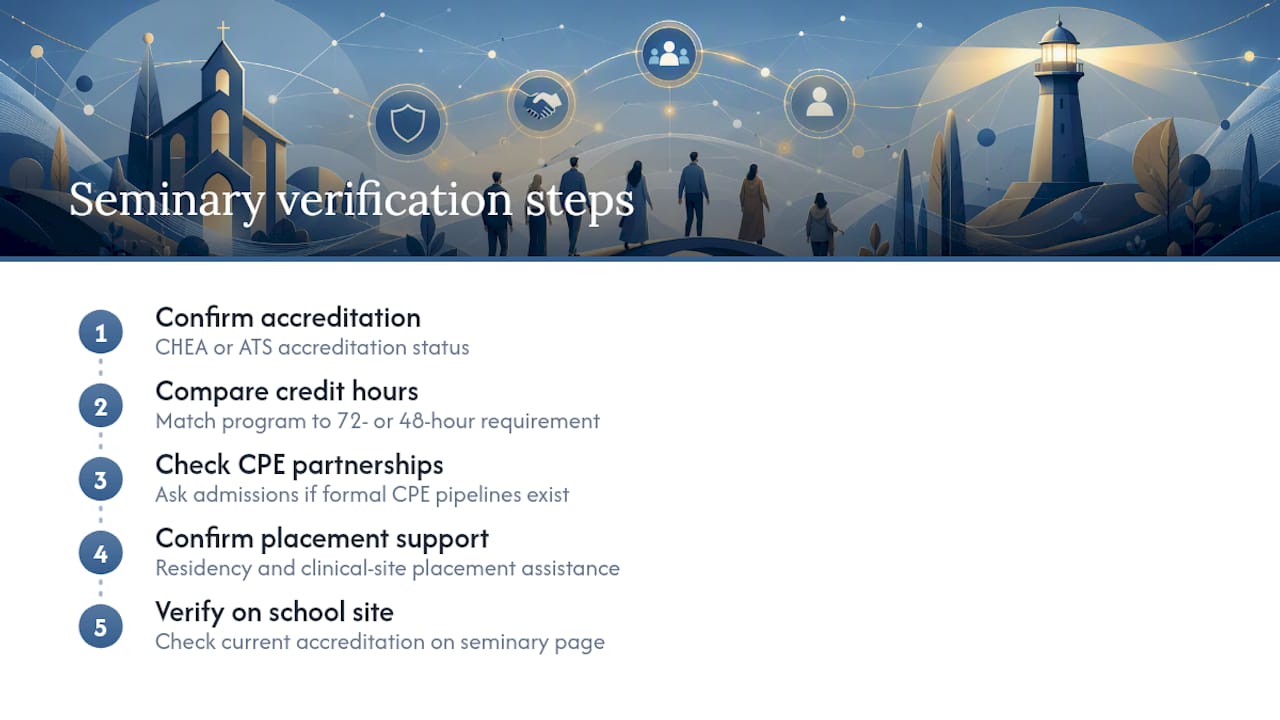
When you contact admissions, ask specifically about CPE partnerships, residency placement support, and whether the program has existing relationships with clinical sites. Programs with established CPE pipelines tend to move candidates through certification faster than those without.
Findbibleschools lists program credit details, accreditation status, and school-specific data across more than 213 institutions, which makes it easier to compare degree structures before committing. Programs like Gordon-Conwell and Covenant Theological Seminary publish credit and accreditation details worth checking against your certifying body’s chart.
Pro Tip: Confirm accreditation status directly on the seminary’s own page, not just through a third-party directory. Accreditation lapses happen, and certifying bodies check current status, not historical status.
Renewal and Continuing Education for Certified Chaplains
Certification isn’t a one-time achievement. Most certifying bodies require periodic renewal, typically every few years, tied to continuing education units and documented ongoing clinical practice. BCCI, NACC, and SCA each publish their own renewal cycles and continuing education thresholds, and letting a renewal lapse can mean re-entering portions of the application process rather than simply catching up.
Continuing education requirements usually cover a mix of clinical skill development, ethics training, and topics specific to your practice setting, whether that’s hospital, hospice, military, or correctional chaplaincy. Many certifying bodies accept conference attendance, supervised peer group participation, or additional coursework toward these hours, but the accepted categories differ enough between bodies that it’s worth confirming what counts before assuming a workshop will satisfy the requirement.
Employers, particularly VA facilities and large hospital systems, often track certification status as an ongoing condition of employment rather than a credential checked once at hiring. That means a lapsed renewal can affect your job standing, not just your professional title. Set calendar reminders well ahead of renewal deadlines, since processing renewal paperwork sometimes takes longer than candidates expect, especially when continuing education documentation needs verification from multiple sources.
Some certifying bodies also require a renewed endorsement letter at recertification, particularly if a significant amount of time has passed since your original endorsement. Treat renewal as a smaller version of the original application rather than a formality, because the documentation standards rarely loosen.
Ethical Standards and Professional Conduct for Certified Chaplains
Certified chaplains operate under formal codes of ethics maintained by their certifying body, and these codes carry real consequences, not just aspirational language. Violations can result in probation, suspension, or revocation of certification, which in turn can end employment at institutions that require board certification as a condition of hiring.
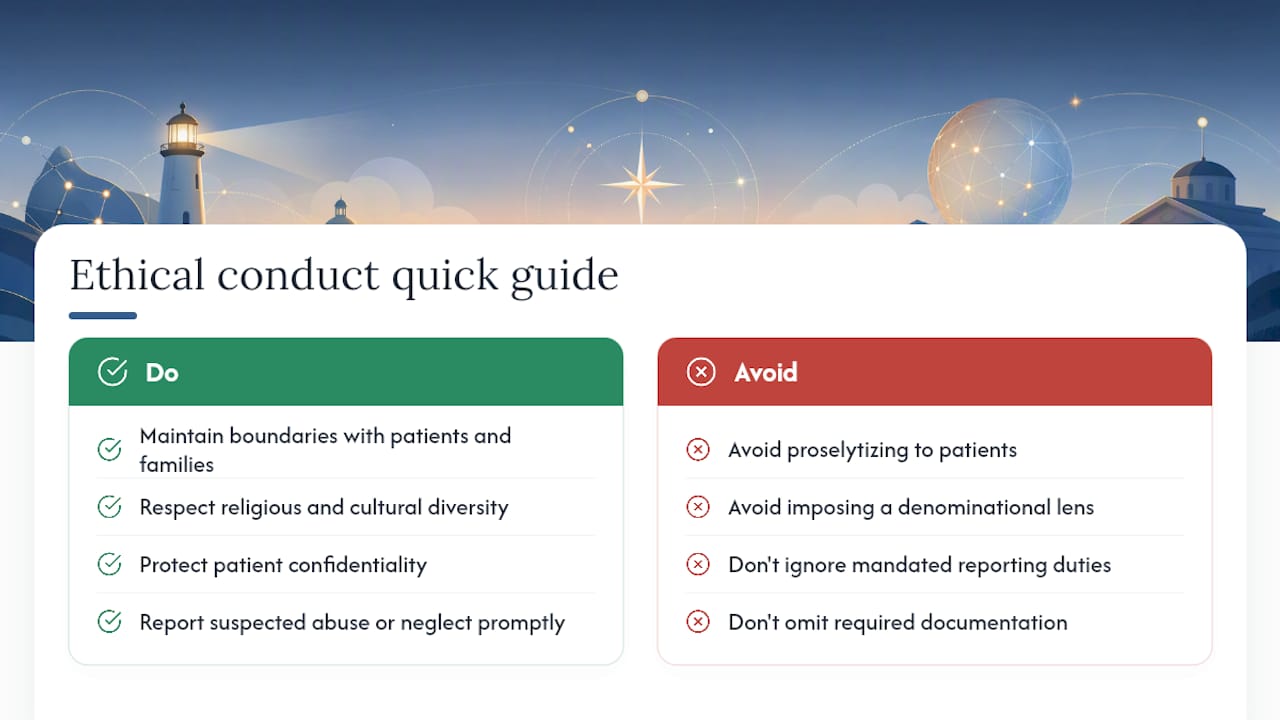
The core ethical expectations tend to cluster around a few themes: maintaining appropriate boundaries with patients and families, respecting the religious and cultural diversity of the people you serve regardless of your own tradition, protecting confidentiality in clinical settings, and avoiding proselytizing in institutional roles where patients haven’t requested it. Chaplains working in hospitals or the VA system serve people across every faith background and no faith background at all, and certifying bodies expect conduct that reflects that reality rather than a narrower denominational lens.
Documentation and reporting obligations also fall under professional conduct. Chaplains are often mandated reporters in cases involving abuse or neglect, and certifying bodies expect familiarity with the reporting requirements of the state and institution where you practice. Interdisciplinary collaboration is another ethical expectation baked into the competency framework itself: chaplains are expected to work within care teams, document appropriately in patient records where required, and communicate professionally with medical staff who may not share their religious framework.
Most certifying bodies publish their ethics code publicly, and reviewing it before your interview isn’t optional preparation. Committees frequently ask candidates to reason through ethical scenarios as part of the interview itself.
An Editorial Take on Chaplain Certification Requirements
The conventional advice treats chaplain certification like a checklist you complete once and forget. That’s the wrong mental model. The credential that actually opens doors, particularly at the VA and in major hospital systems, is the combination of ACPE-accredited CPE and board certification together, not either one alone. Candidates who chase CPE hours without confirming ACPE accreditation often discover too late that their clinical training doesn’t satisfy the employer they actually want to work for.
What’s underrated is how much the choice of certifying body shapes everything downstream. Picking APC/BCCI, NACC, or SCA isn’t a paperwork detail. It determines which coursework counts, whether you need a faith-group endorsement, and how your portfolio gets evaluated. Candidates who choose first and plan backward move faster than those who accumulate credentials and try to fit them into a certifying body’s framework afterward.
If you’re early in this process, the priority isn’t finding the fastest CPE program. It’s confirming your graduate degree and target certifying body align before you spend another dollar on coursework.
— Grant
Find Accredited Programs That Meet Chaplain Certification Requirements
You can find resources to help verify whether your degree comes from a properly accredited program. Many online directories allow you to compare accreditation status, program credits, and tuition side by side across numerous U.S. institutions.
Search for programs that clearly list CHEA or ATS accreditation, and when you contact admissions, ask directly about CPE partnerships and residency placement support. Programs with established clinical site relationships tend to move students into CPE faster than those figuring it out school by school. Browse accredited Bible colleges and seminaries by state to compare tuition and program structures near you, or start with the full program directory to filter by degree type before you request information from any single school.