Published August 29, 2026
U.S. Catholic Seminaries: Directory Backed by 180+ Accredited Programs
This guide lists Catholic seminaries across the United States by region and gives the practical criteria, accreditation checks, cost expectations, and application steps a discerner needs to choose and apply well. It also explains how minor and major seminaries differ, what diocesan sponsorship looks like, and what daily formation actually involves once you arrive.
TL;DR:
- Most diocesan candidates are sponsored by their diocese, which covers tuition and formation costs, making funding largely dependent on diocesan support rather than personal finances.
- Seminary costs vary by type, with diocesan sponsorship often eliminating out-of-pocket expenses for new priests, while lay students and international applicants must secure scholarships or pay tuition themselves.
- When selecting a seminary, consider theological fit, pastoral emphasis, language requirements, community life, and faculty accessibility, and ask formation directors about dismissal rates and pastoral placements.
- Accreditation through regional agencies and the Association of Theological Schools ensures degrees will be transferable and recognized for further studies or ordination.
- Seminary days follow a disciplined rhythm centered on prayer, community, and pastoral work, with a significant focus on spiritual formation, mental health support, and community living challenges.
Table of Contents
- Catholic Seminaries in the USA: A Regional Directory
- What Types of Catholic Seminaries Exist?
- How Do You Choose the Right Catholic Seminary?
- Accreditation and Degree Programs: What to Verify
- What Does Seminary Actually Cost?
- What Is the Application Process and Timeline?
- How This Directory Was Compiled
- How Many Catholic Seminaries and Seminarians Are There in the U.S.?
- What Does Daily Life Look Like Inside a Seminary?
- What Happens After Seminary? Career Paths and Ordination
- What Support and Community Life Do Seminaries Provide?
- What Challenges and Trends Are Shaping Seminary Education Now?
- A Discerner’s Checklist Before You Apply
- Compare Seminary Programs and Costs Before You Apply
- Sources
Catholic Seminaries in the USA: A Regional Directory
Roman Catholic seminaries in the USA fall into a handful of governance types, and the fastest way to get oriented is to scan them by region. The list below draws on institutional pages and the state-by-state entries at GCatholic, which tracks city, rite, and institutional type for seminaries nationwide. Cross-check any seminary’s current program details against its own website before applying, since course offerings and formation directors change from year to year.
Northeast
The Northeast carries the country’s oldest concentration of Catholic theological schools, many tied to religious orders that first settled in the region.
- St. Mary’s Seminary & University (Baltimore, Maryland): a historic Sulpician-run seminary emphasizing spiritual direction and continuing formation programs for ordained priests, detailed on its own site.
- Mount St. Mary’s Seminary (Emmitsburg, Maryland): one of the oldest seminaries in the country, serving multiple East Coast dioceses.
- St. Joseph’s Seminary (Dunwoodie) (Yonkers, New York): the major seminary of the Archdiocese of New York, offering MDiv and MA formation tracks.
- Pope St. John XXIII National Seminary (Weston, Massachusetts): a national seminary formation house for men discerning a vocation later in life, drawing candidates from dioceses across several states.
- St. Vladimir’s Orthodox Theological Seminary and Eastern Catholic houses of formation in the region serve rite-specific candidates outside the Latin Rite; readers exploring an Eastern Catholic vocation should confirm rite jurisdiction directly with their eparchy.
Midwest
The Midwest hosts the largest national seminary in the country and several diocesan houses of formation tied to Catholic universities.
- Pontifical College Josephinum (Columbus, Ohio): the only pontifical seminary in the U.S. located outside Rome’s direct oversight structure that also serves as a national seminary, drawing seminarians from dioceses across the country and following canonical formation norms set out in the Code of Canon Law and USCCB standards.
- University of St. Mary of the Lake / Mundelein Seminary (Mundelein, Illinois): the seminary of the Archdiocese of Chicago, with graduate theology degrees taught through an affiliated school of theology.
- Kenrick-Glennon Seminary (St. Louis, Missouri): serves the Archdiocese of St. Louis and several neighboring dioceses.
- Saint John Vianney College Seminary (St. Paul, Minnesota): a college-level house of formation, useful for readers still weighing a vocation during undergraduate years.
- Sacred Heart Major Seminary (Detroit, Michigan): serves the Archdiocese of Detroit and offers lay ministry degrees alongside priesthood formation tracks.
South
Southern seminaries tend to be smaller and diocesan-run, reflecting the region’s historically dispersed Catholic population.
- Notre Dame Seminary (New Orleans, Louisiana): the major seminary for several Gulf Coast dioceses, with MDiv and STB programs.
- St. Vincent de Paul Regional Seminary (Boynton Beach, Florida): serves multiple Florida dioceses and some Caribbean and Central American sending dioceses.
- Holy Trinity Seminary (Irving, Texas): affiliated with the University of Dallas, blending seminary formation with a university academic setting.
- Sacred Heart Seminary and School of Theology has a presence felt in Southern diocesan sponsorship agreements even where formation happens elsewhere, a reminder that “seminary” often means a sending relationship as much as a physical campus.
West
Western seminaries skew toward university affiliation and, in several cases, explicit missionary or immigrant-community focus.
- St. Patrick’s Seminary and University (Menlo Park, California): serves the Archdiocese of San Francisco and several Northern California dioceses.
- St. John’s Seminary (Camarillo, California): the major seminary of the Archdiocese of Los Angeles, one of the largest sending dioceses in the country.
- Mount Angel Seminary (St. Benedict, Oregon): a Benedictine-run seminary serving the Pacific Northwest, notable for its monastic rhythm layered onto standard formation.
- Diocese of Denver’s St. John Vianney Theological Seminary (Denver, Colorado): known for a strong emphasis on Theology of the Body and lay ecclesial formation programs.
Pro Tip: Before scheduling a visit, call the vocations office of your own diocese first, not the seminary directly. Diocesan candidates are almost always sent to a specific seminary chosen by the bishop, so an independent application to a school outside that arrangement rarely leads anywhere.
What Types of Catholic Seminaries Exist?
A minor seminary serves high school or early college-age young men who are exploring a vocation, combining standard academics with introductory spiritual formation. A major seminary is graduate-level theological and pastoral formation for men who have completed a bachelor’s degree (or its equivalent through a pre-theology program) and are on a defined path toward ordination.
Governance splits seminaries into two structures with real practical consequences:
- Diocesan seminaries form men for parish ministry under a specific bishop; graduates typically stay within that diocese’s boundaries for their entire priesthood, moving between parish assignments as the bishop directs.
- Religious-order seminaries (Jesuit, Dominican, Franciscan, Benedictine, and others) form men who will live in community and could be assigned anywhere the order operates, sometimes internationally, and community life during formation reflects that order’s particular charism and rule.
- Rite-specific houses of formation serve Eastern Catholic churches in full communion with Rome (Byzantine, Maronite, Ukrainian, and others), with liturgical formation and canonical requirements distinct from Latin Rite programs.
- University-affiliated schools of theology, such as those tied to the University of Dallas or Franciscan University of Steubenville, place seminary formation alongside a broader graduate theology faculty, which can mean more elective coursework and a more academically diverse peer group than a stand-alone diocesan house.
Knowing which type you’re looking at changes how you read every other section of this guide, since costs, governance, and daily rhythm all shift depending on whether you’re evaluating a diocesan house, a religious-order novitiate-adjacent seminary, or a national pontifical institution like the Josephinum.
How Do You Choose the Right Catholic Seminary?
Most discerners start by asking which seminary is “best,” but that question has no universal answer. Formation quality is not one-dimensional, and the right fit depends on theological tradition, pastoral emphasis, and your own diocese’s sending relationships. Practical guides on how to choose a seminary consistently point to a handful of concrete factors worth weighing side by side, an approach echoed in resources like Fuller Theological Seminary’s guide on seminary selection.
- Theological and liturgical fit. Does the seminary’s approach to Scripture, moral theology, and liturgy match what you’re looking for, and does it align with your bishop’s expectations if you’re a diocesan candidate?
- Formation emphasis. Some houses weight academic theology heavily; others put more time into pastoral placements, hospital chaplaincy rotations, or parish internships.
- Pastoral placement frequency. Ask how often seminarians leave campus for parish or hospital assignments, and how those placements are supervised and evaluated.
- Language and rite requirements. If you’re headed toward an Eastern Catholic rite or a diocese with a large Spanish-speaking population, confirm the seminary teaches the liturgical language and pastoral Spanish you’ll actually need.
- Community life and daily structure. Some houses run a tighter monastic-style schedule; others allow more independence. Neither is objectively better, but mismatch causes real friction.
- Faculty accessibility. Ask whether formation directors and spiritual directors are available for regular one-on-one meetings or mostly teach large lecture courses.
When you visit or interview, ask formation directors directly: How many seminarians have been dismissed or asked to withdraw in the past three years, and why? What does a typical pastoral placement look like in year two versus year four? How much one-on-one time does each seminarian get with a spiritual director each month? Ask current seminarians a blunter question: What would you change about formation here if you could?
Theological educators who write on seminary selection, including Kevin DeYoung’s commentary on choosing a seminary, stress that strong formation balances academic rigor with real pastoral engagement rather than favoring one at the expense of the other. A red flag worth taking seriously: a seminary that cannot clearly explain its pastoral placement structure, or a formation director who deflects questions about dismissal rates, usually has something to hide about program quality.
Accreditation and Degree Programs: What to Verify
Accreditation confirms a seminary’s degrees will transfer and hold weight for further graduate study, so it deserves scrutiny before you apply anywhere. Verify accreditation through two channels: the seminary’s regional accreditor (the body that also accredits most U.S. colleges and universities) and, for theological programs specifically, the Association of Theological Schools (ATS), the specialized accrediting body for seminaries and divinity schools. Institutional pages, like St. Mary’s Seminary & University’s, typically list both accreditations along with any canonical or diocesan endorsements, and that primary source should outrank any secondary directory when the two disagree.
Common degree types you’ll encounter:
- Master of Divinity (MDiv): the standard professional degree for ordination, combining theology coursework with pastoral formation.
- Master of Arts (MA): often a shorter academic track for lay ministry students or as a pre-theology credential.
- Sacred Theology Licentiate/Master (STL/STM): advanced theological study, sometimes required for seminary faculty or canon law work.
- Canonical degrees (STB, JCL, JCD): ecclesiastical degrees recognized specifically within Church structures, distinct from civil accreditation.
Formation itself runs alongside academics through spiritual direction (regular one-on-one meetings with an assigned spiritual director), pastoral placements in parishes or hospitals, and liturgical formation that trains seminarians to serve at Mass and eventually celebrate the sacraments. National seminaries like the Josephinum follow formation norms tied to the Code of Canon Law, which shapes how these components are sequenced across a program’s several years.
What Does Seminary Actually Cost?
Tuition at Catholic seminaries usually runs comparable to other private graduate theological programs, though the number that actually matters for most discerners is far lower than sticker price suggests.
The reality most applicants don’t expect: diocesan candidates rarely pay seminary tuition out of pocket at all. Dioceses typically sponsor their own seminarians, covering tuition, room, and board in exchange for a commitment to serve that diocese after ordination.
That sponsorship model changes the financial calculation entirely for anyone pursuing priesthood through a diocese rather than enrolling independently.
- Diocesan sponsorship covers most or all costs for men accepted into a diocese’s formation program; the diocese essentially pays because it’s training its own future priests.
- Religious-order candidates typically have costs covered by their order once accepted into formation, following that community’s own funding structure.
- Lay students pursuing MA or MDiv degrees without a diocesan or order sponsorship pay tuition directly and should ask about scholarships, tuition remission for part-time staff roles, and standard graduate financial aid, since funding models vary significantly from school to school.
- Federal loans have real limits for seminary study, particularly for canonical-only programs that don’t carry standard civil accreditation, so confirm loan eligibility before counting on it.
- Ask admissions directly about scholarship deadlines, since many are tied to a separate, earlier cycle than the general application deadline.
What Is the Application Process and Timeline?
Applying to a Catholic seminary is not the same as applying to a standard graduate program. Diocesan candidates go through their diocese first, and the seminary application follows only after the bishop or vocations director signs off.
- Initial discernment and diocesan contact. Meet with your diocese’s vocations director well before you plan to apply; this conversation often needs to happen a full year ahead.
- Written application and references. Seminaries typically require personal essays, academic transcripts, and multiple pastoral and personal references.
- Bishop’s endorsement. For diocesan candidates, the seminary won’t proceed without formal endorsement from the sponsoring bishop.
- Psychological assessment. Nearly all U.S. seminaries require a standardized psychological evaluation as part of screening.
- Interviews. Expect interviews with the admissions committee, formation director, and sometimes current seminarians.
Most seminaries run on an academic-year cycle with applications due in late winter or early spring for fall admission, so starting diocesan conversations a full year in advance gives enough runway for assessments and interviews. Transfer students and international applicants should budget extra time. Visa processing and transcript evaluation for foreign degrees can each add several months, and international candidates should confirm well ahead of time whether their sending diocese or religious order will handle the visa sponsorship process.
How This Directory Was Compiled
Findbibleschools connects prospective students with 180+ accredited theological institutions across the United States, curating program, cost, and accreditation details so readers can compare schools without digging through dozens of separate websites. That same approach shaped this directory: entries were compiled from institutional pages, official Catholic directories, and structured listings like GCatholic’s state-by-state seminary index, then checked against each seminary’s own site for current program details.
Author Grant, who writes on theological education and seminary selection for Findbibleschools, drew on institutional self-descriptions and published formation standards rather than firsthand campus visits. Readers should treat every entry here as a starting point for research, not a final word, and always confirm current details directly with the seminary before applying.
How Many Catholic Seminaries and Seminarians Are There in the U.S.?
Precise, current national counts are harder to pin down than you’d expect, since no single public database tracks every U.S. Catholic seminary in real time. The most commonly cited historical figures come from the Official Catholic Directory as summarized on Wikipedia, which reported roughly 189 seminaries and about 5,131 seminarians nationwide around 2009.
Those numbers are worth citing with a caveat: seminary enrollment has shifted meaningfully since then, with some dioceses consolidating formation houses and sending candidates to regional or national seminaries rather than maintaining their own. That consolidation trend is itself a data point. Fewer, larger seminaries serving multiple dioceses, like the Josephinum’s national model, have become more common than the smaller diocesan-only house that dominated the mid-20th century landscape.
For a current snapshot of what actually exists on the ground, a structured directory like GCatholic’s seminary listing gives a more reliable state-by-state count than any single historical figure, precisely because it’s maintained against current institutional data rather than a fixed-year directory. If you’re trying to answer “how many seminaries are there right now,” treat the 2009 figures as a historical anchor point and the live directory as the number that matters for present-day planning.
What Does Daily Life Look Like Inside a Seminary?
Seminary days run on a rhythm closer to a monastery than a typical graduate school, built around prayer as much as coursework. Most houses begin before dawn with community Morning Prayer or Lauds, followed by Mass, then a block of academic classes through the late morning and early afternoon.
Afternoons often include pastoral work, either on-campus assignments like sacristy duty and choir, or off-campus placements at parishes, hospitals, or prisons depending on the seminarian’s year of formation. Evening brings a second communal prayer, often Vespers, followed by dinner and study time. Many seminaries build in a weekly holy hour of Eucharistic adoration and a required day of silence or retreat several times per semester.
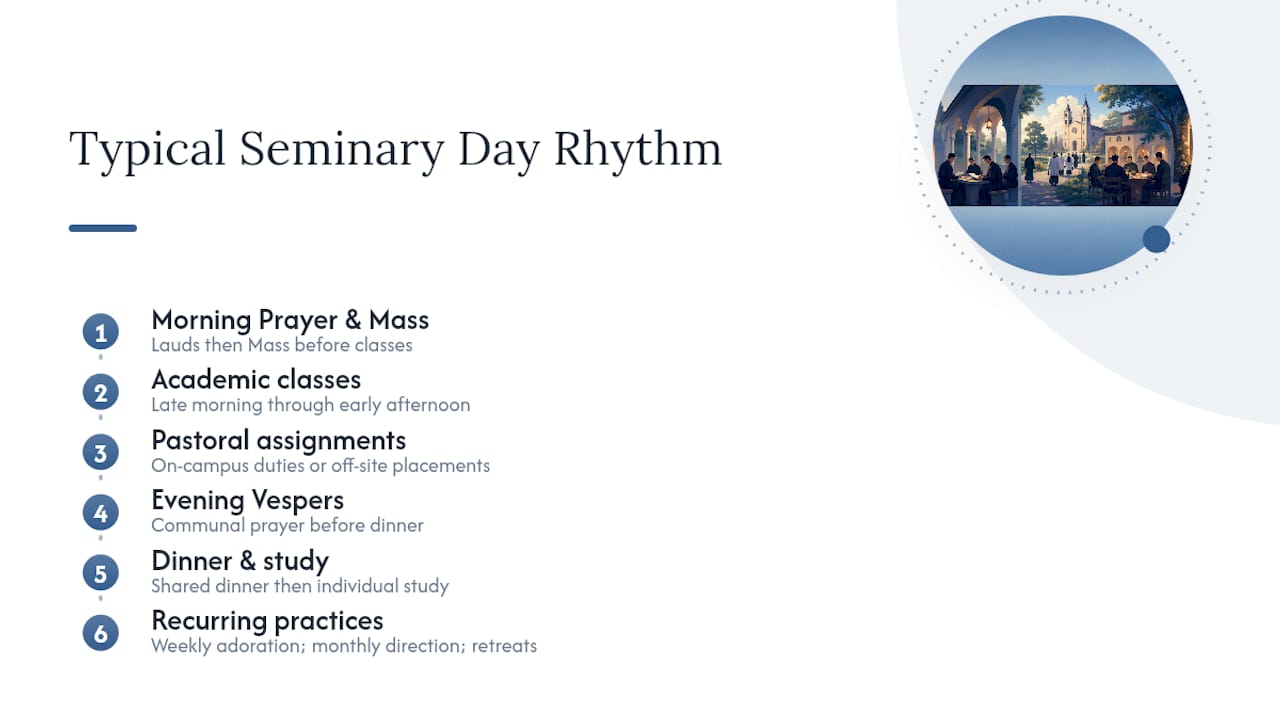
Spiritual direction happens outside this daily schedule, typically a monthly one-on-one meeting with an assigned priest, separate from academic advising and confidential by canonical requirement. First-year seminarians often describe the adjustment to a fixed communal schedule, silence at certain hours, and shared living quarters as the hardest part of transition, harder in many cases than the academic coursework itself. That structure is intentional. Formation directors use the daily rhythm itself as a teaching tool, training seminarians in the disciplined life they’ll need to sustain once ordained and serving a parish alone.
What Happens After Seminary? Career Paths and Ordination
Graduation from a major seminary does not automatically mean ordination. Diocesan candidates are ordained transitional deacons roughly a year before priesthood, then ordained priests after the bishop and formation team confirm readiness, a decision that rests with the diocese, not the seminary faculty alone.
Once ordained, diocesan priests are typically assigned as parochial vicars (associate pastors) for their first several years, working under an experienced pastor before eventually leading a parish themselves. Religious-order priests follow a different track, often moving into teaching, missionary work, or specialized ministry depending on their order’s charism and current staffing needs.
Not every seminarian is ordained. Formation is explicitly designed to include discernment, and a meaningful percentage of men who enter major seminary discern out before ordination, sometimes at the seminary’s recommendation, sometimes by their own choice. That outcome isn’t treated as failure within Catholic formation culture; it’s built into the process as evidence the discernment worked as intended.
For those who complete formation and are ordained, career paths beyond parish ministry include diocesan administration, seminary faculty positions (often requiring the STL or STD credential), military and hospital chaplaincy, and canon law work for men who pursue the JCL or JCD after ordination. A smaller number move into academic theology at Catholic universities, frequently after additional doctoral study.
What Support and Community Life Do Seminaries Provide?
Seminaries build community deliberately, since isolation during formation is considered a genuine risk to both mental health and vocational discernment. Most houses assign incoming seminarians a mentor from an upper class year, pairing new students with someone who has already navigated the adjustment to communal life and academic demands.
Spiritual direction, mentioned earlier as part of the daily rhythm, doubles as a support structure: a confidential space to process the emotional and spiritual weight of formation outside academic evaluation. Many seminaries also provide access to licensed counselors or psychologists, distinct from the admissions psychological assessment, for ongoing mental health support during the multi-year formation process.
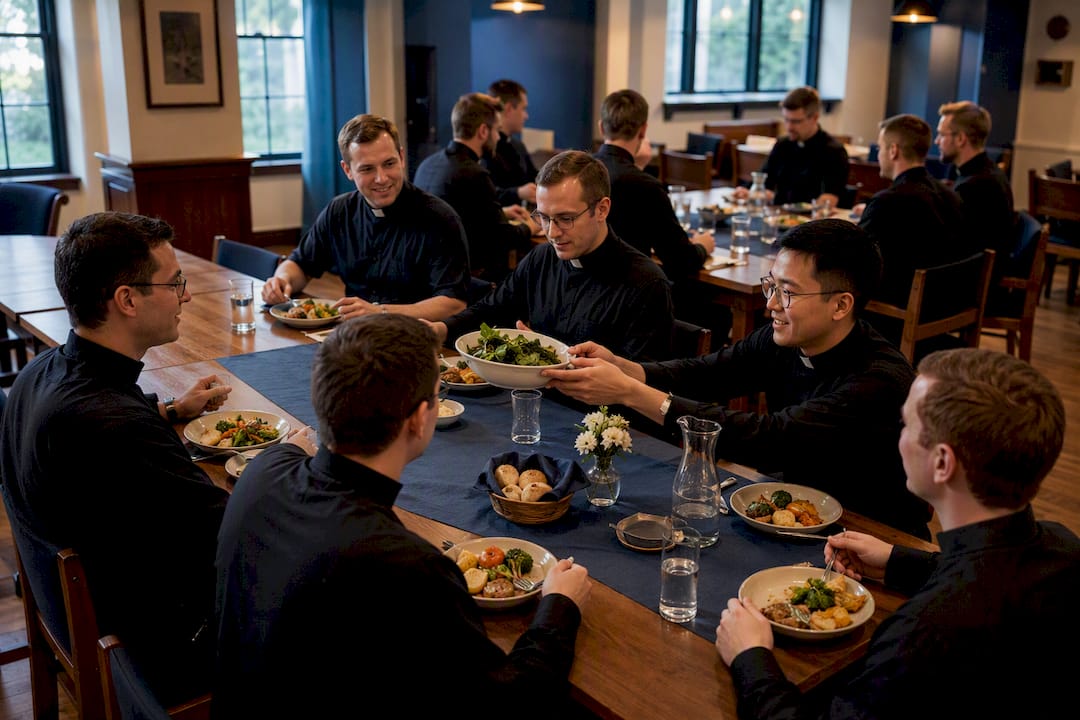
Communal meals, shared recreation time, and intramural sports show up at nearly every seminary, not as filler but as a deliberate counterbalance to the intensity of academic and spiritual demands. Language and cultural support matter increasingly too. Seminaries serving diverse sending dioceses often provide ESL support or culturally specific chaplaincy for international seminarians, and formation staff at larger national houses like the Josephinum manage a genuinely multicultural student body drawn from dioceses across the country and, in some cases, abroad.
Alumni networks extend support past ordination, with many seminaries running continuing formation programs, exactly the kind of ongoing education St. Mary’s Seminary & University offers, for priests years into active ministry.
What Challenges and Trends Are Shaping Seminary Education Now?
Enrollment pressure is the trend nobody in Catholic formation avoids discussing. Total priestly vocations have declined over recent decades, which has pushed some dioceses toward seminary consolidation, sending candidates to regional or national houses rather than maintaining smaller stand-alone diocesan programs.
That consolidation has an upside worth naming. Fewer, larger seminaries often mean deeper faculty benches, more diverse pastoral placement options, and a broader peer cohort than a small diocesan house could offer alone. Older seminarians represent a second major trend. A meaningful share of men entering formation today arrive after a first career, sometimes a decade or more into working life, which has pushed schools like Pope St. John XXIII National Seminary to build programs specifically around older, second-career candidates rather than assuming a traditional college-to-seminary pipeline.
Individual seminarians face their own real challenges apart from these institutional shifts. Adjusting to communal living after years of independence, sustaining celibate life in a culture that rarely reinforces it, and managing academic workload alongside pastoral placements all surface repeatedly in formation literature. Financial anxiety shows up too, particularly among lay MA and MDiv students without diocesan sponsorship who are financing graduate theological education largely on their own.
Formation programs have responded by expanding psychological screening and ongoing counseling access, treating mental health support as integral to formation rather than an afterthought. Whether that response fully matches the scale of the challenge is a fair question for any discerner to ask directly during a campus visit.
A Discerner’s Checklist Before You Apply
If you’re seriously discerning, don’t let research replace direct contact. Visit at least one seminary in person before you form strong opinions from websites alone; a campus feels different than a page ever will. Meet formation staff face to face, not just admissions officers, and ask the pastoral questions this guide raises directly rather than waiting for a formal interview.
A short-term discernment retreat or weekend “come and see” program, offered by most diocesan vocations offices, tells you more in 48 hours than months of independent reading. Talk to current seminarians candidly, away from staff, if the seminary allows it. And weigh theological fit and pastoral formation as equal factors, not one subordinate to the other. A seminary strong on academics but thin on pastoral placement will leave real gaps a classroom can’t fill.
— Grant
Compare Seminary Programs and Costs Before You Apply
Findbibleschools is the resource that pairs this directory’s context with the granular detail every seminary comparison actually needs: current tuition figures, accreditation status, and program structure laid out side by side rather than scattered across dozens of individual institution sites. Instead of tracking down separate PDFs and admissions pages for every school you’re considering, you can pull up a single page per institution and see what actually differs between them.
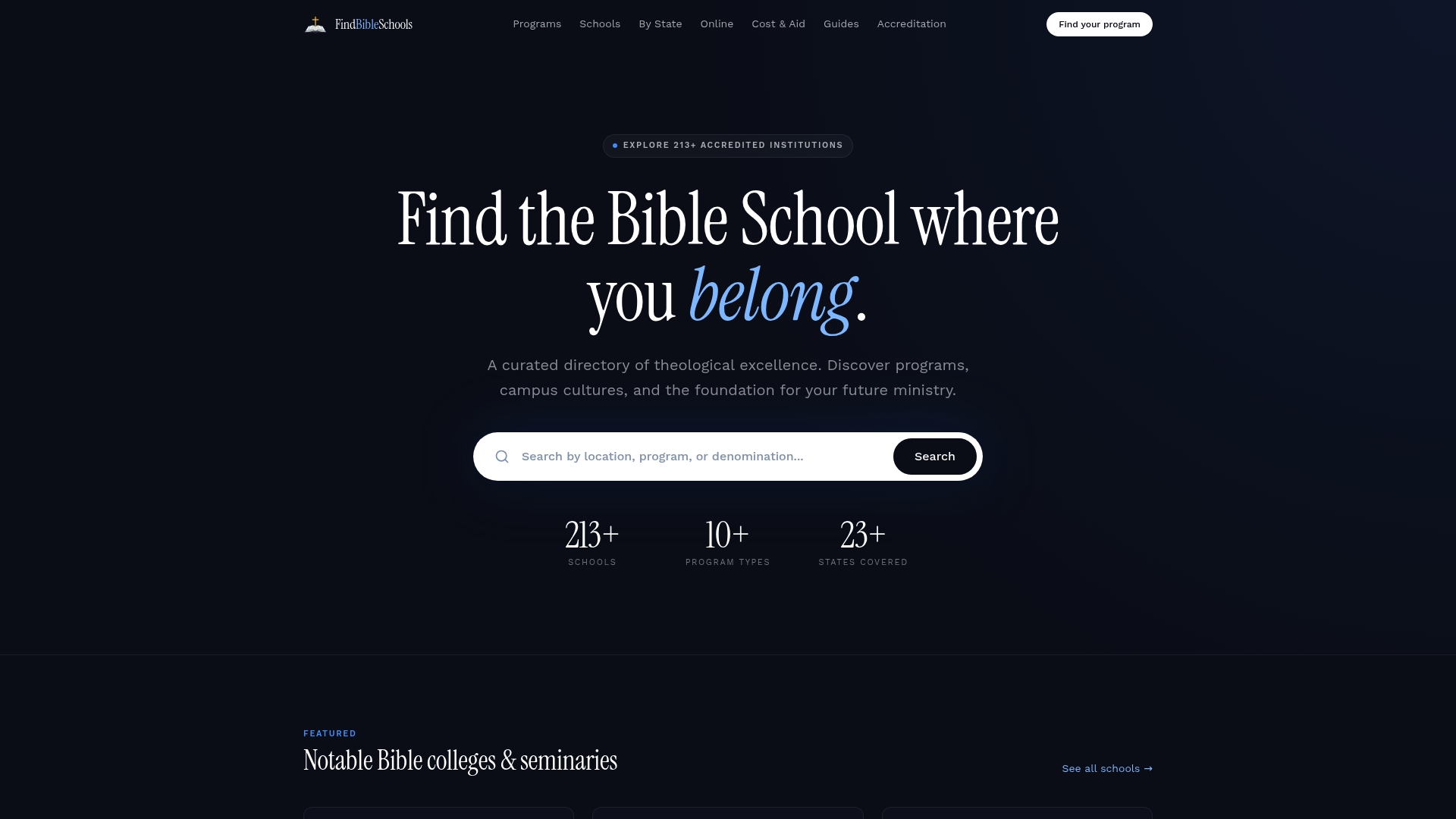
School pages like the one for Talbot School of Theology at Biola University consolidate degree offerings, tuition, and accreditation status in one place, and the same structure applies across the state-by-state directory covering more than 180 accredited institutions nationwide. If a particular region matters to your search, state pages such as Bible Colleges in Tennessee or Bible Colleges in North Carolina narrow the search further. Start by searching your state or the specific seminary you’re evaluating, then reach out through the school’s page to request admissions information directly.
Sources
- Seminaries in USA
- List of Catholic seminaries
- Pontifical College Josephinum | National Catholic Seminary
- St. Mary’s Seminary & University