
Published September 13, 2026
Students & Ministry: 5 Questions to Choose Biblical Studies or Theology

Biblical studies examines the biblical text itself: its original languages, historical setting, and literary structure. Theology takes that textual foundation and organizes it into doctrine, systematic beliefs, and frameworks for ministry practice. If your goal is research, translation, or teaching the text closely, biblical studies fits. If your goal is preaching, pastoral leadership, or doctrinal formation, theology (often through a Master of Divinity) is the more direct route.
TL;DR:
- Biblical studies primarily focus on analyzing the biblical text through languages, exegesis, and historical context, requiring Hebrew and Greek proficiency.
- Theology organizes biblical findings into doctrines like salvation and the Trinity, often integrating tradition and reasoned reflection for practical application.
- Degree programs differ in core courses, with biblical studies emphasizing language and exegesis, while theology highlights systematic doctrines and church history.
- Text-focused careers in biblical studies include research, translation, and academia, whereas theology degrees prepare students for pastoral, counseling, or church leadership roles.
- Choosing between the two depends on whether one’s goal is detailed scriptural research or doctrinal leadership, and accreditation, curriculum, and faculty clarity are key factors.
Table of Contents
- Biblical Studies vs Theology: Definitions and How Each Field Works
- How Do Biblical Studies and Theology Degree Programs Differ?
- What Careers Come From a Biblical Studies vs Theology Degree?
- How Do You Choose Between a Biblical Studies and Theology Program?
- Finding Accredited Programs Through Find Bible Schools
- Where Did Biblical Studies and Theology Come From as Academic Fields?
- Which Scholars Define Biblical Studies and Theology Today?
- A Note on Studying Both
- Search Programs That Match Your Study Goals
- Sources
- FAQ
Biblical Studies vs Theology: Definitions and How Each Field Works
The clearest way to separate the two comes from a question Lancaster Bible College poses well: biblical studies asks “What does the Bible say?” while theology asks “What does the Bible teach?” That distinction shapes everything from course reading lists to the kind of paper a professor assigns.
Biblical studies works close to the text. Students spend semesters in Hebrew and Greek, learn textual criticism (comparing manuscript variants to establish what a passage originally said), and study the historical and cultural world behind the words. Exegesis, the method of drawing meaning directly out of a passage rather than reading later ideas into it, sits at the center of the discipline. A biblical studies course might ask students to trace how the genre of Hebrew poetry in Psalms differs from the apocalyptic imagery in Daniel, or how first-century Roman politics shaped Paul’s letters.
Theology moves a step further out. It takes what biblical studies establishes and organizes it into coherent doctrine, drawing on Scripture alongside church tradition and reasoned reflection. United Theological Seminary breaks theology into recognizable subfields:
- Systematic theology organizes doctrines like the Trinity, salvation, and the nature of the church into a unified framework.
- Historical theology traces how Christian doctrine developed and shifted across centuries.
- Practical theology applies doctrine to preaching, counseling, and church leadership.
A theology course might ask how the doctrine of justification developed from Augustine through the Reformation, a question that assumes the biblical groundwork rather than reexamining it line by line.
How Do Biblical Studies and Theology Degree Programs Differ?
Degree names signal which discipline a program emphasizes, though many schools blend both fields into a single curriculum. Calvin Seminary notes that undergraduate programs typically carry titles like BA in Biblical Studies or BA in Bible, while graduate theological degrees include the Master of Divinity (MDiv), Master of Arts in Theology, Master of Theology (ThM), and PhD, each with a distinct curricular weight.
Course lists make the difference concrete:
- Biblical studies core courses: Introduction to Biblical Hebrew, Introduction to Biblical Greek, Old Testament Survey, New Testament Survey, Hermeneutics and Exegesis.
- Theology core courses: Systematic Theology I and II, Church History, Christian Ethics, Practical Theology, Homiletics (the study of preaching).
Some schools lay these differences out directly. Colorado Christian University publishes a side-by-side course comparison so prospective students can see exactly which classes belong to which track before enrolling, an approach worth looking for wherever you apply.
Delivery mode matters too. On-campus programs tend to offer deeper language immersion and direct faculty mentoring, while online and hybrid formats have expanded access considerably. If you’re weighing an online theology or biblical studies track, check whether the school participates in NC-SARA, the interstate authorization framework that confirms an online program can legally enroll students across state lines. An accredited online Bible college should list this clearly.
What Careers Come From a Biblical Studies vs Theology Degree?
The career path in theology vs biblical studies tends to follow the discipline’s center of gravity: text-focused work versus doctrine-and-practice work.
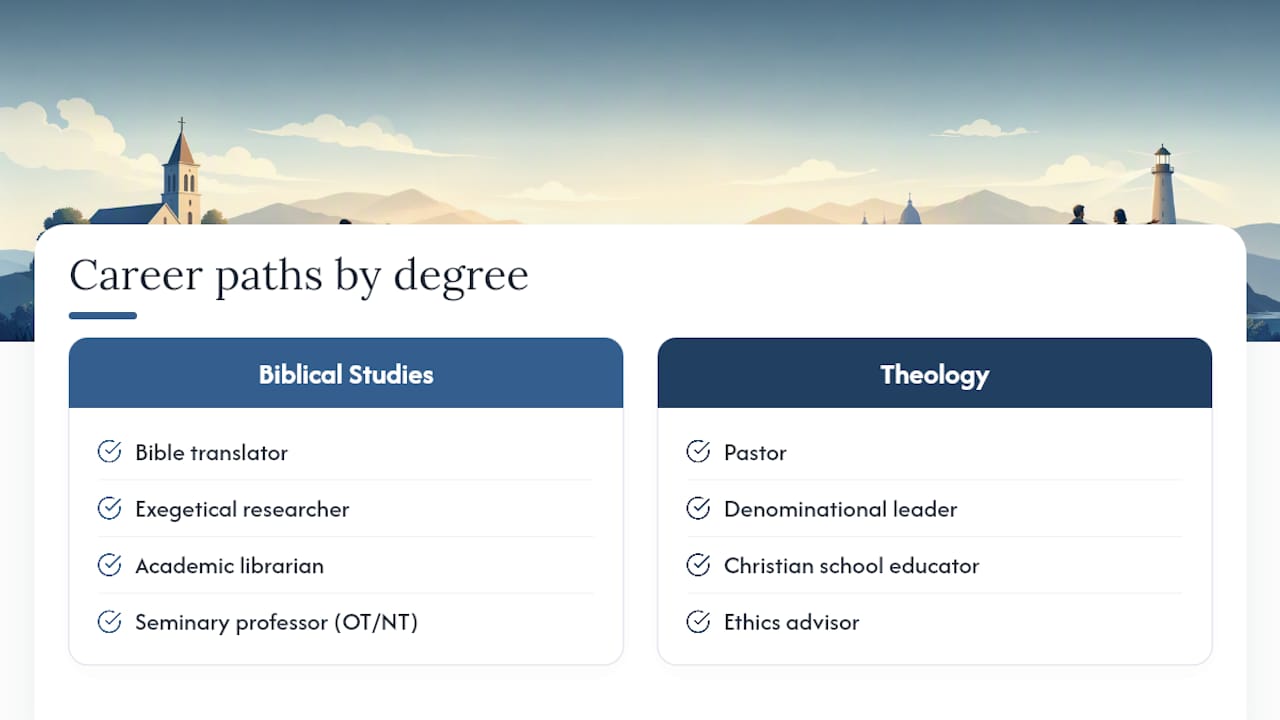
A biblical studies degree typically points toward roles such as Bible translator, exegetical researcher, academic librarian, or seminary professor specializing in Old or New Testament studies. These are research and text-heavy positions, often requiring graduate work.
A theology degree points more directly toward ministry: pastor, denominational leader, Christian school educator, ethics advisor, or counselor working within a church or parachurch setting. The MDiv exists largely to prepare people for ordained ministry.
Graduate study reshapes both paths. A ThM or PhD in either field shifts the outcome toward research and teaching, whether that means a biblical studies scholar publishing commentary work or a theologian training the next generation of pastors in a seminary classroom.
How Do You Choose Between a Biblical Studies and Theology Program?
Run through this checklist before applying anywhere:
- Name your actual goal. Research and teaching call for biblical studies; preaching, chaplaincy, or church leadership call for theology.
- Check the language and methodology requirements. Heavy Hebrew and Greek sequences signal a biblical studies emphasis; heavier doctrine and ethics coursework signals theology.
- Review faculty expertise and sample syllabi. A professor’s published work tells you what the program actually teaches, not just what the catalog claims.
- Confirm accreditation and the degree’s real-world outcome. An MDiv from an accredited seminary carries different weight for ordination than an unaccredited certificate.
- Weigh cost, time, and delivery mode together. A three-year MDiv on campus is a different commitment than a two-year online MA in Theology.
Watch for red flags: vague course descriptions, no faculty bios listed anywhere on the site, or accreditation claims that don’t name a recognized accrediting body.
Pro Tip: Prioritize programs that publish faculty CVs and sample syllabi online. If a school won’t show you what you’ll actually study before you apply, that’s worth noticing.
Finding Accredited Programs Through Find Bible Schools
A curated platform allows filtering by degree level, program focus, accreditation status, and delivery mode to help narrow national listings down to programs that fit different goals.
Each program page lists tuition, accreditation, sample course lists, and faculty information, the exact details step three and four of the checklist call for. Findbibleschools tracks over 213 accredited theological institutions across the country, organized by state and program type, so comparing a biblical studies track against a theology track takes minutes instead of dozens of open browser tabs.
Where Did Biblical Studies and Theology Come From as Academic Fields?
Both disciplines trace back to the same root but split as universities professionalized over time. Early Christian scholarship treated Scripture and doctrine as a single, unified pursuit. Origen and Augustine wrote commentary and doctrine in the same breath, with no institutional line between the two.
That began to change with the rise of medieval universities in the 12th and 13th centuries, when theology became a formal faculty discipline at schools like the University of Paris, organized around systematic argument and structured around figures like Peter Lombard’s Sentences, a compilation of doctrinal questions that became the standard theology textbook for centuries.
Biblical studies as a distinct academic field emerged later, largely through the historical-critical methods that developed in German universities during the 18th and 19th centuries. Scholars began treating biblical texts with the same historical and linguistic tools applied to other ancient literature, asking questions about authorship, dating, and textual transmission that earlier theologians had rarely raised in that form.
By the 20th century, American seminaries had largely institutionalized the split you see today: biblical studies departments focused on languages and exegesis, theology departments focused on doctrine and ministry preparation, often housed under the same roof but teaching from different angles. The MDiv degree, standardized in North American seminary education through the mid-1900s, formalized the practice of requiring both.
Which Scholars Define Biblical Studies and Theology Today?
A handful of names illustrate how differently these fields operate.
In biblical studies, scholars like N.T. Wright built careers around close historical and literary analysis, particularly Wright’s work reconstructing the Jewish and Greco-Roman context behind Paul’s letters. Textual critics such as Bruce Metzger spent careers comparing ancient manuscripts to determine what the New Testament originally said, work that has almost nothing to do with doctrine and everything to do with linguistic and historical precision.
In theology, figures like Karl Barth reorganized 20th century systematic theology around the doctrine of revelation, while Wolfhart Pannenberg approached doctrine through the lens of historical reasoning. Augustine and Thomas Aquinas remain foundational reference points precisely because they built comprehensive doctrinal systems rather than textual commentaries.
The contrast in method matters more than the names themselves. A biblical scholar’s contribution gets measured by how convincingly they reconstruct what a text meant to its original audience. A theologian’s contribution gets measured by how coherently they organize belief into a system that holds together and applies to real church life. Reading even a page of Wright next to a page of Barth makes the difference between theology and biblical interpretation immediately visible: one is reconstructing a first-century argument, the other is building a doctrinal case for today.
A Note on Studying Both
Most working pastors need pieces of each discipline, not one to the exclusion of the other. A common and sensible path: a BA in Biblical Studies first, then an MDiv or MA in Theology, letting the language and text work ground the doctrine that follows.
— Grant
Search Programs That Match Your Study Goals
Once you know whether you’re chasing exegesis or doctrine, the harder part is finding a program that actually delivers it, not just claims to. Specialized directories can provide an alternative to scrolling through dozens of individual seminary websites by aggregating tuition, accreditation, and course lists side by side. Such tools can also surface details like faculty credentials and sample syllabi, and help determine whether a school’s MDiv or MA in Theology track matches particular ministry or research goals.

If graduate ministry training is the goal, program pages like Trinity Evangelical Divinity School show tuition and accreditation status up front. If you’re still narrowing between a biblical studies emphasis and a theology track, browse the full program directory by degree level and focus, and start comparing schools before you commit to an application.
Sources
- Biblical Studies vs Theology: What is the Difference? - Grace College
- The difference between biblical studies & theology - United Theological Seminary
- Biblical Studies vs. Theology Degree: What’s the Difference? - Calvin Seminary
FAQ
What Are the Four Types of Theology?
Theology is commonly divided into systematic theology, historical theology, practical theology, and biblical theology, each approaching doctrine from a different angle, whether organizing belief, tracing its development, or applying it to ministry.
Does a Biblical Studies Degree Count as a Real Degree?
Yes. A biblical studies degree from an accredited institution is a legitimate academic credential, recognized for graduate admission and for careers in translation, research, education, and academic ministry roles.
What Are the Two Main Types of Bible Study?
Bible study approaches generally split into inductive study, working directly from the text to draw out its meaning, and topical or doctrinal study, which organizes Scripture around a theme or belief, mirroring the broader split between biblical studies and theology.
Is Calvinism Unbiblical?
Calvinism is a theological system built through doctrinal interpretation of Scripture, and whether it accurately reflects biblical teaching is a matter of ongoing denominational debate rather than a settled academic fact; different seminaries and traditions weigh the same texts differently.
How Do I Know Which Degree Fits My Ministry Goal?
Match the degree to the outcome: research, teaching, or translation work points toward biblical studies, while preaching, pastoral leadership, or chaplaincy points toward an MDiv or MA in Theology, and Findbibleschools’ program directory lets you filter by exactly that focus.