
Published September 16, 2026
Verify 7 Chicago Bible Colleges’ Accreditation in 15 Minutes

Chicago is home to several Bible colleges and theological seminaries, including Moody Bible Institute, Chicago Theological Seminary, McCormick Theological Seminary, The Lutheran School of Theology at Chicago, North Park University, and Concordia University Chicago. Chicago Bible Institute also trains ministry students in the city, though its accreditation status differs from the others. Before applying anywhere, confirm the school’s accreditation through the U.S. Department of Education, then reach out to admissions to compare programs directly.
TL;DR:
- Most Chicago Bible colleges and seminaries are accredited by recognized agencies, which is essential for federal aid and credit transferability.
- Degree options range from certificates and associate degrees to PhDs, with delivery formats including on-campus, hybrid, and fully online programs tailored to different student needs.
- Schools like Moody and McCormick emphasize urban engagement and practical ministry training, while others like CTS focus on social justice or ecumenical theology.
- Verify accreditation through the U.S. Department of Education and inquire about credit transfer, tuition net price, veteran benefits, and field placement success before applying.
- Career outcomes extend beyond pastoral roles into chaplaincy, nonprofit leadership, and academic positions, with placement data best obtained through direct school inquiries.
Table of Contents
- What Degree Programs Do Chicago Bible Colleges Offer?
- How Do You Verify Accreditation Before You Apply?
- Which Accredited Chicago Schools Fit Your Goals?
- Comparing Chicago Bible Colleges Fast
- What Career Paths Do Chicago Seminary Graduates Pursue?
- What Support Services Help Students Succeed?
- Planning Your Application Timeline for Chicago Ministry Programs
- Where to Verify Accreditation and Program Details
- Sources
- FAQ
What Degree Programs Do Chicago Bible Colleges Offer?
Chicago’s theological schools cover the full academic ladder, and picking the right rung matters as much as picking the right school. A certificate or diploma program suits someone testing a calling to ministry without committing to a four-year degree. An associate or bachelor’s degree opens doors to ordination tracks and entry-level ministry roles. Graduate students pursuing pastoral leadership, chaplaincy, or academic theology typically need a Master of Divinity (MDiv) or Master of Theology (ThM), while a PhD prepares graduates for seminary teaching or advanced denominational leadership.
Delivery format shapes the experience just as much as the degree itself:
- On-campus programs put students inside Chicago’s church networks and nonprofit partnerships, which matters for hands-on formation.
- Hybrid cohorts blend weekend or evening classes with online coursework, common for working adults and bivocational pastors.
- Fully online programs offer flexibility but require more intentional effort to build mentorship relationships.
Common specializations across these schools include pastoral ministry, youth ministry, worship leadership, missions, biblical counseling, and systematic theology. Your intended vocation should drive both the degree level and delivery mode you choose, not the other way around.
How Do You Verify Accreditation Before You Apply?
Not every Bible-focused program in Chicago confers an accredited degree, and that distinction affects everything from federal financial aid to whether a future graduate program will accept your credits. A diploma from a non-accredited Bible institute can still offer real spiritual formation, but it won’t transfer the way an accredited degree will.
Pro Tip: Before you fill out a single application, spend fifteen minutes on the U.S. Department of Education’s accreditation search. It’s the fastest way to rule out a school that looks legitimate but isn’t recognized by an ED-approved agency.
Here’s a practical sequence for verifying any school on your list:
- Search the school by name on the U.S. Department of Education’s accreditation database to confirm it appears with a recognized accreditor.
- Cross-check the accreditor’s name against the school’s own catalog or website, since some institutions list an accrediting body that isn’t ED-recognized.
- Ask admissions directly about credit transferability, sample syllabi, and any cross-registration agreements with other seminaries.
- Request a financial aid worksheet that breaks down published tuition, mandatory fees, program length, and available scholarships.
- Ask about veteran benefits if you qualify, since several Chicago schools participate in GI Bill programs.
- Schedule a campus visit or virtual info session before committing, so you can meet faculty and current students.
Accreditation status also determines whether a school’s credits satisfy denominational ordination requirements, which some readers overlook until it’s too late. The U.S. Department of Education notes that recognized accreditation is the gatekeeper for federal aid eligibility and graduate school acceptance, so this single checkbox carries more weight than almost any other factor on your list.
Cost deserves its own line of questions. Published tuition rarely reflects what a student actually pays after aid, so ask each school for a net price estimate based on your specific circumstances rather than relying on the sticker figure alone.
Which Accredited Chicago Schools Fit Your Goals?
Each school below approaches ministry training differently, and the right fit depends on your denominational background, career goals, and preferred learning environment.
Moody Bible Institute trains students for practical, Bible-centered ministry across undergraduate degree levels, with a curriculum built around biblical literacy and field ministry placements. Moody’s Chicago undergraduate campus page details admissions requirements, tuition, and the scholarships and veteran benefits available to incoming students. Moody fits students who want a conservative evangelical framework paired with structured, hands-on ministry experience from their first year.
Chicago Theological Seminary takes a progressive theological approach at the graduate level, with a strong emphasis on social justice and public theology. CTS’s institutional site outlines its mission and admissions process for students pursuing MDiv or academic theology tracks. This school suits candidates drawn to activist-minded ministry and interfaith engagement rather than a strictly denominational path.
McCormick Theological Seminary focuses on graduate ministry formation with deep roots in urban engagement, placing students in Chicago congregations and community organizations as part of their training. It fits students who want their coursework tied directly to fieldwork in a major metropolitan setting.
The Lutheran School of Theology at Chicago (LSTC) offers ecumenical Lutheran seminary programs and participates in cross-registration agreements that let students take courses at partner seminaries nearby. LSTC’s site describes these arrangements along with program statistics, which matters for students who want broader course access than a single seminary can provide on its own.
North Park University operates as a Christian university offering both undergraduate and graduate theological options, with an intercultural, city-centered mission woven through its programs. North Park’s website lists its degree paths and Chicago location details. It’s a strong fit for students who want an undergraduate theology foundation inside a broader liberal arts university setting.
Concordia University Chicago provides Lutheran-rooted theological degrees alongside professional pathways in education and counseling, giving graduates flexibility if ministry plans shift toward adjacent vocational fields.
Chicago Bible Institute offers diploma-level ministry training for students who want focused biblical instruction without a full degree commitment. CBI’s site lists its program structure and application steps, but prospective students should confirm accreditation status directly, since diploma programs at non-degree-granting institutes don’t always carry the same recognized accreditation as the university-level schools above.
Comparing Chicago Bible Colleges Fast
Comparing seven schools by hand means opening seven browser tabs, and most prospective students give up halfway through. Find Bible Schools tracks accredited theological institutions across the country, including the Chicago-area schools covered here, so you can filter by degree level, denominational distinctives, delivery mode, and cost range instead of hunting through individual admissions pages one at a time.
When you pull up a school’s profile, look for these specific data points before you reach out:
- Accreditation status and the name of the recognized accrediting agency
- Program length and available degree levels
- Veteran benefits and scholarship categories
- Campus visit or virtual info session links
Pro Tip: Build a shortlist of three to five schools and contact all of them within the same two week window. Admissions offices often move faster, and share more detailed financial aid information, when they know you’re comparing offers.
What Career Paths Do Chicago Seminary Graduates Pursue?
Graduates from Chicago’s theological schools move into a wider range of roles than the word “ministry” usually suggests. Pastoral positions in local congregations remain the most common outcome for MDiv graduates, but the same degree also opens doors to hospital and military chaplaincy, campus ministry, denominational administration, and nonprofit leadership.
Students who complete undergraduate biblical studies degrees, like those Moody Bible Institute emphasizes, often move into youth ministry, worship leadership, missions work, or parachurch organizations before pursuing graduate study later. Seminaries with strong urban engagement components, such as McCormick Theological Seminary, tend to place graduates directly into Chicago-based community organizations and congregations where they’ve already completed fieldwork placements.
Placement outcomes vary significantly by denomination and specialization, and schools rarely publish standardized placement rate statistics the way secular universities publish employment data. That makes it worth asking admissions directly for a placement or field ministry summary rather than relying on marketing copy. A school that can point to specific alumni outcomes, denominational partnerships, or ongoing relationships with local churches is showing you something a glossy brochure can’t.
Academic-track graduates pursuing a PhD typically aim for seminary or university teaching positions, though those roles are limited nationally and often require relocation. If your goal is denominational ordination rather than academic teaching, ask each school how its curriculum aligns with your specific denomination’s credentialing requirements before you enroll, since misalignment here can add years to your ordination timeline.
What Support Services Help Students Succeed?
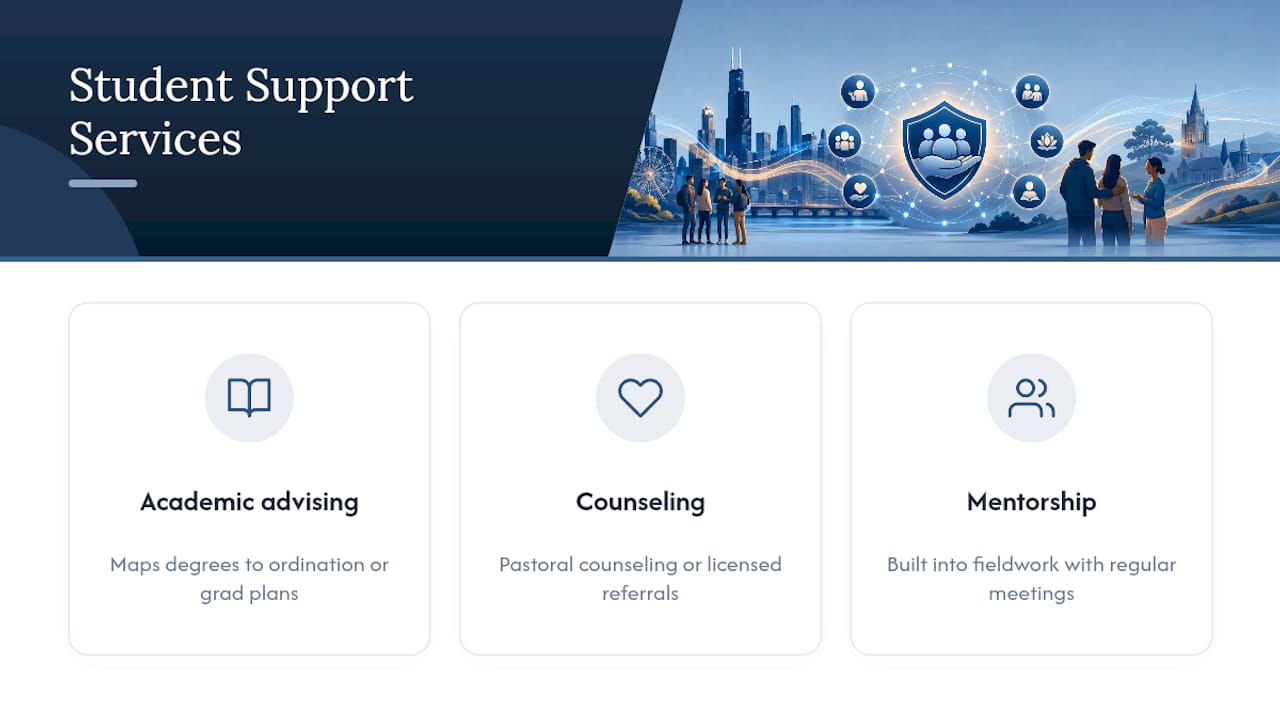
Theological education asks more of students emotionally than a typical undergraduate program, and the schools covered here generally build support structures around that reality. Academic advising helps students map degree requirements to ordination timelines or graduate school plans, which matters most for students juggling coursework with an active ministry role or a full-time job.
Counseling services address a need that’s common but rarely discussed openly in ministry training: students processing their own doubts, family strain, or burnout while preparing to shepherd others through the same struggles. Most seminaries and Bible colleges in Chicago offer some form of pastoral counseling or referral to licensed counselors, though the depth of these services varies by institution size and budget.
Mentorship tends to be the most valuable support structure in ministry-focused programs, and it usually takes the form of faculty advisors, denominational mentors, or field ministry supervisors who meet regularly with students during practicum placements. Schools with strong urban ministry partnerships, like McCormick Theological Seminary and LSTC’s cross-registration network, often build mentorship directly into required fieldwork rather than treating it as an optional add-on.
Ask admissions specifically how mentorship is structured, since “available upon request” and “built into every semester” are very different levels of support. A school’s willingness to answer this question in detail tells you a lot about how seriously it takes student formation beyond the classroom.
Planning Your Application Timeline for Chicago Ministry Programs
Start by narrowing your intended vocational outcome. A future pastor, a campus ministry leader, and someone pursuing academic theology need different degree levels and different schools, and trying to keep all three paths open usually just delays the decision.
Give yourself a realistic timeline. Use the next few weeks for research and shortlisting three to five schools. Book campus visits or virtual info sessions over the following one to three months, since seeing a campus in person (or asking pointed questions on a video call) reveals things a website never will. Submit applications three to six months before your intended start term, and begin financial aid paperwork the same week you apply, not after acceptance.
Before you sign anything, verify accreditation status one more time and ask each finalist school for sample syllabi and a placement or field ministry record. A school confident in its outcomes will hand these over without hesitation. One that hedges is telling you something worth hearing before you commit.
— Grant
Where to Verify Accreditation and Program Details
Cross-check any Chicago school against these sources before you apply:
- Each school’s own admissions and program pages for tuition, faculty, and application deadlines
- Find Bible Schools’ Illinois listings, which cover accredited programs across the state beyond Chicago proper
Sources
- Chicago Undergraduate Campus | Moody Bible Institute
- The Lutheran School of Theology at Chicago - LSTC
FAQ
Is There a Bible College in Chicago?
Yes. Chicago hosts several accredited institutions, including Moody Bible Institute, Chicago Theological Seminary, McCormick Theological Seminary, The Lutheran School of Theology at Chicago, North Park University, and Concordia University Chicago.
What Is the Best Bible College in the United States?
There’s no single “best” school. The right choice depends on your denominational tradition, desired degree level, and career goal, so compare accreditation, program focus, and cost across a shortlist rather than searching for one universal answer.
Are There Any Free Bible Colleges in the USA?
Fully free Bible colleges are rare, though some schools offer substantial scholarships, work-study arrangements, or tuition discounts tied to ministry service that significantly reduce out-of-pocket costs. Ask each school’s financial aid office about need-based aid and denominational scholarship programs.
How Much Do Bible Colleges Cost?
Costs vary widely by school, degree level, and denomination, with published tuition rates differing significantly between undergraduate Bible colleges and graduate seminaries. Request each school’s current tuition rate along with a net price estimate that factors in scholarships and financial aid, since sticker prices rarely reflect what students actually pay.