
Published September 12, 2026
Verify ATS Accredited Seminaries in the US in 5 Minutes

The ATS member-school list is the definitive, official source for identifying seminaries accredited by the Association of Theological Schools. This searchable directory, maintained directly by ATS, lists current status, contact details, and program types for every member institution. Accreditation status can shift between review cycles, so always confirm a school’s standing on the ATS site itself rather than relying on a secondhand list, however recent it looks.
TL;DR:
- Always verify a seminary’s current accreditation status on the official ATS member-school list before making any commitments.
- ATS accreditation is recognized by the U.S. Department of Education, ensuring eligibility for federal financial aid programs.
- Full accreditation requires schools to pass periodic reaffirmation reviews; associate membership alone does not indicate full accreditation.
- Check the program-specific accreditation status, as school-wide accreditation does not guarantee recognition for all degrees or tracks.
- Confirm that the school’s accreditation status has not changed recently, by reviewing its detailed ATS record, to avoid relying on outdated information.
Table of Contents
- How to Search the Official ATS Member-School List
- What ATS Accreditation Actually Means
- How to Verify a Seminary’s Accreditation Status Step by Step
- Well-Known ATS-Accredited Seminaries Worth Knowing
- How Find Bible Schools Helps You Compare Programs After Verification
- Why Attending an ATS-Accredited Seminary Actually Matters
- ATS Accreditation vs. Regional and National Accreditation
- Does ATS Accreditation Affect Federal Financial Aid Eligibility?
- How a Seminary Actually Becomes ATS Accredited
- Common Misconceptions About ATS Accreditation
- Why Verification Habits Matter More Than the List Itself
- Start Your Search With State and Program Directories
- Sources
- FAQ
How to Search the Official ATS Member-School List
Finding ATS accredited seminaries starts at one place: the ATS Member School List, accessible directly from the association’s website. The directory functions less like a static roster and more like a searchable database, which matters if you’re comparing several institutions before you commit to an application.
To use it effectively, open the member-school list and apply the filters ATS provides. You can narrow results by country (United States or Canada), by denominational family, and in many cases by program level. This matters because “ATS member” and “ATS accredited” are not interchangeable terms, a distinction covered in more detail in the next section.
Each listing shows a consistent set of fields:
- Accreditation status (Accredited Member, Associate Member, or a notation of change)
- Institutional contact information, including the registrar or admissions office
- Degree programs offered, from certificates through doctoral degrees
- Denominational affiliation, where applicable
- Delivery mode indicators, showing whether programs run on campus, online, or hybrid
If you’re searching for a Master of Divinity program in a specific state, or an online MDiv track, the filters cut the list down fast. A search for Texas, for instance, surfaces institutions like Dallas Theological Seminary alongside smaller regional schools, letting you compare accreditation status side by side rather than hunting through individual websites.
Pro Tip: Bookmark the school’s individual ATS record, not just the search results page. Institutions sometimes carry notations, such as a probation status or a pending reaffirmation, that only show up on the detailed record.
What ATS Accreditation Actually Means
ATS accreditation is granted by the Commission on Accrediting of the Association of Theological Schools, a body that operates with formal recognition from both the Council for Higher Education Accreditation and the U.S. Secretary of Education. That dual recognition is what gives ATS accreditation weight with employers, licensing bodies, and other institutions evaluating a degree’s legitimacy.
The Commission and the Association are related but distinct. ATS itself is the membership organization; the Commission on Accrediting carries out the actual accreditation work using its own board procedures, approved standards, and peer-review teams, largely independent of the Association’s other activities.
ATS accreditation standards focus on three broad areas, including detailed evaluation of student learning outcomes:
- Student learning outcomes, meaning whether graduates demonstrate the competencies a degree claims to build
- Theological and spiritual formation, recognizing that seminary education carries a vocational dimension beyond academic coursework
- Institutional mission and integrity, covering governance, finances, and whether the school’s practices match its stated purpose
Membership status matters here. Schools typically join ATS as an Associate Member first, a pre-accreditation stage, before pursuing full accredited status. Associate membership alone is not proof of accreditation. It’s a step toward it. ATS and its Commission collectively support a substantial number of graduate theological schools across the United States and Canada, and none of that recognition is permanent by default. Every accredited school goes through periodic reaffirmation, involving self-study reports and site visits from peer evaluators.
How to Verify a Seminary’s Accreditation Status Step by Step
A seminary’s marketing page can say almost anything. The ATS database is where you confirm what’s actually true, and the process takes about five minutes once you know the sequence.
- Search the ATS member-school list and open the specific school’s record, not just the search results snippet.
- Read the accreditation label carefully. Look for “Accredited Member” versus “Associate Member,” and note any dates or Commission remarks attached to the listing.
- Cross-check with CHEA if you want a second confirmation that the Commission on Accrediting itself carries current recognition.
- Contact the registrar or accreditation office directly if you need documentation for licensure, ordination requirements, or transfer credit evaluation.
Watch for a few warning signs along the way. A school advertising itself as “seminary accredited” without appearing on the ATS list at all is the clearest red flag. Associate-only status held for many years without progress toward full accreditation is another. So is any recent notice of closure or change buried in the Commission’s notes, which the annual ATS data tables document alongside broader membership statistics each cycle.
Well-Known ATS-Accredited Seminaries Worth Knowing
Several ATS accredited theological schools come up constantly in searches for graduate ministry education, and knowing a few names helps orient you before you dive into the full directory. These are illustrative examples, not a ranked list, and every one of them should still be confirmed against the current ATS member-school record before you apply.
- Princeton Theological Seminary, a longstanding Presbyterian-rooted institution known for its academic depth in biblical studies and theology.
- Duke Divinity School, a university-affiliated Methodist seminary with strong ties to Duke University’s broader graduate school ecosystem.
- Fuller Theological Seminary, one of the largest multidenominational seminaries in the country, with a wide range of degree tracks and delivery formats.
- Gordon-Conwell Theological Seminary, an evangelical seminary with multiple regional campuses across the Northeast and Southeast.
- Trinity Evangelical Divinity School, affiliated with Trinity International University and known for its evangelical scholarship tradition.
- Asbury Theological Seminary, a Wesleyan-holiness institution with a strong emphasis on practical ministry formation.
- Covenant Theological Seminary, the seminary of the Presbyterian Church in America, centered in St. Louis.
- Dallas Theological Seminary, a large dispensationalist institution with an extensive online MDiv track.
Each of these schools offers a different theological emphasis, campus culture, and degree lineup, and program-level accreditation can vary even within a single institution. A school’s overall ATS status doesn’t automatically mean every certificate or specialized track carries the same recognition, so check the specific program you’re considering, not just the institution’s name.
How Find Bible Schools Helps You Compare Programs After Verification
ATS answers the accreditation question. The site helps answer the next question: which accredited school fits your ministry goals, budget, and preferred format.
The site maintains profiles on many accredited theological institutions, curating details the ATS directory doesn’t emphasize, such as campus culture, estimated tuition, and denominational distinctives side by side. Think of it as a division of labor: ATS confirms that a school meets the Commission’s standards, and Findbibleschools helps you evaluate whether that school is the right fit once accreditation is settled.
Practical ways the site supports that comparison work include:
- State-level directories that group accredited schools geographically, useful if location or in-state tuition matters to your decision.
- Program-type pages organized by degree level, from associate certificates through doctoral programs.
- Cost and financial aid context alongside accreditation and program details, so you’re not toggling between five browser tabs.
None of that replaces checking the official ATS record. It just makes the research that follows verification faster and more useful.
Why Attending an ATS-Accredited Seminary Actually Matters
Credit transferability is the most immediate practical benefit. Graduate credits earned at an ATS-accredited seminary are far more likely to transfer to another accredited institution if you switch programs, pursue a doctoral degree later, or add a certificate at a different school. Unaccredited coursework often transfers nowhere, which can mean redoing years of study.
Employer and denominational recognition follows closely behind. Many denominations require an ATS-accredited MDiv or equivalent degree as a baseline for ordination, and hiring committees at churches, chaplaincy programs, and nonprofit ministries frequently list ATS accreditation as a screening criterion, whether stated outright or assumed.
There’s also a quality assurance dimension that’s easy to overlook. Because the Commission’s review process emphasizes student learning outcomes and institutional integrity on an ongoing cycle rather than a one-time approval, an accredited seminary has demonstrated more than baseline competence. It has kept demonstrating it, through self-studies and peer site visits, over years of reaffirmation. That’s a different kind of trust signal than a school simply claiming excellence on its own homepage.
ATS Accreditation vs. Regional and National Accreditation
ATS accreditation is a specialized, programmatic form of accreditation focused specifically on graduate theological education. Regional accreditation, historically handled by bodies covering geographic areas of the country, and national accreditation, often associated with career-focused or faith-based institutions, evaluate a much broader range of programs across an entire university, not just its theological offerings.
Some seminaries hold both. A divinity school attached to a larger university might carry regional accreditation through the university’s overall status, while the seminary program itself separately holds ATS accreditation for its theological degrees specifically. Standalone seminaries, by contrast, often rely on ATS accreditation as their primary or sole institutional accreditation.
This distinction matters most when transferring credits or applying to doctoral programs outside the theological field. A DMin holder applying to a secular PhD program, for example, may find that ATS accreditation alone doesn’t satisfy an institution expecting regional accreditation. Conversely, a denomination’s ordination committee typically cares far more about ATS status than about whether the school also happens to carry regional recognition. Neither type of accreditation substitutes for the other. They answer different questions for different audiences.
Does ATS Accreditation Affect Federal Financial Aid Eligibility?
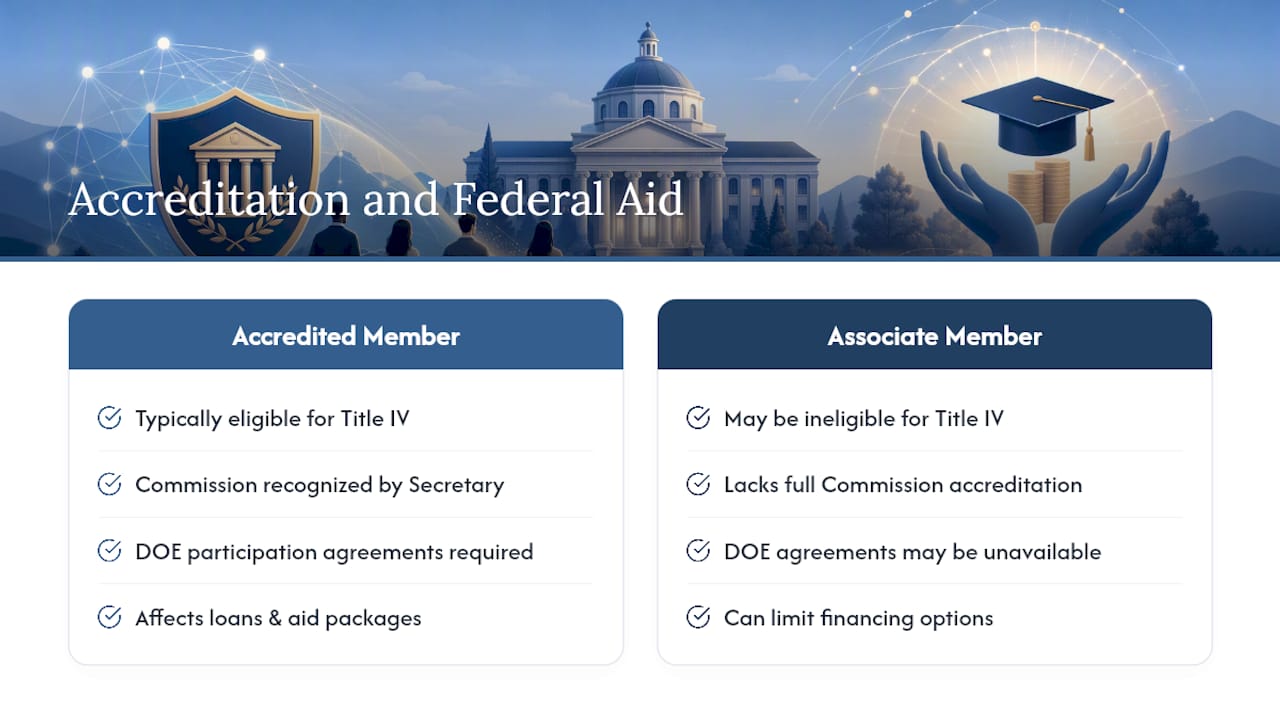
Accreditation status directly affects whether a seminary’s students can access federal financial aid, including Direct Loans and other Title IV programs. The U.S. Department of Education requires institutions to hold accreditation from an agency it recognizes before that institution can participate in federal aid programs, and the Commission on Accrediting’s recognition by the Secretary of Education is exactly what qualifies ATS-accredited seminaries for that eligibility.
In practical terms, this means a seminary listed as “Accredited Member” on the ATS directory has generally cleared the threshold needed to offer federal financial aid to eligible students, assuming the institution itself has also completed the Department of Education’s separate participation agreements. A school holding only Associate Membership, without full Commission accreditation, may not meet that threshold yet, which can directly limit a prospective student’s financing options.
This is one of the most consequential reasons to verify status before enrolling rather than after. Financial aid packages, loan eligibility, and even GI Bill benefits for veterans often hinge on accreditation status that can look ambiguous on a school’s own marketing materials but is stated plainly on the ATS record.
How a Seminary Actually Becomes ATS Accredited
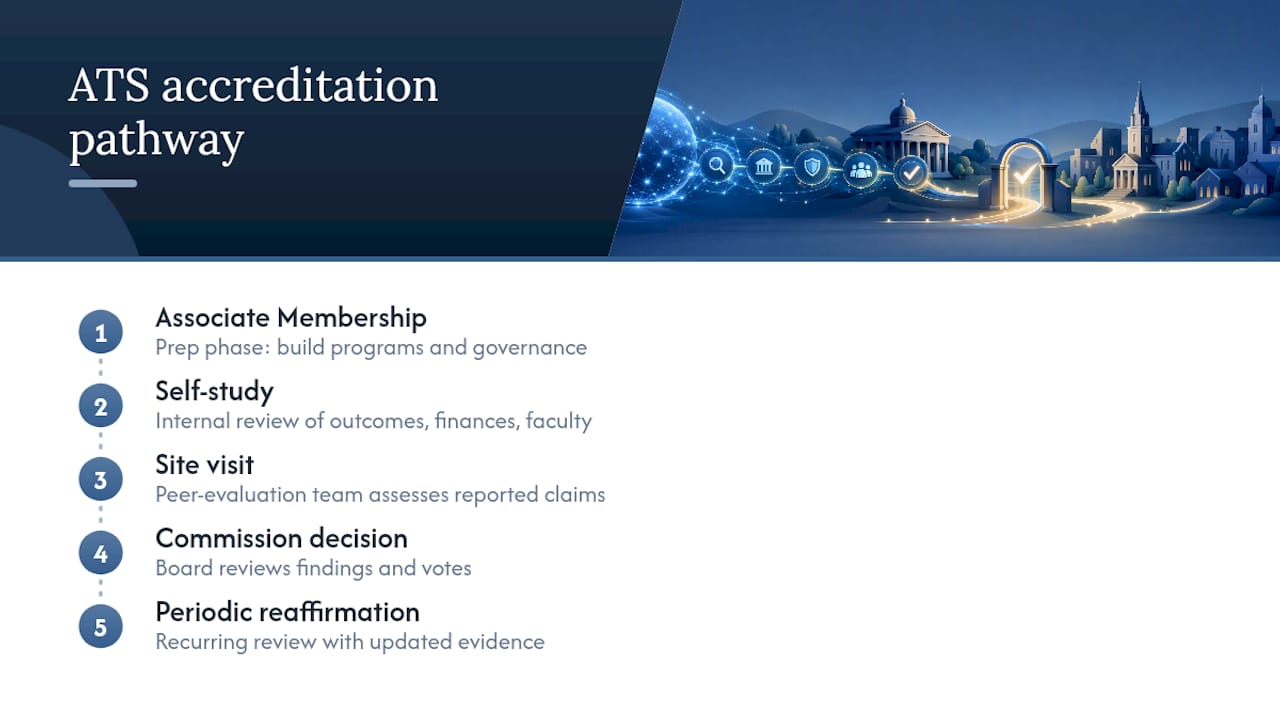
Accreditation is not a paperwork formality. It’s a multi-year process that starts with a school applying for Associate Membership, a preparatory phase during which the institution builds its programs, governance, and reporting practices toward Commission standards.
From there, the school undergoes a self-study, an extensive internal review examining student learning outcomes, financial stability, faculty qualifications, and institutional mission integrity. That self-study feeds into a site visit from a peer-evaluation team, drawn from faculty and administrators at other ATS member schools, who assess whether the institution’s practice matches its self-reported claims.
The Commission’s board then reviews the evaluators’ findings and votes on accreditation status. Approval isn’t permanent. Accredited schools return to this cycle periodically for reaffirmation, meaning the standards a seminary met five years ago have to be met again, with updated evidence, on a recurring basis. That ongoing-review structure is what separates ATS accreditation from a one-time credential and makes it function more like continuous quality assurance.
Common Misconceptions About ATS Accreditation
The biggest misconception is treating ATS membership and ATS accreditation as the same thing. A school can be a member, even an Associate Member in good standing, without holding full Commission accreditation. Always check the specific status label, not just whether the school appears in the directory at all.
A second misconception assumes accreditation is permanent once granted. It isn’t. The periodic reaffirmation cycle means a school’s status can shift, occasionally downward, if it fails to maintain standards between reviews. That’s precisely why compiled reference lists, including the Wikipedia summary of ATS-accredited institutions, should be treated as a starting point rather than a final answer.
A third misconception conflates ATS accreditation with denominational endorsement. ATS evaluates academic and institutional standards. It does not certify a school’s theological positions, doctrinal alignment, or denominational suitability for a given student. Two ATS-accredited seminaries can hold sharply different theological convictions on the same issue, and accreditation says nothing about which one matches your beliefs. That’s a separate research task entirely, one that program-fit resources are better suited to than an accreditation database.
Why Verification Habits Matter More Than the List Itself
Most people searching for accredited seminaries make the same mistake: they find a list, screenshot it, and stop checking. Status changes, reaffirmation cycles run on their own schedule, and a school that was accredited when a blog post was written two years ago isn’t guaranteed to hold the same standing today.
The stronger habit is pairing status verification with program-fit research at the same time, rather than treating them as separate steps done months apart. Check the ATS record first, then evaluate cost, format, and denominational alignment before you invest in an application. A tool like Findbibleschools’ program directory can speed up that second half of the process once accreditation is confirmed.
If there’s one habit worth building before you apply anywhere, it’s this: check the official ATS listing directly, every time, even for schools you’re confident about.
— Grant
Start Your Search With State and Program Directories
Findbibleschools exists for the moment right after you’ve confirmed a school’s ATS status, when the real question becomes which accredited program actually fits your budget, calling, and denominational preference. Instead of piecing together tuition figures and program details from a dozen separate school websites, you get that comparison in one place.

Browse accredited options by geography through directories like Bible colleges in Tennessee or Bible colleges in Kentucky, or go straight to a specific institution’s profile, such as Trinity Evangelical Divinity School’s program and tuition details, to see accreditation status alongside cost and degree options in one view. If you already know the degree level you want, the full programs directory lets you filter by associate, bachelor’s, master’s, or doctoral tracks across every accredited school in the network. Start with the state or program page that matches where you are in your search right now.
Sources
FAQ
Is ATS an Accredited Recognized Accrediting Body?
Yes. The Commission on Accrediting of ATS is recognized by both the Council for Higher Education Accreditation and the U.S. Secretary of Education, which qualifies its accredited schools for federal financial aid participation.
What Are Some Well-Known ATS-Accredited Seminaries?
Frequently cited examples include Princeton Theological Seminary, Duke Divinity School, Fuller Theological Seminary, Gordon-Conwell Theological Seminary, and Dallas Theological Seminary; all accreditation statuses should be confirmed on the current ATS member-school list, though all status should be confirmed on the current ATS member-school list.
Is Fuller Seminary LGBTQ Affirming?
Fuller Theological Seminary maintains a traditional evangelical position on sexuality and does not present itself as LGBTQ affirming; prospective students should review the school’s published community standards directly rather than relying on secondhand summaries.
Which Online Seminaries Are Considered Among the Best?
Several ATS-accredited seminaries, including Dallas Theological Seminary and Gordon-Conwell, offer well-established online or hybrid MDiv tracks; Findbibleschools’ online program guide breaks down accredited options by delivery format.
How Often Does ATS Accreditation Status Change?
Accredited schools go through periodic reaffirmation cycles rather than a one-time approval, so status can shift between reviews; always check the ATS directory directly rather than an older compiled list before applying.