
Published September 7, 2026
Transferable Associate in Ministry: Compare 213 Accredited Programs

An associate degree in ministry is typically structured as a program of around 60 credits, usually designed to be completed in approximately two years of full-time study, combining foundational Bible and theology coursework with practical ministry training. Common labels include the A.A. in Ministry Leadership, the A.S. in Christian Ministries, and the Associate of Arts in Church Leadership. Graduates walk away with either entry-level readiness for church and para-church roles or a transferable foundation for a bachelor’s degree.
TL;DR:
- An associate degree in ministry typically consists of around 60 credits and can be completed in two years of full-time study, combining biblical coursework with practical training.
- Programs vary in focus, with Associate of Arts degrees being more transfer-friendly for bachelor’s pathways and Associate of Science degrees emphasizing applied ministry skills.
- Accreditation—both regional and denominational—is crucial for credit transfer, with regional accreditation being essential for future bachelor’s credits.
- The practical component, especially ministry practicums, provides hands-on experience that is vital for employment and denominational certification.
- Most students use the associate as a stepping stone to a bachelor’s degree, seminary, or specialized certificates; careful planning and understanding transfer policies are key to success.
Table of Contents
- Which Associate Degree in Ministry Fits Your Goals?
- What Courses Make Up the Curriculum?
- Online, Hybrid, or On-Campus: Which Format Actually Works?
- How Do You Verify Accreditation and Transfer Credit?
- What Careers and Next Steps Does This Degree Open?
- How Do You Choose Between Programs?
- How Findbibleschools Helps You Compare Programs
- What Background Do You Need Before Enrolling?
- What Does a Ministry Practicum Actually Look Like?
- What Skills Will You Actually Walk Away With?
- Where Can This Degree Take You Next?
- What Trips Students Up in These Programs?
- Associate Degree or Certificate: What’s the Real Difference?
- Who Should Actually Choose This Degree?
- Ready to Compare Ministry Programs?
- Sources
Which Associate Degree in Ministry Fits Your Goals?
Program names sound similar, but the letters matter. An Associate of Arts (A.A.) usually carries a broader general education core, which makes it the stronger choice if you plan to transfer into a bachelor’s program later. An Associate of Science (A.S.), like Indiana Wesleyan University’s A.S. in Christian Ministries, tends to weight coursework toward applied ministry skills and biblical literacy, with transfer still possible but framed as a secondary benefit rather than the primary design.
Specialty titles tell you where the practical emphasis sits. A “Ministry Leadership” degree, such as Columbia International University’s AA in Ministry Leadership, leans into supervised leadership experience alongside coursework. A “Church Leadership” degree, like the one at North Central University, often ties directly into denominational credentialing tracks.
Before enrolling, ask your denomination or local church whether they recognize a particular program’s credential for licensing or ordination steps down the road. Some fellowships specify accredited programs or particular coursework for certified minister status, and finding that out early saves you from redoing credits later.
What Courses Make Up the Curriculum?
An associate in ministry generally includes a combination of general education credits, Bible and theology core courses, and ministry practicum or electives that together make up the degree requirements, often around 60 credits in total, though the exact distribution varies by program. That range holds fairly steady across institutions, though the exact split varies by program design.
A representative first two years might look like this:
- Semester 1: Introduction to Old Testament, English Composition, Introduction to Ministry
- Semester 2: Introduction to New Testament, Public Speaking, Christian Formation
- Semester 3: Systematic Theology I, Church History, General Education elective (math or science)
- Semester 4: Systematic Theology II, Ministry Practicum I, Leadership Foundations
- Semester 5: Homiletics or Pastoral Care, Ministry Practicum II, General Education elective
- Semester 6: Capstone or Senior Seminar, Ministry Practicum III, Elective in area of interest (youth, worship, missions)
Part-time students stretch this same sequence over three to four years, often taking one or two courses per term while working or serving in a church role. The practicum courses matter more than their credit count suggests: they put you in front of real ministry situations under supervision, which is exactly the experience employers and denominational boards want to see before they hand you responsibility.
Online, Hybrid, or On-Campus: Which Format Actually Works?
Fully online, asynchronous programs let you log in on your own schedule, which suits working adults and bivocational ministers juggling a job and family. Northwest University’s online associate in ministry leadership runs six start dates a year, so you’re rarely waiting long to begin. Hybrid programs mix that flexibility with periodic in-person intensives, useful if your practicum needs face-to-face supervision. On-campus programs offer the most built-in mentorship and community, but they demand relocation or a daily commute.
Cohort-based online programs move a group of students through coursework together, which builds accountability but can feel rigid if life throws you a curveball. Self-paced asynchronous formats offer more control but require more self-discipline. Accelerated terms can shrink an eight-week course into five or six weeks, cutting time-to-degree but raising weekly workload.
Pro Tip: Confirm with each school’s financial aid office whether the specific program is eligible for federal aid before you enroll. Accreditation status and program structure both affect eligibility, and this detail is easy to overlook until it costs you a semester’s funding.
How Do You Verify Accreditation and Transfer Credit?
Accreditation works on two tracks that both matter. Regional accreditation (through bodies overseeing higher education broadly) is what most bachelor’s programs require for transfer credit to count. Specialized or denominational accreditation, from bodies focused specifically on Bible colleges and seminaries, signals that a program meets standards particular to ministry training and may satisfy denominational certification requirements.
Verify both before enrolling:
- Check the program catalog for its stated accreditor and confirm that accreditor’s status directly on its own website.
- Ask the registrar for a written articulation agreement if you plan to transfer into a specific bachelor’s program.
- Confirm how many credits the receiving school will actually accept. Some cap transfer credit or require you to retake upper-division coursework.
- Ask whether your denomination has separate certification requirements beyond the academic degree itself.
USNews notes that programs commonly run within a range of credits that varies by institution, and recommends checking accreditation and transfer policy carefully before comparing programs on cost alone. Residency requirements, meaning a minimum number of credits you must complete at the degree-granting school, can also trip up transfer students who assumed every credit would move freely.
What Careers and Next Steps Does This Degree Open?
An associate degree opens doors to entry-level and volunteer ministry roles: youth ministry assistant, worship team support, children’s ministry coordinator, administrative or pastoral support staff, and various para-church positions in missions or nonprofit ministry work. It rarely qualifies someone for a senior pastor role outright, but it gets a foot in the door.
Ordination pathways vary widely by denomination. Some fellowships accept an associate plus supervised ministry hours toward certified minister status, as seen in North Central University’s alignment with Assemblies of God credentialing in some cases. Others require a bachelor’s or Master of Divinity before ordination consideration.
For most graduates, the associate becomes a launching pad rather than a finish line. It transfers into a bachelor’s in ministry, feeds into standalone certificates in specialized areas like counseling or worship arts, or eventually leads toward seminary and an M.Div. for those called to pastoral leadership.
How Do You Choose Between Programs?
Run every program through the same checklist before comparing tuition:
- Confirm accreditation type and verify it directly with the accrediting body, not just the school’s marketing page.
- Ask exactly how many credits transfer if you plan to pursue a bachelor’s later.
- Find out who supervises the ministry practicum and how placements are arranged.
- Check faculty credentials in your area of interest, whether that’s youth ministry, worship, or biblical studies.
- Compare true per-credit cost against available financial aid, not just the sticker price.
- Ask about denominational fit if certification matters to your calling.
When you call admissions, ask direct questions: “What percentage of your last cohort transferred those exact credits to a four-year school?” and “Who signs off on practicum hours, and how are placements found?” Vague answers or a refusal to put transfer policy in writing are red flags worth walking away from.
How Findbibleschools Helps You Compare Programs
Findbibleschools tracks 213 accredited Bible colleges and seminaries across the country, with program details, accreditation status, and cost information organized so you can compare options without hunting through a dozen separate school websites. The directory covers a range of programs from associate through doctoral levels, filterable by state, delivery format, and program type.
Start by browsing the full school directory to shortlist programs matching your accreditation and format preferences, then request information directly from the schools that fit before making a decision.
What Background Do You Need Before Enrolling?
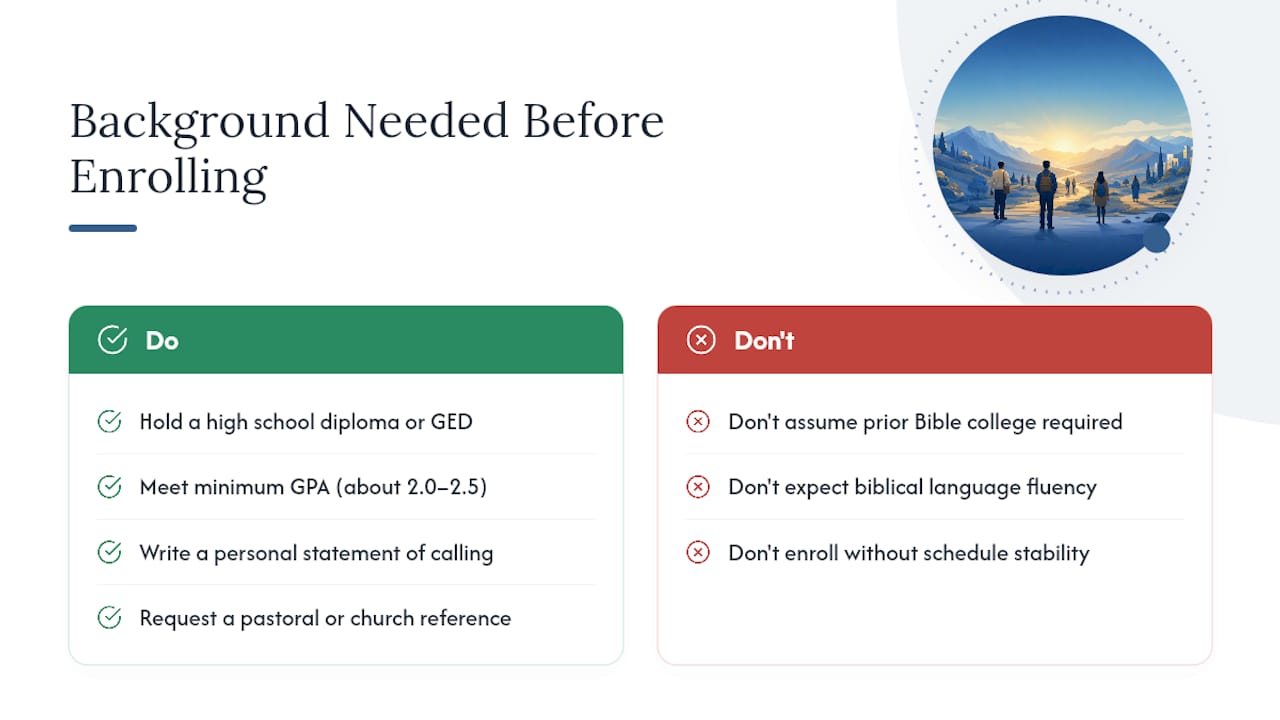
Most associate ministry programs set the same baseline as any college associate degree: a high school diploma or GED, and often a minimum GPA around 2.0 to 2.5 for regular admission. Some programs request a personal statement describing your sense of calling or ministry involvement, and a pastoral or church leader reference is common, especially for programs tied to denominational credentialing.
You don’t need prior Bible college experience or fluency in biblical languages. These are foundational programs by design, built for students who may be brand new to formal theological study. What helps more than academic preparation is active involvement in a local church, whether through volunteer service, a small group, or informal ministry work, because it gives context to the coursework and often satisfies part of the practicum requirement early.
Adult students returning to education after years in the workforce make up a large share of enrollment in these programs. Admissions offices at most Bible colleges expect and accommodate that, often through transfer credit for prior college coursework or life-experience credit for substantial ministry service. If English is not your first language, check whether the program requires a standardized language proficiency score, since this varies by institution and delivery format.
The honest prerequisite isn’t academic credentials. It’s a genuine interest in ministry work and enough stability in your schedule to commit to coursework alongside whatever job, family, or church responsibilities you’re already carrying.
What Does a Ministry Practicum Actually Look Like?
Practicum design varies more than most prospective students expect. Some programs require a fixed number of supervised ministry hours tied directly to course credit, with a faculty member reviewing your work and a site supervisor signing off on your hours. Others treat the practicum as an elective internship credit, giving you more freedom in choosing a placement but less structured oversight.
A typical placement might involve leading a youth small group under a pastor’s supervision, assisting with worship planning and rehearsals, coordinating a food pantry or benevolence ministry, or shadowing a hospital or nursing home chaplain on visitation rounds. Missions-focused programs sometimes arrange a short-term cross-cultural placement, either domestic or international, paired with a reflection paper connecting the experience to coursework.
The best practicums build in regular check-ins, not just a hours log turned in at semester’s end. A faculty advisor who reviews your reflections monthly and a site supervisor who gives real feedback, not just a signature, make the difference between a checkbox exercise and genuine formation. Because practicum structure differs so much between schools, request the actual practicum syllabus before enrolling rather than relying on a program’s general description. Ask specifically who arranges placements: many schools connect you with a partner church, while others expect you to find your own site and simply require approval.
What Skills Will You Actually Walk Away With?
Beyond a transcript, an associate in ministry builds a specific skill set that shows up in job interviews and church interviews alike. Biblical literacy tops the list: the ability to read Scripture in its original context, trace a book’s structure, and teach from it without leaning entirely on someone else’s notes.
Public communication is the second major gain. Homiletics and public speaking coursework push students to organize a talk, hold a room’s attention, and adapt delivery for different audiences, whether that’s a youth group or a Sunday morning congregation. Pastoral care basics, meaning how to sit with someone in crisis without trying to fix everything in one conversation, come through both coursework and the hands-on practicum experience.
Administrative and organizational skills round out the practical side: budgeting a small ministry program, recruiting and coordinating volunteers, and managing the logistics of an event or outreach. Indiana Wesleyan’s program outcomes specifically name spiritual formation alongside ministry leadership as core results, reflecting a pattern across most accredited associate programs: they aim to shape character and conviction, not just transfer information. Graduates consistently report that the practicum, more than any single course, is what turned classroom concepts into usable instinct under real pressure.
Where Can This Degree Take You Next?
An associate in ministry rarely functions as a terminal credential. Most students and schools alike design it as the first two years of a longer academic plan, whether that’s a bachelor’s in ministry, a Bible degree with a different specialization, or eventually a Master of Divinity for those pursuing ordained pastoral leadership.
Articulation agreements make that path smoother when they exist. These are formal agreements between an associate program and a specific bachelor’s program guaranteeing that a defined set of credits transfers without the receiving school picking apart your transcript course by course. Not every associate program has one, and not every bachelor’s program you might target will have a matching agreement with the school where you earned your associate. Ask directly whether an articulation agreement exists with the four-year program you have in mind, and get the credit-equivalency list in writing.
Without a formal agreement, transfer still happens, but expect the receiving institution to evaluate courses individually. Regionally accredited credits transfer more predictably than credits from a program carrying only specialized accreditation, which is one more reason accreditation type deserves attention before you enroll rather than after you’ve finished. Certificate stacking is another route: some students add a focused certificate in an area like biblical counseling or worship leadership onto their associate rather than committing immediately to a full bachelor’s, testing their calling further before the bigger investment.
What Trips Students Up in These Programs?
Balancing coursework against an already full life is the most common challenge. Many associate ministry students are bivocational, meaning they hold a job outside ministry while serving in some church capacity, and stacking coursework on top of that leaves little margin. Part-time pacing helps, but it also stretches time-to-degree, which can test motivation over three or four years instead of two.
Practicum logistics create a second common snag. Finding a supervising pastor with the bandwidth to mentor a student, especially in smaller churches already stretched thin on staff, sometimes delays practicum placement or forces a student to travel further than expected for a suitable site.
Transfer anxiety shows up often, too. Students choose a program without confirming transfer policy up front, then discover during their final semester that a target bachelor’s program will only accept a portion of their credits. Financial strain compounds all of this: even at a modest per-credit rate, tuition adds up over 60 credits, and financial aid eligibility rules for religious programs can differ from standard undergraduate aid, catching students off guard if they didn’t ask ahead of time.
Associate Degree or Certificate: What’s the Real Difference?
A certificate in ministry studies typically runs 15 to 30 credits, takes well under a year to complete, and focuses narrowly on one area, such as youth ministry or biblical counseling, without the general education requirements a degree carries. An associate degree runs roughly double that credit load, includes general education alongside ministry coursework, and carries far more weight for transfer into a bachelor’s program.
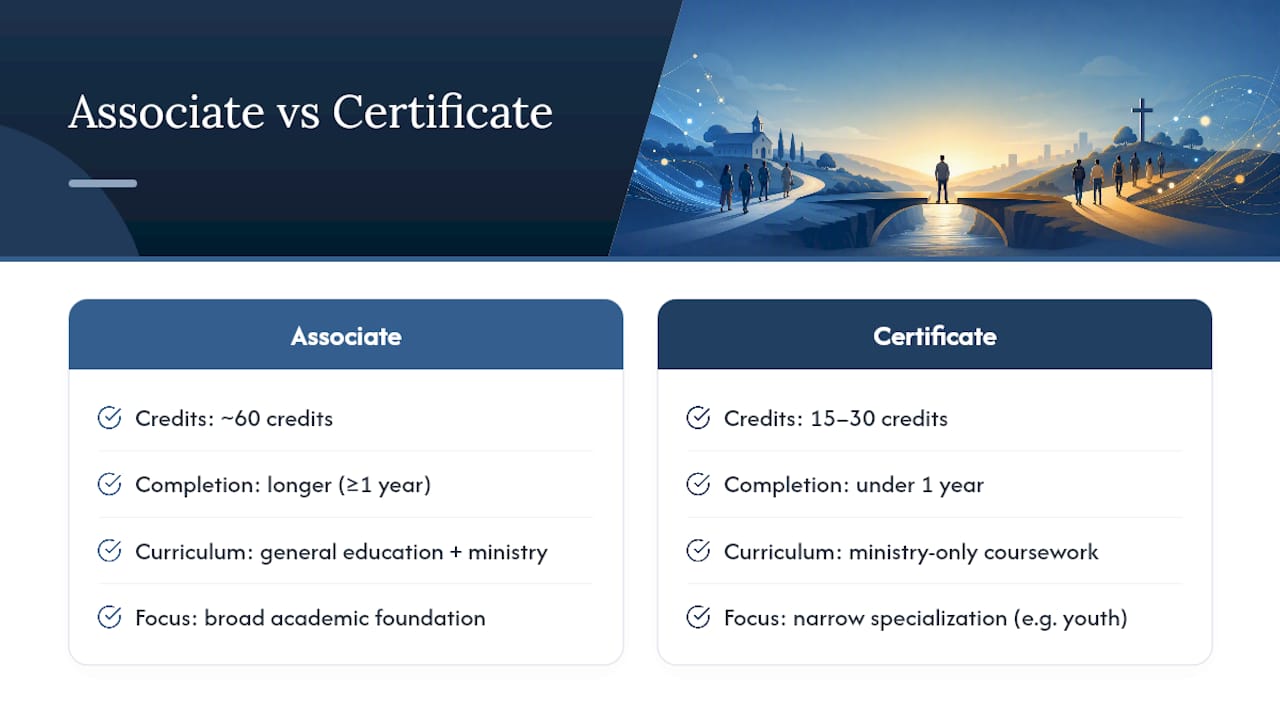
The tradeoff is speed versus breadth. A certificate gets you into a specific ministry role faster and costs less, but it rarely satisfies denominational certification requirements that specify a degree, and it won’t transfer toward a bachelor’s the way an associate’s general education credits will. If you’re testing a calling before committing years of study, a certificate is the lower-risk option. If you already sense a longer-term vocational direction, whether pastoral ministry, missions, or seminary eventually, the associate degree builds the academic foundation a certificate simply isn’t designed to provide.
Who Should Actually Choose This Degree?
An associate makes the most sense for someone testing a calling without upending their life, a bivocational leader balancing work and family, or a small-church volunteer ready to formalize skills they’re already using. If you already know you’re headed toward pastoral leadership or a seminary track, weigh whether starting straight into a bachelor’s saves time. Whatever path you choose, pair classroom study with real ministry involvement from day one. That combination, more than the letters after your name, is what actually prepares you.
— Grant
Ready to Compare Ministry Programs?
This platform provides a faster way to compare associate ministry programs than piecing together information from a dozen individual college websites. Instead of hunting through separate admissions pages to figure out which schools carry the accreditation and program format you need, you filter once and see results side by side.

The full school directory lets you browse by state, delivery format, and accreditation type across 213 accredited institutions. If you’re set on studying remotely, the accredited online programs guide narrows the field to schools built for distance learners, with notes on how to verify accreditation before you apply. Looking at options in a specific region? The Bible colleges in Tennessee page shows what’s available in that state as one example of how the state-level pages work. Once you’ve shortlisted two or three programs that match your accreditation, format, and cost requirements, request information directly from those schools and start comparing real answers instead of marketing copy.
Sources
- Online Associate in Ministry Leadership | Northwest University
- Christian Ministries - Associate Degree | Indiana Wesleyan University