
Published August 19, 2026
Yes, You Can Earn an Accredited Apologetics Degree

Accredited bachelor’s and master’s degrees in Christian apologetics exist across a range of American institutions, from evangelical seminaries to Christian liberal arts universities. The two dominant credentials are the Bachelor of Arts or Science with an apologetics concentration and the Master of Arts in Christian Apologetics, and both prepare students for ministry, teaching, writing, or graduate-level philosophy work.
A short list of programs anchors most serious searches:
- Biola University (Talbot School of Theology) — MA in Christian Apologetics, delivered online.
- Liberty University — Bachelor of Science in Religion with an Apologetics concentration.
- Southern Evangelical Seminary (SES) — MA in Christian Apologetics, with a long-standing academic focus on the discipline.
- Luther Rice and The Southern Baptist Theological Seminary — additional MA options with distinct credit structures and course emphases.
If your goal is ministry preparation, an undergraduate concentration like Liberty’s gets you into the field faster. If you want depth for teaching, writing, or doctoral study, a dedicated MA like Biola’s or SES’s carries more weight. The comparison below breaks down format, credits, and cost so you can see how these choices stack up against each other.
Key Takeaways
Accredited apologetics degrees exist at the bachelor’s and master’s level across multiple U.S. institutions, and program fit depends more on credit structure and faculty specialization than on brand name alone.
| Point | Details |
|---|---|
| Degree options are real | Bachelor’s concentrations and dedicated MA programs in Christian apologetics are available and accredited. |
| Credit loads vary widely | MA programs range in credit requirements and completion timelines vary from about one and a half to three years. |
| Accreditation type matters | Confirm regional accreditation and, for graduate programs, ATS status before applying. |
| Cost shape differs by school | Some programs quote per-credit tuition, others flat program pricing; always calculate the full total including fees. |
| Verify before you apply | Use official program pages and Find Bible Schools institutional entries to confirm facts admissions offices might gloss over. |
Where to Verify Program Facts
Check the official program page, the school’s catalog, the regional accreditor’s site, the relevant Find Bible Schools institutional page, and BLS occupational guidance for career context. Contact admissions directly for anything time-sensitive; use aggregator sites for initial comparison only.
Table of Contents
- What Are the Leading Apologetics Degree Programs?
- Which Apologetics Degree Level Fits Your Goals?
- How Do You Choose an Accredited Apologetics Program?
- What Do Apologetics Programs Require for Admission?
- What Will You Study, and Where Does It Lead?
- What Does an Apologetics Degree Cost?
- Should You Study Online, On-Campus, or Hybrid?
- How Do You Verify Apologetics Programs on Find Bible Schools?
- Ready to Compare Accredited Apologetics Programs?
- What Actually Matters When Picking an Apologetics Program
- Frequently Asked Questions
- Sources
What Are the Leading Apologetics Degree Programs?
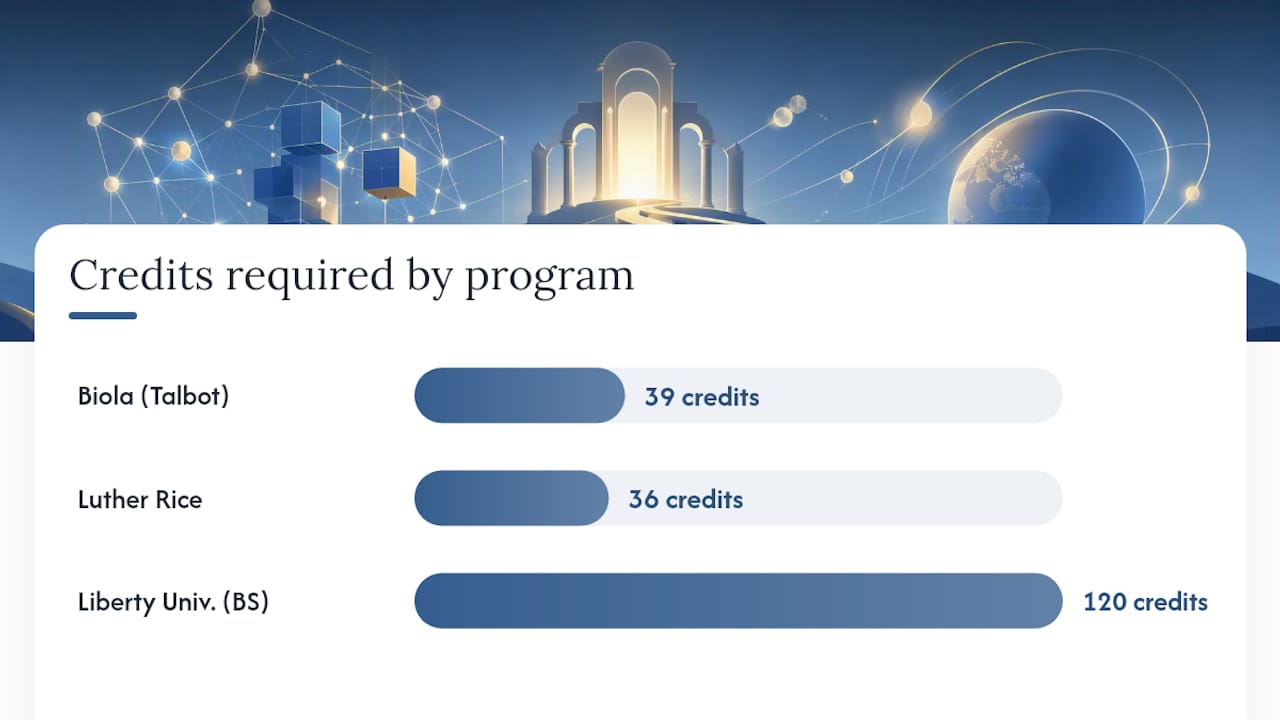
Comparing programs side by side reveals real differences in structure, not just marketing language. Biola’s online MA runs 39 credits with a strong biblical and theological foundation before students specialize. Luther Rice’s MA in Apologetics trims that down to 36 credits and markets a completion window of roughly 16 to 24 months, positioning it as a faster, ministry-ready track. Southern Evangelical Seminary has built its entire institutional identity around apologetics training, which shows up in faculty specialization more than in raw credit counts.
| Program | Degree Level | Format | Credits | Typical Completion | Tuition Shape | Accreditation | Best For |
|---|---|---|---|---|---|---|---|
| Biola University (Talbot) | MA | Online | 39 credits | 2–3 years part-time | Per-credit, published on program page | Regional + ATS | Academic depth, biblical foundation |
| Liberty University | BS (Religion, Apologetics concentration) | Online/on-campus | Standard 120-credit BS | 4 years full-time | Flat per-credit undergraduate rate | Regional | Early ministry preparation, budget-conscious students |
| Southern Evangelical Seminary | MA in Christian Apologetics | On-campus/hybrid | Varies — verify with school | 2 years typical | Per-credit | ATS-affiliated | Focused apologetics specialization, debate/philosophy emphasis |
| Luther Rice | MA in Apologetics | online | 36 credits | 16–24 months | Per-credit | Regional | Working adults, faster ministry-ready timeline |
Each program earns its place on this list for a different reason.
Biola’s Talbot School of Theology built its online MA in Christian Apologetics around a full theological foundation, not just argumentation techniques, which matters if you eventually want to teach or write in the field. Liberty University’s apologetics concentration sits inside a broader religion degree, so you graduate with generalist ministry skills plus a specific defense-of-the-faith toolkit, an efficient option for students who aren’t sure yet whether they want a specialized graduate degree. Southern Evangelical Seminary has trained apologists since the 1990s under founders known for public debate work, and that DNA still shapes the curriculum’s heavy philosophy and worldview component.
Pro Tip: Before comparing tuition totals, check whether the school quotes cost per credit or cost per program. A “$14,000 tuition” figure means nothing until you know whether it covers 36 credits or 120.
Where a program’s cost or credit total isn’t published clearly, treat it as unconfirmed and reach out directly, or check the school’s Find Bible Schools institutional page before applying.
Which Apologetics Degree Level Fits Your Goals?
Apologetics credentials range from a single certificate to a Ph.D., and the right one depends on what you’re actually trying to do.
- Undergraduate BA/BS with an apologetics concentration: Best for students entering ministry, youth work, or Christian education who want defense-of-the-faith training layered onto a broader religion or biblical studies degree.
- Master of Arts in Christian Apologetics: Best for pastors, teachers, and lay leaders who want focused expertise in philosophy, worldview analysis, and historical Christian evidences, without committing to a full M.Div.
- M.Div. with an apologetics emphasis: Best for those pursuing ordination or pastoral leadership who also want strong apologetics training baked into ministerial formation. NOBTS’s Institute for Christian Apologetics offers exactly this kind of track alongside separate M.A. and Ph.D. paths.
- Graduate certificates: Best for working professionals who want focused coursework without a full degree commitment, often stackable toward a later MA.
- Ph.D. in Apologetics or Philosophy of Religion: Best for those aiming at academic teaching, published scholarship, or seminary faculty roles.
As a rule of thumb, a certificate takes about a year of part-time study, an MA runs roughly two to three years, and a doctorate typically requires four or more years beyond the master’s level. If you already have ministry experience and just need credentialing, start with the MA. If you’re building a career from scratch, the undergraduate route gives you broader footing first.
How Do You Choose an Accredited Apologetics Program?
Picking a program comes down to six factors, in roughly this order of priority:
- Accreditation type. Confirm regional accreditation at minimum, and look for Association of Theological Schools (ATS) accreditation on graduate programs, since ATS carries specific weight for ministry credentialing and future doctoral admissions.
- Program format and flexibility. Decide whether you need fully online, hybrid, or on-campus delivery, and whether “online” secretly means synchronous class times that conflict with a job.
- Faculty expertise. Look for professors who publish, debate, or speak professionally in apologetics, not just adjuncts teaching outside their specialty.
- Curriculum breadth. A strong program covers philosophy, church history, comparative worldviews, and science-and-faith issues, not just rebuttal talking points.
- Credit transfer policy. If you’re bringing in credits from a Bible college or previous graduate work, ask how many transfer and whether they need departmental approval.
- Total cost, including fees. Per-credit tuition rarely tells the whole story once technology fees, graduation fees, and books are added.
Use this checklist when comparing schools:
- Does the program list its accrediting body clearly on its website, not buried in a footer?
- Are faculty bios public, with actual credentials and publication history?
- Is the credit total and typical completion time stated plainly?
- Does the admissions page specify GPA and document requirements, or is it vague?
- Are career outcome claims specific, or do they lean on generic “prepares you for ministry” language with no substance behind it?
Watch for red flags: no clear accreditation statement anywhere on the site, credit-hour totals that shift between the catalog and the marketing page, missing faculty credentials, or promises of guaranteed job placement. Legitimate seminaries don’t need to oversell.
Pro Tip: Send admissions a short, direct email: “Can you confirm your program’s total credit hours, current per-credit tuition, typical completion timeline for part-time students, and accrediting body?” A slow or evasive answer tells you as much as a fast one.
What Do Apologetics Programs Require for Admission?
Undergraduate programs generally ask for high school transcripts, a minimum GPA (often in the 2.0 to 2.5 range for open-enrollment Christian universities), and sometimes a statement of faith. Master’s programs raise the bar: most require an accredited bachelor’s degree, a GPA around 2.5 to 3.0 depending on the school, letters of recommendation, and a personal or ministry statement. Some, like Biola’s MA, expect applicants to demonstrate foundational biblical literacy before diving into specialized coursework.
- Fall, spring, and sometimes summer start terms are common across online MA programs.
- Transfer credit and advanced standing decisions typically happen during the admissions review, before your first semester.
- Plan on 8 to 12 weeks of lead time to gather transcripts, secure recommendation letters, and write a statement of purpose before a stated deadline.
Because career data specific to “apologist” doesn’t exist in standard federal occupational datasets, admissions offices tend to frame outcomes around ministry roles, teaching, and writing rather than precise salary projections. Budget extra time if you’re requesting transcripts from multiple prior institutions.
What Will You Study, and Where Does It Lead?
Apologetics curricula share a recognizable backbone across schools. Expect required coursework in epistemology, Christian philosophy, the historical Jesus and New Testament reliability, the problem of evil, formal logic, and the intersection of science and faith. The Southern Baptist Theological Seminary’s MA in Apologetics lists representative courses including Christian Philosophy, Christian Apologetics, History and Methods of Apologetics, Problem of Evil, and Logic, a fairly standard model echoed at Biola, Luther Rice, and SES.
- Epistemology and worldview analysis
- Historical and philosophical apologetics methods
- Problem of evil and suffering
- Logic and critical reasoning
- Science and Christian faith
- New Testament reliability and historical Jesus studies
| Career Path | Typical Role | Degree Best Suited |
|---|---|---|
| Youth or college ministry | Discipleship and worldview training for students | BA/BS with apologetics concentration |
| Pastoral leadership | Preaching, teaching, congregational apologetics | M.Div. with apologetics emphasis |
| Apologetics speaker or author | Public engagement, writing, debate | MA in Apologetics |
| Further graduate study | Seminary or university teaching | Ph.D. in Apologetics or Philosophy of Religion |
Certificate credits often apply toward a full MA later, so a shorter commitment now doesn’t necessarily close off deeper study down the road. Check each program’s stacking policy before assuming credits transfer automatically.
What Does an Apologetics Degree Cost?
Tuition shape varies more than the headline number suggests. Biola’s online B.S. in Bible, Theology & Apologetics publishes per-credit cost indicators across its 120-credit structure, while some seminaries quote a flat program tuition instead. Graduate apologetics programs commonly run in the same general range as other seminary master’s degrees nationally, though the exact per-credit rate depends heavily on the institution and whether you qualify for denominational or institutional discounts.
- Institutional scholarships are common for students with strong undergraduate GPAs or demonstrated ministry involvement.
- Denominational scholarships exist for students affiliated with a sponsoring church body, worth asking about even if not advertised prominently.
- Federal financial aid applies at regionally accredited institutions, so confirm accreditation status before assuming Title IV eligibility.
- Transfer credits and certificate-to-degree pathways reduce total credits needed, which directly lowers total cost.
Pro Tip: Calculate total program cost by multiplying per-credit tuition by total required credits, then add technology, graduation, and library fees separately. Marketing pages rarely bundle these into the headline number.
For students prioritizing affordability, comparing low-cost online options before committing to a single program can meaningfully change the total bill.
Should You Study Online, On-Campus, or Hybrid?
Format changes the experience more than most applicants expect going in.
- Online: Best for working adults and ministry leaders already serving a congregation; flexible, but some programs still require synchronous sessions or short residency intensives.
- On-campus: Best for students wanting direct mentorship, in-person debate practice, and daily contact with faculty who specialize in apologetics.
- Hybrid: Splits the difference, offering periodic in-person intensives with online coursework between sessions, a common model for working students who still want face-to-face formation.
Check the fine print before assuming “online” means fully asynchronous. Some MA programs require live video sessions at set times, which matters if you’re juggling ministry duties across time zones.
How Do You Verify Apologetics Programs on Find Bible Schools?
Start by searching the Find Bible Schools directory and filtering by degree level or state to surface accredited apologetics-adjacent programs quickly.
- Search by program type (BA, MA, certificate) or narrow by state using the state-by-state directory.
- Open an institutional page, such as the entry for Talbot School of Theology at Biola University, to review accreditation status, delivery mode, and program summaries side by side.
- Cross-check tuition indicators and sample curriculum against the school’s own catalog before applying.
Findbibleschools verifies accreditation status, delivery mode, and sample curriculum against publicly published institutional sources, then presents them in a consistent format so you’re not hunting through a dozen inconsistent PDFs. A page like the one for Asbury Theological Seminary shows exactly how much detail gets aggregated in one place, tuition notes, accreditation statements, and program descriptions together.
Ready to Compare Accredited Apologetics Programs?
Once you know whether you want an undergraduate concentration or a dedicated MA, the fastest next step is comparing accredited options in your state or preferred format. Findbibleschools’ state-by-state directory lets you narrow by geography, while institutional pages give you accreditation and tuition details before you ever contact an admissions office. If you’re weighing a seminary-level apologetics track alongside ministry preparation, Covenant Theological Seminary’s program page is a solid starting point for comparison.
What Actually Matters When Picking an Apologetics Program
Most guides to apologetics degrees spend too much energy ranking schools by prestige and not enough on the one variable that actually predicts whether you finish: fit between program pace and your real-life schedule. A 36-credit online MA from Luther Rice and a 39-credit online MA from Biola look similar on paper, but the difference in credit load and course sequencing changes what a working ministry leader can realistically sustain over two years.

The conventional advice, “check accreditation and compare tuition,” isn’t wrong, but it’s incomplete. Accreditation confirms legitimacy; it says nothing about whether a program’s philosophy emphasis matches your actual ministry context. A youth pastor fielding questions about evolution and a campus minister debating secular philosophy majors need different course weighting, even within “apologetics” as a category.
Prioritize faculty specialization and curriculum breadth over brand recognition. A smaller, focused program like Southern Evangelical Seminary can outperform a bigger name if its faculty actually work in the specific apologetics niche you care about.
Frequently Asked Questions
Is an apologetics degree the same as a theology degree? No. A theology degree covers broad biblical and doctrinal study, while an apologetics degree or concentration focuses specifically on defending Christian belief through philosophy, logic, and historical evidence, usually built on a theological foundation.
Can you get an apologetics degree fully online? Yes. Programs at Biola, Luther Rice, and several other accredited seminaries offer fully online master’s degrees in apologetics, though some include synchronous sessions or short residencies.
What can you do with an apologetics degree? Common paths include youth or college ministry, pastoral leadership, teaching, writing, public speaking, and further graduate study toward seminary or university faculty positions.
How long does a master’s in apologetics take? Most programs run between 16 months and three years, depending on credit total (36 to 39 credits is typical) and whether you study full-time or part-time.
Do apologetics certificates count toward a full degree? Often yes. Many schools allow certificate credits to stack toward a later MA, though the transfer policy varies by institution, so confirm it directly with admissions.
Sources
- Master of Arts — Christian Apologetics - Biola University
- Master of Arts in Apologetics Online | Luther Rice
- Data for occupations not covered in the Occupational Outlook Handbook | U.S. Bureau of Labor Statistics