
Published August 20, 2026
Best U.S. Anglican Seminaries: A Practical Comparison Guide

If you’re preparing for Anglican ministry, six U.S. institutions carry the clearest Anglican-designated identity: Trinity School for Ministry, Nashotah House, Reformed Episcopal Seminary, Virginia Theological Seminary, Berkeley Divinity School at Yale, and the School of Theology at Sewanee. Alongside them sits a second, equally legitimate path: Anglican studies tracks or houses of study at mainstream seminaries like Asbury, Beeson, Gordon-Conwell, and Duke Divinity School.
Both routes can lead to ordination, but only if the specific program carries recognition from your diocese, the Anglican Church in North America (ACNA), or the Episcopal Church. Accreditation through the Association of Theological Schools (ATS) or a regional accreditor affects whether your degree transfers and whether a bishop will accept it at all.
The Anglican-designated seminaries include:
- Trinity School for Ministry (Ambridge, Pennsylvania)
- Nashotah House (Nashotah, Wisconsin)
- Reformed Episcopal Seminary (Blue Bell, Pennsylvania)
- Virginia Theological Seminary (Alexandria, Virginia)
- Berkeley Divinity School at Yale (New Haven, Connecticut)
- School of Theology at Sewanee (Sewanee, Tennessee)
The Anglican-track alternative runs through Asbury Theological Seminary, Beeson Divinity School, Gordon-Conwell Theological Seminary, and Duke Divinity School’s Anglican/Episcopal House of Studies. Before you commit to either, confirm directly with your diocesan vocational office or ACNA that the specific program qualifies for ordination.
Key Takeaways
Choosing an Anglican seminary comes down to confirming diocesan or ACNA recognition first, then weighing liturgical formation against cost, format, and accreditation.
| Point | Details |
|---|---|
| Two viable paths exist | Choose between Anglican-designated seminaries (Trinity, Nashotah House, VTS) or Anglican tracks at broader schools (Asbury, Beeson, Duke). |
| Recognition beats branding | Confirm ACNA, Episcopal Church, or diocesan recognition before applying, since not every “Anglican” label transfers to ordination. |
| M.Div. is the ordination standard | Most dioceses require a Master of Divinity for priesthood; certificates and MAs typically support lay or diaconal formation instead. |
| Liturgical formation varies by format | Residential programs offer daily offices and Eucharist; online and hybrid formats trade some of that immersion for flexibility. |
| Compare programs before applying | Findbibleschools lets you filter accredited U.S. seminaries by degree, format, and denominational focus in one search. |
Table of Contents
- What Makes a Seminary “Anglican,” Exactly?
- Which U.S. Seminaries Are Recognized as Anglican?
- Which Seminaries Offer Anglican Studies Tracks?
- How Do You Choose the Right Anglican Seminary?
- What Degree Do You Actually Need, and Does Accreditation Matter?
- How Do You Verify a Program Before You Apply?
- Frequently Asked Questions
- Sources
What Makes a Seminary “Anglican,” Exactly?
An “Anglican-designated” seminary exists specifically to form clergy within the Anglican tradition. Its faculty, chapel life, and governance are built around Anglican polity from the ground up. A seminary “offering an Anglican track,” by contrast, is a broader institution, often evangelical or interdenominational, that has added a certificate, concentration, or house of studies for Anglican-bound students without restructuring its core identity around Anglicanism.
Recognition matters more than branding. A program calling itself “Anglican” doesn’t automatically mean your bishop or diocesan commission on ministry will accept it. Formal recognition by ACNA, the Episcopal Church, or a specific diocese is the operative credential, not the seminary’s marketing copy.
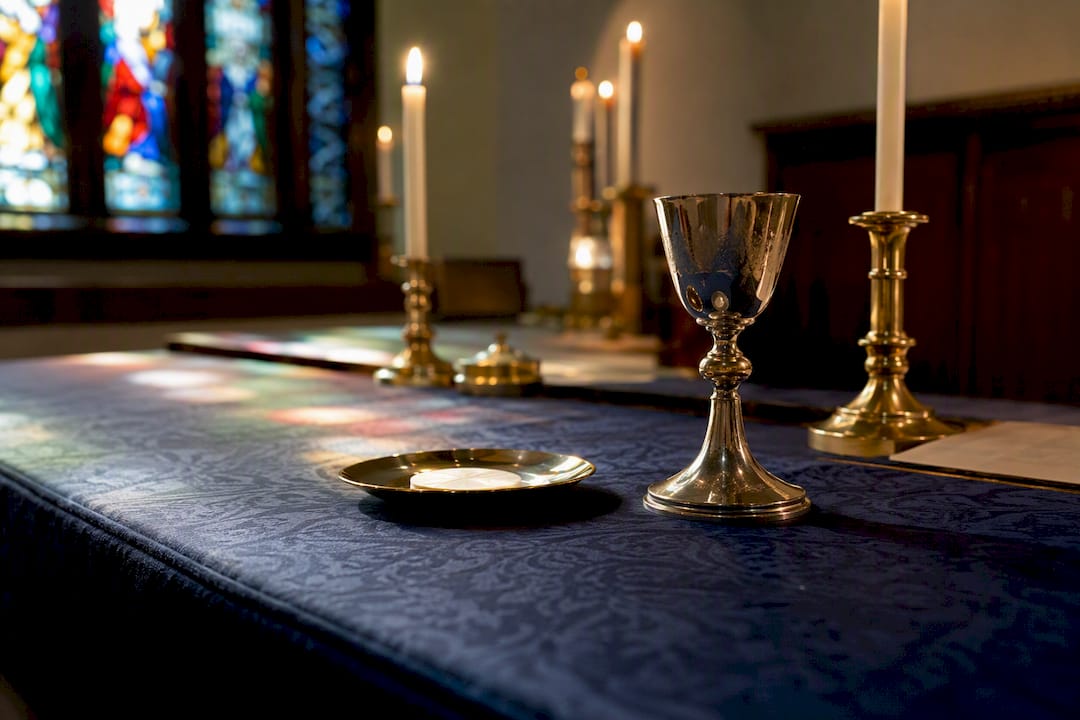
Anglican formation typically includes daily offices (Morning and Evening Prayer), regular Eucharistic worship, coursework in church polity and Anglican formularies like the Book of Common Prayer, and structured pastoral formation under supervision. A seminary that offers these consistently, rather than as an elective add-on, tends to produce candidates who are more prepared for the liturgical rhythms of ordained Anglican ministry.
Which U.S. Seminaries Are Recognized as Anglican?
The Anglican Communion Office’s global directory of theological colleges and seminaries lists 139 institutions across 46 countries, with a meaningful U.S. subset. The Episcopal Church maintains its own list of affiliated seminaries, which is the reference point for Episcopal ordinands specifically. Six schools show up consistently across both frameworks and independent analyses.
- Trinity School for Ministry is widely cited among the largest ACNA-recognized seminaries, offering an M.Div. and MA with a strong evangelical Anglican identity and residential formation in western Pennsylvania.
- Nashotah House leans Anglo-Catholic, with daily Eucharist and a monastic rhythm baked into residential life. It also offers hybrid and low-residency options for working students.
- Reformed Episcopal Seminary, affiliated with the Reformed Episcopal Church (a jurisdiction within ACNA), emphasizes a Reformed theological reading of Anglicanism and offers M.Div. and certificate tracks.
- Virginia Theological Seminary is the largest Episcopal seminary by enrollment, with strong Episcopal Church recognition and a broad M.Div. curriculum plus low-residency options.
- Berkeley Divinity School at Yale functions as an Episcopal house of studies inside Yale Divinity School, combining Ivy League academics with Episcopal formation and a competitive scholarship structure.
- School of Theology at Sewanee (University of the South) is owned by 28 Episcopal dioceses, giving graduates unusually direct pipelines into diocesan placement.
Each of these differs in churchmanship, from Nashotah House’s Anglo-Catholic sacramentalism to Trinity’s evangelical emphasis, so theological fit matters as much as accreditation when you’re comparing them.
Which Seminaries Offer Anglican Studies Tracks?
If relocating to an Anglican-designated seminary isn’t realistic, several mainstream seminaries let you pursue Anglican formation within a broader institutional setting.
- Asbury Theological Seminary hosts an Anglican studies concentration that pairs its Wesleyan-evangelical core curriculum with Anglican liturgical and doctrinal coursework.
- Beeson Divinity School at Samford University offers an Anglican studies track inside its M.Div., with faculty connections to ACNA congregations across the Southeast.
- Gordon-Conwell Theological Seminary provides Anglican-relevant coursework and has supported ordinands heading into Anglican ministry through its broader evangelical M.Div. program.
- Duke Divinity School’s Anglican/Episcopal House of Studies embeds Anglican formation inside an elite research university, drawing candidates who want academic rigor alongside denominational preparation.
A track makes sense when geography, cost, or a preference for ecumenical exposure outweighs the benefit of full immersion in Anglican community life. The tradeoff is real: you’ll likely get less daily liturgical formation and a thinner diocesan pipeline than you would at a dedicated Anglican seminary, so plan to supplement with fieldwork in an Anglican parish.
How Do You Choose the Right Anglican Seminary?
Start with the one filter that can eliminate half your options instantly: does your bishop or diocesan commission on ministry actually recognize this specific program? Everything else is secondary until you answer that.
- Confirm diocesan and ACNA/Episcopal recognition first. A seminary can be excellent and still be the wrong choice if your ordaining body won’t credit the degree.
- Evaluate liturgical formation intensity. Ask how often students attend daily offices and Eucharist, and whether chapel attendance is mandatory or optional.
- Verify accreditation. Confirm ATS accreditation or regional accreditation status, since this affects transferability and financial aid eligibility.
- Check field education structure. Ask whether placements happen in Anglican parishes specifically, not just any nearby congregation.
- Compare cost and format. Weigh residential tuition and housing against hybrid or low-residency options that let you keep working.
Pro Tip: Email your diocesan vocational officer before you apply anywhere. Ask them directly which seminaries they’ve approved for candidates in the past three years. This one question can save you a full semester of wasted tuition.
What Degree Do You Actually Need, and Does Accreditation Matter?
Most dioceses require a Master of Divinity (M.Div.) for priesthood, typically 72 to 96 credit hours over three years. An MA in theology or a Certificate in Anglican Studies works for lay formation, diaconal tracks in some dioceses, or supplementary study, but it rarely satisfies priesthood requirements alone.
- ATS accreditation is the standard most dioceses expect for M.Div. programs; verify it directly on the seminary’s own site rather than assuming.
- Regional accreditation (through bodies like NECHE) affects whether credits transfer if you switch programs mid-degree.
- Tuition shape varies widely: expect a meaningful spread between smaller denominational seminaries and university-affiliated divinity schools, with financial aid and diocesan scholarships often closing much of the gap.
- Online and hybrid formats work well for academic coursework but weaken the daily liturgical rhythm that shapes sacramental instincts, a tradeoff worth naming honestly rather than glossing over.
Roughly a third of ATS-accredited M.Div. students now study through some hybrid or distance format, according to broader theological education trends, which is why more Anglican-designated seminaries have added low-residency options in recent years.
How Do You Verify a Program Before You Apply?
Don’t take any seminary’s self-description at face value. Cross-check it against two public sources: the Anglican Communion Office’s directory of theological colleges, which lists global Anglican institutions including U.S. entries, and the Episcopal Church’s seminary list for Episcopal-specific affiliation.
Findbibleschools complements those directories by letting you filter accredited U.S. institutions by degree type, delivery format, and denominational focus in one place, so you can shortlist candidates before you start emailing admissions offices.
- Search by state and program type to compare Anglican-track and Anglican-designated options side by side.
- Check accreditation status and tuition ranges before requesting information from a school.
- Request a syllabus, sit in on a chapel service if you can visit, and talk to a current student about field placement quality.
Common Mistakes Prospective Ordinands Make
The most frequent error I see is assuming an “Anglican” label equals diocesan endorsement. It doesn’t. Apply on the timeline your diocese’s ordination process demands, not the seminary’s admissions calendar, since field education requirements often lag a semester behind coursework. Always confirm recognition with your vocational office before you sign anything.
Compare Anglican-Friendly Programs on Findbibleschools
Findbibleschools gives you one place to compare accreditation, degree type, and delivery format across accredited U.S. seminaries, instead of piecing that research together across a dozen individual school websites and denominational lists.
You can search the full seminary directory by state, filter by degree level on the programs page, or go straight to individual profiles like Gordon-Conwell and Covenant Theological Seminary to check tuition and accreditation before you request information. If you’re weighing options by region, the state-by-state directory covers over 180 accredited schools, including listings for states like Tennessee and Kentucky. Start by searching your preferred format and denomination, then request information directly from the schools that match.
Frequently Asked Questions
What is an Anglican seminary? An Anglican seminary is a theological institution built specifically to form clergy and lay leaders within Anglican doctrine, liturgy, and polity, distinct from broader seminaries that only offer Anglican coursework as an add-on.
Do I need an M.Div. to be ordained as an Anglican priest? Most dioceses and ACNA jurisdictions require a Master of Divinity for priesthood. Certificates and MA degrees typically support diaconal or lay ministry tracks instead.
Can I get ordained after studying at a seminary with only an Anglican track, not a full Anglican seminary? Yes, if your diocese or ACNA recognizes that specific program. Schools like Beeson, Asbury, and Gordon-Conwell have prepared ordinands this way, but confirmation from your vocational office matters more than the school’s reputation.
Is online seminary training acceptable for Anglican ordination? Many dioceses accept hybrid or low-residency M.Div. programs, but they often still require in-person field education and liturgical formation. Check with your specific diocese before enrolling.
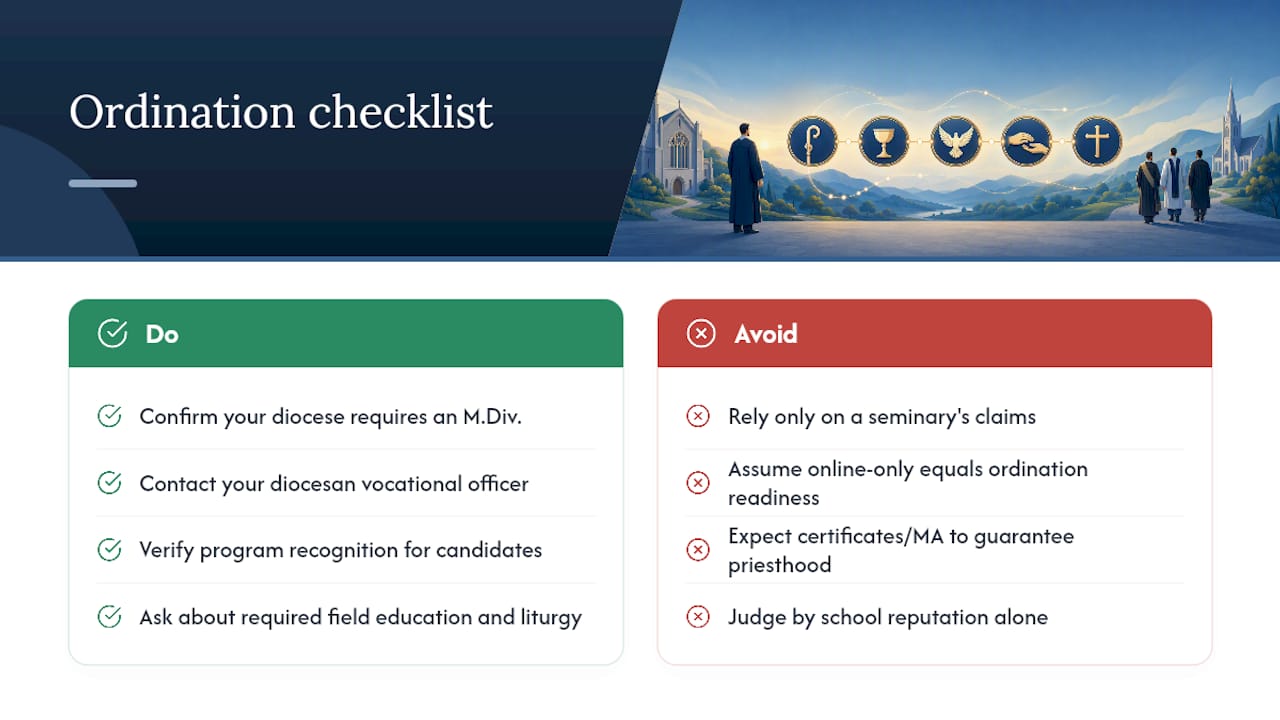
How do I confirm a seminary is recognized by my diocese? Contact your diocesan vocational officer or commission on ministry directly and ask which specific programs they’ve approved for candidates in recent years, rather than relying on a seminary’s own claims.
Sources
- Theological Colleges and Seminaries of the Anglican Communion
- Episcopal Seminaries – The Episcopal Church
- What are the Largest Anglican Seminaries?