
Published September 15, 2026
Verify U.S. Accredited Bible Colleges: A 5 Step Admissions Checklist

Yes, accredited Bible colleges operate throughout the United States, and accreditation status is the single detail that determines whether your credits, financial aid, and future ministry credentials will hold up. Start by checking the Association for Biblical Higher Education (ABHE) or Association of Theological Schools (ATS) directories, then cross-reference results using a curated resource such as Find Bible Schools.
TL;DR:
- Only schools accredited by recognized bodies like ABHE or ATS will ensure the validity of your credits, financial aid, and ministry credentials.
- Confirm accreditation through official directories and request written verification from the school’s registrar before applying or transferring credits.
- Degree programs vary in level and vocational fit; a master of divinity is often required for ordination, while certificates serve entry-level roles.
- Online accreditation must explicitly cover the delivery format, and credits may not transfer if this is not confirmed in writing.
- Denominational endorsement is not equivalent to accreditation and does not guarantee academic credibility or eligibility for licensing or ordination.
Table of Contents
- Where to Search for Accredited Bible Colleges
- How Accreditation Actually Works
- What Actually Changes Your Outcome
- Online or Campus: Which Fits Your Situation
- Your Verification Checklist Before You Apply
- What Graduates of Accredited Bible Colleges Actually Do
- Accreditation vs. Ecclesiastical Endorsement: Not the Same Thing
- Does Accreditation Affect Ordination and Ministry Credentials?
- A Publisher’s Perspective on Simplifying This Search
- Start Your Search With a Curated Directory
- Sources
- FAQ
Where to Search for Accredited Bible Colleges
Certain sources carry real weight when you’re trying to confirm whether a school’s accreditation claim is legitimate. Each one serves a slightly different purpose, and knowing when to use which one saves you from taking a school’s marketing copy at face value.
- ABHE maintains a member directory listing U.S. Bible colleges with addresses and an “Accredited Institution” flag, which is your fastest way to confirm status school by school.
- ATS accredits graduate-level seminaries and divinity schools, so if you’re eyeing a master of divinity or doctoral program, this is the directory that actually applies to you.
- CHEA doesn’t accredit schools directly. It recognizes the accreditors themselves, which is why checking CHEA’s ABHE profile tells you whether ABHE’s approval carries federal recognition weight.
How Accreditation Actually Works
Accreditation isn’t one uniform stamp of approval. It comes in two distinct flavors, and mixing them up leads to real financial and academic consequences.
Institutional accreditation covers the entire school, meaning every degree it offers has passed review. Programmatic accreditation covers a specific program only, which matters if a school’s general education division is accredited, but its theology track was added later and hasn’t gone through separate review. Nazarene Bible College is a useful example of how schools communicate this, since it explicitly notes both regional and national accreditation to signal parity with state universities and community colleges.
Two accreditors dominate the Bible college and seminary space:
- ABHE, recognized by the U.S. Department of Education, covers member institutions ranging from certificate programs to graduate degrees.
- ATS focuses specifically on seminaries and graduate theological education, so it’s the relevant accreditor once you move past a bachelor’s degree.
CHEA sits above both as a recognition body. It doesn’t grade individual schools, but its profile pages document which accreditors carry legitimate standing and when institutions are added or removed as their status changes.
Pro Tip: Don’t rely on a school’s “we are accredited” banner alone. Search the accreditor’s own directory by name, and if the school doesn’t appear, ask the registrar directly for an official accreditation letter. A legitimate institution will produce one within a day.
What Actually Changes Your Outcome
Not every difference between schools matters equally. Four factors have an outsized effect on whether your degree serves the goal you’re pursuing.
- Program level and vocational fit. A certificate suits someone testing a calling; a master of divinity is often required for ordination in many denominations.
- Transferability. Ask specifically about articulation agreements, since accreditation alone doesn’t guarantee another school will accept every credit.
- Cost shape. Look past sticker tuition to what FAFSA covers, whether the school participates in VA education benefits, and whether aid is need based or merit based.
- Faculty and formation opportunities. Denominational stance shapes classroom content, and hands-on ministry placements (internships, church partnerships, supervised counseling) often matter more to employers than GPA.
A useful comparison for the associate versus bachelor’s decision, if you’re weighing how far to commit up front, is this breakdown of degree-level differences, which explains how credits typically stack between the two.
Online or Campus: Which Fits Your Situation
The right delivery mode depends less on convenience and more on what kind of formation you actually need. Online programs work well for working adults, parents, and anyone already embedded in a ministry role who needs flexibility more than a traditional campus experience. Campus programs tend to serve people earlier in their calling better, since in-person mentoring, cohort relationships, and supervised field ministry are harder to replicate through a screen.
Accreditation status doesn’t automatically transfer to every delivery format a school offers. A campus might be accredited while a newer online partnership with another university runs under separate terms, so confirm explicitly that the accreditor’s approval covers the online track you’re considering, not just the physical campus.
Directories that track program culture and cost, including online-specific listings, often surface FAFSA and VA eligibility details that general school marketing pages leave out. That’s worth checking before you assume an online seat qualifies for the same aid as an in-person one.
- Confirm the accreditor’s scope covers the specific delivery format, not just the institution overall.
- Ask whether online credits transfer identically to campus credits at the same school.
- Verify field education or practicum requirements aren’t quietly waived (or added) for online students.
Your Verification Checklist Before You Apply
Run through this before submitting any application, and keep the answers in writing.
- Confirm institutional accreditation through the accreditor’s own directory, not the school’s claim.
- Ask whether your specific program carries separate programmatic accreditation.
- Get the school’s FAFSA code and confirm VA benefit eligibility if that applies to you.
- Request the transfer credit policy in writing, including any articulation agreements.
- Ask what field education or ministry practicum hours are required for your degree.
Sample questions for admissions or the registrar: “Can you send me your current accreditation letter?” “Which of your programs carry accreditation separately from the institution?” “What percentage of transfer credits from [prior school] typically apply here?”
Pro Tip: Treat vague answers as a red flag. A school that can’t quickly produce accreditor verification or a written transfer policy usually can’t back up its other claims either.
What Graduates of Accredited Bible Colleges Actually Do
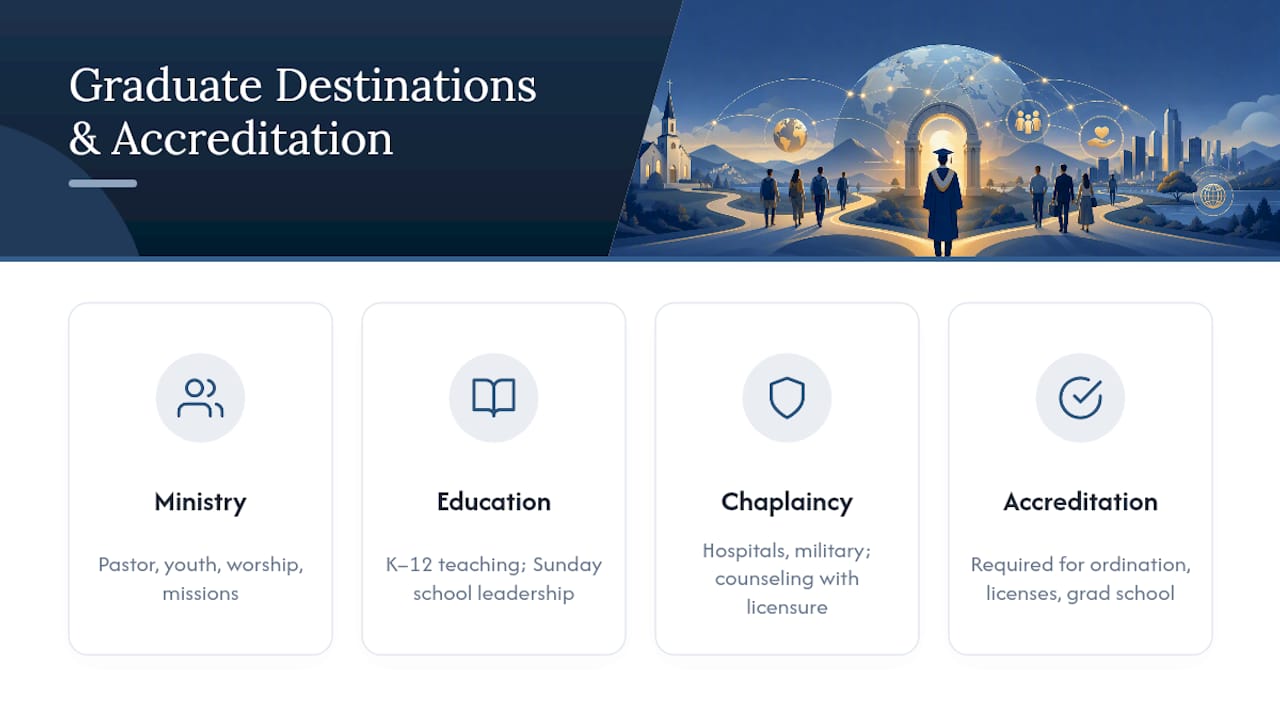
Ministry roles remain the most common destination: pastoral leadership, youth ministry, worship direction, and missions work all draw heavily from Bible college graduates, particularly those with degrees from ATS-accredited seminaries pursuing ordination-track credentials. But the placement picture is broader than pulpit work alone.
Graduates also move into Christian education (teaching at K-12 Christian schools or leading Sunday school programs), nonprofit and parachurch leadership, chaplaincy in hospitals and the military, and counseling roles that pair a theology degree with additional clinical licensure. Denominational seminaries in particular feed directly into ordination pipelines, since many denominations require a master of divinity or equivalent from an ATS-accredited school before they’ll consider a candidate for credentialing.
Accreditation status affects this pipeline directly. Employers, denominational boards, and licensing bodies routinely ask which accreditor stands behind a degree, and an unaccredited credential can quietly disqualify an otherwise qualified candidate from chaplaincy programs, counseling licensure tracks, or graduate school admission. This is also where program level matters: a certificate opens doors to volunteer and entry-level ministry support roles, while credentialed pastoral positions and denominational ordination almost always require a bachelor’s degree or higher from an accredited institution.
The practical takeaway is straightforward. If your career plan involves any credential, license, or denominational approval down the line, accreditation isn’t optional groundwork. It’s the foundation everything else gets built on.
Accreditation vs. Ecclesiastical Endorsement: Not the Same Thing
Accreditation and denominational endorsement solve two different problems, and confusing them is one of the more expensive mistakes prospective students make.
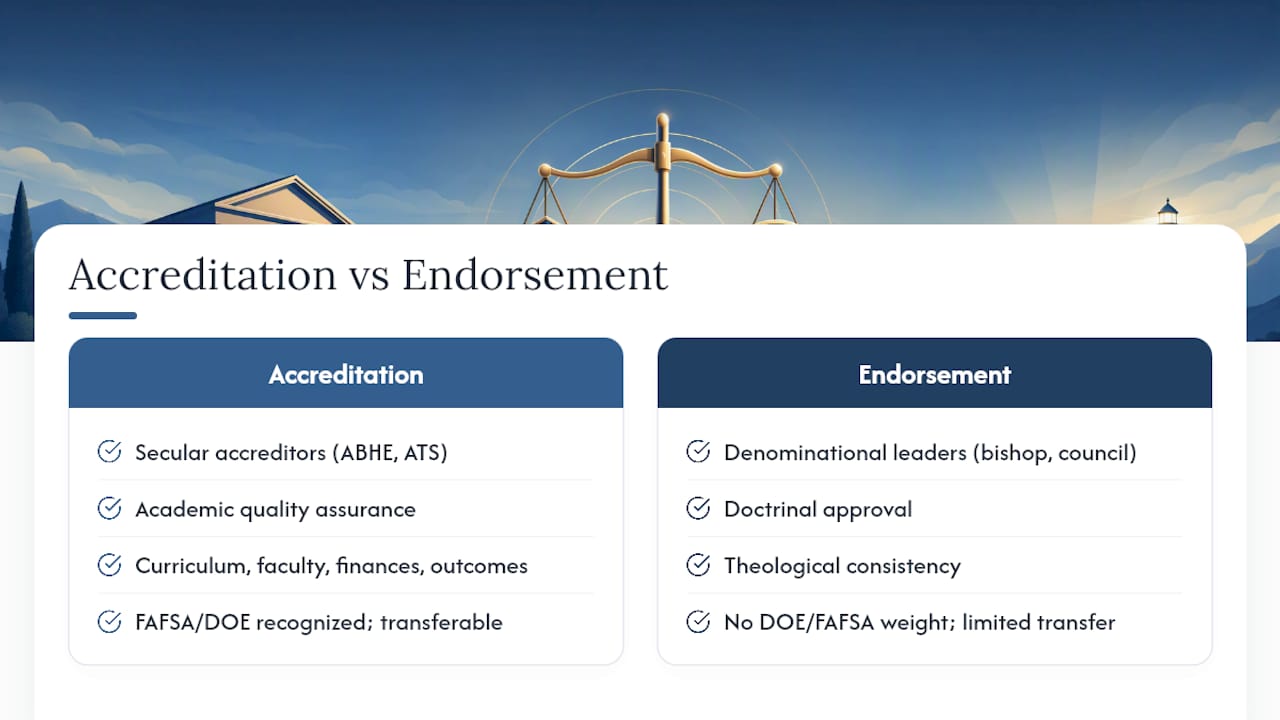
Accreditation is an academic quality assurance process run by secular bodies like ABHE, ATS, and regional accreditors, all of which CHEA recognizes as legitimate. It measures curriculum rigor, faculty qualifications, financial stability, and student outcomes against standards that apply regardless of theological tradition. A school can hold strong accreditation while serving a narrow denominational niche, or broad denominational reach while holding no accreditation at all.
Ecclesiastical endorsement or recognition, by contrast, is a denomination’s own approval that a school teaches doctrine consistent with that denomination’s beliefs. A seminary can carry a bishop’s blessing or a denominational council’s endorsement without ever going through ABHE or ATS review, and that endorsement carries zero weight with the U.S. Department of Education, FAFSA eligibility, or most secular employers.
The two can and often do coexist. A denominationally endorsed seminary that also holds ATS accreditation gives you both doctrinal alignment and academic credibility that transfers outside church circles. But if a school leads with denominational endorsement language and stays vague about accreditation, treat that as a prompt to dig deeper, not a substitute for verification.
Does Accreditation Affect Ordination and Ministry Credentials?
Denominational ordination boards vary widely in how strictly they require accredited coursework, but the trend across most mainline and evangelical denominations leans toward requiring it, especially for full ordination rather than lay ministry licensure.
Many denominations specify a master of divinity from an ATS-accredited seminary as the baseline for ordination consideration. Others accept bachelor’s-level theology degrees from ABHE-accredited institutions for licensed ministry or associate pastor roles, reserving the master’s requirement for senior pastoral or denominational leadership positions. Chaplaincy programs, particularly those tied to hospitals, the military, or federal institutions, tend to be the strictest, often requiring both an accredited master’s degree and additional clinical pastoral education hours.
This is where an unaccredited or narrowly programmatic-accredited degree can quietly derail a calling years after the fact. A graduate who completes a theology degree at an unaccredited school may find, only when applying for ordination or a chaplaincy credential, that the board won’t recognize the coursework at all. That’s a costly discovery to make after three or four years of tuition and study, and it’s entirely avoidable with a five-minute accreditor search before you enroll.
A Publisher’s Perspective on Simplifying This Search
Find Bible Schools tracks hundreds of accredited institutions across the country, and the goal behind building that directory was simple: reduce the hours a prospective student spends cross-referencing accreditor lists against denominational directories against tuition pages. When you filter by state, degree level, and delivery format, you’re seeing curated data, not marketing copy, and that distinction is worth more time than most applicants give it.
— Grant
Start Your Search With a Curated Directory
Some curated directories provide side-by-side comparison of cost, campus culture, and program type without opening a dozen separate tabs, offering an advantage over piecing together ABHE, ATS, and individual school websites on your own.
The full directory of accredited Bible colleges and seminaries lets you filter by degree level and delivery format across the entire country, and state-specific pages make regional searches faster. If you’re focused on the Southeast, the Tennessee listings are a good starting point; readers in other regions can browse state-by-state options the same way. Once you’ve narrowed your list, save your top picks and contact each registrar directly for a written accreditation letter and transfer policy before you apply. That single step catches problems no amount of website browsing will.
Sources
- Association for Biblical Higher Education Commission on Accreditation | CHEA
- ABHE member directory
- Word of Life Bible Institute | Accredited Bible College Programs
FAQ
What Makes a Bible College “Accredited”?
A Bible college is accredited when a recognized body such as ABHE or ATS has reviewed its curriculum, faculty, and finances against national standards, and CHEA recognizes that accreditor as legitimate.
How Do I Check if a Specific Program Is Accredited?
Search the accreditor’s own directory, since institutional accreditation doesn’t always extend to every individual program, and request written confirmation from the school’s registrar if the program isn’t listed separately.
Are Online Bible College Credits Transferable?
Often yes, but only when the accreditor’s approval explicitly covers the online delivery format; always confirm this in writing before enrolling rather than assuming campus accreditation automatically applies.
Does Find Bible Schools List Accreditation Status for Each School?
Yes, Find Bible Schools curates accreditation, cost, and program details across 213+ institutions so you can filter and compare without checking each accreditor’s site individually.
Is Denominational Endorsement the Same as Accreditation?
No, denominational endorsement reflects doctrinal approval from a church body, while accreditation is an academic quality review from bodies like ABHE and ATS that carries weight with FAFSA, employers, and licensing boards.