
Published September 25, 2026
Finish in 4–5 Years: U.S. Accelerated Bible Degrees with Title IV

Yes, accredited accelerated Bible degrees are available across the United States, and they follow a handful of well-tested formats. The most common are combined BA plus M.Div or BA plus MTS tracks that finish in about five years, compressed master’s programs completed in four to five years, and credit-by-exam or competency routes that shorten time to graduation further. Before choosing any of them, confirm the accreditor’s recognition and whether the program’s distance-education status is covered for federal aid.
TL;DR:
- Accelerated Bible degree programs often rely on credit overlap and fast-paced eight-week terms to shorten time to graduation, typically completing in four to five years.
- Transfer credits, prior ministry experience, or related undergraduate studies can significantly reduce the time needed for degree completion in these fast tracks.
- Confirming that the institution’s accreditor specifically covers distance education and that the program qualifies for federal aid are critical steps before enrollment.
- Comparing programs through a fixed set of criteria, including transfer policies, delivery format, and total cost, helps identify the best fit for individual needs and timelines.
- Building a structured study schedule, early communication with advisors, and understanding the scope of accreditation can improve success in managing the intense pace of accelerated programs.
Table of Contents
- How accelerated Bible programs are structured
- Who benefits from accelerated tracks and realistic timelines
- Accreditation and federal aid rules for accelerated distance programs
- A checklist for choosing an accelerated program
- Step-by-step next actions to start your application
- How Find Bible Schools helps you compare accredited accelerated programs
- Potential challenges and coping strategies for accelerated students
- Career outcomes and ministry opportunities after graduation
- Curriculum differences between accelerated and traditional tracks
- What the research actually supports
- Find your accelerated program match
- Where to verify these facts yourself
- Sources
- FAQ
How accelerated Bible programs are structured
Most accelerated tracks rely on one of a few structural models rather than simply cramming more coursework into less time. A BA-to-M.Div or BA-to-MTS combined track lets a student begin graduate-level courses while still technically an undergraduate, with select courses counting toward both degrees. Some schools describe this as a 3+2 or 3+3 pattern, where the first three years cover undergraduate general education and Bible core requirements, and the remaining years blend upper-level undergraduate work with graduate seminary courses.
Credit overlap is the mechanism that actually saves time: a single course satisfies requirements in both the bachelor’s and the master’s program, rather than students repeating similar material twice. Some programs also allow credit-by-exam or portfolio review for students with prior ministry experience or transfer coursework.
- A traditional 120-credit BA followed by a separate 72 to 96-credit M.Div can take six to seven years; a combined track compresses that timeline by applying graduate credits earlier.
- Programs built around eight-week terms rather than traditional 15-week semesters let students complete more courses per calendar year without increasing weekly workload dramatically.
Who benefits from accelerated tracks and realistic timelines
Accelerated Bible programs tend to fit a specific kind of student, and knowing whether you match that profile matters more than the marketing on a school’s homepage.
- Transfer students entering with substantial general-education or Bible-core credit already completed, since overlap works best when there is less ground left to cover.
- Recent college graduates who want a seminary-level credential without starting a second degree from zero, particularly those who studied a related field like history or philosophy.
- Second-career adults moving into ministry from another profession, who often value compressed timelines because they are already managing family and work commitments.
Completion windows typically run four to five years for combined BA plus master’s tracks, though transfer credits can shorten that further. The tradeoff is intensity: eight-week terms, summer sessions, and required residencies or intensives compress the same amount of reading and writing into shorter windows, which can strain students juggling full-time work. Be cautious of any program promising a full seminary credential in under three years, without prerequisites or a residency component. That pace is unusual and worth double-checking against the school’s own catalog before enrolling.
Accreditation and federal aid rules for accelerated distance programs
Accreditation is not a formality here. It determines whether the credit hours you earn are transferable, whether employers and denominations recognize your degree, and whether you can use federal aid to pay for it. Regional or national institutional accreditation covers the school as a whole, while programmatic accreditors like the Association for Biblical Higher Education (ABHE) evaluate theological curriculum specifically. Checking both, rather than trusting a school’s own marketing, is the safer path, and the difference between national and regional accreditation is worth understanding before you apply.
Distance-education programs qualify for federal aid only when the institution’s accreditor is recognized by the U.S. Department of Education and that recognition explicitly covers distance education, according to FSA program-eligibility guidance. This single detail determines whether an online accelerated Bible degree is eligible for Title IV aid at all.
- Look up the institution’s accreditor on the CHEA or Department of Education databases rather than relying on a school’s own accreditation page.
- Ask the financial aid office directly whether your specific accelerated pathway, not just the general degree program, is confirmed for Title IV eligibility.
- Confirm whether the accreditor’s scope of recognition names distance education specifically, since some accreditors cover only on-campus instruction.
Our guide to verifying accredited online Bible schools walks through this process step by step. Skipping this check risks enrolling in a program whose credits do not transfer or whose online format falls outside federal aid coverage.
A checklist for choosing an accelerated program
Comparing accelerated programs works best with a fixed set of criteria rather than judging each school on its own marketing language.
- Confirm admissions fit: minimum GPA thresholds, prerequisite coursework, and whether the accelerated track requires a separate application from the standard degree.
- Review the transfer-credit policy in writing, including exactly how many graduate credits can be earned during the undergraduate years.
- Clarify delivery mode and schedule: fully online, hybrid with periodic residencies, or campus-based with intensives during breaks.
- Calculate net price after aid across the full time-to-degree, not just per-credit tuition, since a faster program can cost less overall even at a higher sticker price.
Ask admissions and financial aid officers directly: which courses count toward both degrees, what happens if you fall below the required GPA, and whether the accelerated cohort has a fixed start date or rolling admission.
Pro Tip: Insist on seeing the accreditor’s distance-education scope of recognition in writing before you enroll, not just a verbal assurance from admissions.
Step-by-step next actions to start your application
Once you have narrowed your list, a few concrete steps move you from research to enrollment.
- Request an official transcript evaluation from each school’s admissions office, along with a written credit-by-credit breakdown of how prior coursework applies.
- File the FAFSA as early as possible and ask the financial aid office to confirm Title IV coverage for the specific accelerated pathway, not the general degree.
- Coordinate with your advisor to schedule overlapping undergraduate and graduate coursework, particularly if the program uses eight-week terms rather than traditional semesters.
- Track the admissions timeline for accelerated cohorts, which often have earlier application deadlines than standard undergraduate admissions, and follow up in writing after each submitted document.
How Find Bible Schools helps you compare accredited accelerated programs
A directory of accredited theological institutions across the United States includes programs spanning associate degrees through doctorates. The platform organizes programs by type, denomination, delivery format, and cost, which makes it possible to filter specifically for accelerated, online, or combined BA plus MA pairings rather than searching school by school. Guides walk through accreditation basics, including how to confirm ABHE recognition and verify Title IV eligibility for a specific distance-education pathway. This combination of curated directory and plain-English accreditation guidance is meant to shorten the research phase for students who already know they want a faster route into ministry preparation.
Potential challenges and coping strategies for accelerated students
Compressed timelines create real pressure points that traditional four-year programs rarely test. Eight-week terms mean less time to absorb dense theological reading, and a missed week can set a student meaningfully behind in a way that a 15-week semester would absorb more easily. Students juggling full-time work or family responsibilities often find the pace hardest to sustain during required residencies or intensives, which can demand a week or more away from normal routines.
Coping strategies that consistently help include building a fixed weekly study schedule before the term starts rather than reacting to deadlines as they arrive, and front-loading reading during lighter weeks to create buffer before major papers or exams. Many accelerated cohorts build in peer study groups specifically because isolation tends to compound the stress of a fast pace. Students should also communicate early with advisors if a GPA threshold required for the accelerated track is at risk, since most programs would rather adjust a course load than lose a student to attrition. Treating the accelerated timeline as a fixed constraint rather than a flexible target, and building margin into the schedule for unexpected setbacks like illness or family obligations, tends to separate students who finish on time from those who fall back to the standard track.

Career outcomes and ministry opportunities after graduation
An accelerated Bible degree opens the same general career paths as a traditional one: pastoral ministry, chaplaincy, missions, church administration, and denominational leadership roles that typically expect seminary-level training. What changes is timing. Graduates enter ministry roles or continue toward ordination years earlier than peers on a traditional track, which matters for students already serving in part-time or volunteer ministry roles who want formal credentials to match responsibilities they are already carrying.
Denominational recognition and ordination requirements vary significantly, so it is worth checking with your specific denomination or church body about which accredited degrees satisfy ordination prerequisites before assuming an accelerated M.Div or MTS will automatically qualify. Employers and denominational boards generally evaluate the credential itself rather than how quickly it was earned, provided the accrediting body is one they recognize. That makes accreditation, again, the detail that determines whether a faster degree carries the same weight as a traditional one in a hiring or ordination decision.
Curriculum differences between accelerated and traditional tracks
The core theological curriculum in an accelerated program is generally the same as in a traditional one: biblical languages, systematic theology, church history, and practical ministry courses tend to appear in both. What differs is sequencing and depth of elective exploration. Traditional four-year and six-year programs typically allow more room for elective concentrations, such as a specific denominational tradition, counseling emphasis, or missions focus, simply because the calendar allows for it.
Accelerated tracks compress the required core and often reduce elective flexibility to hit the shortened timeline, which means students choosing this route should expect a curriculum focused tightly on degree requirements rather than broad exploration. Some accelerated programs also front-load foundational courses, such as introductory Hebrew or Greek, earlier in the sequence so that graduate-level exegesis courses can begin sooner. Students who value a wide range of elective theological study may find a traditional track a better fit, while students who already know their ministry focus tend to do well with the tighter accelerated curriculum.

What the research actually supports
The honest takeaway from researching accelerated Bible degrees is that the format itself is not the risk. Combined BA plus M.Div tracks, 3+2 patterns, and compressed master’s programs are well-established and offered by legitimate accredited institutions. The real risk sits in the verification step that many prospective students skip: confirming that a specific program’s distance-education delivery falls within its accreditor’s recognized scope, and that the financial aid office can confirm Title IV eligibility for that exact pathway rather than the school in general.
Conventional advice tends to stop at “check if the school is accredited,” which is necessary but incomplete. A school can be accredited overall while a particular accelerated or online pathway sits outside that recognition, and that gap is where students lose transfer credit or aid eligibility after enrolling rather than before. If you take one action from this article, make it this: get the accreditor’s distance-education scope and your program’s Title IV status confirmed in writing before you submit a deposit, not after your first term begins.
— Grant
Find your accelerated program match
Comparing accreditation scope, transfer policy, and cost across dozens of school websites takes real time, time that a student trying to move quickly into ministry rarely has to spare. Find Bible Schools organizes accredited programs from associate degrees through doctorates in one place, with filters for accelerated tracks, online delivery, and combined BA plus MA pairings, so you can compare real options side by side instead of starting from scratch on each school’s site.
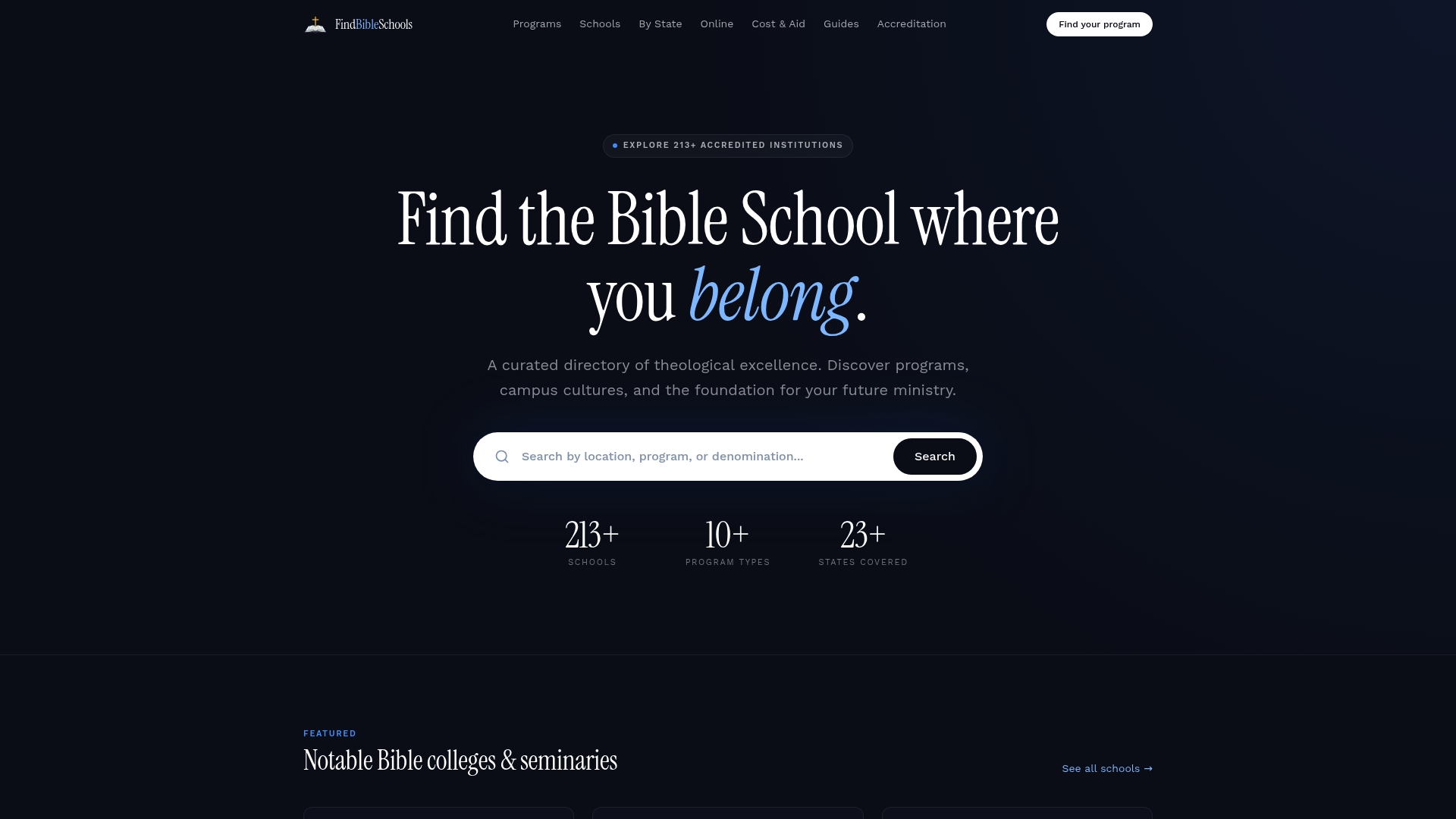
Search current accredited theology and Bible degree programs to find accelerated tracks that match your timeline and budget.
Where to verify these facts yourself
For the federal rules on distance education and Title IV eligibility, consult the FSA Handbook’s program-eligibility guidance directly. Representative accelerated program pages, including Cedarville’s BA-to-MTS pathway and Spurgeon College’s Accelerate program, show how individual schools structure these tracks in practice. Our own guide on how many years a Bible degree takes breaks down credit counts and timelines in more detail.
Sources
- FSA Handbook — Program eligibility, written arrangements, and distance education (Vol. 2, Ch. 2)
- National vs. Regional Accreditation: What’s the difference? — Drexel Online
- BA to MTS accelerated online degree pathway — Cedarville University
- The Accelerate Program — Spurgeon College
FAQ
What is the best Bible college in America?
There is no single official ranking of the best Bible college, since fit depends heavily on denomination, program type, and career goals. A stronger question is whether a specific school’s accreditor is recognized for your intended degree and delivery format, which you can check directly through CHEA or Department of Education databases.
Does a biblical studies degree count as an actual degree?
Yes, a biblical studies degree is a real academic degree when earned from an institution with recognized accreditation, carrying the same standing as any other bachelor’s or associate degree in that respect. Its value for ministry roles or further graduate study depends on the accreditor’s recognition and how a specific denomination or employer evaluates that credential.
What is the easiest Bible college to get into?
Admissions selectivity varies widely by school, and no verified ranking of “easiest” Bible colleges exists. Prospective students are better served comparing published admissions requirements, such as minimum GPA and prerequisite coursework, directly on each school’s admissions page.
Is a doctor of divinity a real doctorate?
An earned Doctor of Divinity from an accredited institution, following required coursework and research, is a legitimate academic doctorate. Some churches and organizations also award honorary Doctor of Divinity degrees without coursework, which is a distinct practice and not equivalent to an earned academic credential.