
Published September 21, 2026
Confirm ABHE Accreditation in Minutes: 5 Steps for U.S. Students

ABHE accreditation means a Bible college or seminary has met the standards of the Association for Biblical Higher Education’s Commission on Accreditation, which is recognized by both the U.S. Department of Education and the Council for Higher Education Accreditation. That recognition covers certificates through master’s degrees, but not doctoral programs, so students eyeing graduate study, federal aid, or licensure still need to confirm details before enrolling.
TL;DR:
- ABHE accreditation is recognized by the U.S. Department of Education and CHEA for certificates through master’s degrees, but not for doctoral programs.
- Schools gain full accreditation after passing through applicant and candidate stages, with ongoing reports and reaffirmation every ten years.
- Its standards assess mission alignment, governance, faculty credentials, academic outcomes, and institutional effectiveness, applying equally to online and on-campus programs.
- Federal financial aid eligibility depends on USDE recognition, but transfer credit acceptance remains at the discretion of the receiving school.
- Confirm current accreditation status via the ABHE directory, get official letters, and verify federal aid participation before enrolling.
Table of Contents
- What Are ABHE and the Commission on Accreditation?
- What Degrees and Programs Does ABHE Accredit?
- How Does a School Move From Applicant to Fully Accredited?
- What Standards Do ABHE Reviewers Actually Check?
- Does ABHE Accreditation Guarantee Financial Aid or Transfer Credit?
- How Do You Confirm a School’s Current ABHE Status?
- Using Find Bible Schools to Locate ABHE-Accredited Programs
- Faith Fit Matters as Much as the Paperwork
- Find an ABHE-Accredited Bible College That Fits Your Calling
- Sources
- FAQ
What Are ABHE and the Commission on Accreditation?
The Association for Biblical Higher Education is the membership body for Christian colleges and seminaries focused on ministry preparation. Its Commission on Accreditation, known as the COA, operates as the independent decision-making arm that actually grants or denies accredited status, a separation the Department of Education’s analysis specifically confirms as meeting federal recognition criteria.
Two outside bodies vouch for ABHE’s credibility, and they don’t do the same job:
- CHEA recognizes ABHE as a national, faith-related accrediting organization, affirming its standards align with national quality expectations for institutions preparing students for Christian ministry.
- USDE recognizes ABHE’s COA for federal purposes, primarily Title IV financial aid eligibility, which is the practical reason accreditation matters to most applicants.
CHEA recognition speaks to quality and peer consistency; USDE recognition speaks to federal funding access. Neither one guarantees that a specific school’s program will transfer or satisfy a licensing board.
What Degrees and Programs Does ABHE Accredit?
ABHE’s scope is broader under CHEA than under USDE, and that gap trips people up more than any other detail in the accreditation picture.
- USDE-recognized scope: certificates, associate degrees, baccalaureate degrees, graduate certificates, and master’s degrees. Doctoral programs fall outside this recognition.
- CHEA-recognized scope: the same range plus graduate-level programs generally, reflecting a wider quality-assurance lens than the federal one.
- Institutional vs. programmatic: ABHE accredits institutions as a whole, and its programmatic reviews (for specific majors or ministry tracks) fall under CHEA recognition only, not USDE.
- Geographic reach: primarily the United States, with CHEA noting coverage extending to Canada and related territories as well.
For a U.S. student, the practical read is simple: undergraduate and master’s-level programs at an ABHE-accredited school carry solid federal standing, but doctoral claims need a second look.
How Does a School Move From Applicant to Fully Accredited?
Every ABHE-accredited institution passes through three distinct stages, each with its own documentation and time limits, according to the association’s self-study framework.
- Applicant status. The school submits eligibility materials and demonstrates it meets baseline conditions before any deeper review begins.
- Candidate status. The institution conducts a self-study, hosts a peer evaluation team on campus, and submits annual reports and assessment data while the Commission tracks progress toward full standards. This stage carries a maximum allowable timeframe; schools that don’t advance within it lose candidate status.
- Accredited status. The Commission votes to grant full accreditation after reviewing the self-study, the visiting team’s report, and evidence of institutional effectiveness.
Once accredited, a school isn’t finished. It files annual reports, undergoes periodic monitoring, and completes a full reaffirmation review roughly every ten years, including a fresh self-study and another peer visit. A common mix-up worth flagging: being an ABHE member is not the same as being accredited. Applicant and candidate schools are common in the ecosystem, and each status carries different implications for financial aid and transfer, a distinction the ABHE directory tracks precisely.
What Standards Do ABHE Reviewers Actually Check?
Accreditation isn’t a rubber stamp on a mission statement. The COA’s standards require documented evidence across several domains, and reviewers expect to see it in writing, not just hear it in an interview.
- Mission and tenets of faith: the school’s doctrinal statement and how it shapes institutional decisions.
- Governance: board structure, administrative authority, and lines of accountability.
- Academic programs and learning outcomes: curriculum design tied to measurable student learning.
- Faculty: credentials, workload, and scholarly or ministry engagement appropriate to the degree level.
- Student services: advising, spiritual formation support, and retention resources.
- Finances and facilities: fiscal stability and adequate physical or virtual learning infrastructure.
- Institutional effectiveness: a documented assessment cycle that feeds back into planning, published where the public can see it.
Standards apply the same way to distance education and competency-based programs, so an online ABHE-accredited degree faces the same assessment expectations as one taught on campus.
Pro Tip: Ask any school for its most recent institutional effectiveness report. If admissions can’t produce one quickly, that tells you something about how seriously assessment is actually practiced there.
Does ABHE Accreditation Guarantee Financial Aid or Transfer Credit?
Accreditation opens doors. It doesn’t open all of them automatically, and the fine print matters more here than almost anywhere else in the process.
- Federal aid: USDE recognition of ABHE’s COA is what makes Title IV eligibility possible, but individual schools must maintain their own participation agreement. Confirm current status directly with the school’s financial aid office.
- Transfer credit: ABHE’s own FAQ page states plainly that accreditation does not guarantee credit transfer. The receiving institution decides, full stop, so get any transfer promise in writing before you commit.
- Doctoral and licensure paths: since USDE’s recognition of ABHE stops at the master’s level, students planning doctoral study need to confirm directly with the target program whether an ABHE-accredited master’s will be accepted. Licensure boards in counseling or chaplaincy fields often have their own separate accreditation requirements worth checking early.
How Do You Confirm a School’s Current ABHE Status?
A short verification routine now saves a painful surprise later, and it only takes a handful of steps.
- Search the ABHE directory. The official accreditation page lists accredited, candidate, and applicant institutions along with the effective dates of their status.
- Request the accreditation letter. Ask admissions for the school’s current letter from the Commission, and confirm the exact program names listed on it match what you’re enrolling in.
- Verify Title IV participation. If federal aid factors into your decision, confirm the school’s current federal eligibility with the financial aid office, not just its ABHE status.
- Get transfer policy in writing. Email the registrar and ask specifically how many credits typically transfer in or out, and save the reply.
- Timestamp everything. Screenshot the directory listing and file your correspondence with dates attached, since accreditation status can change between your first search and your enrollment date.
Pro Tip: Substantive changes like new degree programs or additional campus locations require Commission approval before a school can offer them. If a program feels brand new, ask when it was added to the school’s approved offerings.
Using Find Bible Schools to Locate ABHE-Accredited Programs
A directory search is a faster starting point than combing through Commission action lists one institution at a time. Findbibleschools flags accreditation status alongside program type, campus culture, and cost indicators, letting you compare several accredited Bible colleges and seminaries side by side before you contact anyone.
- Search by program level or state to narrow a long list into a realistic shortlist.
- Save the school records that fit your budget and vocational goals.
- Request the accreditation letter and program names directly from each school’s admissions office.
- Confirm any financial aid or transfer questions before applying.
Treat the directory as a research tool that speeds up comparison, not a substitute for ABHE’s own official records. The final verification always runs through the Commission and the school itself.
Faith Fit Matters as Much as the Paperwork
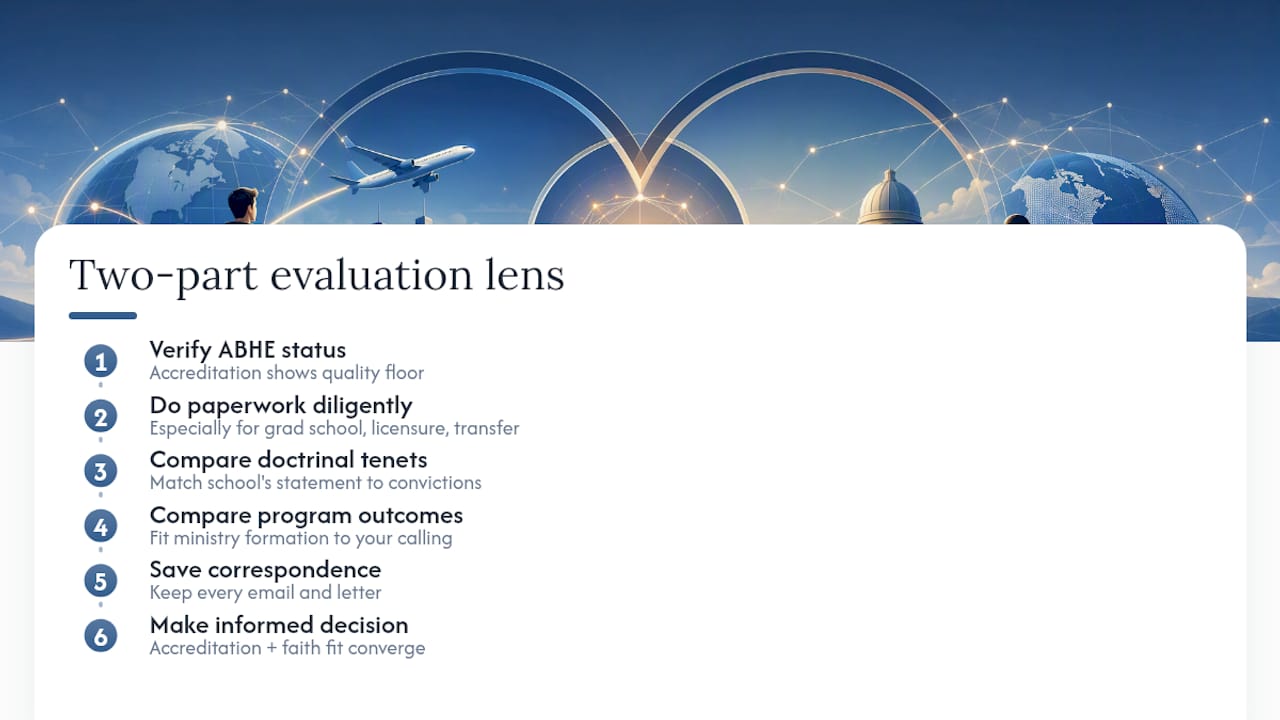
Accreditation tells you a school meets a documented floor of quality. It doesn’t tell you whether that school’s doctrinal statement matches your convictions or whether its ministry formation model fits your calling. I’d argue too many prospective students treat ABHE status as the finish line when it’s really the starting filter.
Do the paperwork diligently, especially if graduate school, licensure, or transfer is anywhere in your plan. But spend equal energy comparing tenets of faith and program outcomes against your own vocational direction. Save every email and letter along the way. The schools worth attending will have no trouble providing what you ask for.
— Grant
Find an ABHE-Accredited Bible College That Fits Your Calling
Findbibleschools does the side-by-side work that would otherwise mean opening a dozen browser tabs and comparing accreditation letters by hand. The directory pulls program type, cost indicators, and accreditation status into one view, so you can compare an ABHE-accredited master’s at Covenant Theological Seminary against a bachelor’s-level program without digging through separate school websites.

Start by browsing the full school directory or narrowing your search by state, including options like Bible colleges in Tennessee or Bible colleges in Kentucky. Once you’ve shortlisted a few schools, confirm their current accreditation status directly with ABHE or the school’s admissions office before you apply. That final check takes minutes and protects years of tuition and credits.
Sources
- Accreditation - Association for Biblical Higher Education
- National faith-related accrediting organizations | CHEA
- Report of analysis: ABHE (U.S. Department of Education)
FAQ
Is ABHE a Regional Accreditor?
No. ABHE is a national, faith-related accreditor recognized by CHEA, not one of the regional accreditors that traditionally cover general-purpose colleges and universities. National and regional accreditation carry equal legitimacy for federal aid purposes, but some graduate programs still show a preference for regional accreditation, so it’s worth confirming with your target program.
Is ABHE Considered a National Accreditation?
Yes. CHEA specifically categorizes ABHE among its national faith-related accrediting organizations, a category built for institutions preparing students for Christian ministry rather than general higher education.
Which Accreditation Is Best for a Bible College or Seminary?
There’s no single “best” accreditor. The right one depends on your goals: ABHE fits students focused on ministry-centered programs, while regional accreditation may matter more if you’re planning to transfer into a secular graduate program later. Compare accreditor types on the Findbibleschools accreditation guide before deciding.
What Does ABHE Accreditation Actually Recognize?
ABHE accreditation, through its Commission on Accreditation, confirms that a school meets documented standards in governance, academics, faculty, and institutional effectiveness. The U.S. Department of Education recognizes this for certificates through master’s degrees, which is what makes Title IV federal aid possible at accredited schools.
Does ABHE Accreditation Guarantee My Credits Will Transfer?
No. ABHE’s own FAQ page states directly that transfer decisions belong to the receiving institution, not the accreditor. Always request a school’s transfer policy in writing before assuming credits will carry over.